Google Search Console can now track AI visibility, but only partially. Since 3 June 2026 its Generative AI performance reports isolate your impressions inside Google’s own AI surfaces, AI Overviews, AI Mode, and generative features in Discover, broken down by page, country, device, and date. What it cannot show matters equally: it does not cover ChatGPT, Claude, Perplexity, or Grok, it reports impressions and never clicks, and its history reaches back only to 18 May 2026. Since the majority of AI referral traffic comes from engines Search Console does not see, it is now a real AI visibility source for Google’s surfaces and a starting point rather than the whole map.
Scope: this article is about what Google’s own report can and cannot tell you. The retrieval mechanism behind it is not Google-specific: ChatGPT, Claude, Gemini, Perplexity, Grok, Microsoft Copilot, and Google AI Overviews all assemble answers from sources they fetch at answer time. What differs is the index each one reaches into, which is exactly why one engine’s report cannot stand in for the others. The cross-engine version of this measurement is in how to monitor your brand across AI search engines.
If you have been waiting for Google to tell you how you are doing in AI search, part of the answer is now in Search Console. Here is how to read it, and where you still need to look elsewhere.
What GSC shows about AI, and what it can’t
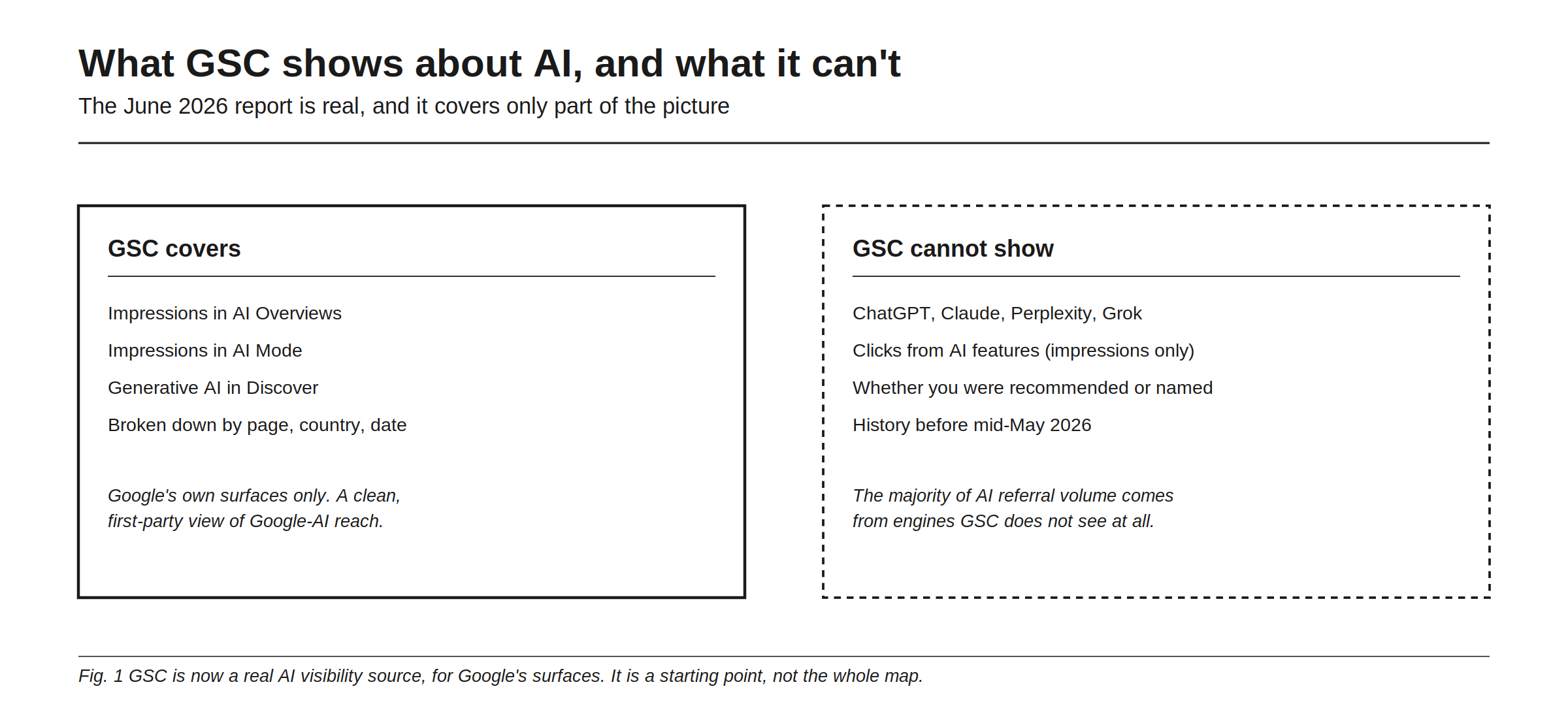
The June 2026 report is a genuine step forward, with clear boundaries. On the covered side, Search Console now shows impressions in AI Overviews, impressions in AI Mode, and generative AI in Discover, broken down by page, country, and date, a clean first-party view of your Google-AI reach. On the uncovered side, it cannot show ChatGPT, Claude, Perplexity, or Grok; it reports impressions only, not clicks; it does not tell you whether you were recommended or merely named; and it has no history before 18 May 2026.
Two practical details are missing from most write-ups of the launch. First, availability: the rollout began with a subset of site owners in the United Kingdom and reached all websites worldwide on 31 August 2026, though not every property saw it the same day. If the section is not in your Search Console, that is the rollout, not your site. Second, access: the report lives in the interface only. The type field of the Search Analytics API has not changed, there is no BigQuery export, and a manual CSV download is the only documented way to get the numbers out. No tool can pull those impressions for you today, whatever a vendor page claims.
That boundary matters because the majority of AI referral volume comes from engines Search Console does not see at all, with ChatGPT alone driving the large majority of it. So the report answers one specific question well, “is Google’s AI showing my pages”, and stays silent on the bigger one, “does AI in general recommend me, and does it send me people.”
Why one engine’s report is not enough
The trap is treating Google’s AI report as your AI visibility strategy. Google’s surfaces matter, and AI Overviews and AI Mode appear in a growing share of searches, but they are one part of a landscape where buyers also ask ChatGPT, Claude, and Perplexity directly, engines with their own indexes and their own answers. A brand that looks healthy in the Search Console AI report can be invisible in ChatGPT, which does not read Google’s index, and Search Console will never tell you.
The impression-only limit compounds this. You can see that Google’s AI showed your page, but not whether anyone clicked, so you cannot connect visibility to outcome from Search Console alone. And because the report shows reach rather than endorsement, it cannot distinguish being cited as the recommended option from being listed among alternatives, which is usually the difference that matters commercially.
The complete AI visibility stack
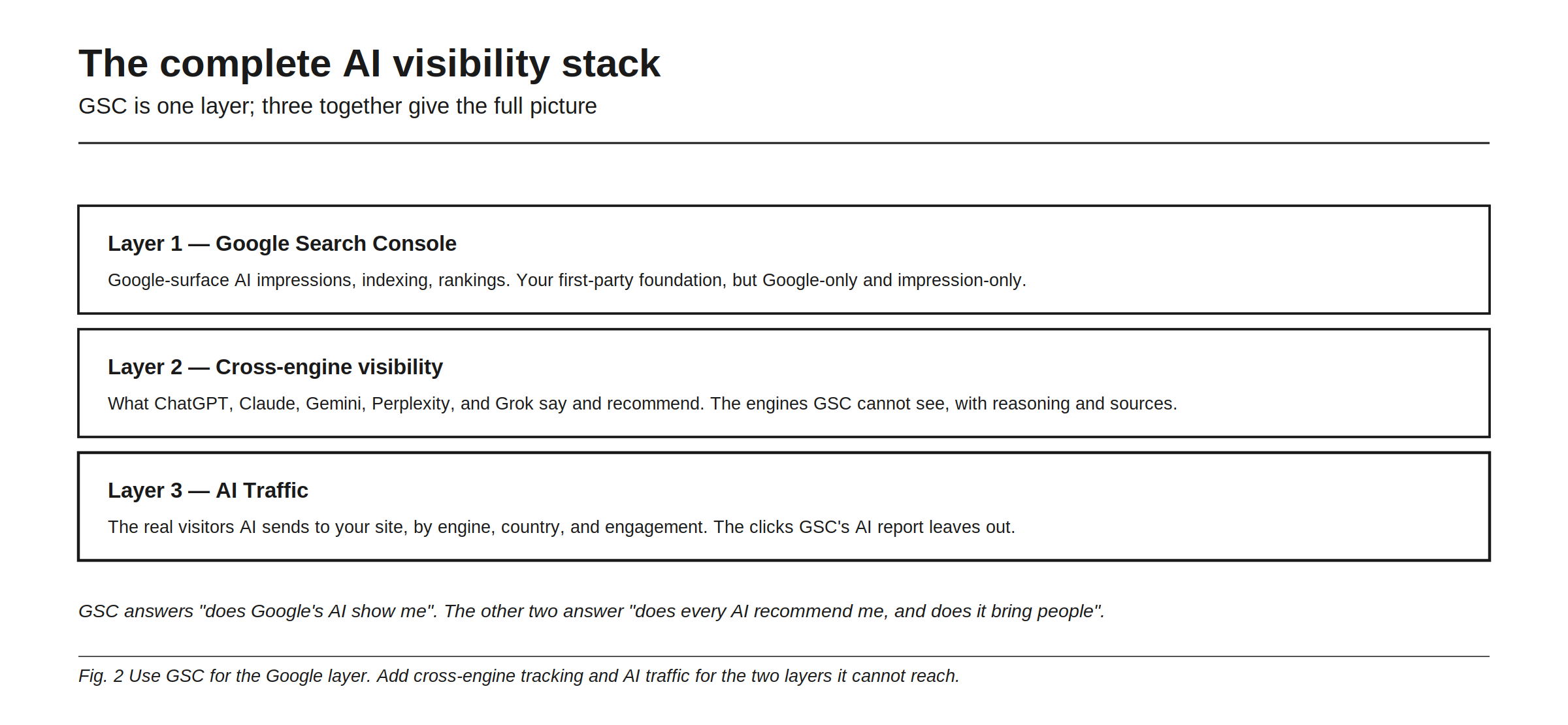
Think of AI visibility as three layers.
Layer one is Google Search Console: Google-surface AI impressions, indexing, and rankings. Your first-party foundation, and Google-only.
Layer two is cross-engine visibility: what the engines say and recommend, with the reasoning and the sources behind each answer. In Rankry, seven engines are available on every plan, ChatGPT, Claude, Gemini, Perplexity, Grok, Microsoft Copilot, and Google AI Overviews, with any five active per project. Google AI Overviews being one of them is worth noticing here: it means the Google layer gets read from both directions, Search Console counting how often your pages appeared, and prompt-level tracking recording what the answer actually said.
Layer three is AI Traffic: the real visitors AI sends to your site, by engine, country, and engagement, the clicks the Search Console AI report leaves out.
Used together they give you cause, coverage, and effect. The integration that brings layer one into the same dashboard is covered in Introducing the Google Search Console integration, and the traffic layer in Introducing AI Traffic.
How to use GSC’s AI data well
Treat the report as an editorial signal, not a vanity dashboard. Read the Pages tab first, because it shows which of your URLs Google’s AI already cites, which is a direct roadmap for what to create more of. Set up tracking now, since the data only goes back to 18 May 2026 and an early baseline is an advantage teams that start later cannot recover. And always pair impressions with clicks and traffic from another source, because impression volume with no click or conversion data cannot tell you whether AI visibility is turning into pipeline. The reading guide for the report itself is in how to read Google Search Console’s Generative AI report, and the workflow that turns Search Console data into GEO work is in how to use Google Search Console for GEO.
FAQ
Does Google Search Console track AI search? Partially, since 3 June 2026. Its Generative AI performance reports isolate your impressions in Google’s own AI surfaces, AI Overviews, AI Mode, and generative features in Discover, broken down by page, country, device, and date. It does not track non-Google engines, and it does not report clicks.
Why can’t I find the Generative AI report in my Search Console? Because the rollout is still limited. Google launched it on 3 June 2026 to a subset of site owners starting in the United Kingdom, and extended it to all websites worldwide on 31 August 2026. If the section is missing, that is the rollout, not a problem with your site.
What are the limits of GSC’s AI reports? Four that matter. They cover only Google’s surfaces, not ChatGPT, Claude, Perplexity, or Grok. They show impressions only, with no clicks, no CTR, no average position, and no query breakdown. Their history starts at 18 May 2026 with no backfill. And they are interface-only, with no Search Analytics API access and no BigQuery export, so a manual CSV download is the only way to get the numbers out.
Does GSC show AI clicks, or only impressions? Only impressions. You can see how often your pages appeared in Google’s AI features, but not whether anyone clicked through, so you cannot measure AI-driven traffic or conversions from Search Console alone.
How do I track AI visibility beyond Google? Use a tool that queries the engines directly. In Rankry, seven engines are available on every plan, ChatGPT, Claude, Gemini, Perplexity, Grok, Microsoft Copilot, and Google AI Overviews, with any five active per project, and it records what each answer said, who was recommended, and which sources were cited.
Does this apply only to Google AI Overviews? No. The Search Console report is Google-only, but the underlying mechanism is not: every engine builds its answer from sources it retrieves, so being absent on one and present on another is a diagnostic signal rather than a quirk. What differs is the index behind each one, which is why a Google-only report cannot stand in for the rest.
See the AI visibility Google cannot report, across every engine you track, connected to your Search Console data. Start a free 7-day Rankry trial, no card, first report in two minutes.