To use Google Search Console for GEO, mine the data you already have. Turn the queries you rank for into buyer questions and test them across AI engines, rewrite your high-impression low-click pages to be answer-first so AI quotes them, study the pages Google’s AI already cites and repeat their format, and prioritize by your country and page breakdowns. Search Console will not tell you whether ChatGPT or Claude recommends you, which needs cross-engine tracking, but it is the best free starting point for GEO, because your existing rankings are proven demand you already have authority on.
You do not need new data to start. The roadmap is already sitting in your Search Console; most people never read it as a GEO tool.
Scope: the data here comes from Google, but the work is judged elsewhere. ChatGPT, Claude, Gemini, Perplexity, Grok, Microsoft Copilot, and Google AI Overviews each retrieve from a different index, so a page that ranks on Google is a strong candidate rather than a guaranteed citation. That is exactly why step two of the loop below tests the engines instead of assuming the ranking carries over.
Your GSC data is a GEO goldmine
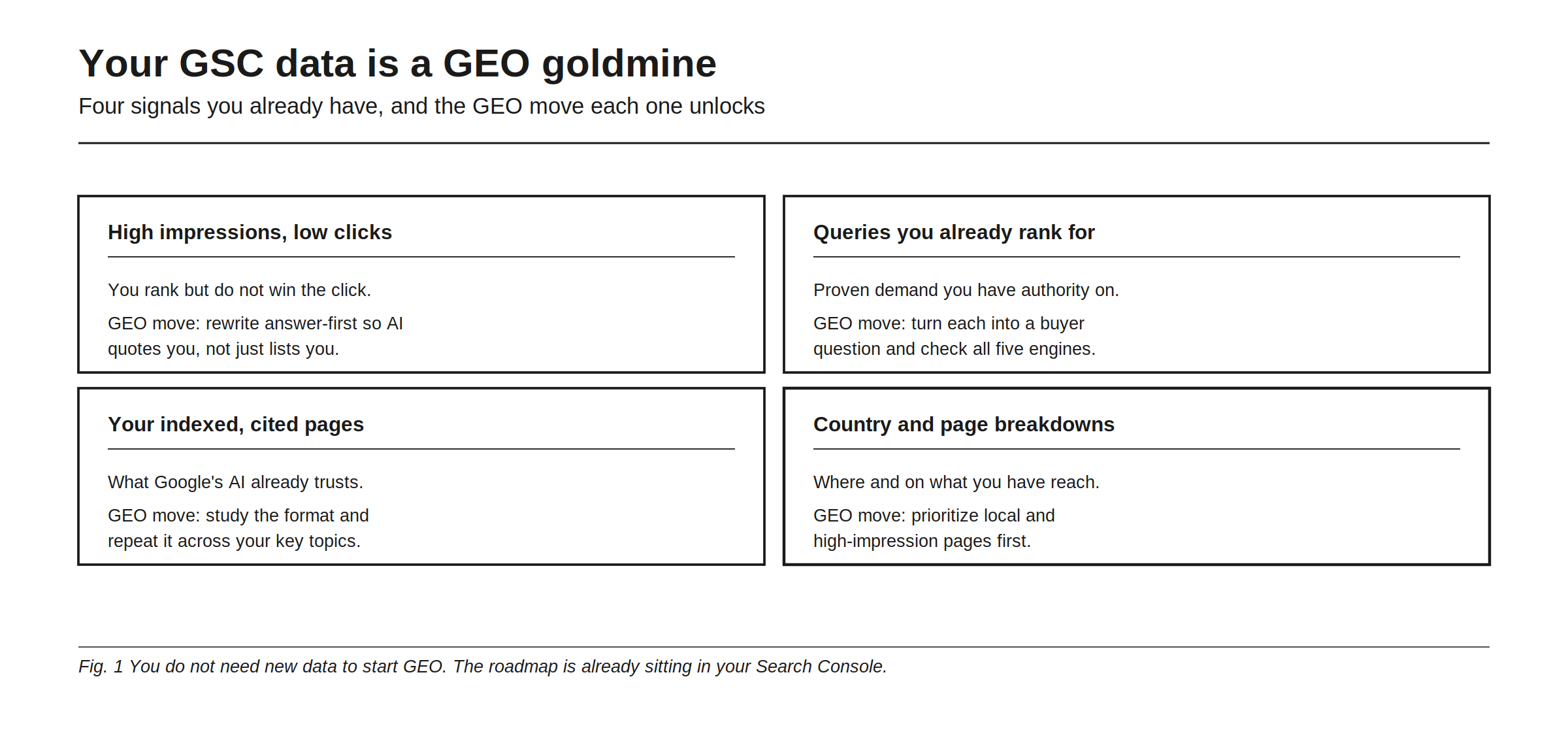
Four signals you already have, each unlocking a GEO move.
High impressions with low clicks means you rank but do not win the click. The move is to rewrite answer-first, so AI quotes you rather than listing you.
Queries you already rank for are proven demand you have authority on. The move is to turn each into a buyer question and check the engines you track to see who they recommend.
Your indexed, cited pages are what Google’s AI already trusts. The move is to study the format, the depth, the structure, and repeat it across your key topics.
Your country and page breakdowns show where and on what you have reach. The move is to prioritize local and high-impression pages first.
None of this requires a new tool to begin. Search Console gives you demand, authority, and a proven-format signal for free. What it does not give you is the other half of the loop.
From GSC query to AI citation
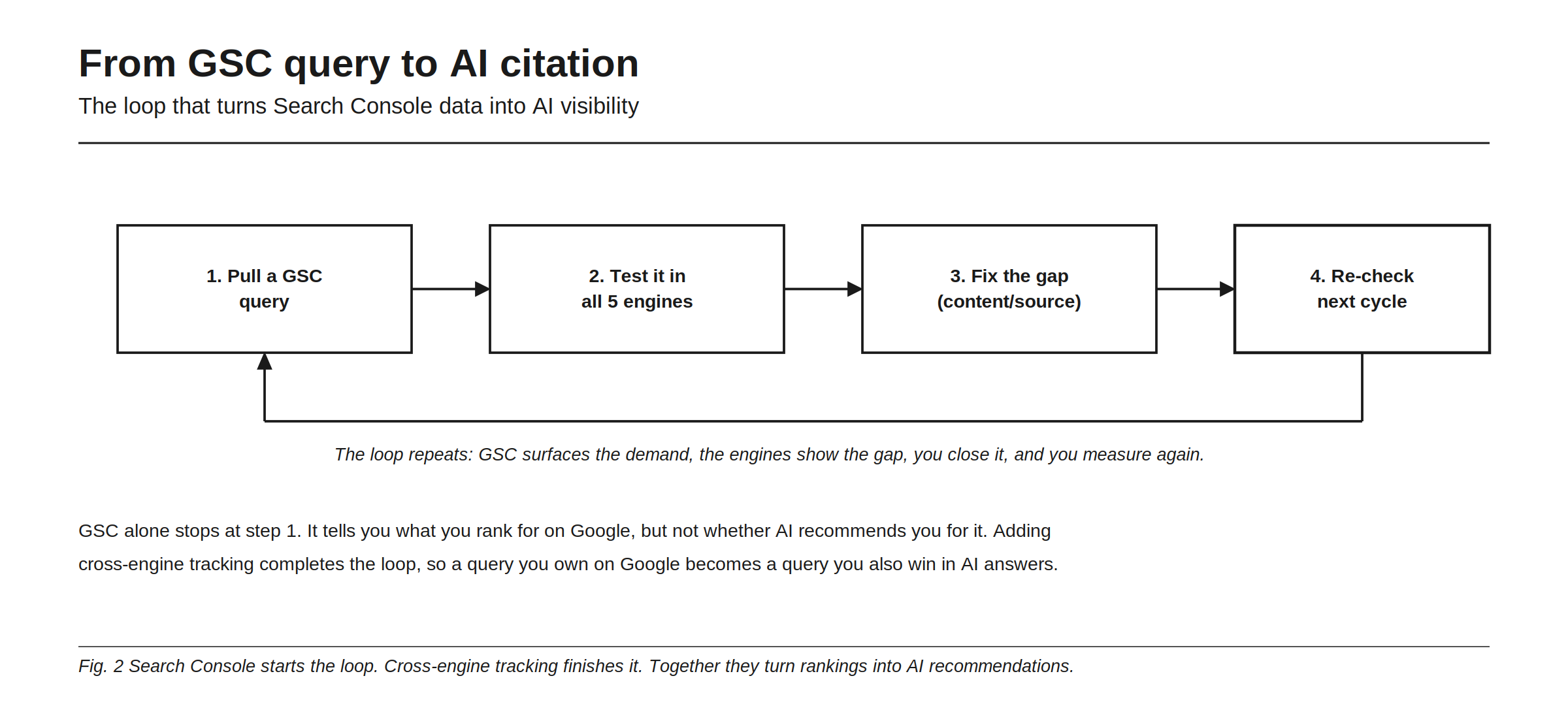
The GEO loop has four steps. Pull a Search Console query you rank for. Test it in the engines you track, to see whether AI names you, a competitor, or no one. Fix the gap, by rewriting the page answer-first or by earning a citation on a source the engines trust. Then re-check next cycle to see whether the fix worked.
The important limit: Search Console alone stops at step one. It tells you what you rank for on Google, but not whether AI recommends you for it, and its own Generative AI report, where you have it, covers Google’s surfaces and impressions only. Adding cross-engine tracking completes the loop, so a query you own on Google becomes a query you also win in AI answers. The ongoing practice is in how to monitor your brand across AI search engines.
A practical GEO workflow using GSC
Here is a workflow you can run this week.
Export your top queries by impressions from Search Performance and flag the ones with strong impressions but weak CTR. Those pages have authority Google recognizes and content that is not winning the click, which usually means it is not answer-first.
Take the top ten, phrase each as the buyer question a person would actually ask an AI, and run them through the engines you track. For each, note whether you appear, who is recommended instead, and which sources are cited. Now you have a ranked GEO to-do list, drawn entirely from your own Google data, of the pages to rewrite and the sources to earn.
Rewrite the worst offenders answer-first, leading with the direct answer, adding specifics and structure, then re-check the engines next cycle. The rewrite principles are in AI search ranking strategies, and the citation mechanics are in how to get cited by AI.
Connect it so you stop exporting spreadsheets
Doing this by hand works, and it means exporting Search Console data, pasting prompts into several engines, and tracking results in a sheet you will stop updating by week three. Connecting Search Console to a GEO platform removes that friction: your queries, impressions, and cited pages sit next to the cross-engine results and the real AI traffic, so the loop runs in one place.
Rankry connects your Search Console data and adds the two layers it cannot reach. Seven engines are available on every plan, ChatGPT, Claude, Gemini, Perplexity, Grok, Microsoft Copilot, and Google AI Overviews, with any five active per project, and AI Traffic records the visitors those answers send you. The setup is in Introducing the Google Search Console integration. The goal is to make the GEO loop something you keep running, not a one-time audit you abandon after week two.
FAQ
How do I use Google Search Console for GEO? Mine the data you already have. Turn ranked queries into buyer questions and test them across AI engines, rewrite high-impression low-click pages to be answer-first, study the pages Google’s AI already cites and repeat their format, and prioritize by your country and page breakdowns.
Can Search Console tell me if AI recommends my brand? Not for non-Google engines. Search Console shows your Google rankings and, where the Generative AI report is available, your impressions in Google’s own AI surfaces. It never shows what an answer said or who it recommended, so knowing whether ChatGPT, Claude, or Perplexity recommends you needs a tool that queries those engines directly.
Which GSC data is most useful for GEO? Three signals. Queries you already rank for, which are proven demand you have authority on. High-impression low-click pages, which are your rewrite candidates. And the pages Google’s AI already cites, which are a proven-format roadmap. All three are free.
What does answer-first mean for GEO rewrites? Leading a page with the direct answer to the question, in the opening lines, before background or setup. Engines pull citations disproportionately from the top of a page, so an answer-first structure raises the odds of being quoted rather than merely listed.
Do I need a paid tool to do GEO with GSC? No. You can start free by exporting Search Console data and testing your queries in the engines by hand. A tool removes the export-and-track friction and adds the cross-engine and traffic data Search Console cannot provide, which is what keeps the loop running past week two.
Does this workflow only apply to Google? The data source is Google, the work is not. Search Console tells you which questions you already have authority on; the fixes are judged by ChatGPT, Claude, Gemini, Perplexity, Grok, Microsoft Copilot, and Google AI Overviews, each retrieving from its own index. That is why step two of the loop tests the engines rather than assuming Google’s ranking carries over.
Turn the queries you already rank for into AI recommendations, with your Search Console data and cross-engine tracking in one place. Start a free 7-day Rankry trial, no card, first report in two minutes.