There is no single “alternative” that replaces your SEO tool for AI search visibility, because the two measure different things. Your SEO suite tells you where you rank on Google; an AI visibility tool tells you whether ChatGPT, Claude, Gemini, Perplexity, Grok, Microsoft Copilot, and Google AI Overviews recommend you, why, and from which sources. The right move is not to swap one for the other but to add a purpose-built AI visibility layer on top of the SEO fundamentals you already have. The strongest AI-native options in 2026 are Rankry, Peec AI, Otterly.AI, and Profound; this guide explains what actually transfers from SEO, what does not, and how to choose.
The question “what replaces my SEO tool for AI” is the right instinct pointed slightly wrong. SEO tools did not become useless. They became incomplete, and the gap they leave is exactly the part your buyers now use most.
Your SEO instincts are half right
That is the dangerous half, because the wrong half feels just as confident as the right one.
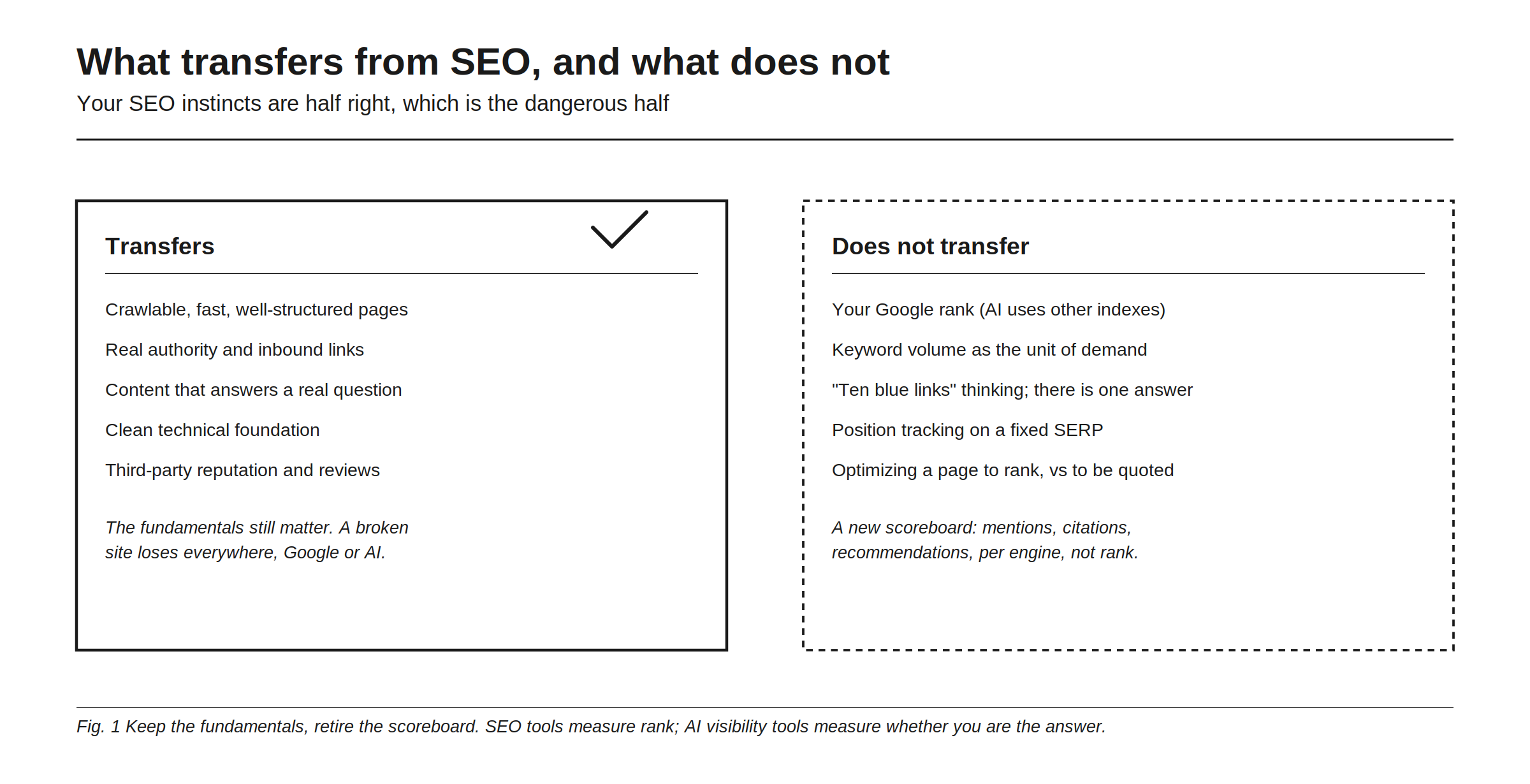
What transfers is the foundation. Crawlable, fast, well-structured pages still matter, because an AI engine that cannot fetch or parse you cannot cite you. Real authority and inbound links still matter, because they feed the indexes AI retrieves from. Content that answers a genuine question still matters, more than ever. A clean technical base and a solid third-party reputation still matter. A broken site loses everywhere, on Google and in AI alike, so none of the fundamentals are obsolete.
What does not transfer is the scoreboard. Your Google rank does not carry over, because AI engines retrieve from different indexes, Claude’s is independent of Google, and only a small share of ChatGPT’s citations sit in Google’s top ten. Keyword volume stops being the unit of demand, because people ask AI full questions, not keywords. “Ten blue links” thinking breaks, because there is one answer now, and you are in it or you are not. Position tracking on a fixed results page stops applying, because there is no fixed page to track. And optimizing a page to rank is not the same as optimizing it to be quoted. Keep the fundamentals; retire the scoreboard. The full conceptual map of that split is in GEO vs SEO: key differences.
Two tools, two jobs
Once you see it as two jobs rather than a replacement, the tool question answers itself.
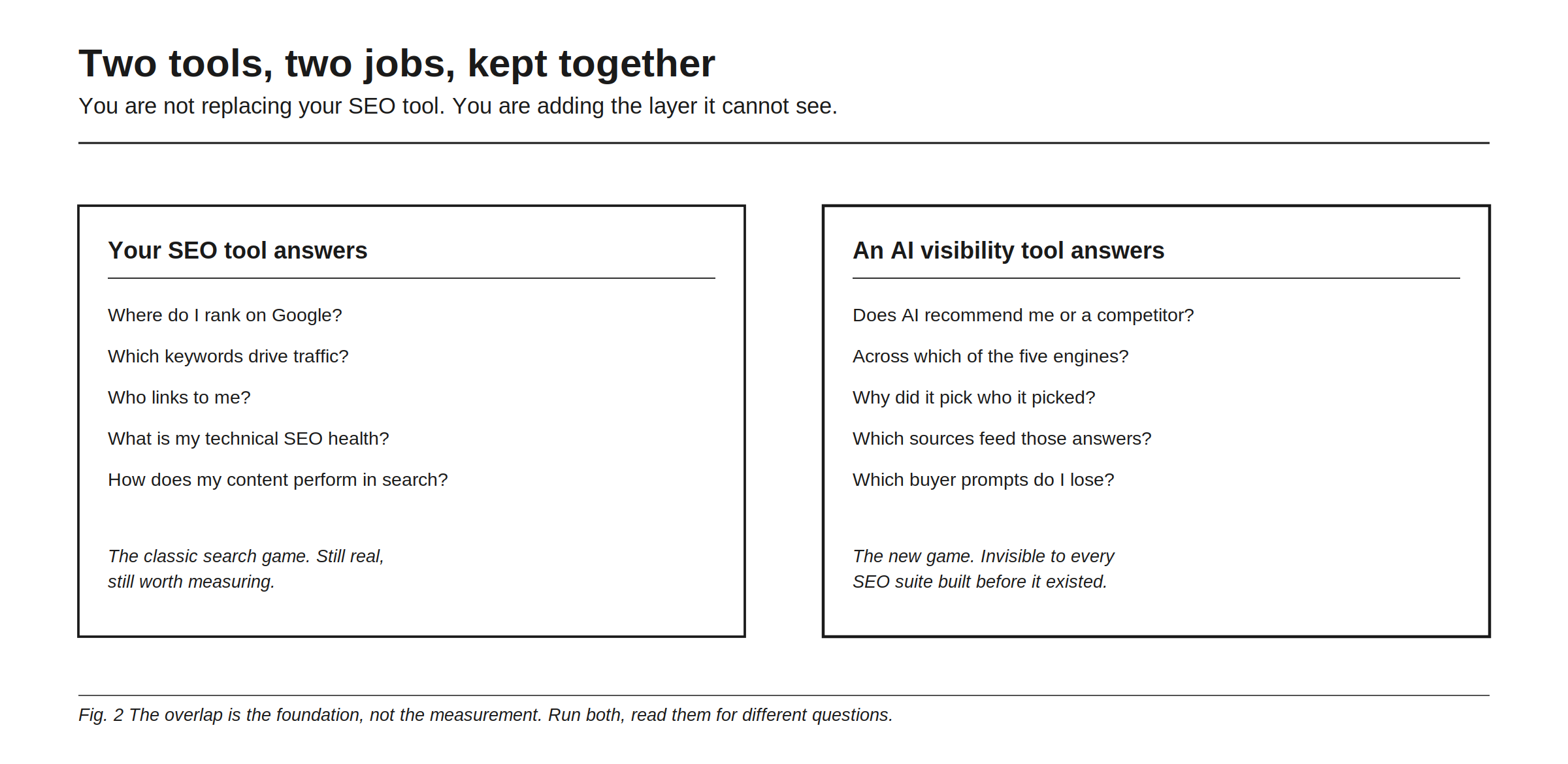
Your SEO tool answers where you rank on Google, which keywords drive traffic, who links to you, and how your content performs in classic search. Those questions are still real. An AI visibility tool answers a different set your SEO suite structurally cannot see: does AI recommend you or a competitor, across which engines, why did it choose who it chose, which sources feed those answers, and which buyer prompts you lose. That is the new game, and it is invisible to every SEO suite built before it existed. The overlap between them is the foundation, not the measurement, so you run both and read each for the questions it can answer.
What makes a real AI-native alternative
If you are adding the AI layer, the tool should be built for it, not bolted onto a search suite. Four capabilities separate a purpose-built tool from a checkbox feature. Full engine coverage, all five, because your buyers do not all use ChatGPT. The reasoning behind each answer, not just a presence count, because “why” is what you act on. Cited-source tracking with gaps flagged, because that list is your outreach plan. And stored raw responses as evidence, because AI answers vary and a score you cannot audit is a score you cannot trust.
Rankry is built around exactly these four: seven engines on every plan with any five active, blind forced-ranking with the model’s reasoning, cited sources with gap flags, and the raw answers kept as evidence, from $99 a month with a no-card trial. Peec AI is a strong daily-tracking alternative with agency features; Otterly.AI is the accessible monitoring option; Profound is the enterprise choice with real user-prompt data. For a full side-by-side of the tools themselves, see the best Semrush alternatives for AI visibility. The point here is narrower: the “alternative” you are looking for is a category of tool, not a single product, and it sits beside your SEO stack rather than replacing it.
How to make the switch in practice
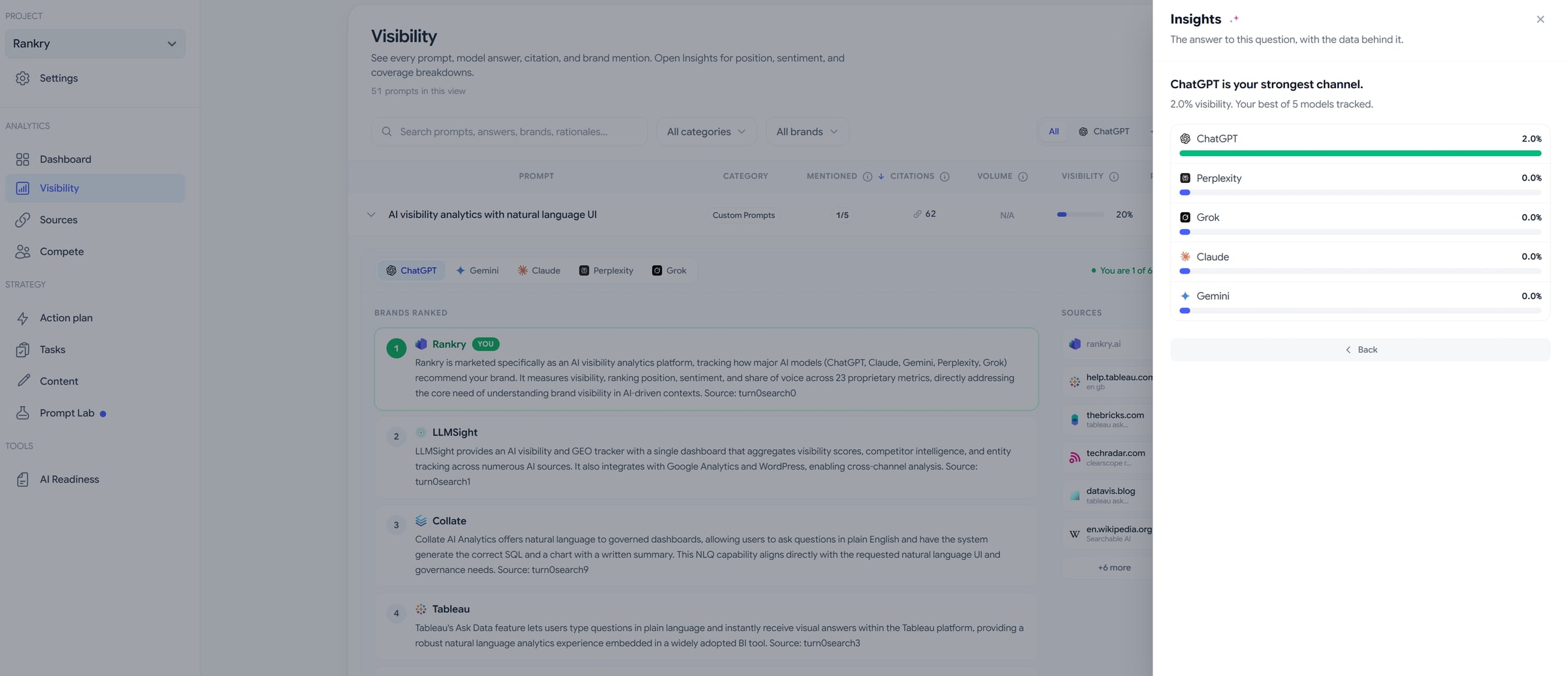
Keep your SEO tool. Add an AI visibility tool on a trial. Run your real buyer prompts through it, note where the two tools disagree, a page that ranks well on Google but never gets cited by Claude is the exact gap this layer exists to reveal, and start fixing for citations, not just rank. The fundamentals you already maintain do double duty; the new layer tells you where they are paying off in AI answers and where they are not. For the fixes themselves, the levers are in how to improve visibility in ChatGPT.
FAQ
What is the best alternative to SEO tools for AI search visibility? There is no direct replacement, because the jobs differ. Add a purpose-built AI visibility tool, Rankry, Peec AI, Otterly.AI, or Profound, alongside your SEO suite. SEO tools measure Google rank; AI visibility tools measure whether AI recommends you.
Can Semrush or Ahrefs track AI visibility? Partially and recently, mostly for ChatGPT and Google AI surfaces. For full coverage across ChatGPT, Claude, Gemini, Perplexity, Grok, Microsoft Copilot, and Google AI Overviews, with reasoning and cited sources, a purpose-built AI-native tool goes deeper.
Do I need to stop using my SEO tool? No. The fundamentals SEO tools measure still matter for AI visibility. Keep your SEO tool and add an AI visibility layer; they answer different questions and most teams run both.
Does my Google ranking affect my AI visibility? Indirectly at best. AI engines use different indexes, Claude’s is independent of Google, and only a small share of ChatGPT’s citations come from Google’s top results. A strong Google rank does not guarantee AI recommends you.
What should an AI visibility tool do that an SEO tool cannot? Track the AI engines your buyers use, show why each recommended who it did, surface the sources feeding those answers with gaps flagged, and store the raw responses as evidence. None of these are in a classic SEO suite.
Add the layer your SEO tool cannot see: whether AI recommends you, across the engines you track, with the sources behind it. Start a free 7-day Rankry trial, no card, first report in two minutes.