The best LLM rank tracking software depends on your size and budget, not on a single winner: Rankry fits founders and SMBs who want a seven-engine catalogue without enterprise pricing ($99/mo, no-card trial), Peec AI suits agencies managing many clients, Profound serves enterprises needing real user-prompt data, and Otterly.AI is the light, cheap monitor. Whatever you pick, insist on five capabilities: coverage of all five AI engines, repeated sampling to beat run-to-run variance, the reasoning behind each answer, cited-source tracking with gaps flagged, and stored raw answers as evidence. A tool missing these is a novelty, not a rank tracker. This guide covers what to look for and which tool fits which team.
“LLM rank tracking” is a slightly loose term, because there is no fixed rank in an AI answer. What these tools actually track is your presence, position, and recommendation rate across AI engines over time. The good ones do it rigorously; the weak ones hand you a single number from a single run and call it a ranking.
What separates real LLM rank tracking
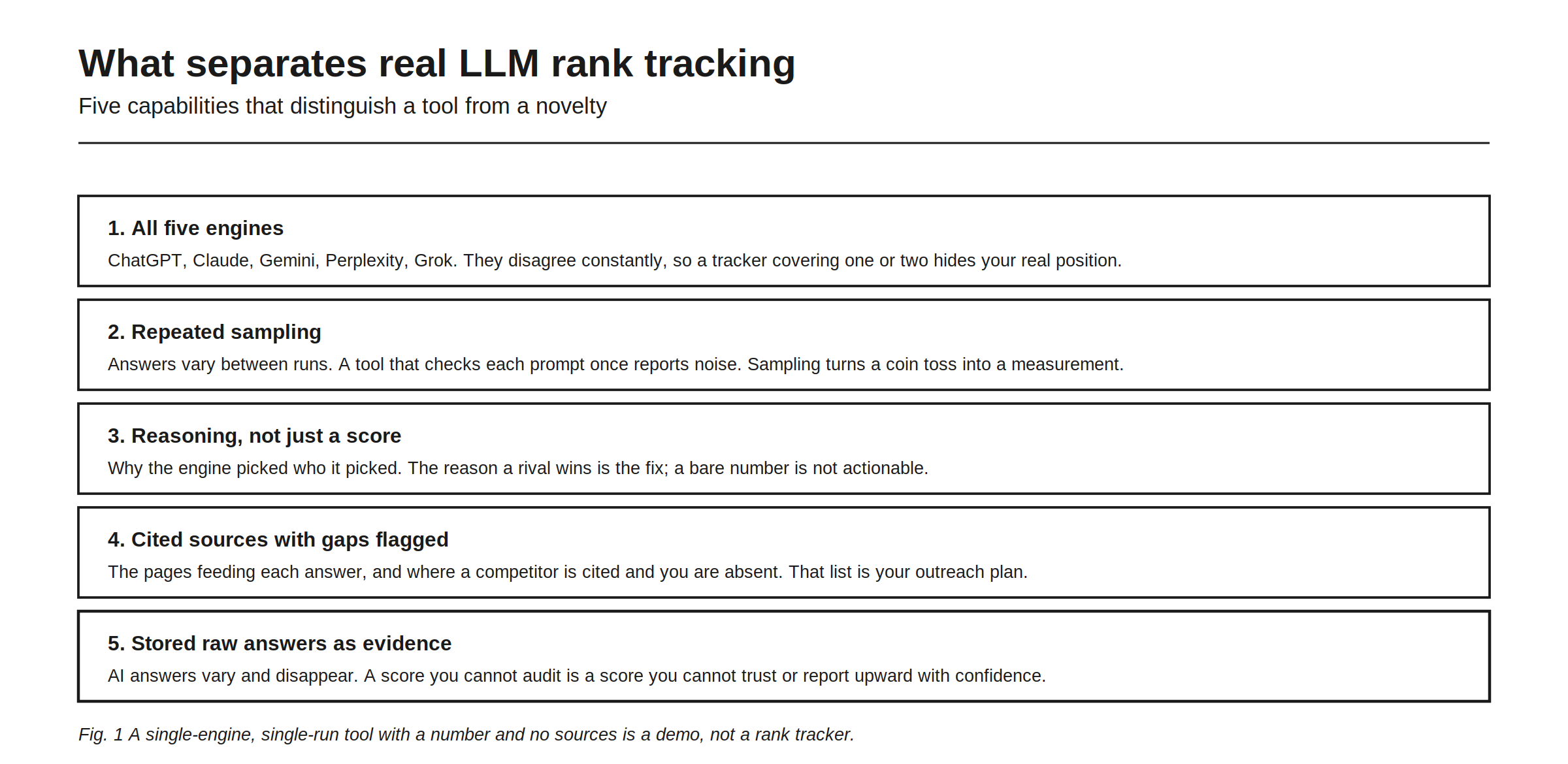
Five capabilities distinguish a tool from a demo. A wide engine catalogue, because ChatGPT, Claude, Gemini, Perplexity, Grok, Microsoft Copilot, and Google AI Overviews disagree constantly and a tracker covering one or two hides your real position. Repeated sampling, because answers vary between runs and a tool that checks each prompt once reports noise. Reasoning, not just a score, because the reason a rival wins is the fix and a bare number is not actionable. Cited sources with gaps flagged, because the pages feeding each answer, and the ones where a competitor is cited and you are absent, are your outreach plan. And stored raw answers as evidence, because AI answers vary and disappear, so a score you cannot audit is a score you cannot trust or report upward.
Hold every tool to these five. A single-engine, single-run tool that gives you a number and no sources is a demo dressed as software.
Matching the tool to the buyer
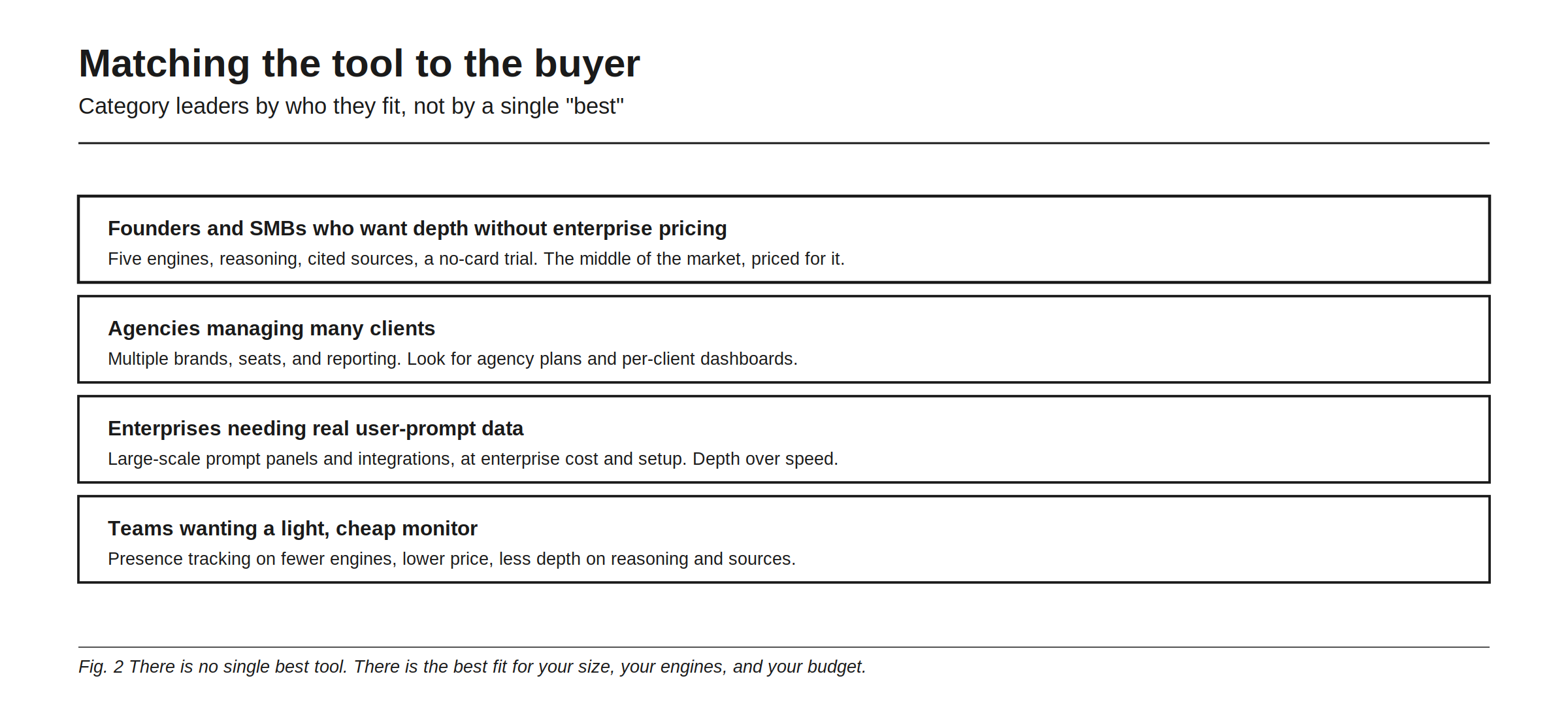
There is no universal best; there is the best fit. Founders and SMBs who want depth without enterprise pricing need engine choice, reasoning, and cited sources at a price built for the middle of the market, on a trial they can test risk-free. Agencies managing many clients need multiple brands, seats, and per-client reporting, so agency plans and client dashboards matter most. Enterprises needing real user-prompt data want large-scale prompt panels and integrations, and will trade cost and setup time for depth. Teams wanting a light, cheap monitor want presence tracking on fewer engines at a low price, accepting less depth on reasoning and sources.
Read any “best LLM rank tracker” list through that lens. The right question is not “which is best” but “which is best for a team my size, tracking my engines, at my budget.”
The main tools, by fit
Rankry is built for founders, SMBs, and lean marketing teams: all seven engines available on every plan with any five active per project, repeated sampling, blind forced-ranking with the model’s reasoning, cited sources with gaps flagged, and raw answers stored as evidence, from $99 a month ($79 annual), with a Pro tier at $249 for more prompts and brands, and a no-card 7-day trial. It hits all five capabilities at a price below the enterprise tools.
Among alternatives, Peec AI is agency-first with strong daily tracking and seat-friendly pricing, a good fit if you manage many clients. Profound targets enterprises with real user-prompt data and premium pricing, powerful but heavier to adopt and typically without a self-serve trial. Otterly.AI is the accessible monitor at a low monthly price, lighter on reasoning and cited-source depth. Others in the space include Scrunch and ZipTie; check current engine coverage carefully, since not all track Claude. For a fuller side-by-side, see the best AI visibility tools, and for the trial-first approach, AI visibility tools with a free trial. Verify all pricing and coverage at the source before deciding, since this category changes monthly.
How to test before you commit
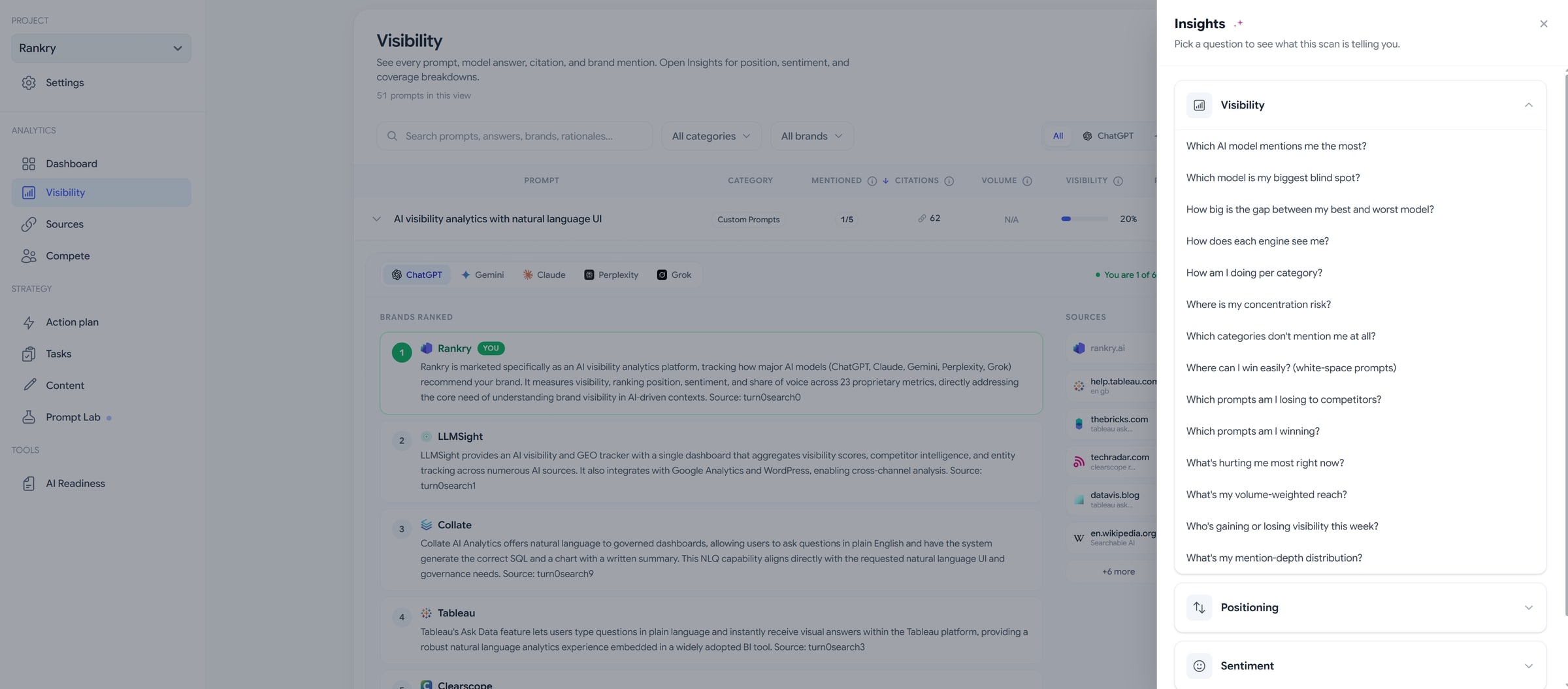
Do not buy on a feature list. Take a no-card trial, load ten of your real buyer prompts, and check three things: does it actually reach the engines your buyers use, does it show you why a competitor wins each prompt, and does it surface the cited sources you would need to fix it. If a tool cannot answer “why are we losing this prompt” in your own data during a trial, it will not answer it after you pay. That single test separates the real trackers from the dashboards. What you should not do during that trial is try to reconcile the two headline scores, because two tools never show the same number: they are answering different questions.
FAQ
What is the best LLM rank tracking software? It depends on fit. Rankry suits founders and SMBs wanting a seven-engine catalogue at $99/mo with a no-card trial; Peec AI fits agencies; Profound serves enterprises; Otterly.AI is the light, cheap option. All should cover five engines, sample repeatedly, and show reasoning and sources.
What should LLM rank tracking software do? Offer a wide engine catalogue, ChatGPT, Claude, Gemini, Perplexity, Grok, Microsoft Copilot, and Google AI Overviews, so you can run the five that decide your category; sample each prompt repeatedly to beat variance; show why the engine recommended who it did; track cited sources with gaps flagged; and store raw answers as evidence you can audit.
How much does LLM rank tracking software cost? It ranges from around $30/mo for light monitors to $99-$250/mo for full multi-engine tools, up to enterprise pricing for user-prompt panels. Verify current prices at the source, as the category shifts often.
Do all LLM rank trackers cover Claude? No. Some track only ChatGPT and Google surfaces, and a few notably skip Claude. If your buyers use Claude, confirm coverage before buying, since a missing engine is a blind spot.
Is there a free LLM rank tracker? Some tools offer no-card trials, and you can track manually for free on one engine. For ongoing five-engine tracking with sampling and sources, a paid tool is usually required; start with a trial to test fit.
Test five-engine rank tracking with the reasoning and sources behind every answer, on your own prompts. Start a free 7-day Rankry trial, no card, first report in two minutes.