No, llms.txt does not currently work as an AI visibility or ranking factor, and the data is fairly clear about it. Across a 515-million-event analysis of AI bot traffic, the share of requests touching /llms.txt was statistically negligible; a separate 90-day test recorded just 84 of 62,100 AI-bot visits hitting the file, about 0.1%; and no major provider, OpenAI, Anthropic, Google, Meta, or Mistral, has committed to using it as a live signal. Google went further: its May 2026 AI Search guide names llms.txt among the tactics site owners can ignore, alongside content chunking and AI-specific schema, and states that Google Search does not use the file. It has narrow value for specific AI-coding-tool integrations, but if you are adding it hoping to get cited more in ChatGPT or Perplexity, the evidence says it will not help. This guide covers the claim, the data, and where to spend the effort instead.
llms.txt was one of the most-recommended GEO tactics of 2025, which is exactly why it is worth looking at honestly. The idea is elegant. The results are not there yet.
What the data actually says
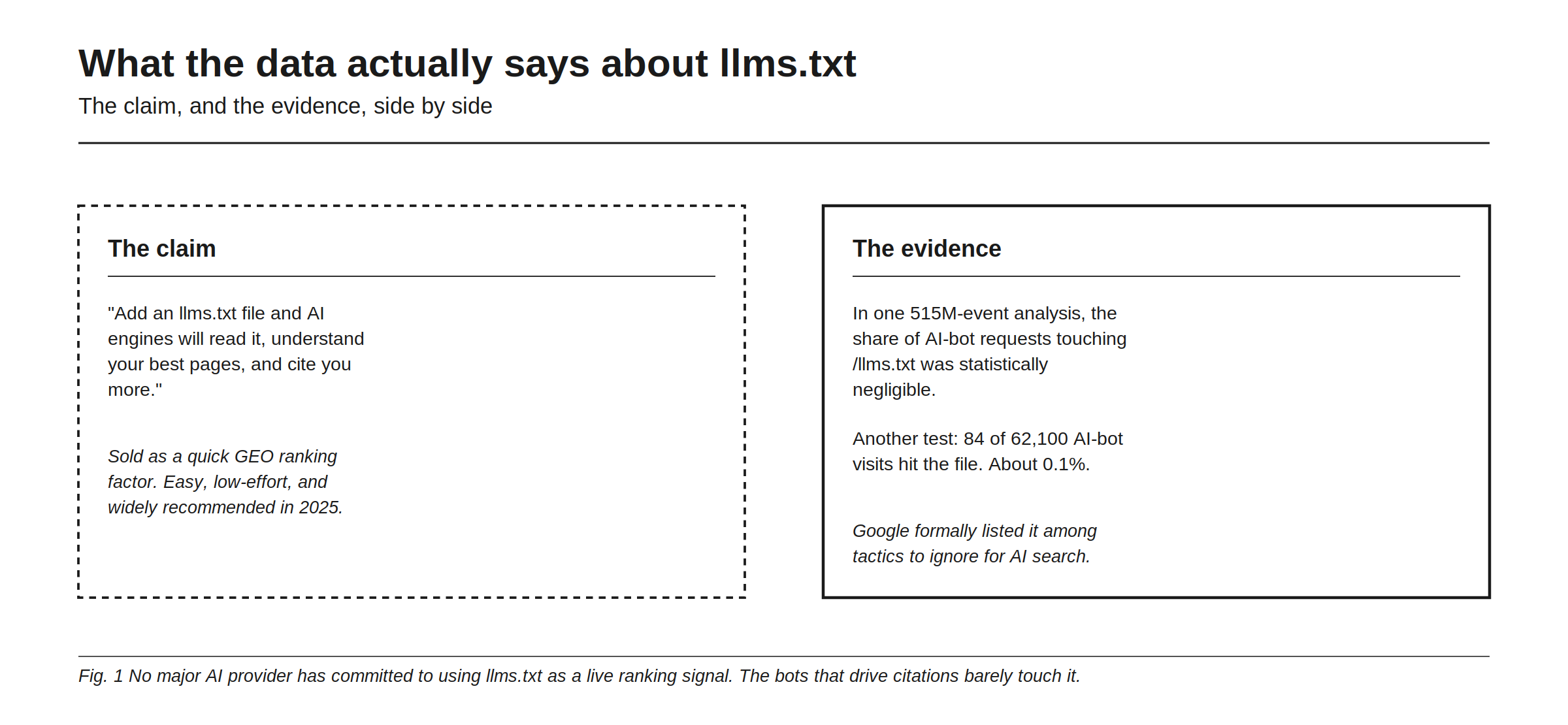
The claim is appealing: add an llms.txt file, and AI engines will read it, understand your best pages, and cite you more. It was sold as a quick, low-effort GEO ranking factor and widely recommended.
The evidence points the other way. In one analysis of over 515 million AI-bot events, filtered to the user agents that actually drive citations, the share of requests touching /llms.txt was statistically negligible, the file was almost untouched by the bots that matter. In a separate 90-day test on a live domain, 84 of 62,100 AI-bot visits hit the file, roughly 0.1% of all AI crawler traffic. And on the record, Google confirmed it does not support llms.txt, compared it to the discredited keywords meta tag, and in May 2026 formally listed it among machine-readable tactics website owners can ignore for AI Overviews and AI Mode. Anyone selling llms.txt as a GEO ranking factor is selling something the data does not support.
One study even found that when researchers removed llms.txt as a variable from their predictive model for AI citations, the model got more accurate, the file was adding noise, not signal. Among the fifty most-cited domains in that dataset, only one had an llms.txt file.
Where it does have narrow value
The honest exception: llms.txt is not useless everywhere. For AI coding assistants and documentation-heavy sites, a curated, machine-readable reading list can genuinely help those specific integrations navigate your docs. If you run an API reference or a large knowledge base and want coding agents to find the right pages, it is a reasonable, low-cost addition. What it is not, on current evidence, is a lever for consumer AI search visibility, getting cited more in ChatGPT, Claude, Gemini, or Perplexity answers for your buyers.
So the nuance is: implement it if you serve AI-coding-tool users and it takes five minutes, but do not expect it to move your brand’s citations, and do not let it displace higher-leverage work. A stale llms.txt is worse than none, so if you add one, keep it current or remove it.
Spend the effort here instead
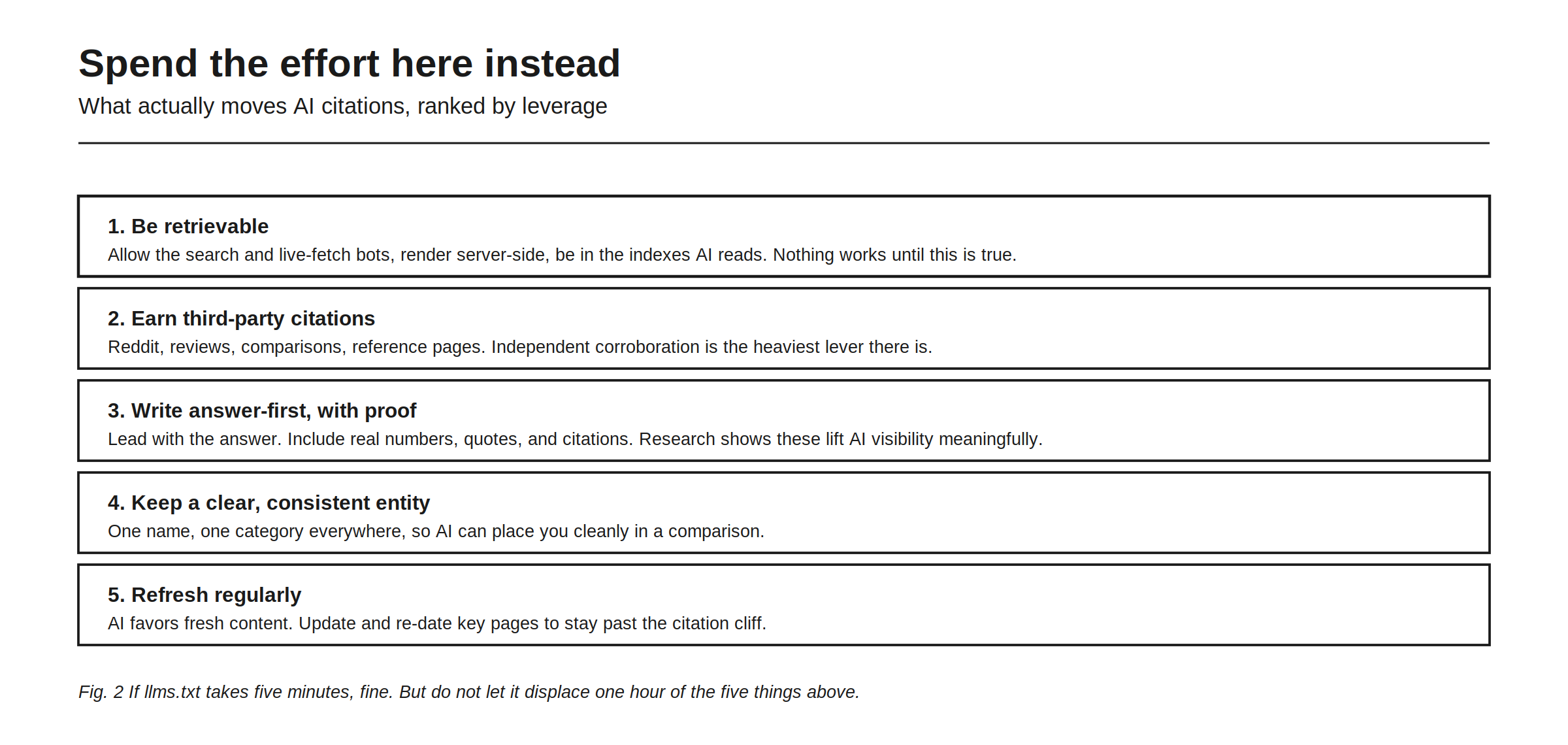
The five things that actually move AI citations, in order of leverage. Be retrievable: allow the search and live-fetch bots, render server-side, and be present in the indexes AI reads, because nothing works until this is true. Earn third-party citations: Reddit, reviews, comparisons, and reference pages, since independent corroboration is the heaviest lever there is. Write answer-first with proof: lead with the answer and include real numbers, quotes, and citations, which the Princeton and IIT Delhi GEO study presented at KDD 2024 found can lift visibility in generative engines by up to 40%. Keep a clear, consistent entity: one name and one category everywhere, so AI can place you cleanly. And refresh regularly: AI favors fresh content, so update and re-date key pages to stay past the roughly three-month citation cliff.
If llms.txt takes five minutes, fine, but do not let it displace one hour of any of these five. The opportunity cost is the real danger of the llms.txt hype: not that the file hurts, but that it draws attention away from the work that actually moves citations. The full playbook is in AI search ranking strategies, and the citation-tracking method that tells you what is working is in LLM citation tracking.
The honest bottom line
llms.txt is not a scam, it is a well-intentioned proposal that the major AI providers have simply not adopted as a ranking signal, and the traffic data shows the bots barely touch it. Treat it the way you would any unproven tactic: harmless in five minutes, dangerous only if it replaces proven work. Measure what actually moves your citations rather than trusting any single tactic, including this one, and let your own data decide. In 2026, that data says: spend your hour on retrievability, third-party citations, and fresh answer-first content, not on a file the engines ignore.
FAQ
Does llms.txt work for AI visibility? On current evidence, no. Traffic analyses show AI bots barely request the file (around 0.1% of crawler visits in one test), and no major AI provider uses it as a live ranking signal. Google formally listed it among tactics to ignore for AI search in its May 2026 AI Search guide.
Should I add an llms.txt file to my site? Only if you serve AI-coding-tool users or documentation integrations, where it has narrow value, and only if it takes minutes and you keep it current. Do not expect it to improve your brand’s citations in consumer AI search, and do not let it displace proven work.
Why do some people still recommend llms.txt? It was heavily promoted in 2025 as an easy GEO win, and the idea is intuitive. But the data that has since come in, negligible bot traffic and no provider adoption, has not supported it as a ranking factor for AI search visibility.
What actually improves AI citations instead? Retrievability (allowing search bots, server-side rendering), third-party citations (Reddit, reviews, comparisons), answer-first content with real proof, a clear consistent entity, and regular content refreshes. These are the evidence-backed levers.
Is llms.txt the same as robots.txt? No. robots.txt controls crawler access and is honored by major bots. llms.txt is a newer, unstandardized file meant to guide AI to your best pages, but adoption by the engines that matter for citations is currently negligible.
Skip the unproven tactics and measure what actually moves your AI citations across every engine you track. Start a free 7-day Rankry trial, no card, first report in two minutes.