You can start optimizing your content for AI search with zero budget by working a free six-step ladder: ask the engines about your category, check your presence on Brave, audit your robots.txt, grep your server logs for AI crawlers, verify in Bing Webmaster Tools, and rewrite one page answer-first. None of this needs a paid tool, and it will tell you more than most dashboards. A tool becomes worth paying for later, when you want to track your chosen engines weekly, picked from ChatGPT, Claude, Gemini, Perplexity, Grok, Microsoft Copilot, and Google AI Overviews, instead of checking a few by hand, but the beginning is genuinely free.
AI content optimization, sometimes called GEO or answer engine optimization, is the work of getting your pages mentioned, cited, and recommended in AI answers. The good news for anyone starting with no budget: the highest-leverage first moves are all free, and most of your competitors have not made them.
The free starting ladder
Climb these in order. Each step is free and each one builds on the last.
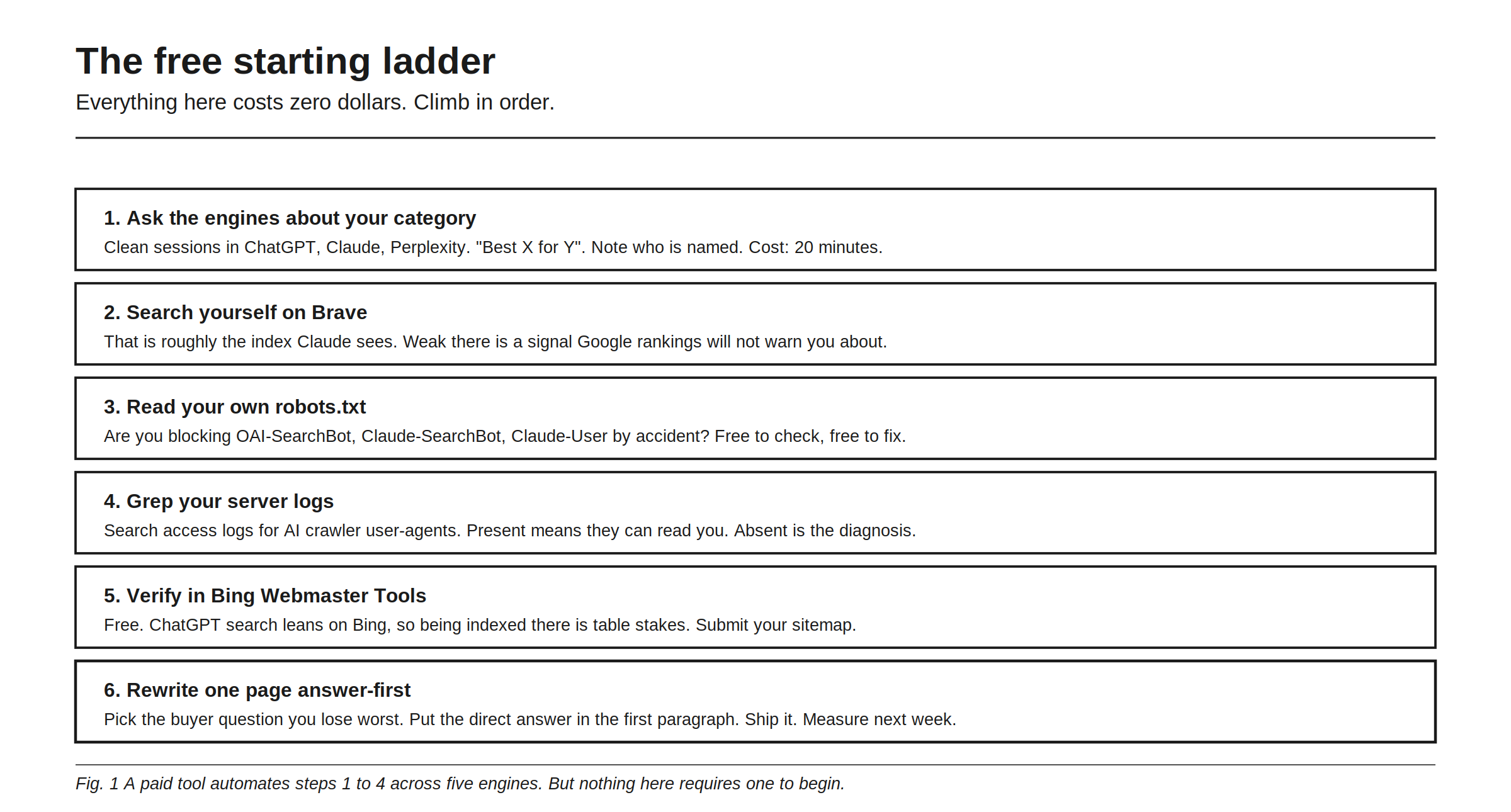
Step 1: ask the engines about your category. Open clean sessions in ChatGPT, Claude, and Perplexity and ask the questions your buyers ask: “best [category] for [use case]”, “[competitor] alternatives”, “is [your product] good for [need]”. Note whether you are named, where, and who wins when you lose. This is your baseline, and it costs twenty minutes. Use fresh sessions so your own history does not skew the answers.
Step 2: search yourself on Brave. Claude’s web search runs, by all public evidence, on Brave’s independent index, so search.brave.com is roughly the view Claude has of your category. If you are thin there, that is a problem your Google rankings will never warn you about. This one check reframes the whole effort: you are not optimizing for Google anymore.
Step 3: read your own robots.txt. Thousands of sites added blanket “block all AI bots” rules in 2024 and forgot them. Open yours and confirm you are not accidentally blocking OAI-SearchBot, Claude-SearchBot, or Claude-User. Blocking these is the single most common reason a site is invisible to AI, and unblocking them is free. Details on which bot does what are in how Claude finds and cites sources.
Step 4: grep your server logs. Search your access logs for AI crawler user-agents, OAI-SearchBot, Claude-User, PerplexityBot. If they appear, the engines can read you. If they are absent, that absence is your diagnosis, and you go back to steps 2 and 3. Full walkthrough in is my website a source for ChatGPT and Perplexity.
Step 5: verify in Bing Webmaster Tools. It is free, and ChatGPT’s search leans on Bing, so being indexed there is table stakes for ChatGPT visibility. Verify the site and submit your sitemap. Most teams have done this for Google and never for Bing.
Step 6: rewrite one page answer-first. Pick the buyer question you lose worst, and rewrite the page that should win it so the direct answer sits in the first paragraph, with clear headings and specific, checkable claims. AI engines quote the part that answers the question; give them something clean to quote. Ship it, and check next week whether it moved.
What “answer-first” actually means
Since it is the heart of free optimization, it is worth being concrete. A brochure page opens with a story about your mission and buries the useful part on line thirty. An answer-first page opens with the answer: what this is, who it is for, what it costs, how it compares, in the first hundred words, then supports it below. AI engines reward the second structure because they are looking for a passage they can lift and cite. The rewrite is free, and it is often the single highest-return move on this list. The full craft, structure, formats, and the mistakes to avoid, is in optimizing content for AI search.
When free stops being enough
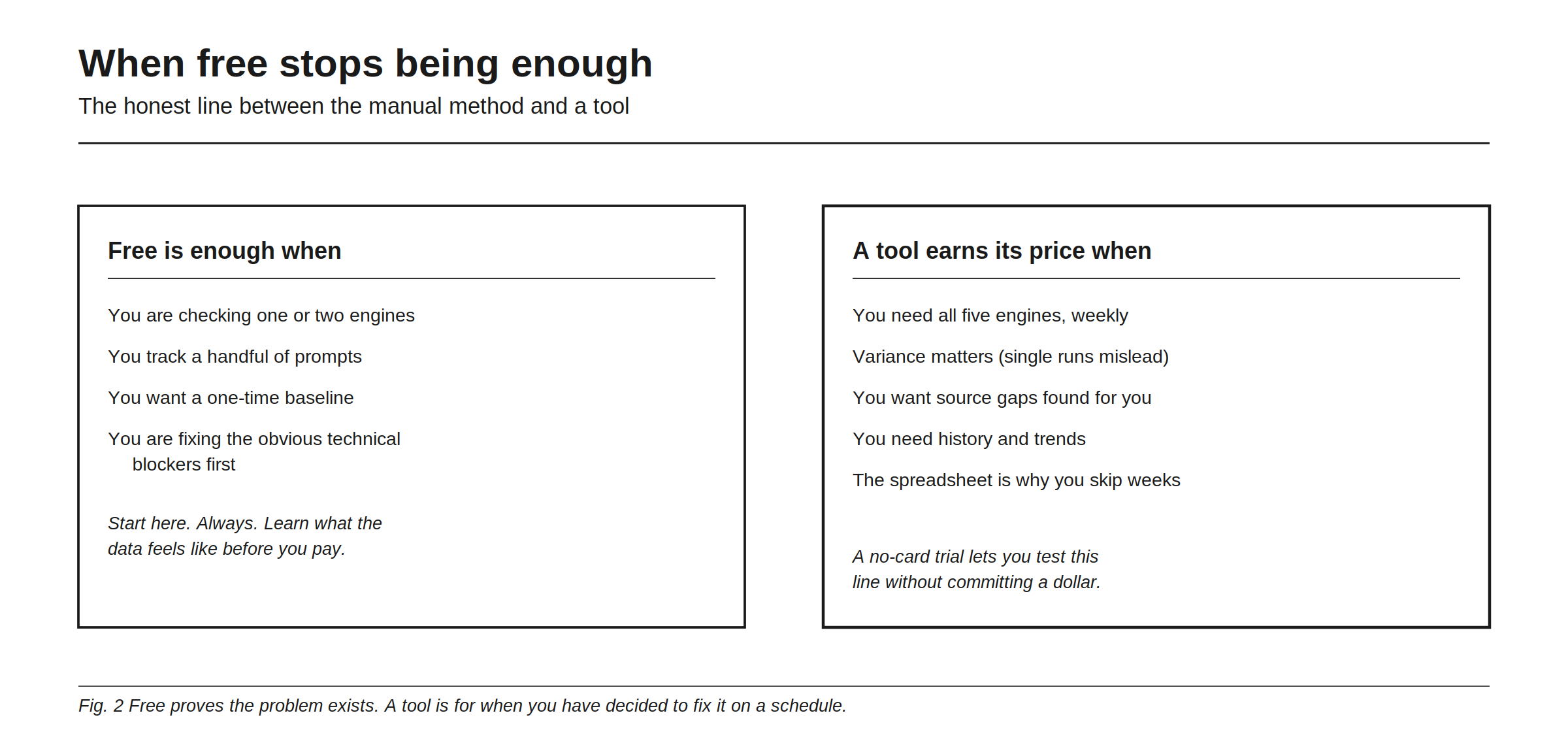
Free is genuinely enough when you are checking one or two engines, tracking a handful of prompts, taking a one-time baseline, or fixing the obvious technical blockers first. Start there, always, because doing it by hand teaches you what the data feels like before you spend anything.
A tool starts earning its price at a specific, honest line: when you need several engines tracked weekly, when variance matters and single manual runs mislead you, when you want source gaps found for you instead of parsed by hand, when you need history and trends, and, bluntly, when the spreadsheet is the reason you keep skipping weeks. That is when automation pays off, not before. A no-card trial lets you test whether you are at that line without committing a dollar, and if you are not there yet, the free ladder is still the right tool. When you do reach it, AI visibility tools with a free trial covers how to run that trial week well.
The free habit that beats most paid effort
Whatever you do or do not pay for, the habit matters more than the tool. Once a week, run your top five buyer prompts through two engines and note what changed. That five-minute ritual, done consistently, beats an expensive tool checked once a quarter. Optimization is a loop, not a project, and the loop is free to start today. When you are ready to run it across every engine that matters automatically, how to monitor your brand across AI search engines covers the upgrade.
FAQ
How do I optimize my content for AI search for free? Work a free six-step ladder: ask the engines about your category, check your presence on Brave, audit robots.txt for blocked AI bots, grep server logs for crawlers, verify in Bing Webmaster Tools, and rewrite one page answer-first. None of these need a paid tool.
Can I improve my AI visibility without any tools? Yes. The highest-leverage first moves, unblocking AI crawlers, rendering real content, answer-first pages, and Bing verification, are all free and manual. Tools automate tracking across engines but are not required to begin.
What is answer-first content? Content that puts the direct answer in the first paragraph, what it is, who it is for, what it costs, how it compares, then supports it below. AI engines quote answer-first passages because they are easy to lift and cite.
Is checking my brand in ChatGPT for free reliable? For a rough baseline, yes, if you use clean sessions. But AI answers vary between runs, so a single manual check is a snapshot, not a measurement. For a reliable read, sample the same prompts repeatedly.
When should I pay for an AI visibility tool? When you need several engines tracked weekly, when single runs mislead you and variance matters, when you want source gaps found automatically, or when the manual spreadsheet is why you skip weeks. Until then, the free method is enough.
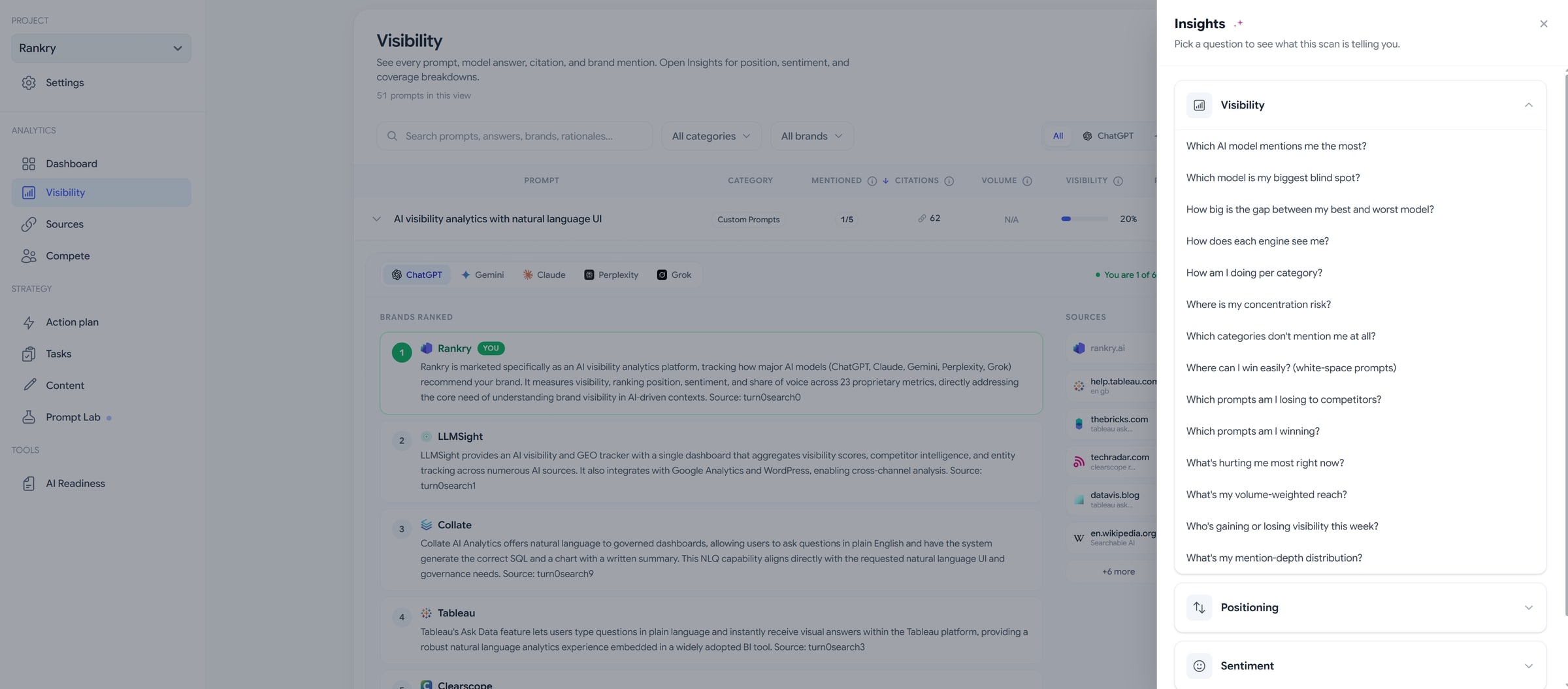
Once the free ladder proves the gaps exist, automate the tracking across the engines you pick. Start a free 7-day Rankry trial, no card, first report in two minutes.