It depends on the prompt, and the published range is wide. We found no study, as of October 5, 2026, that shows half of all Claude buying answers skip the web. Three 2026 vendor measurements put Claude’s web search rate anywhere from 36.6% to over 93%, and a Search Engine Land recap of talks at the Zero Click NY conference reports that the rate changes by prompt type, from about 81% for recency-framed prompts down to about 51% for comparisons. So for some kinds of buying prompts, close to half of Claude’s answers may come from what the model learned in training, not from a live search. For Claude Opus 5.5 and Sonnet 5.5, that training data ends in June 2026, so a review, page or press hit published after that cannot change those answers.
The practical consequence: “get cited” is only half a Claude strategy. Before you optimize anything, find out which of your buying prompts Claude answers from memory and which it searches, because the two need different fixes.
What the studies actually measured
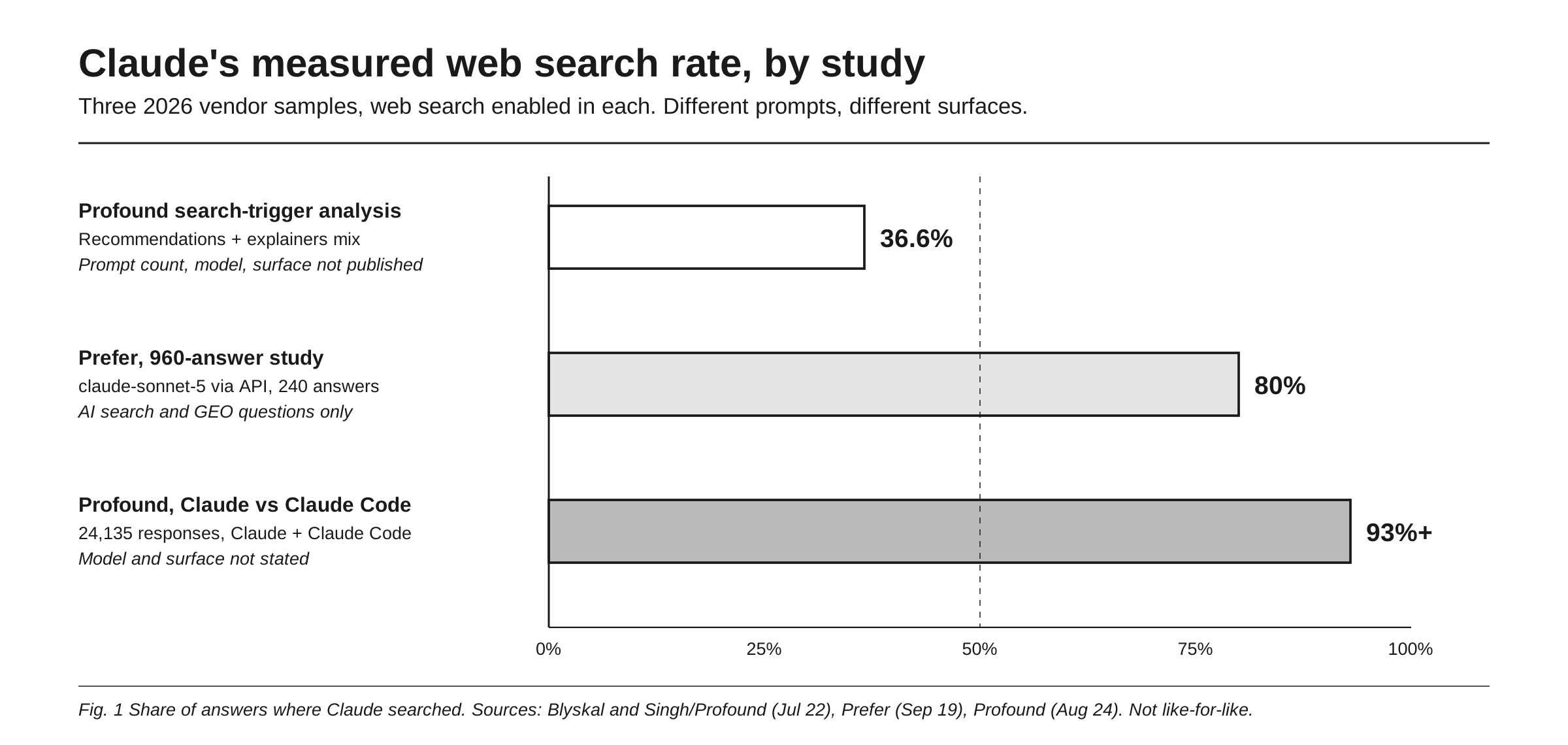
The numbers disagree because the studies measured different things.
Profound’s search-trigger analysis. In a July 22, 2026 write-up of Profound data, Josh Blyskal and Jasman Singh report that Claude “searched 36.6 percent of the time” with web search enabled, and answered without retrieving the web for the other 63.4%. The prompt set mixed current product recommendations with basic explainers, so it is not a buying-only number. The total prompt count is not published, and neither is the model or whether the test ran in the app or the API. The write-up cites a Profound talk at Zero Click New York, and Search Engine Land’s June 2026 recap of that event says Claude “searches only about a third of the time,” likely the same work, though the recap names no data source.
Profound’s Claude vs Claude Code study. On August 24, 2026, Profound published a second dataset: 1,724 prompts and 24,135 Claude and Claude Code responses across 11 categories, collected July 13 to 23 with web search enabled. Here, Claude “searched in over 93% of responses,” against 13% for Claude Code. Profound does not name the model, the surface or the categories, and Search Engine Journal noted the report does not specify any human review.
Prefer’s 960-answer study. On September 19, 2026, Prefer published 240 Claude answers (80 questions, three runs each) from claude-sonnet-5 through the DataForSEO API, with web search requested on every call. Claude searched in 192 of 240 answers, or 80%. The questions were about AI search and GEO, not a spread of consumer categories, and Prefer itself warns: “These are API answers. What a person sees in the consumer apps can differ.”
None of these is a census of Claude traffic. They are vendor samples (Profound and Prefer both sell AI visibility software) with different prompts, surfaces and, in two cases, an unnamed model. The defensible reading: Claude does not search on every prompt, and the share it answers from memory ranges from a small minority to a majority depending on what you ask.
The prompt decides: search rates by prompt type
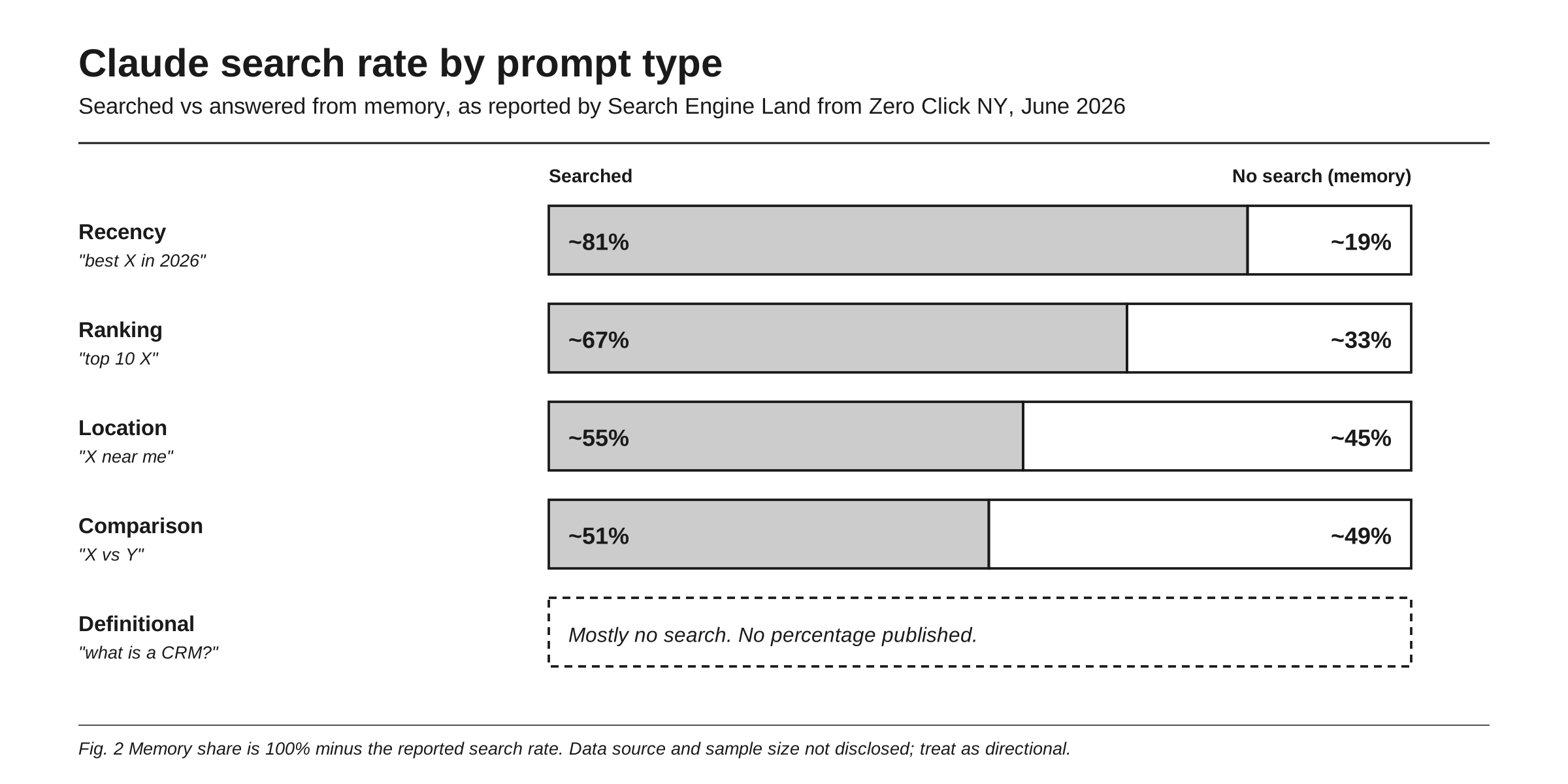
According to Search Engine Land’s recap of the Zero Click NY talks, Claude searched about 81% of the time on recency-framed prompts (“best X in 2026”), about 67% on ranking prompts (“top 10”), about 55% on location-dependent prompts and about 51% on comparisons. Definitional and procedural prompts, such as “what is a CRM?”, mostly did not trigger a search. The recap names neither the data source nor the sample size, so treat these as directional.
Comparisons are where the “half” idea comes from: if Claude searches on about 51% of comparison prompts, roughly half of those answers come from memory. That is one prompt type in one unattributed conference recap, not all buying prompts.
Anthropic’s own documentation explains the pattern. The web search tool docs say “Claude determines when to search based on the prompt.” It searches when a request depends on information that is current, changing or outside its training data, including “Current prices, rates, scores, or statistics” and “Information about specific organizations, people, or products that might have changed.” It answers directly when the request “draws on stable knowledge.” The claude.ai help center puts it more simply: “Claude searches the web when it helps,” and users can force a search by asking for one.
So “best payroll software for a 20-person company in 2026” signals freshness, while “Gusto vs ADP for small business” can read as stable knowledge. The Blyskal and Singh write-up reports the same effect: words such as “best,” “near me” and a current year tended to trigger retrieval. For how this compares with ChatGPT, which Search Engine Land’s recap puts at roughly 95% of prompts searched, see Claude vs ChatGPT brand recommendations.
Why memory answers ignore your latest coverage
When Claude answers without searching, it draws on its training data. Anthropic lists the training data cutoff for both Claude Opus 5.5 (released September 22, 2026) and Claude Sonnet 5.5 (released September 28, 2026) as June 2026. Anything published after that date cannot be in those models’ training data.
That has three consequences for brands.
First, recent wins do not count yet. A July launch or a September roundup that ranks you first can help a search-backed answer this week, but it cannot reach a memory answer until a later model is trained on data that includes it.
Second, being cited is not the same as being remembered. Most Claude visibility advice focuses on getting pages into the search results Claude retrieves, which we cover in how Claude finds and cites sources. That work only pays off on the prompts where Claude searches. On a memory answer, no page is fetched, so no page can be cited.
Third, memory answers change in steps, not daily. A search-backed answer can move when a source page changes; a memory answer tends to move when the model changes. Two new models six days apart, as in late September, is a reason to re-test.
Two paths, two sets of levers
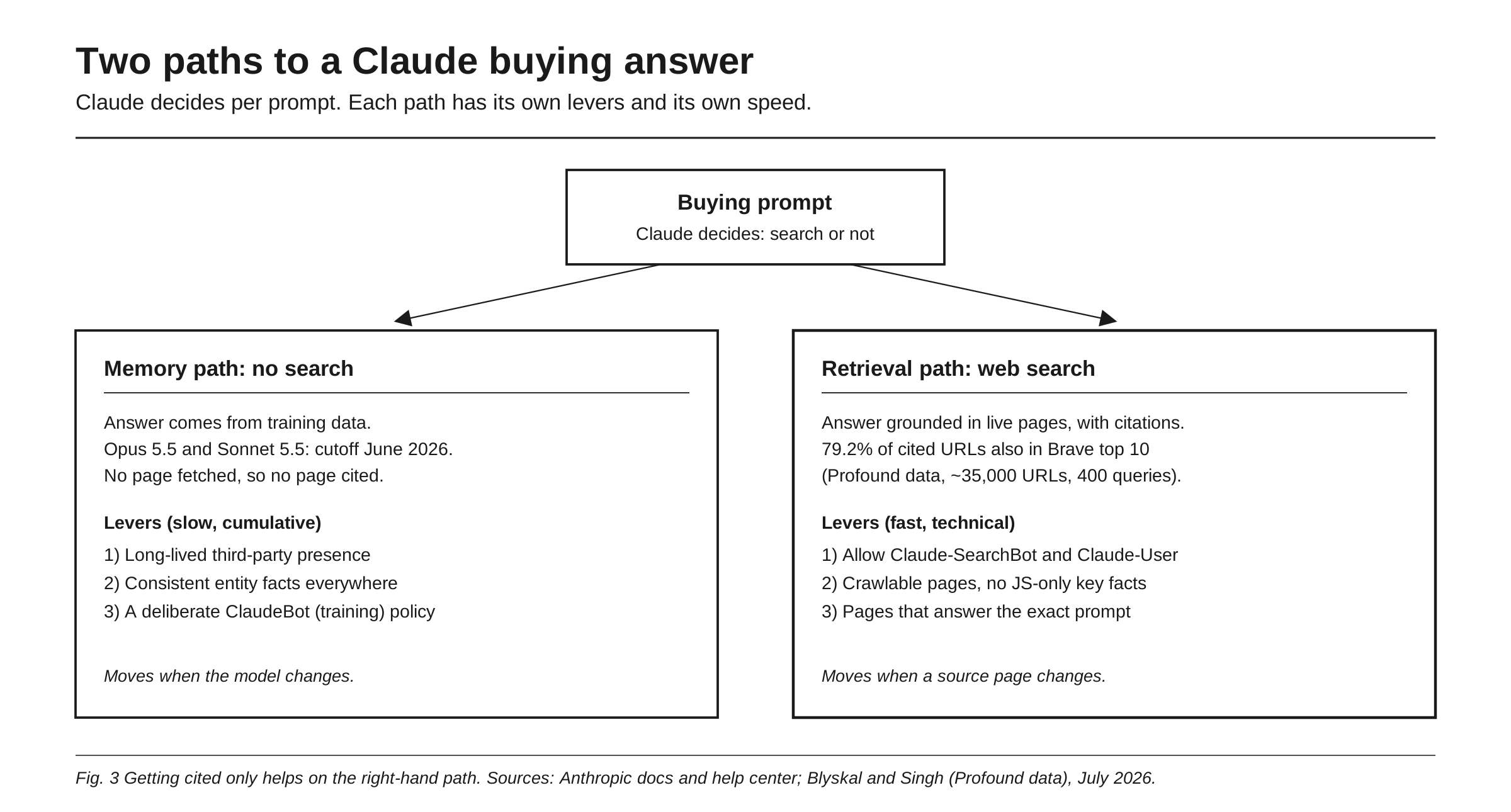
Treat Claude as two systems that share a chat box.
The memory path. The levers here are slow and cumulative. A long-lived third-party presence is the main one: reviews, comparisons, directories, documentation and coverage on independent sites that existed before the cutoff and stayed stable. Consistent entity facts matter too: the same product name, category, pricing model and core use case described the same way across your site and those third-party pages, so the model learns one clear picture of what you are. Your own crawler policy plays a part: Anthropic says that restricting ClaudeBot “signals that the site’s future materials should be excluded from our AI model training datasets.” That is a legitimate choice, but make it knowing it applies to future training data from your site. The trade-offs are in should you allow or block AI crawlers.
The retrieval path. The levers here are fast and technical. Anthropic runs two bots for this side. Claude-SearchBot indexes content for search, and Anthropic warns that disabling it “may reduce your site’s visibility and accuracy in user search results.” Claude-User fetches pages when a person asks Claude something, and blocking it “prevents our system from retrieving your content in response to a user query.” Pages need key facts that load without client-side rendering, clear dates and a direct answer to the comparison or “best for” question. Profound’s data adds a useful diagnostic: across roughly 35,000 URLs tied to 400 queries, 79.2% of Claude’s cited URLs also appeared in Brave’s top 10. The write-up calls that a strong match, not proof of cause, but it makes Brave results a cheap first check.
Most brands need both; the test below tells you which one each prompt depends on.
How to test which buying prompts Claude answers from memory
You do not need a large study to sort your own prompts, only a fixed list and a few repeat runs.
-
Write 20 to 40 buying prompts in four shapes. Include “best X in 2026,” “top X for Y,” “X vs Y,” and “what is the best X” without a year. These shapes map to the prompt types in the Search Engine Land breakdown, so you will see the split quickly.
-
Run each prompt three to five times in claude.ai with web search available. Use a fresh chat each time so earlier turns do not steer the answer, and do not tell Claude whether to search. Anthropic’s help center says searched answers include citations, so record whether each run shows sources.
-
Optionally, repeat in the API. With the web search tool enabled, the response shows whether a search ran and includes citations when it did. Leave the system prompt empty, because Anthropic notes triggering is steerable through the system prompt, and remember Prefer’s warning that API answers can differ from the app.
-
Sort each prompt into three buckets. Searched on every run, searched on none, or mixed. In Prefer’s sample, Claude searched on some runs and not others for 13 of 80 questions, so one run tells you little.
-
For memory prompts, work the slow levers. Check what Claude says about you without search: name, category, strengths, competitors. Fix inconsistent facts across your site and major third-party pages, and invest in durable independent coverage. Do not expect movement until a new model ships. The full playbook is in how to get your brand recommended by Claude.
-
For search prompts, work the fast levers. Confirm Claude-SearchBot and Claude-User are allowed in robots.txt and at your CDN, check your server logs for both, look at Brave’s top 10 for the same query, and make sure a crawlable page answers the prompt directly.
-
Test the phrasing flip. Add “in 2026” to a memory prompt and see whether it starts searching. If it does, buyers who phrase it that way reach your search levers, and buyers who do not reach your memory levers.
-
Re-run after every model release. A new model can change both its search habits and what it remembers. Keep the prompt list fixed so the comparison is fair.
This is the problem Rankry is built to keep in view. Rankry runs a stable set of buyer-intent prompts against Claude and the other major engines every day, and records whether you are mentioned, how you rank and which sources each answer cites, so prompts that keep coming back without citations stand out from those where you are losing a source battle. A phrasing test like the “in 2026” flip is one more prompt, answered as soon as you add it.
FAQ
Does Claude always search the web before recommending a product? No. Anthropic’s documentation says Claude decides when to search based on the prompt, and answers directly when a request draws on stable knowledge. Vendor studies in 2026 measured search rates from 36.6% to over 93% depending on the prompt set, and a Search Engine Land conference recap reports comparison prompts triggered a search only 51% of the time.
Is it true that half of Claude’s buying answers come from memory? Not as a general rule. No study we found before October 5, 2026 shows that for buying prompts overall. The closest data point is a Search Engine Land recap of Zero Click NY talks: 51% of comparison prompts triggered a search, so roughly half of those answers came from memory. Recency-framed “best X in 2026” prompts searched about 81% of the time.
What is the training data cutoff for Claude Opus 5.5 and Sonnet 5.5? Anthropic lists June 2026 as both the reliable knowledge cutoff and the training data cutoff for Claude Opus 5.5, released September 22, 2026, and Claude Sonnet 5.5, released September 28, 2026. Content published after June 2026 cannot be in their training data, so it only reaches Claude through live search.
How can I tell whether Claude searched for a specific answer? In claude.ai, searched answers include citations, according to Anthropic’s help center, so an answer with no sources is a likely memory answer. Run each prompt several times in fresh chats, because the same prompt can search on one run and not the next. In the API, the response shows whether the web search tool ran.
Should I block ClaudeBot if I want Claude to recommend me? That is a separate decision from search visibility. ClaudeBot is Anthropic’s training crawler; restricting it signals that your site’s future content should be excluded from training data. Claude-SearchBot and Claude-User handle search and user requests. Blocking ClaudeBot does not block those, but it limits what future models can learn directly from your site.
Sources
- The state of AEO in 2026: Claude is not ChatGPT, Josh Blyskal and Jasman Singh (Profound data), July 22, 2026
- 7 AI search shifts you can’t afford to ignore, Frank Olivo, Search Engine Land, June 17, 2026
- Claude and Claude Code are distinct Answer Engines, Profound, August 24, 2026
- Claude Searches Web Differently From Claude Code, Data Shows, Search Engine Journal, August 31, 2026
- How AI engines search and cite: 960 answers measured, Prefer, September 19, 2026
- Web search tool, Claude Platform Docs, n.d.
- Enable and use web search, Claude Help Center, n.d.
- Does Anthropic crawl data from the web, and how can site owners block the crawler?, Claude Help Center, n.d.
- Claude Opus 5.5, Claude Platform Docs, released September 22, 2026
- Claude Sonnet 5.5, Claude Platform Docs, released September 28, 2026
- Claude Platform release notes, Claude Platform Docs, September 2026 entries
See which of your buying prompts Claude answers with citations and which come back without sources, on a fixed prompt set tracked every day. Start a free 7-day Rankry trial, no card required.