Claude and ChatGPT pick brands differently because they see different webs. Claude retrieves from one external index, by all public evidence Brave’s, and its citations track that index closely, so your Brave presence largely decides your Claude presence. ChatGPT has moved off Bing onto a hybrid of its own fast-growing index plus licensed partner data, which it re-ranks aggressively, so no single search engine’s rankings predict its citations anymore. The result: a brand can dominate one engine and be invisible in the other, and the playbooks for fixing each overlap but do not match.
This is the comparison that matters if AI answers feed your pipeline, because “we optimized for AI” usually means “we optimized for ChatGPT” while Claude quietly recommends someone else to a smaller but unusually high-intent professional audience. Here is how each engine actually builds its shortlist, where the mechanics diverge, and what to do about each.
Which engines this covers. This is a two-engine comparison because Claude and ChatGPT sit at the extremes of the index question, which makes the contrast easy to see. They are two of seven engines that matter: Gemini, Perplexity, Grok, Microsoft Copilot, and Google AI Overviews each build their shortlists from yet another source mix, and a brand that wins both engines below can still be absent from all five of the others. Read this as the clearest illustration of a general rule rather than a complete map, and take the full picture from why AI engines disagree about your brand.
Two pipelines, side by side
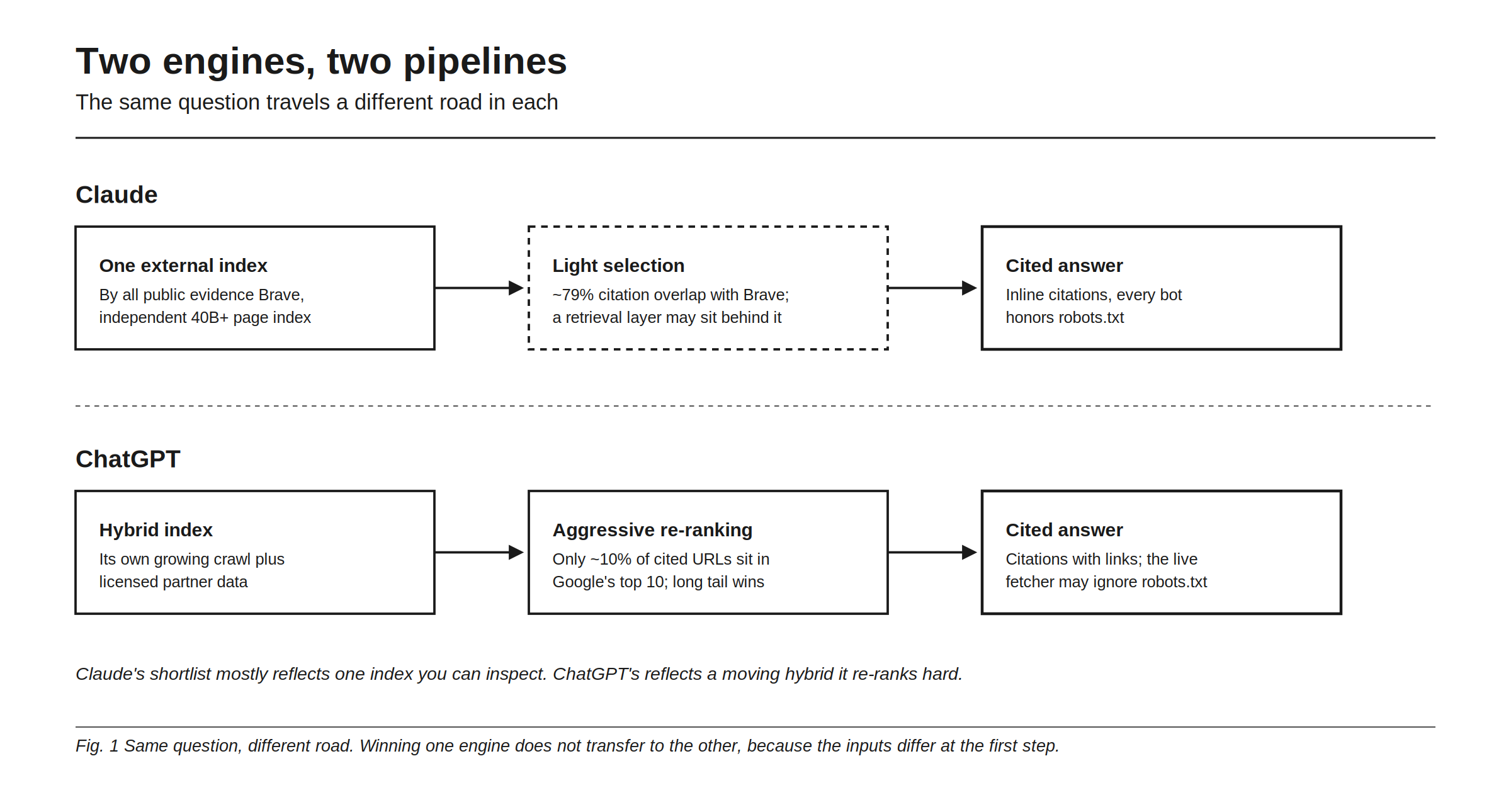
Both engines follow the same broad loop: decide whether the question needs the live web, search, read the results, and write a cited answer. The divergence is in what they search and how much they reshape what comes back.
Claude queries one external index. Anthropic has never officially named it, but the evidence chain is strong: Brave Search sits on Anthropic’s own subprocessor list for all products, Claude’s tool definition exposed Brave-specific parameters at launch, and the most recent large overlap test, roughly 400 queries in June 2026, found 79.2 percent of Claude’s citations matching Brave’s top results. That is high enough to treat Brave as Claude’s view of the web, with one honest caveat: a second “Web Search” subprocessor, TurboPuffer, a retrieval database added in May 2026, means a selection layer may sit between Brave’s results and Claude’s citations that nobody outside Anthropic can fully map. Close to passthrough, no longer provably pure passthrough.
ChatGPT ran on Bing at launch, and the early advice, “rank on Bing, win ChatGPT,” was accurate then. It is outdated now. Measured Bing alignment collapsed from 26 percent to 8 percent while Google alignment tripled, and a separate study found only about 10 percent of ChatGPT’s cited URLs sitting in Google’s top ten, which together point at neither engine being the backbone. What replaced Bing is a hybrid: OpenAI’s own index, fed by a crawl that tripled in volume since August 2025, plus licensed partner data, all re-ranked hard by the model. One more structural fact makes ChatGPT’s behavior distinctive: in a 730,000-conversation study, the top ten domains took only about 12 percent of citations. ChatGPT’s answers live in the long tail, where a specific page on a small domain gets cited over a big brand’s homepage constantly.
Where the recommendation logic diverges
For a brand, four differences matter most.
The index you must win is different. For Claude, it is one inspectable index: search your category on search.brave.com and you are looking at approximately what Claude sees. For ChatGPT, there is no single scoreboard to check anymore, which shifts the work from “rank somewhere specific” to “be fetchable and quotable everywhere.”
The degree of re-ranking is different. Claude’s shortlist mostly reflects its index’s view, filtered for relevance. ChatGPT’s shortlist is heavily reshaped by the model, which is why its citations correlate weakly with every traditional rank tracker, and why extractable facts and statistics on the page measurably help there.
The bots follow different rules. Anthropic’s three crawlers, including the live fetcher Claude-User, all honor robots.txt. OpenAI’s documentation is explicit that OAI-SearchBot is the visibility switch, but has walked back the promise that ChatGPT-User, the live fetcher, obeys robots.txt the same way. Practically: with Claude you have full, reliable control; with ChatGPT you control search inclusion but not necessarily live fetches.
The corroboration sources differ in weight. Both engines lean on third-party consensus, but ChatGPT’s citation mix gives unusual weight to Wikipedia and Reddit, which together account for a large share of its US citations. Claude’s mix follows Brave’s index, which rewards the broader open web: reviews, comparisons, documentation, and community pages that rank there.
What wins in each, and what wins in both
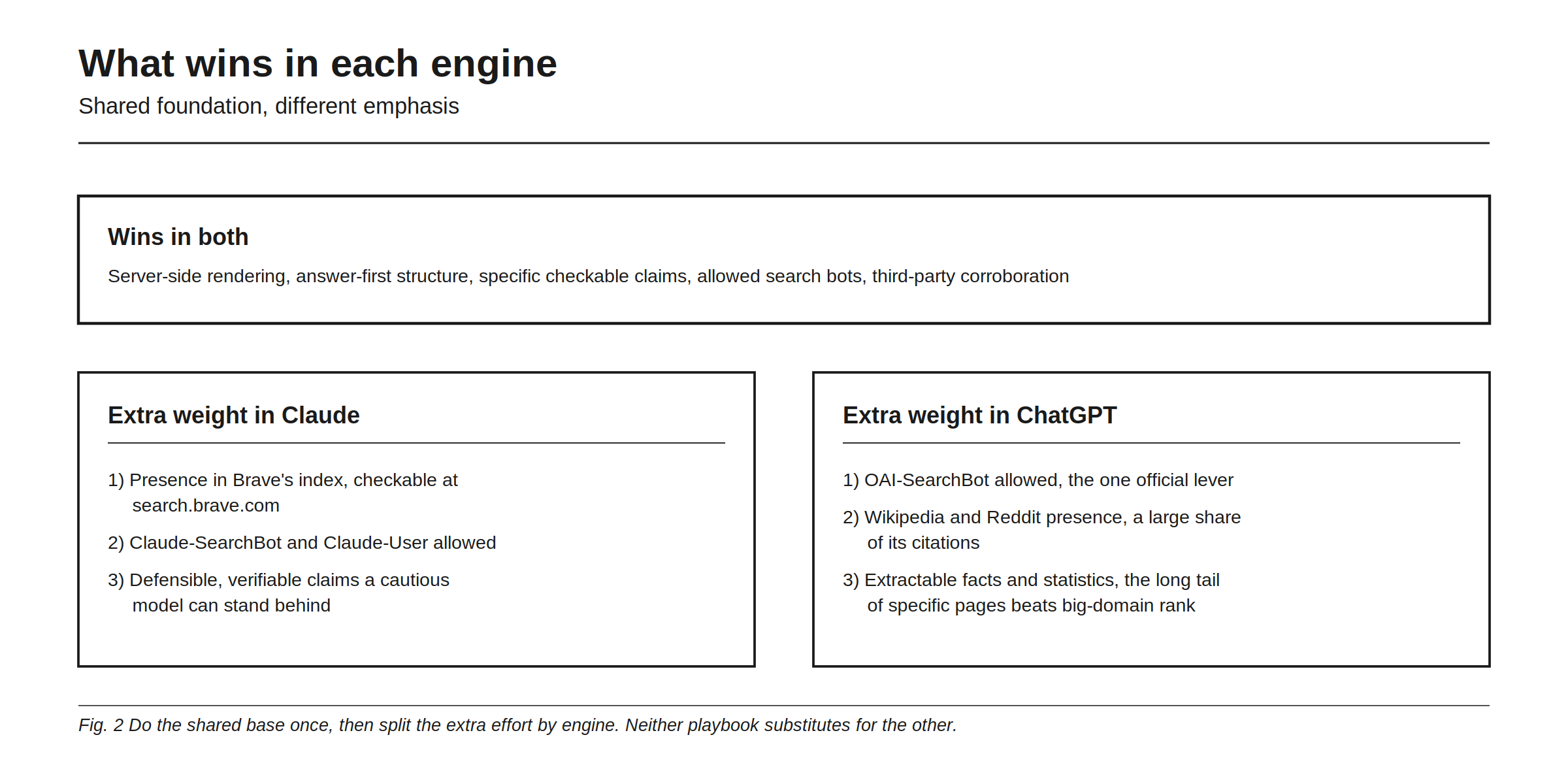
The shared foundation is identical and comes first: server-side rendering so the fetchers can read you, answer-first structure so there is something to quote, specific checkable claims, search bots allowed in robots.txt, and independent corroboration. Do that once and both engines benefit.
Then split the extra effort. For Claude, verify your presence in Brave’s index, confirm Claude-SearchBot and Claude-User are allowed, and make your claims defensible, because Claude is the more cautious citer and favors sources it can stand behind. For ChatGPT, treat OAI-SearchBot as the one official lever, invest in Wikipedia accuracy and genuine Reddit presence, and pack pages with extractable facts, because the long tail of specific pages beats domain size there. The full Claude-side playbook is in how to get your brand recommended by Claude, and the mechanics behind it in how Claude finds and cites sources.
Quick comparison
| Claude | ChatGPT | |
|---|---|---|
| Index | One external index, by all evidence Brave | Hybrid: own index + licensed partners |
| Re-ranking | Light, ~79% overlap with Brave | Aggressive, weak correlation with any SERP |
| Scoreboard you can inspect | search.brave.com | None reliable |
| Live fetcher obeys robots.txt | Yes (Claude-User) | Not guaranteed (ChatGPT-User) |
| Visibility switch | Claude-SearchBot + Claude-User | OAI-SearchBot |
| Citation mix skews toward | Open-web pages ranking in Brave | Long tail + Wikipedia and Reddit |
| Trend to watch | TurboPuffer retrieval layer, role unclear | Own index growing, partners shifting |
Why you have to measure both separately
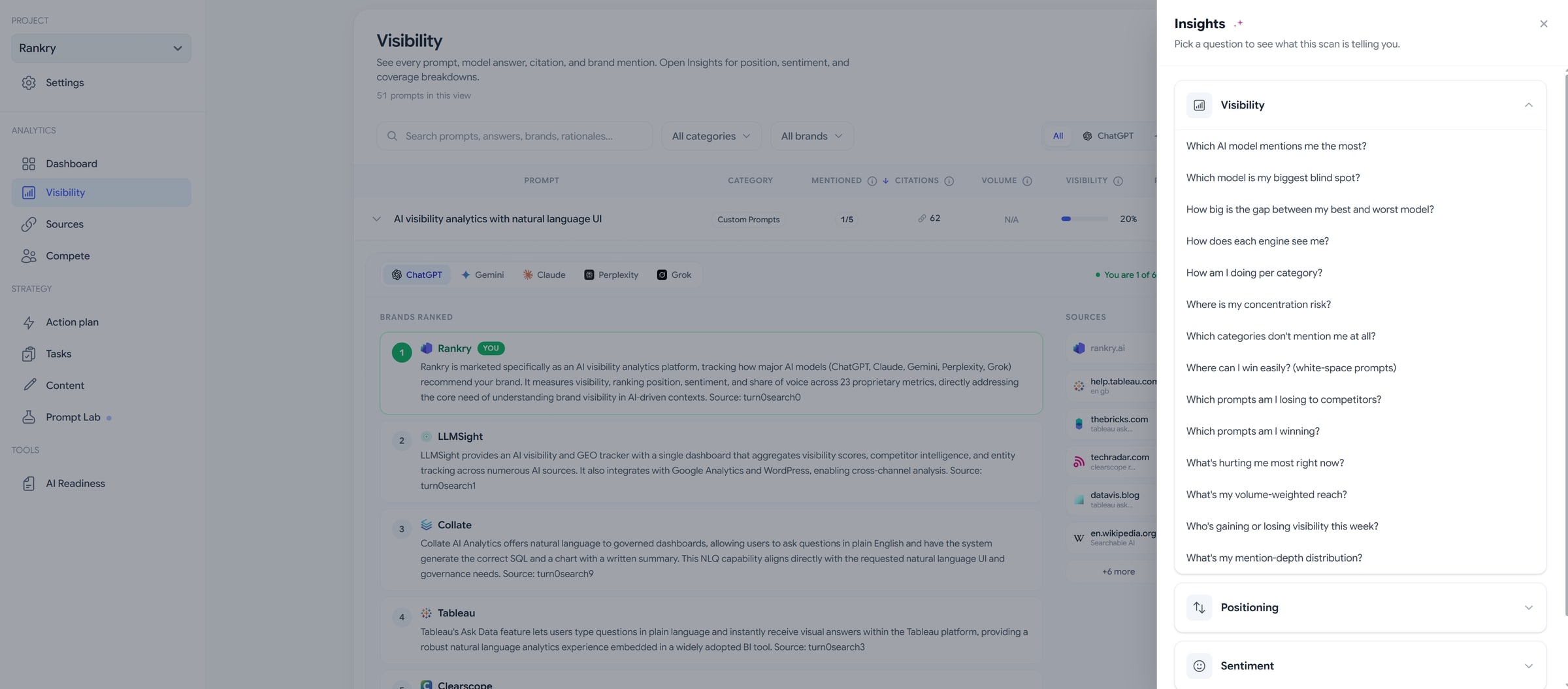
Because the inputs differ at the first step, the outputs diverge run after run: the same buyer question routinely returns different shortlists on Claude and ChatGPT, and a fix that moves one can leave the other untouched. The only way to know your real position is to track the same prompts on both engines on a schedule, with the reasoning and cited sources recorded, and treat them as two channels with two scoreboards. Rankry tracks Claude and ChatGPT side by side, along with Gemini, Perplexity, and Grok, so the divergence stops being a surprise and becomes a column you can read. You can see Claude’s specific treatment of your category on the Claude visibility tracker page.
FAQ
Do Claude and ChatGPT recommend the same brands? Often not. They retrieve from different indexes and reshape results differently, so the same buyer question routinely returns different shortlists. A brand can lead in one and be absent from the other.
Which search index does each engine use? Claude retrieves, by all public evidence, from Brave’s independent index, with high citation overlap. ChatGPT has moved off Bing onto a hybrid of its own growing index plus licensed partner data, re-ranked by the model, so no single engine’s rankings predict its citations.
Is it easier to get recommended by Claude or ChatGPT? They are different rather than easier. Claude gives you one inspectable index (Brave) and bots that reliably obey robots.txt, so the path is clearer. ChatGPT offers a bigger audience and a long-tail citation pattern where small, specific pages win, but no single scoreboard to optimize against.
Does ranking on Google help in either? Only indirectly. Claude’s index is independent of Google, and only around 10 percent of ChatGPT’s cited URLs sit in Google’s top ten. The shared fundamentals, crawlable, quotable, corroborated content, help everywhere, but Google rank itself transfers to neither.
How do I track my brand in Claude and ChatGPT at once? Run the same set of buyer-intent prompts on both engines on a schedule and record presence, rank, reasoning, and cited sources per engine. An AI visibility tool automates this and shows where the two diverge.
What about the other engines? Claude and ChatGPT are the extremes of the index question, which is why they make the clearest comparison, but they are two of seven. Gemini, Perplexity, Grok, Microsoft Copilot, and Google AI Overviews each build shortlists from another source mix, and winning both engines here does not imply anything about those five. Track the ones your buyers actually use and expect the ranking to differ on each.
See the same buyer prompts answered by Claude and ChatGPT side by side, with the sources behind each pick. Start a free 7-day Rankry trial, no card, first report in two minutes.