In an experiment published on October 7, 2026, Peec AI researcher Metehan Yesilyurt generated 50,000 statistics pages with GPT-4.1 on a brand-new domain, stateglobe.com, for about $50 in total, and by his own account never checked a single number. Google indexed the site, then two updates collapsed its visibility and the pages were deindexed, while ChatGPT kept fetching them to answer users: about 72,000 ChatGPT-User requests in 30 days and more than 10,000 AI sessions since launch. The invented numbers then traveled into an academic paper and a bank’s investment research. It is a sharp demonstration that retrieval-based AI answers can repeat unverified data. It is also a trap for any brand tempted to copy it: the method fits what Google’s spam policies describe as scaled content abuse, the gap is now public and likely to close, and every fake number leaves a trail that leads back to whoever published it.
The experiment will get passed around as a hack. Read it as a warning label. Even the author writes that the tactic “neither can nor should be the basis for your organization’s entire GEO strategy.” Here is what was confirmed, why it backfires for brands, and how to publish numbers that earn citations honestly.
What the experiment actually did
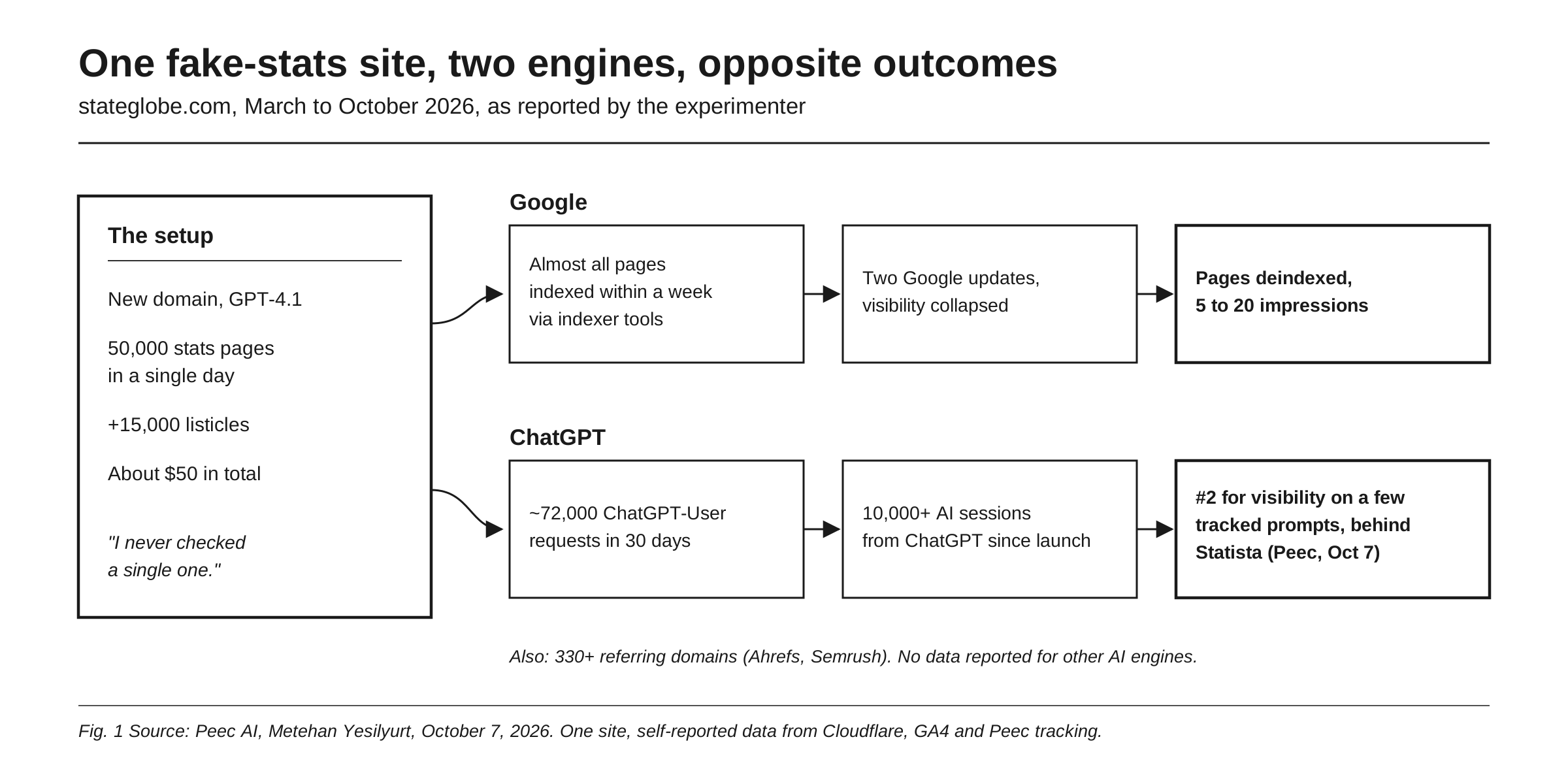
In March 2026, Yesilyurt started building the experiment: he bought a new domain and generated 50,000 statistics pages in a single day with GPT-4.1, covering SEO, content marketing, social media, e-commerce and web technology across 200 countries. The prompt was a list of countries and topics plus two sentences. He later added 15,000 listicles. Total cost: about $50.
Google first. Using indexer tools, he got almost the whole site indexed within a week, and it started appearing in results. Then, in the author’s words, “two Google updates came out right after launch, and my Google visibility collapsed.” Today the indexed pages bounce between 5 and 20 impressions, and he sums it up as: “Google has forgotten the site exists and deindexed the pages, but ChatGPT hasn’t.”
ChatGPT second. By the author’s account, Cloudflare logged more than 600,000 bot requests in the 30 days before writing, around 72,000 of them from ChatGPT-User. GA4 shows more than 10,000 AI sessions from ChatGPT since launch, with direct traffic excluded because it likely reflected bots. Ahrefs and Semrush show 330+ referring domains, including Shopify, Bluehost and DHL. On October 7, a Peec dashboard he set up to track a few prompts placed stateglobe.com second for visibility on those prompts, behind only Statista.
Keep the limits in view: one site, one new domain, one author’s self-reported analytics, published by Peec AI, an AI search analytics vendor. The write-up does not say which engines the Peec dashboard covered, and it reports nothing for Perplexity, Gemini, Claude or Google AI Overviews. The confirmed story is about ChatGPT. The only consequences the write-up documents are the Google drop and a disclaimer now on the still-live site. It reports no action by OpenAI.
Why it worked: retrieval is not verification
The detail that explains most of the result is the user agent. OpenAI documents ChatGPT-User as the agent it uses “for certain user actions in ChatGPT and Custom GPTs,” and says it “is not used for crawling the web in an automatic fashion.” The author reads the 72,000 requests the same way: ChatGPT fetching pages in real time to answer someone’s question, not training crawls. In the author’s description of that flow, “Fact-checking doesn’t happen anywhere in the process.”
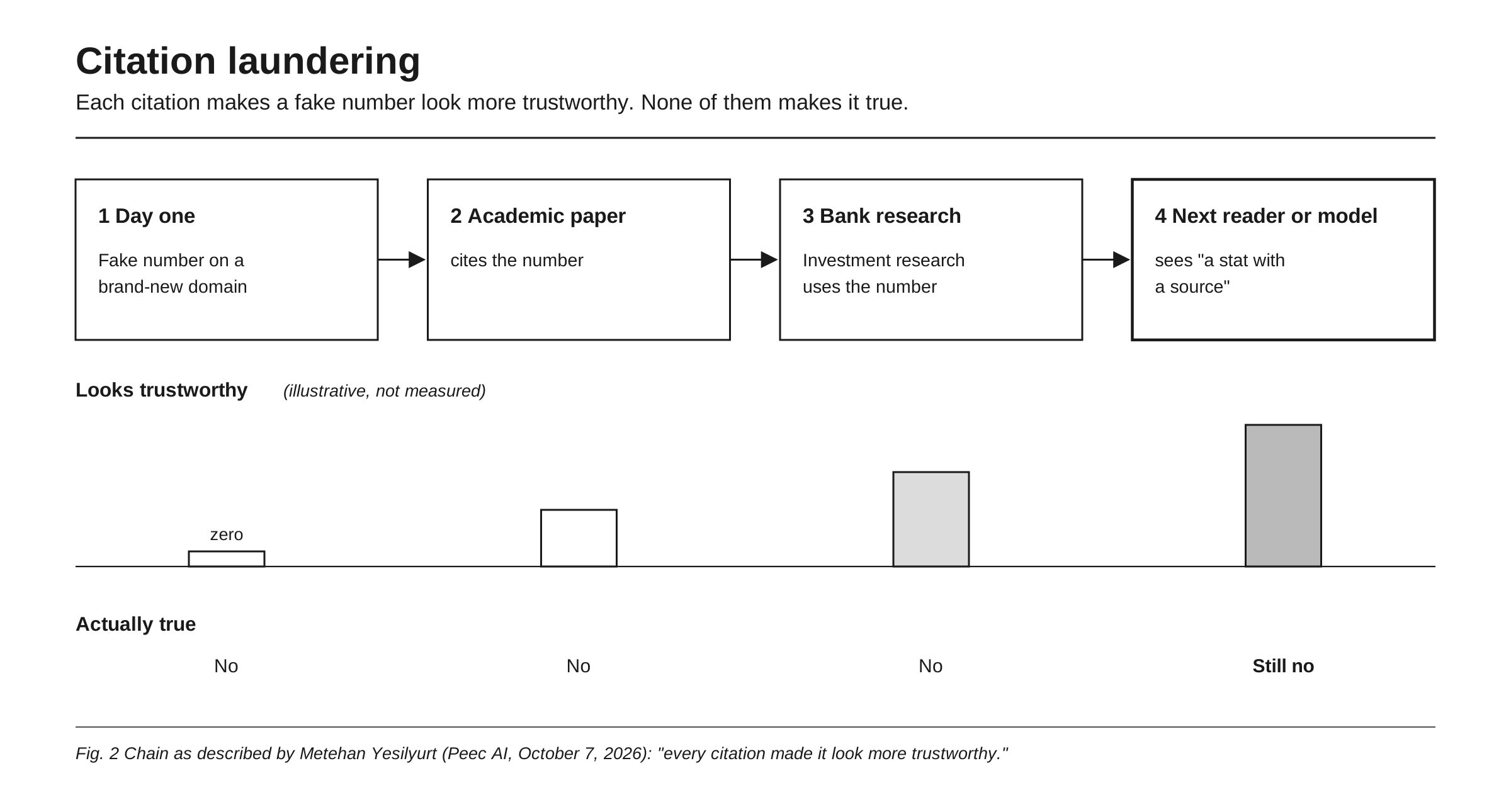
Then the second effect kicks in, which the author calls citation laundering. “On day one, a fake number on StateGlobe had zero authority.” Then an academic paper cited it, then a bank. “Now the next person, or the next model, that finds this number sees a stat with a source.” His conclusion: “The fake data certainly didn’t become true, but every citation made it look more trustworthy.” Visible citations included investment research from Qatar’s largest financial group, an Indian economics publication and a Canadian influencer community’s report, and those are only the ones that linked back.
A citation is not an endorsement. An AI answer that links a page is not vouching for it, a distinction covered in brand mentions vs citations in AI. How engines pick those sources in the first place is covered in where AI actually gets its answers. The author adds one more warning: “these pages end up in web crawls, and web crawls end up in training data.” Fabricated numbers may not stay contained to one answer.
Why it is a trap for brands
Google has already written the rule. Google’s spam policies define scaled content abuse as “when many pages are generated for the primary purpose of manipulating search rankings and not helping users,” and the first example listed is “using generative AI tools or other similar tools to generate many pages without adding value for users.” The stated consequence: “Sites that violate our policies may rank lower in results or not appear in results at all,” and human review “can result in a manual action.” The write-up cites no explanation from Google for the drop, but what happened to stateglobe.com fits that description.
Losing Google also means losing Google’s AI surfaces. Google’s documentation for AI features says that to appear as a supporting link in AI Overviews or AI Mode, “a page must be indexed and eligible to be shown in Google Search with a snippet.” A deindexed page cannot meet that bar.
The gap is public now. The author’s own caveat: “LLMs might close this gap.” The full write-up went live on October 7, after pieces of the experiment had already been shared publicly. Building on a widely shared loophole is a bet that no AI vendor will fix it.
The trail is easy to follow. The experimenter could see who repeated his numbers because they linked back, and backlink tools such as Ahrefs and Semrush list referring domains. Searching the exact numbers in quotes finds unlinked uses too. A journalist, competitor or academic who doubts a number can run the same lookup on your domain.
There is legal exposure in the US. The FTC’s policy statement on advertising substantiation treats “a firm’s failure to possess and rely upon a reasonable basis for objective claims” as an unfair and deceptive practice, and when a claim says “studies show,” the Commission “expects the firm to have at least the advertised level of substantiation.” Invented numbers used in marketing have no basis by definition. This is not legal advice; ask counsel before publishing any data-backed claim.
Reputation runs the laundering in reverse. Once the numbers are exposed, the chain that made stateglobe.com look credible becomes a public list of everyone you misled. The researcher had some cover: he ran the test to share the results publicly, and the site now carries a disclaimer. A brand would have neither. The author also notes that “the brands most likely to benefit from using the technique are those people already trust.” For a trusted brand, fabricated numbers would put that trust on the line.
The legitimate version: original research that earns citations
The useful insight survives once you strip out the fraud: in the author’s analysis, LLMs researching an article go looking for specific numbers. Peec tested the honest version too. It published a second page where “there were no made-up numbers, and we checked every stat and properly cited its source,” and, per the author, sites the team suspects use AI to write their content “started linking to us.” In Peec’s own account, the format earned links without fabrication.
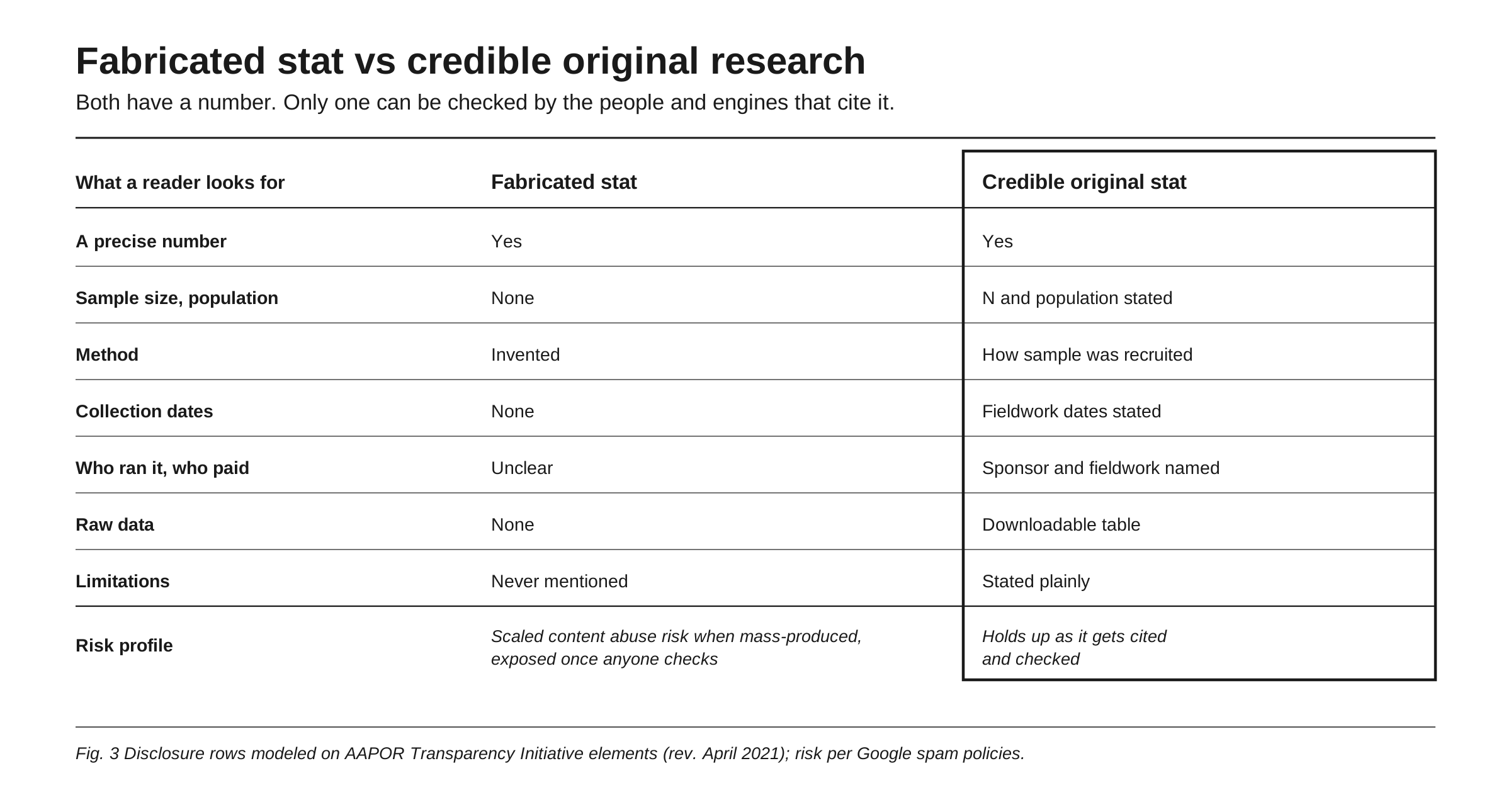
What makes a number credible is old, well-documented practice. Survey researchers have a standard checklist: AAPOR’s Transparency Initiative asks for disclosure of who sponsored and who conducted the research, the population studied, how the sample was generated and recruited, the mode of data collection, the dates of collection, sample sizes, how the data were weighted, how quality was checked, and a plain statement of the limitations. Product usage data, an honest customer survey or an analysis of a public dataset all qualify, if you show your work.
A fabricated stat has a number and a confident sentence. A credible stat has a number, a sample, a method, a date and a way to check it. The path from a new page to a cited one is covered in how to get cited by AI.
Checklist: publishing original data that AI engines and humans trust
- Start from data you actually hold. If you cannot name the dataset behind a number, do not publish the number.
- Put the sample size and the population in the same sentence as the headline figure (“in our survey of [N] US marketing managers”).
- State the method and collection dates. Without a method, a number cannot be judged.
- Say who ran the research and who paid for it. A vendor study is fine if it says it is a vendor study.
- Put the source and year next to every number, and make one claim per sentence. Both are the author’s own recommendations.
- Publish the raw data or a downloadable table, plus the question wording for surveys.
- Write a short limitations paragraph: what the data cannot tell you, and where the sample is thin.
- Date the page and keep a changelog. When you refresh the numbers, keep the previous version reachable.
- Never scale numbers nobody checked. If AI drafts the page, a person verifies every figure against the source before it ships.
- Keep the page indexable in Google and open to answer crawlers such as OAI-SearchBot, so it can be cited at all.
- Watch where the numbers travel: which sites quote you, which AI answers cite you, and whether they quote you accurately.
Rankry covers the AI side of that last step. It runs a stable set of buyer-intent prompts every day across ChatGPT, Claude, Gemini, Perplexity, Grok and Google AI Mode and AI Overviews, and records whether each engine mentions your brand and which pages it cites, so you can see whether a research page becomes a source and whether a competitor’s thinner stats page outranks it. AI traffic tracking shows the visits AI platforms send to your site, the referral side of what the experimenter read in GA4.
FAQ
Did ChatGPT really cite fake statistics? In this experiment, ChatGPT repeatedly retrieved the fabricated pages and sent traffic to them. The author reports about 72,000 ChatGPT-User requests in 30 days, more than 10,000 AI sessions from ChatGPT since launch, and a second-place visibility rank behind Statista on a few prompts tracked in Peec. It is one site and self-reported data, and the write-up covers ChatGPT only, not other engines.
Why did Google drop the site but ChatGPT keep using it? Google indexed the site, then two updates collapsed its visibility and the pages were deindexed. The write-up cites no reason from Google, but its spam policies list generating many pages with AI without adding value for users as scaled content abuse. ChatGPT kept fetching pages in real time through ChatGPT-User. The author warns that LLMs might close this gap now that it is public.
Is publishing AI-generated statistics against Google’s rules? Google’s policy targets purpose and scale, not the tool: scaled content abuse covers large amounts of unoriginal, low-value content “no matter how it’s created.” One listed example is “using generative AI tools or other similar tools to generate many pages without adding value for users.” Sites that violate the policies may rank lower or disappear from results, and human review can lead to a manual action. Unverified mass-generated numbers fit that description closely.
How can I publish statistics that get cited legitimately? Use data you actually hold, then show your work: sample size, population, method, collection dates, who ran it and who paid, raw data and limitations. Put the source and year next to each number and make one claim per sentence. Peec’s own follow-up page with checked, sourced stats attracted links without any fabricated figures.
How do I know if AI engines are citing my data? Track a fixed set of prompts across engines over time and record which pages each answer cites, then check your logs and analytics for AI bot visits and AI referrals. One manual check is a single sample. Watching backlinks also shows who quotes your numbers and whether they quote them accurately.
Sources
- Publish stats, get cited: The tactic that put my data all over the web, Peec AI (Metehan Yesilyurt), October 7, 2026
- Publish stats, get cited: The tactic that put my data all over the web (author’s copy), metehan.ai, October 7, 2026
- Spam policies for Google web search, Google Search Central, updated August 28, 2026
- AI features and your website, Google Search Central, updated December 10, 2025
- Overview of OpenAI crawlers, OpenAI, n.d.
- FTC Policy Statement Regarding Advertising Substantiation, Federal Trade Commission, November 23, 1984
- Transparency Initiative Disclosure Elements, AAPOR, revised April 2021
See which pages AI engines actually cite in your category, and whether your own research makes the list. Start a free 7-day Rankry trial, no card required.