Google’s official guide to its generative AI features says you do not need llms.txt files, AI text files, Markdown copies, special markup, or special schema.org structured data to appear in AI Overviews or AI Mode. It also says you do not need to “chunk” content, rewrite pages for AI, or chase inauthentic mentions, and it warns that creating separate pages for fan-out queries, primarily to manipulate rankings or AI responses, violates its scaled content abuse policy. What does matter is ordinary SEO: indexable, snippet-eligible pages, open crawling, internal links, good page experience, text content, and structured data that matches the visible page. The catch most summaries miss: every one of these statements is scoped to Google Search. ChatGPT, Claude, and Perplexity run their own crawlers and retrieval, so “Google says you don’t need X” is not the same as “X is useless everywhere.”
This article sticks to Google’s own words, quoted from the version in force in September 2026, and keeps them separate from what Googlers have said on social media.
Which Google documents, and which version
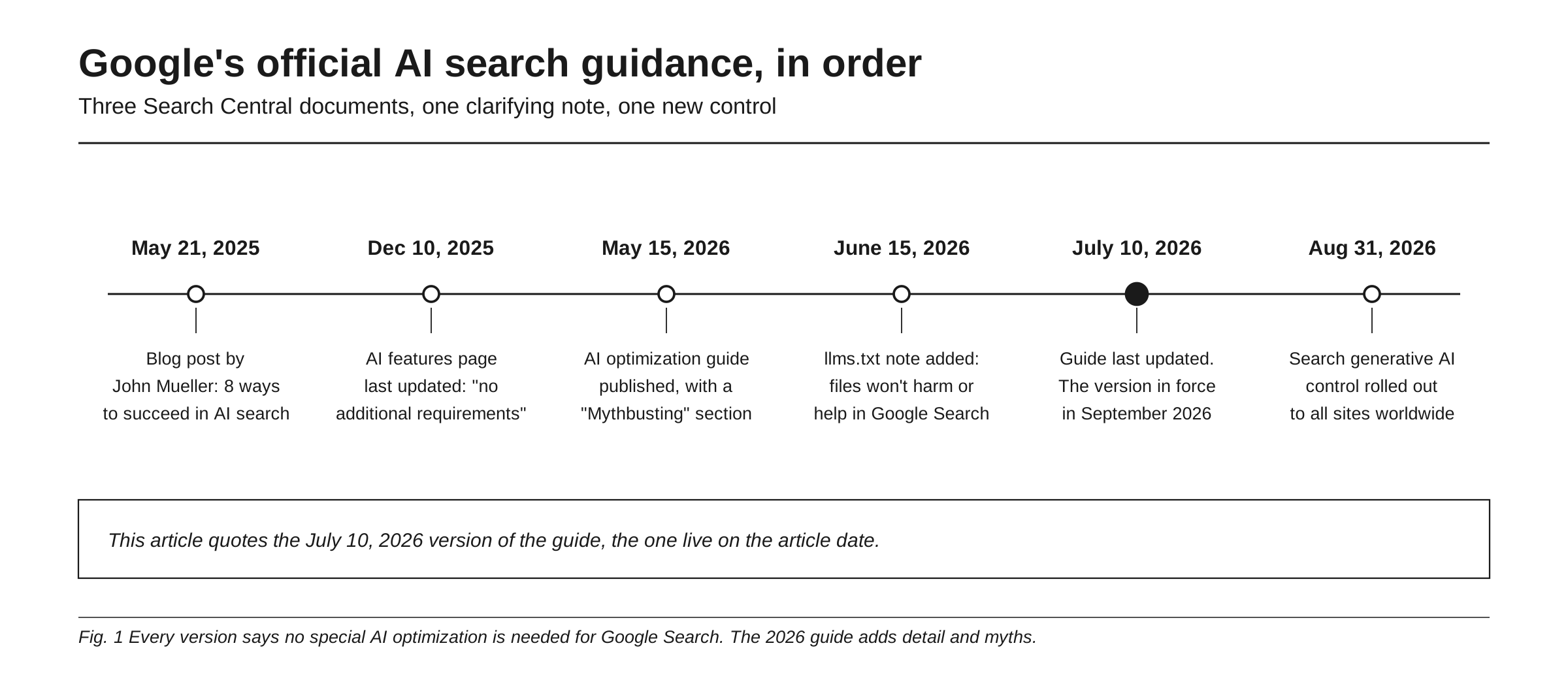
Three Google Search Central documents cover this topic.
The first is a May 21, 2025 blog post by John Mueller, “Top ways to ensure your content performs well in Google’s AI experiences on Search.” It lists eight practices and says: “Meeting the technical requirements covers you for search generally, including AI formats.”
The second is the help page “AI features and your website,” last updated December 10, 2025. Its opening is Google’s position in one line: “There are no additional requirements to appear in AI Overviews or AI Mode, nor other special optimizations necessary.”
The third, and the most detailed, is “Optimizing your website for generative AI features on Google Search,” added May 15, 2026 per Google’s documentation changelog. Google added a clarifying llms.txt note on June 15, 2026, and the page shows “Last updated 2026-07-10,” the version quoted here. The same day the guide launched, Google clarified that its spam policies apply to generative AI responses too.
What Google says you can ignore, in its own words
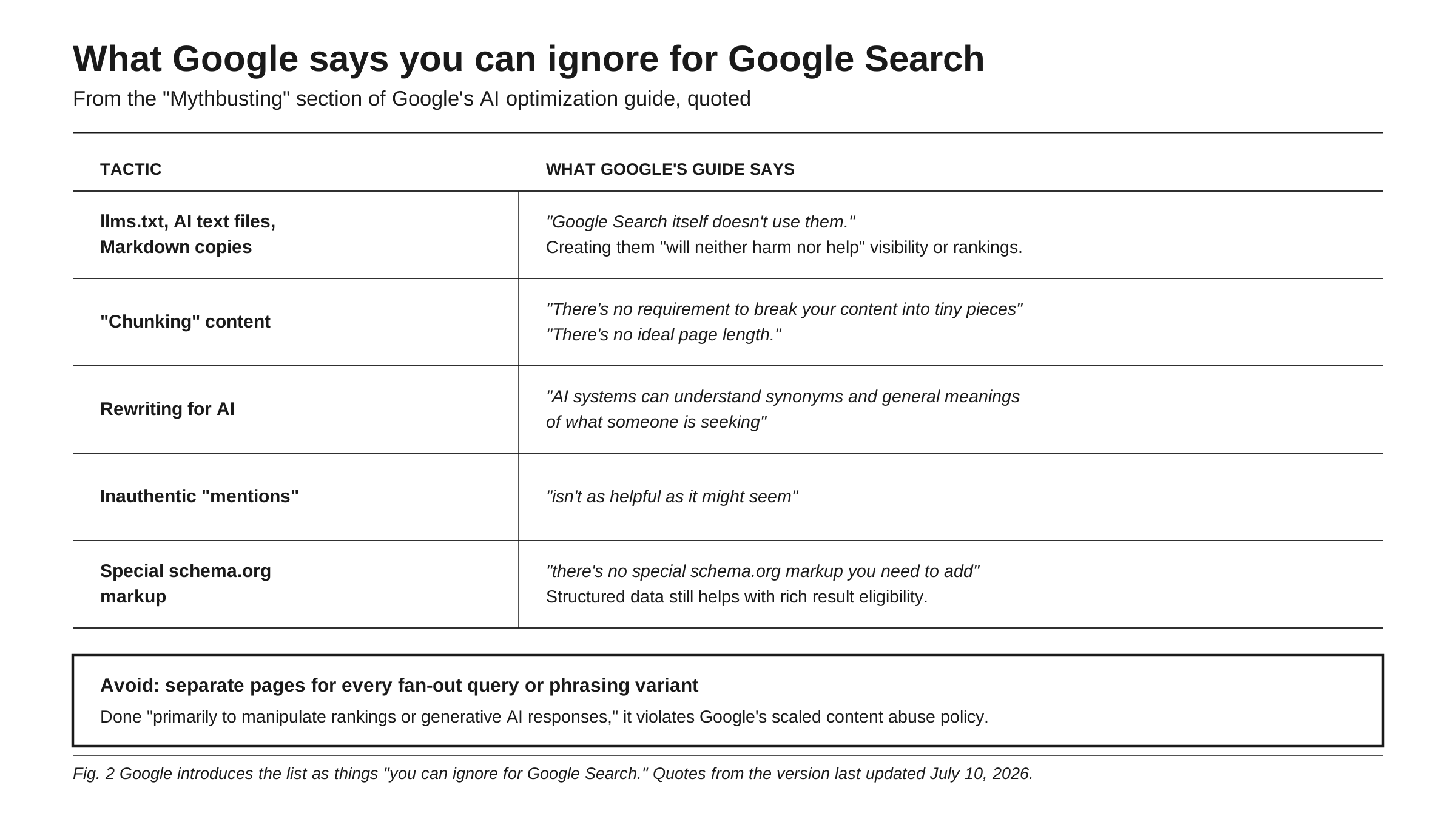
The guide has a section titled “Mythbusting generative AI search: what you don’t need to do.” It introduces the list as “a few things you can ignore for Google Search.” Here is each item, quoted.
llms.txt and other special files. “You don’t need to create new machine readable files, AI text files, markup, or Markdown to appear in Google Search (including its generative AI capabilities), as Google Search itself doesn’t use them.” The llms.txt note Google added on June 15, reworded slightly later that month per Search Engine Roundtable, now reads: “Doing so will neither harm nor help your site’s visibility or rankings in Google Search, as Google Search ignores them.” Google also points out that it may crawl and index many file types, and “this doesn’t mean that the file is treated in a special way.” A Googlebot fetch of your llms.txt is not evidence that it counts.
Chunking. “There’s no requirement to break your content into tiny pieces for AI to better understand it.” The guide adds that “There’s no ideal page length.”
Rewriting for AI. Google says “AI systems can understand synonyms and general meanings of what someone is seeking,” so you don’t have to worry about missing “long-tail” keywords or every variation of a query.
Inauthentic mentions. “Seeking inauthentic ‘mentions’ across the web isn’t as helpful as it might seem,” because Google’s systems focus on quality and block spam.
Structured data. “Structured data isn’t required for generative AI search, and there’s no special schema.org markup you need to add.” Google still recommends it “as it helps with being eligible for rich results on Google Search.” For how markup works in AI pipelines, see what structured data actually does for AI visibility.
The one thing to avoid. The sharpest line sits outside the myths list: “While it might be tempting to create separate content for every possible variation of how people might search (for example, by focusing on other queries that people have asked, or fan-out queries), doing so primarily to manipulate rankings or generative AI responses in Google Search violates Google’s scaled content abuse spam policy.” It adds that “a high quantity of pages doesn’t make a website higher quality or more relevant to users.” Fan-out is real, Google describes it as related queries the model generates, but mass-producing pages for fan-out queries to manipulate results is now explicitly named as scaled content abuse.
What Google says does matter
Google frames it this way: “From Google Search’s perspective, optimizing for generative AI search is optimizing for the search experience, and thus still SEO.” The positive list is familiar.
Eligibility. A page “must be indexed and eligible to be shown in Google Search with a snippet.” The guide adds a second condition: a site “must be included in Search generative AI features in Search Console.” That is the Search generative AI control, rolled out to all websites worldwide as of August 31, 2026, per Google’s help page. Inclusion is the default; excluding your site removes its links and content from AI Overviews, AI Mode, and generative AI features in Discover.
Fundamentals. The AI features page lists crawling allowed “in robots.txt, and by any CDN or hosting infrastructure”; content findable through internal links; a great page experience; important content in textual form; high-quality images and videos where relevant; structured data that “matches the visible text on the page”; and up-to-date Merchant Center and Business Profile information. The 2025 blog post makes the structured data rule concrete: make sure “all the content in your markup is also visible on your web page.”
Technical tolerance. “Google is able to process content within JavaScript as long as it isn’t blocked.” On semantic HTML: “focus on human readability and don’t worry about perfect code.”
Content. The longest section is about “non-commodity” content: first-hand experience and expert takes, not restated common knowledge.
Measurement. Google points to the Generative AI performance report in Search Console, which counts AI Overviews and AI Mode impressions. Our walkthrough is in how to read Search Console’s generative AI report. It also warns: “No third-party tool has access to our internal ranking or AI systems.”
What individual Googlers have said about llms.txt
The guide is the official position. Googlers have said the same, more bluntly, for over a year:
- John Mueller, Reddit, April 2025: “AFAIK none of the AI services have said they’re using LLMs.TXT,” and “To me, it’s comparable to the keywords meta tag.”
- John Mueller, Bluesky, July 2025: “using noindex for it could make sense, as sites might link to it and it could otherwise become indexed, which would be weird for users.”
- Gary Illyes, Bluesky, July 2025: “it’s very easy to draw a parallel between 1990’s keywords meta tag and this.”
- John Mueller, Bluesky, February 2026, on serving Markdown versions of pages to bots: “Converting pages to markdown is such a stupid idea.”
One complication comes from Google itself. Chrome’s Lighthouse has an llms.txt audit under “Agentic browsing” that calls the file “an emerging convention” for LLMs and AI agents, and marks a missing file Not Applicable “as providing the file is optional at the moment.” That is a Chrome agent-readiness check, not a Search ranking statement, so the two do not contradict.
Whether any engine reads the file is a data question, covered in does llms.txt work.
Google’s “you don’t need it” is scoped to Google Search
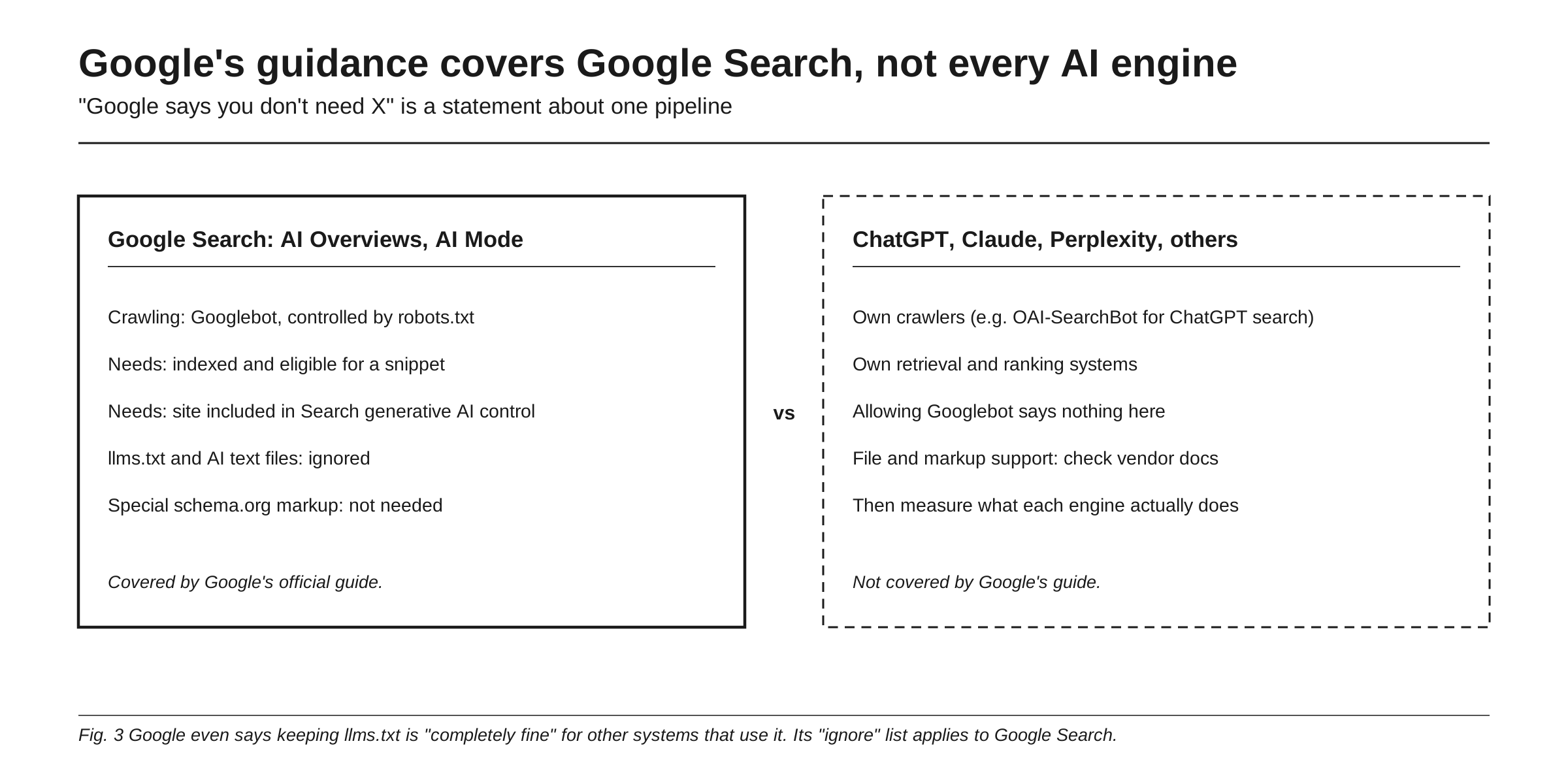
Read closely and the scope is explicit throughout: “for Google Search,” “in Google Search,” “Google Search itself doesn’t use them.” Google even acknowledges other systems: “It’s completely fine if you decide to create and maintain LLMS.txt files (or other similar files) for other services or systems that use these files.”
That matters because other answer engines are separate systems. OpenAI’s crawler documentation says ChatGPT search relies on its own bot: “Sites that are opted out of OAI-SearchBot will not be shown in ChatGPT search answers, though can still appear as navigational links.” Allowing Googlebot tells you nothing about that. In March 2025, Search Engine Roundtable reported a LinkedIn post by David Mihm saying Microsoft’s Fabrice Canel confirmed, in an SMX Munich presentation, that schema markup helps Microsoft’s LLMs understand content. That account is secondhand, but it shows a different vendor speaking for a different pipeline.
The precise reading: Google has told you what Google Search uses and ignores. It has not told you what ChatGPT, Claude, or Perplexity do. Where those engines have not documented a behavior, measure instead of assuming. Crawler access for those engines is covered in should you allow or block AI crawlers.
Stop doing, keep doing
Based strictly on Google’s guidance, for AI Overviews and AI Mode:
Stop doing:
- Stop treating llms.txt as a Google visibility project. Google Search ignores it. Keeping one for other systems is fine; consider Mueller’s noindex tip.
- Stop building Markdown or “AI-only” copies of pages for Google. Google says it does not use them.
- Stop hunting for “AI schema.” There is no special schema.org type for generative AI search.
- Stop splitting good pages into fragments for “chunking.” There is no ideal page length.
- Stop generating a page for every fan-out query or phrasing variant. If the purpose is manipulation, Google calls it scaled content abuse.
- Stop chasing inauthentic mentions. Google says its spam policies apply to generative AI responses too.
Keep doing:
- Keep pages indexable and snippet-eligible. A nosnippet or noindex directive limits or removes you from AI features too.
- Check the Search generative AI control in Search Console and confirm your site is included.
- Keep crawling open in robots.txt and at your CDN or host.
- Keep structured data accurate and matching visible content, for rich results, not as an AI trick.
- Keep important information in text, supported by good images and video.
- Keep Merchant Center feeds and Business Profile data current if you sell products or serve locations.
- Invest in non-commodity content: first-hand experience and expert opinion.
- Measure Google AI visibility in the Generative AI performance report, and measure other engines separately.
Google’s warning about third-party tools is fair, so here is where Rankry stands: it has no access to Google’s internal systems and does not claim to. It observes outputs, running a stable set of buyer-intent prompts every day across Google AI Mode and AI Overviews, ChatGPT, Claude, Gemini, Perplexity, and Grok, and recording whether each engine mentions, ranks, cites, or recommends your brand. The Google Search Console integration keeps Google’s own data alongside, and AI traffic tracking shows the visits AI platforms send to your site. Follow Google’s guide for Google, and check the other engines with evidence.
FAQ
Does Google use llms.txt for AI Overviews or AI Mode? No. Google’s AI optimization guide says Google Search “doesn’t use” new machine-readable files, AI text files, markup, or Markdown, and a June 2026 note adds that creating llms.txt will “neither harm nor help” your visibility or rankings in Google Search, “as Google Search ignores them.” Google says keeping one for other services is fine.
Do I need special schema markup to appear in AI Overviews? No. Google states “there’s no special schema.org markup you need to add” for generative AI search. It still recommends structured data as part of overall SEO because it helps with rich result eligibility, and its AI features page asks that your structured data match the visible text on the page.
Is creating pages for query fan-out queries against Google’s rules? It can be. Google’s guide says creating separate content for every variation of how people search, including fan-out queries, “primarily to manipulate rankings or generative AI responses in Google Search violates Google’s scaled content abuse spam policy.” Pages built for real readers are fine; pages mass-produced mainly to capture every phrasing for rankings are the risk.
What does Google say actually matters for AI search visibility? Standard SEO. Pages must be indexed and eligible for a snippet, and the site must be included via the Search generative AI control in Search Console. Beyond that: crawling allowed, internal links, good page experience, text content, quality images and video, accurate structured data, current Merchant Center and Business Profile data, and non-commodity content.
If Google says llms.txt is unnecessary, is it useless for ChatGPT or Claude too? Not necessarily, and Google does not claim that. Its guidance is explicitly scoped to Google Search and says maintaining llms.txt for other systems is fine. Other engines run separate crawlers and retrieval, such as OpenAI’s OAI-SearchBot for ChatGPT search. Whether a given engine uses a file is a question for that engine’s documentation and your own measurement.
Sources
- Optimizing your website for generative AI features on Google Search, Google Search Central, published May 15, 2026, last updated July 10, 2026
- AI features and your website, Google Search Central, last updated December 10, 2025
- Top ways to ensure your content performs well in Google’s AI experiences on Search, Google Search Central Blog (John Mueller), May 21, 2025
- Latest Google Search Documentation Updates (entries for May 15, 2026 and June 15, 2026), Google Search Central
- Search generative AI control, Search Console Help, Google, rolled out worldwide as of August 31, 2026
- Generative AI performance report (Search), Search Console Help, Google, 2026
- Google: LLMS.txt Files Won’t Help Or Hurt Your Search Rankings, Search Engine Roundtable, June 16, 2026 (with June 29, 2026 update)
- Google Says LLMs.Txt Comparable To Keywords Meta Tag, Search Engine Journal, April 17, 2025
- Google: It Makes Sense To Noindex LLMs.txt, Search Engine Roundtable, July 22, 2025
- Google: Easy To Draw Parallel Between Meta Keywords & LLMS.txt File, Search Engine Roundtable, August 1, 2025
- Google’s Mueller Calls Markdown-For-Bots Idea ‘A Stupid Idea’, Search Engine Journal, February 4, 2026
- llms.txt (Agentic browsing audits), Lighthouse, Chrome for Developers, last updated May 5, 2026
- Google’s llms.txt Guidance Depends On Which Product You Ask, Search Engine Journal, May 20, 2026
- Overview of OpenAI crawlers, OpenAI platform documentation (living document)
- Microsoft Confirms Schema Helps Its LLMs (Copilot) Understand Your Content, Search Engine Roundtable, March 20, 2025
See what Google’s AI features and the other answer engines actually say about your brand, measured on the same prompts every day. Start a free 7-day Rankry trial, no card required.