Google is not paying every publisher whose content its AI uses. What it confirmed in September 2026 is an early-stage “AI contribution pilot,” offered to publishers Google has approached, that pays when their content “contributes significantly” to answers in the Gemini app, AI Overviews and AI Mode, with earnings shown in Search Console. Links and citations do not qualify, and neither does content that only confirms a fact after the answer is written, so being cited is not the same as being paid. Google has not published how payouts are calculated or who qualifies. Digiday’s sources say at least dozens of publishers have been approached, that the program has appealed more to small and mid-sized publishers than large ones, and that it reaches beyond news. For brands and B2B SaaS companies, the pilot creates nothing you can bill for, but it puts a price on the sources that shape AI answers, which makes the trade press, niche publishers and your own original content more important to get right.
The headline version, “Google now pays publishers when AI uses their content,” spread fast. It is broader than what Google confirmed, and the gap matters if you are deciding where your next content and PR budget goes.
What Google actually confirmed
Digiday broke the story on September 14, 2026, citing industry sources, pilot participants and Search Console screenshots that include Google’s help text. Per Digiday, “Google confirmed the scheme is an early-stage learning pilot to test how best to reward high-quality content, on top of the traffic and tools it already provides.” The name was not new: on April 13, 2026, Search Engine Roundtable spotted links to an “AI contribution pilot” in Google’s support documentation, with no details on what it showed.
Here is what the reporting establishes, and what it does not:
- Who is in: publishers Google has approached; no public application has been reported. A publisher has to accept the program terms before the earnings panel appears. Digiday’s sources say at least dozens of publishers have been approached, the program has “widened far beyond news publishers,” and it has been more appealing to small and mid-sized publishers than to large ones. Digiday could not confirm a total.
- How money shows up: a Search Console panel shows monthly earnings with some history. Actual payments can differ from reported earnings because of tax deductions or local payment thresholds. Participants can opt out at any time from Search Console settings.
- Which surfaces: the help documentation names the Gemini app, AI Overviews and AI Mode.
- How much: undisclosed. “It’s quite black box,” one executive with knowledge of the program told Digiday, and one source said the early returns have delivered “peanuts” relative to their advertising revenue.
An earlier signal frames it. On June 18, 2026, in a public policy post that Google pointed Digiday back to, Google said it was “piloting a new way to partner with websites whose content meaningfully contributes to the freshness and factuality of generative AI responses through the process of grounding,” without naming the pilot or any payment terms. The same post says Google has “entered into deals in which we are paying for access to and delivery of diverse types of specialized, non-public content.”
Paid contribution vs citation: the line that matters
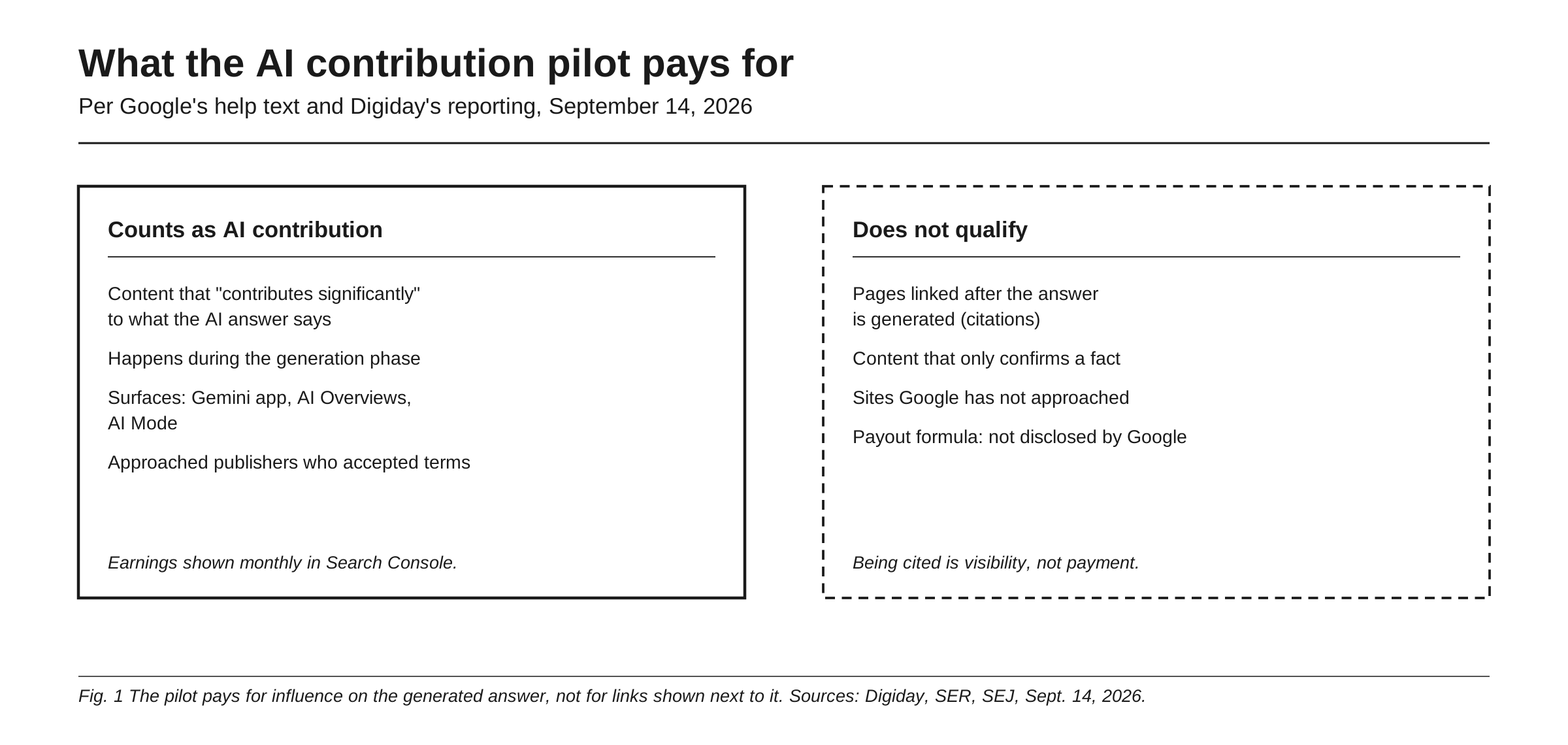
The most important sentence in the help documentation is the one about timing. It says AI contribution “focuses on the phase of generation where web content can significantly influence what response is generated.” Content that only confirms facts, or is linked after a response is generated, does not count: “those instances don’t qualify for AI contribution.”
That splits AI visibility into two different things. A citation is a link shown next to an answer. A contribution, in Google’s sense, is content that shaped what the answer said. The pilot pays for the second and explicitly not for the first. That adds a third layer to mentions and citations: influence on the generated text itself. The difference between being named and being linked is covered in brand mentions vs citations in AI.
There is also a measurement gap. Per Search Engine Journal, Search Console’s generative AI performance report counts impressions from AI Overviews and AI Mode only, while the pilot also pays for the Gemini app, and the earnings panel shows a payout but not the usage behind it. Participants cannot fully match earnings to where their content appeared.
How it compares with other AI content deals
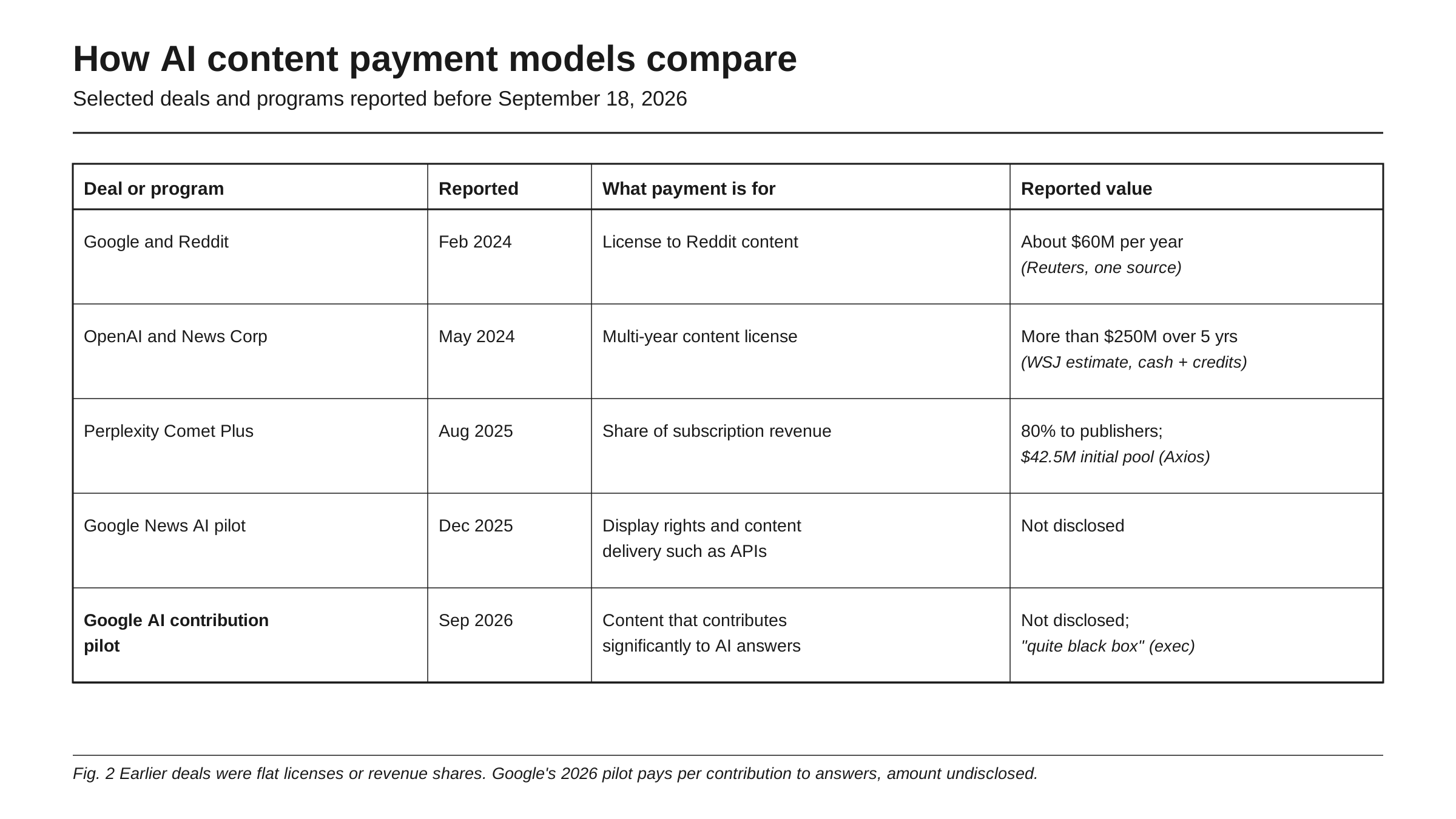
Google’s pilot is a different shape from the deals that came before it. Most earlier arrangements were flat licenses with large publishers or platforms:
- Google and Reddit (February 2024): Reuters reported a licensing deal worth about $60 million per year, citing a source.
- OpenAI and News Corp (May 2024): The Wall Street Journal estimated the multi-year deal at more than $250 million over five years, including cash and credits for OpenAI technology, as reported by Press Gazette.
- Perplexity Comet Plus (August 2025): Perplexity said publishers would get 80% of Comet Plus subscription revenue, with a $42.5 million pool set aside for early participants, per Axios.
- Google’s News AI pilot (December 2025): Google named partners including Der Spiegel, El País, The Guardian and The Washington Post, and said its commercial partnerships pay “for extended display rights and content delivery methods like APIs.” That pilot tests AI article overviews on partners’ Google News pages, plus audio briefings, not AI Overviews in Search.
The AI contribution pilot works differently: per Digiday, payments are “based more on value than raw usage,” so Google pays only when it judges a page meaningfully contributed to an AI answer, not under a flat license. Critics cited by Digiday say it looks “less like a meaningful payout and more like a legal fig leaf.” One publishing executive warned that accepting could weaken negotiating leverage, since Google could point to the pilot as payment that already exists.
Regulation is part of the backdrop. On June 3, 2026, the UK Competition and Markets Authority imposed a conduct requirement on Google search in the UK: publishers get effective tools to prevent their content being used to power AI features in search, such as AI Overviews, and to opt out of use for fine-tuning AI models. Google has nine months to implement all changes.
Does this change who gets cited?
Short answer: there is no evidence yet that it does, and Google has not said it will.
Nothing in the help text or the reporting says participation affects whether a page is selected to ground an answer. As described, the pilot pays for contribution Google measures; it does not describe a change to selection. Reading it as “pay to be cited” gets it backwards, because citations are the one thing it does not pay for.
The indirect effects are worth watching, though, and they are logical consequences rather than reported facts:
- Source mix pressure. If publishers use the opt-out controls the CMA requires in UK search to keep content out of AI features, answers in those categories will lean on whoever stays in, which may include more trade, niche and vendor sources.
- Content investment. Publishers in the pilot now see a monthly number tied to AI influence. Some will invest in the content types that earn it. That could mean more depth in the categories you sell into.
- Licensed, non-public content. Google says it already pays for specialized, non-public content. Answers that draw on licensed data may reflect sources your marketing team cannot reach through ordinary SEO.
None of this favors licensed sources by rule. It does mean the economics around the sources AI relies on are shifting, and brands should know which sources those are in their category. The way engines choose sources in the first place is covered in where AI actually gets its answers.
What it means for brands that are not publishers
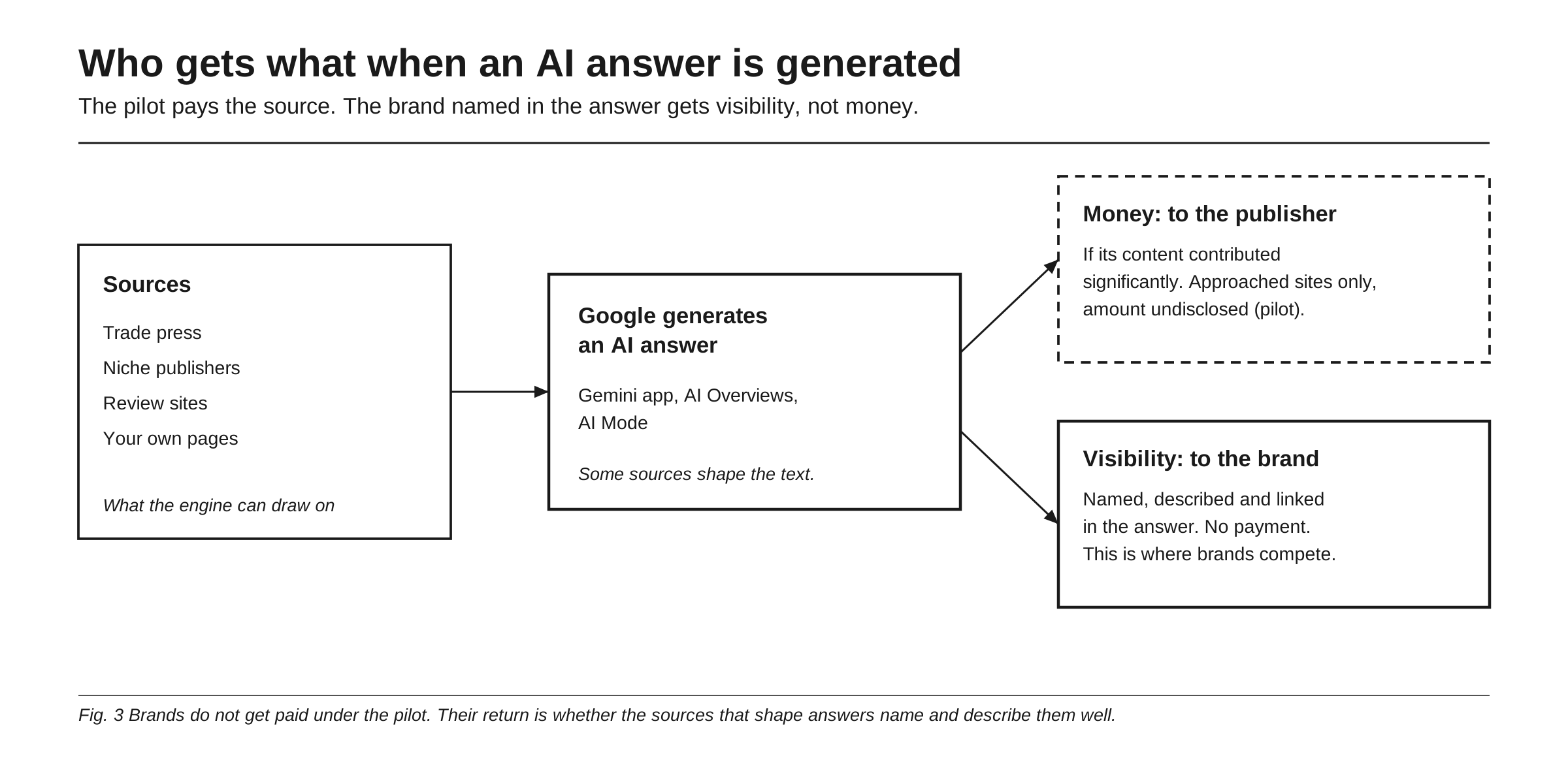
Most B2B SaaS companies will never see an AI contribution panel, and that is fine. The pilot pays the source. It does not pay the brand an answer recommends. Your return is on the visibility side: whether the answer names you, how it describes you and whether it links to you.
What changes is the value of the sources around you. If a trade publication’s buyer’s guide shapes how Gemini answers “best payroll software for a 50-person company,” that publication may get paid for it, and your brand is named or skipped based on how the guide covered you. So earned coverage in the publications AI leans on matters more, and your own pages need original, specific content that shapes an answer rather than decorating it.
One caution: the pilot reaches beyond news, but participation depends on Google approaching you, and nothing reported suggests Google is approaching vendor blogs. Do not build a plan around getting paid.
What to do now: seven moves for brands
- Map your category’s grounding sources. For your top buyer prompts, list which domains AI Overviews, AI Mode and Gemini cite. Those are the outlets most likely to be shaping answers, whether or not they are in the pilot.
- Prioritize earned coverage in those outlets. Trade press, niche review sites and analyst-style publishers that already appear in your category’s answers are worth more PR effort than broad outlets that never do.
- Give publishers material that shapes answers. Original data, clear comparisons and specific, quotable facts are what change the content of a generated answer. Brochure copy gets linked at best.
- Make your own pages contribution-grade. Product, pricing and comparison pages should state facts plainly, with numbers, so an engine can use them during generation, not only as a confirming link.
- Separate mention, citation and description. Track all three. A brand can be linked and still be described wrong, or named with no link at all.
- Watch your Search Console generative AI report. It covers AI Overviews and AI Mode, a useful first-party view, as explained in how to read Search Console’s generative AI report.
- Re-check monthly, not once. Publisher opt-outs under the CMA rules and pilot incentives can shift the source mix over months. A one-time audit will miss it.
The useful question for a brand is which sources shape the answers your buyers read, and whether those sources say the right things about you. Rankry runs a stable set of buyer-intent prompts every day across ChatGPT, Claude, Gemini, Perplexity, Grok and Google AI Mode and AI Overviews, recording whether you are mentioned, how you rank and which sources each engine cites. Its competitor comparison puts your results next to your rivals’ on the same prompts, and the Google Search Console integration puts that next to your first-party data. If the pilot or the UK opt-outs change the source mix in your category, it shows up as a shift in cited domains you can act on.
FAQ
Does Google now pay all publishers when AI uses their content? No. As of September 2026, Google is testing an “AI contribution pilot” with publishers it has approached; Digiday’s sources say at least dozens have been approached. It pays when content contributes significantly to answers in the Gemini app, AI Overviews and AI Mode. It is not open to all sites, and Google has not disclosed how payouts are calculated.
Does being cited in an AI Overview earn money under the pilot? No. Google’s help documentation says the pilot focuses on the generation phase, where content influences what the answer says. Pages that are only linked after a response is generated, or that only confirm facts, do not qualify. A citation is visibility, not a payable contribution, so brands should treat citations and payments as separate things.
Can a B2B SaaS company or brand join the AI contribution pilot? Not by applying. No public application has been reported; Google approaches publishers, and they must accept program terms in Search Console before the earnings panel appears. Reporting says it reaches beyond news publishers, but nothing suggests Google is inviting vendor sites. Brands get more value from earning coverage in the publications that already shape AI answers in their category.
Will the pilot make Google favor licensed or paying sources in AI answers? There is no evidence of that so far, and Google has not said participation affects source selection. The pilot pays after Google measures contribution. Indirect effects are possible: publishers may invest in content that earns payments, and the UK CMA has required Google to give publishers tools to opt out of AI search features, which could change which sources ground answers.
What should brands do differently because of this? Find which outlets AI engines cite for your buyer prompts, then focus PR on getting accurate, specific coverage there. Make your own product and comparison pages factual enough to shape an answer, not only confirm one. Track mentions, citations and how you are described separately, and re-check monthly, because the economics behind AI sources are shifting.
Sources
- Google Search Console Testing Paying Publishers For Use Of Content In AI: AI Contribution Pilot, Search Engine Roundtable, September 14, 2026
- Google Tests Paying Publishers For AI Answers Via Search Console, Search Engine Journal, September 14, 2026
- Google rolls out pay-per-value AI licensing program to publishers, Digiday, September 14, 2026
- Google rolls out pay-per-value AI licensing program to publishers (Digiday syndication), Editor & Publisher, September 15, 2026
- Google ‘AI contribution pilot’ tests paying websites when they’re used in AI results, 9to5Google, September 17, 2026
- Google Search Console Testing AI Contribution Report, Search Engine Roundtable, April 13, 2026
- Google’s ongoing commitment to supporting the information ecosystem, Google Public Policy, June 18, 2026
- Supporting the web with new features and partnerships, Google (The Keyword), December 10, 2025
- Google is testing AI-powered article overviews on select publications’ Google News pages, TechCrunch, December 10, 2025
- CMA secures fairer deal for publishers and improves Google search services in UK, Competition and Markets Authority (GOV.UK), June 3, 2026
- Exclusive: Reddit in AI content licensing deal with Google, sources say, Reuters (via Yahoo Tech), February 22, 2024
- News Corp says OpenAI deal marks ‘beginning of beautiful friendship’, Press Gazette, May 23, 2024
- Perplexity says it will give publishers 80% cut of new subscription product’s revenue, Axios, August 26, 2025
See which sources shape the AI answers your buyers read, and whether they name you. Start a free 7-day Rankry trial, no card required.