Google AI Overviews, Google AI Mode and ChatGPT often give similar answers to the same question while citing different pages. In an Ahrefs study of 540,000 query pairs, AI Mode and AI Overviews cited the same URLs only 13.7% of the time, even though their answers averaged 86% semantic similarity. ChatGPT sits further out: in a Writesonic study of 161,286 prompts, ChatGPT and AI Overviews had a per-prompt domain Jaccard similarity of 0.126, about 13%. Source types differ too: in OtterlyAI’s September 2026 data, Reddit and YouTube each held several percent of Google’s AI citations and well under 1% of ChatGPT’s. So one content plan cannot assume one engine. Audit cited sources per engine for your core prompts, invest first in sources shared across engines, then fill engine-specific gaps.
Most teams treat “AI search” as one channel with one source list. The overlap data says it is at least three.
Same question, different citations: what the overlap studies found
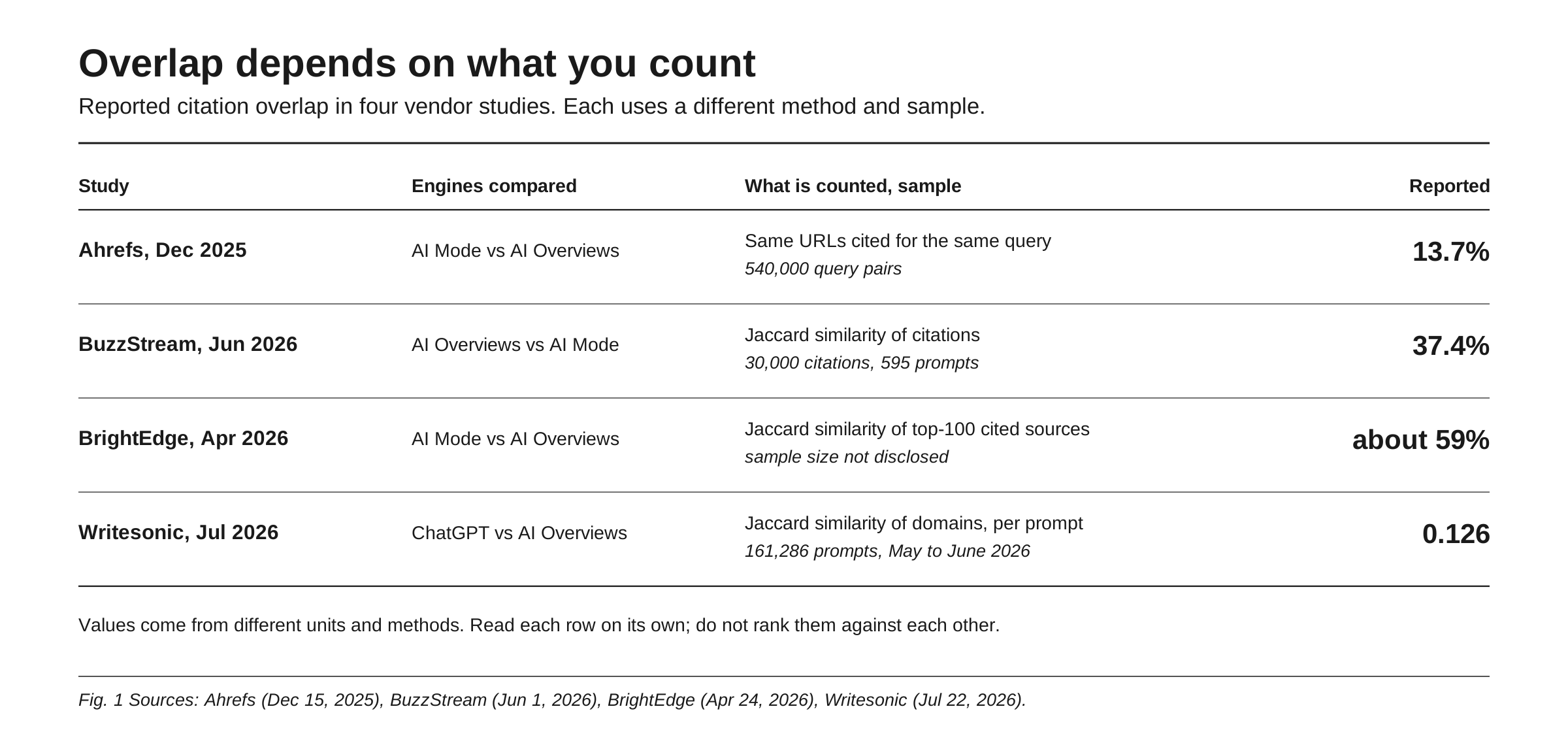
The largest comparison of Google’s two AI surfaces is an Ahrefs study published December 15, 2025. Using US data from September 2025, Ahrefs captured an AI Mode response and an AI Overview for the same queries: 540,000 query pairs for citations and 730,000 for content similarity. The two cited the same URLs 13.7% of the time, and 16.3% when only the top three citations were compared. Yet average semantic similarity was 86%. In Ahrefs’ words: “9 out of 10 times, AI Mode and AI Overview agreed on what to say.” Same answer, different credits.
Other studies report higher overlap, and they count differently.
- BuzzStream (June 1, 2026) analyzed 30,000 citations from 595 prompts across AI Mode, AI Overviews, Gemini and ChatGPT. 76.1% of citations appeared on only one platform and 0.8% on all four. The closest pair was AI Overviews and AI Mode, with a Jaccard similarity of 37.4%. No collection dates are given.
- BrightEdge (April 24, 2026) compared each engine’s top 100 cited sources across five engines, using Jaccard similarity. Pairwise overlap ranged from 16% to 59%, with AI Mode and AI Overviews highest at about 59%. BrightEdge does not disclose its sample size.
- Semrush (July 21, 2025), with 5,000 keywords and more than 150,000 citations, reported an 88% domain and 58% URL intersection between AI Mode and AI Overviews, without defining how intersection was calculated.
These vendor studies use different units: exact URLs per query, citations across a prompt set, or aggregate top-100 lists, and aggregate lists tend to look more alike than the links on one answer. In BuzzStream’s and BrightEdge’s multi-engine data, the two Google surfaces came out closest, yet never close to identical, and overlap was lowest at the level that matters for a brand: the specific page cited for a specific question.
ChatGPT is the outlier
Writesonic, BuzzStream and Semrush all place ChatGPT furthest from Google. Writesonic’s July 22, 2026 study measured per-prompt domain overlap across ChatGPT, Gemini, Perplexity and AI Overviews, using 161,286 prompts from May and June 2026. ChatGPT and AI Overviews scored a Jaccard similarity of 0.126: about 13% of the domains either engine cited were cited by both. The study’s highest pair, Perplexity and AI Overviews, reached only 0.237, and in prompts answered by all four engines, 72% to 73% of cited domains appeared on one engine only. That is domain-level matching, which Writesonic calls the lenient version, noting that exact-URL matching would score lower. AI Mode was not tested. BuzzStream is blunter: ChatGPT “barely overlaps with Google properties at all.”
Comparing citations with Google’s rankings shows why. In Semrush’s 2025 study, AI Overviews shared around 86% of domains and 67% of URLs with Google’s top 10 for the same query, AI Mode about 54% and 35%, and ChatGPT had “the weakest overlap with Google’s top 10 rankings” of the platforms tested. Ahrefs, in August 2025, found only 8.0% of ChatGPT’s in-text citations ranked in Google’s top 10 across 15,000 long-tail queries, while an earlier Ahrefs study cited in the same post found 76% of AI Overview citations came from top-10 pages. AI Overviews stay close to organic results, AI Mode partly, ChatGPT largely not.
Different engines lean on different kinds of sources
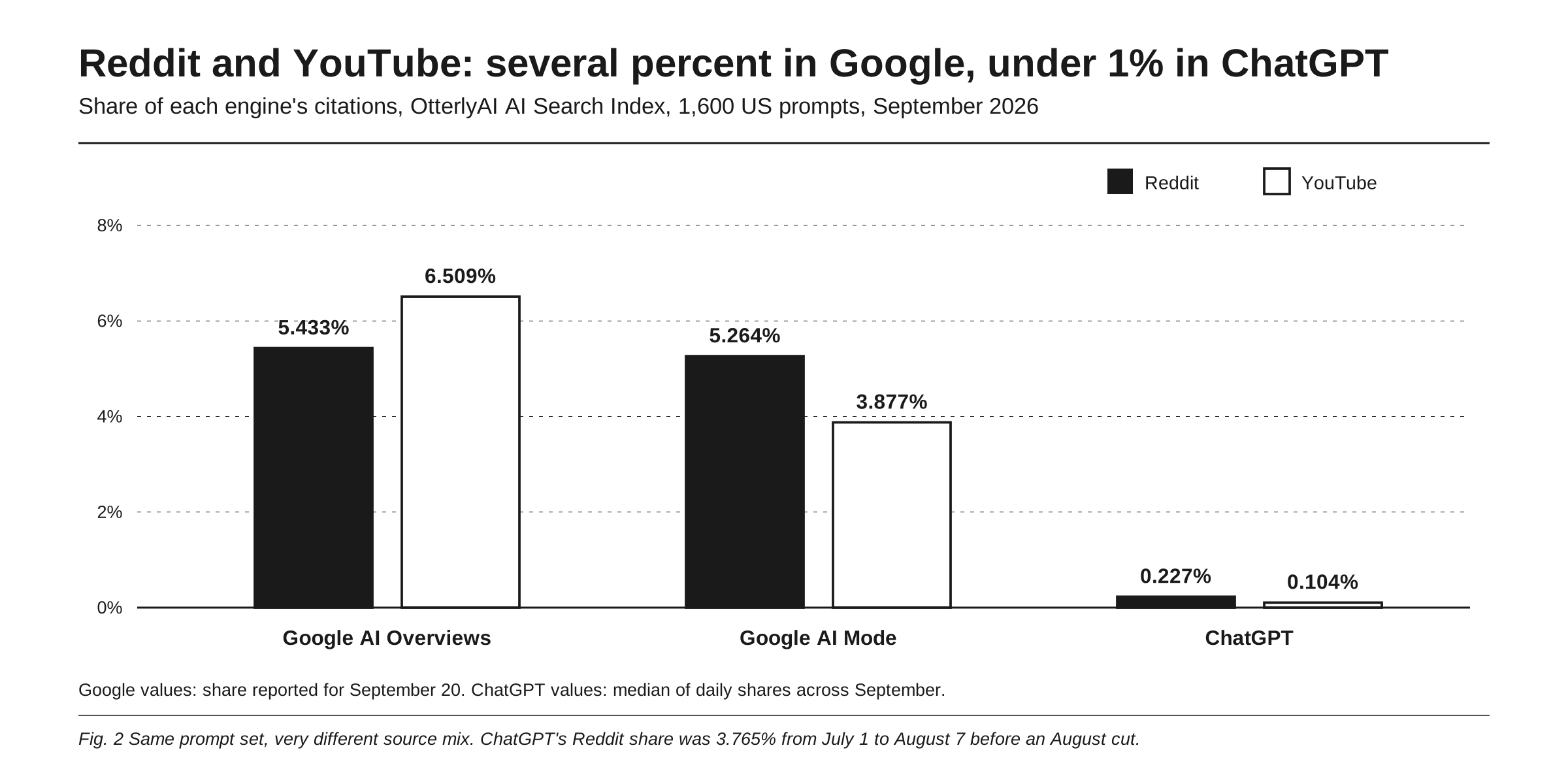
The gap is not only which pages but which kinds of sites. OtterlyAI’s September 22, 2026 update, based on 1,600 US prompts run daily across seven engines, gives per-engine shares on one prompt set:
- Reddit: 5.433% of AI Overviews and 5.264% of AI Mode citations on September 20, against 0.227% of ChatGPT citations over September.
- YouTube: 6.509% of AI Overviews and 3.877% of AI Mode citations on September 20, against 0.104% for ChatGPT over September.
These shares move. ChatGPT’s Reddit share was 3.765% from July 1 to August 7 before an August cut, covered in September’s AI citation shift, and AI Mode’s YouTube share started September at 13.521%.
BrightEdge’s April 2026 study, which sorts cited domains into source types, points the same way. User-generated content made up about 17.5% of AI Overviews citations, about 7% for AI Mode and 0.5% for ChatGPT. What BrightEdge classes as authority sources went the other way: 18% for ChatGPT, 14% for AI Mode, 9.5% for AI Overviews. Ahrefs adds that YouTube held the top position among AI Overviews citations and that Quora appeared 3.5 times more often in AI Mode.
BrightEdge also found brand overlap between engines (36% to 55%) tighter than source overlap (16% to 59%). Engines often reach similar brands through different evidence, so the sources you need differ by engine even when the recommendation looks the same.
One gap in the public data: we found no study that splits brand-owned versus third-party citations for all three engines on the same prompts. OtterlyAI puts brand-owned pages at about 58% of September citations, but only as one figure for its whole index, not per engine. Whether your own site or third parties carry your visibility in each engine is something to measure on your own prompts.
Why the engines read different sources
Google says plainly that its two surfaces differ. Its Search Central guide on AI features says both may use “query fan-out,” issuing multiple related searches across subtopics and data sources, and that “AI Mode and AI Overviews may use different models and techniques, so the set of responses and links they show will vary.” Both draw on Google’s index: a page must be indexed and snippet-eligible to appear as a supporting link. The formats differ too. Ahrefs measured AI Mode responses at about four times the length of AI Overviews, and Semrush counted about seven unique domains in an AI Mode sidebar against three for an AI Overview. A longer answer built from more searches has room for pages outside the organic top 10.
ChatGPT runs a separate pipeline. At launch on October 31, 2024, OpenAI said ChatGPT search “leverages third-party search providers, as well as content provided directly by our partners.” Peec AI reported on September 4, 2026 that a result_source field in ChatGPT’s server-side events carried four values between May 21 and July 21, 2026: Labrador, Bright, Oxylabs and SERP, with Labrador read as OpenAI’s own index. That is a vendor’s inference, not an OpenAI statement; the evidence is weighed in ChatGPT’s own search index. Either way, there is no reason to expect ChatGPT’s citations to track Google’s rankings.
Each engine also re-weights on its own schedule. In September, Reddit’s share rose in AI Overviews and AI Mode while ChatGPT’s kept sliding after its August drop. The broader mechanics are in where AI actually gets its answers.
How to plan content when each engine reads differently
-
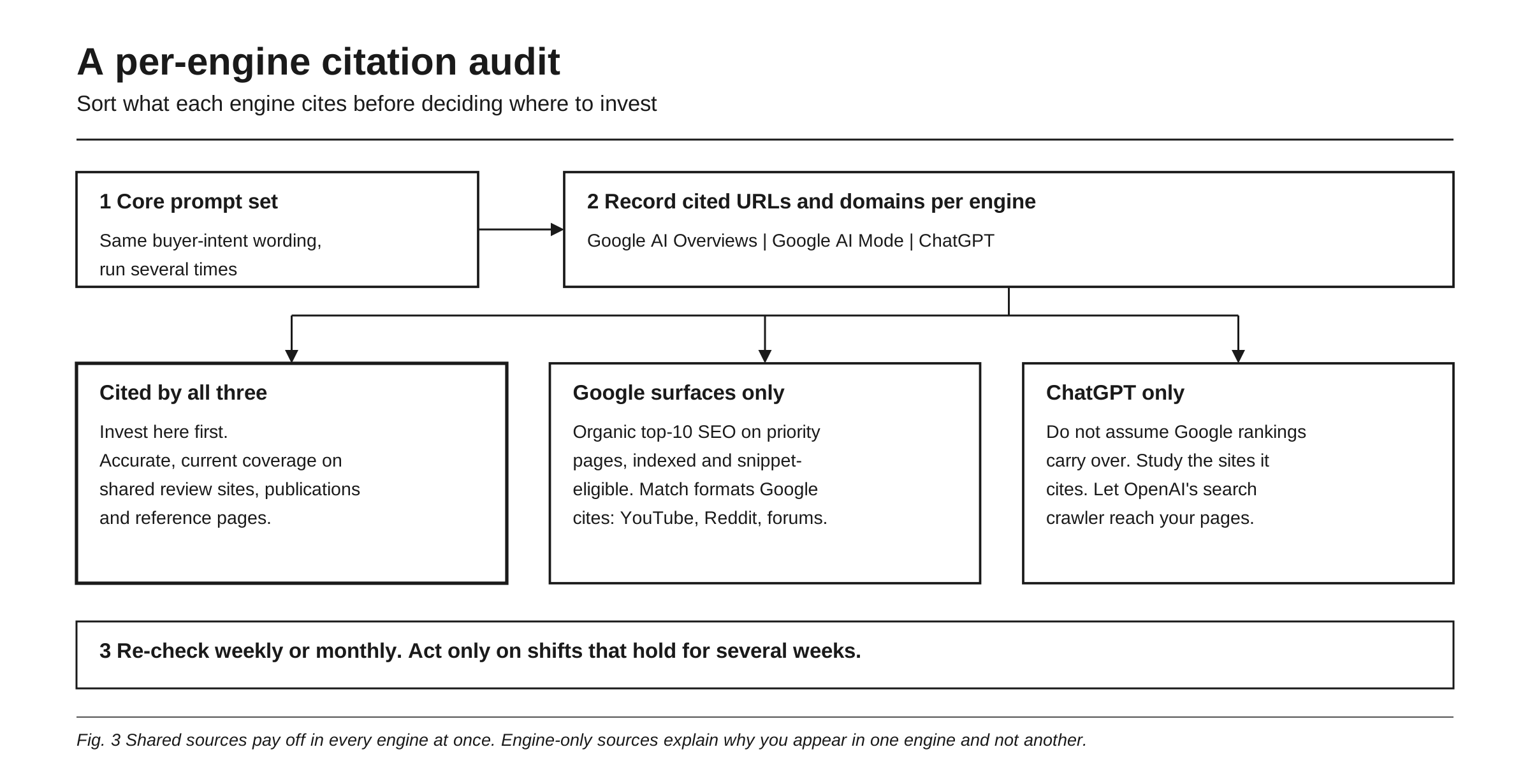
Fix a core prompt set. Pick a few dozen buyer-intent questions and use the same wording in every engine.
-
Run each prompt in each engine, more than once. Record every cited URL and domain for AI Overviews, AI Mode and ChatGPT separately. Single runs vary, so count a source when it recurs.
-
Sort cited sources into three buckets. Cited by all three engines, by Google’s surfaces only, or by ChatGPT only. Mark which mention you, which mention competitors, and which mention neither.
-
Prioritize the shared bucket. A review site, publication or reference page that all three engines cite for your category pays off everywhere at once.
-
Fill Google-specific gaps. AI Overviews stayed closest to the organic top 10 in the studies above, so SEO on priority pages still feeds it. Confirm those pages are indexed and snippet-eligible. If the Google bucket is full of YouTube videos or Reddit threads, that is the format those surfaces reward for your prompts.
-
Fill ChatGPT-specific gaps. Do not assume Google rankings carry over. Study the sites ChatGPT cites instead, which leaned toward authority sources in BrightEdge’s data, and make sure OpenAI’s search crawler can reach your pages.
-
Re-check on a schedule. Repeat the audit weekly or monthly and act only on shifts that hold for several weeks. The tracking setup is in how to track citations and sources in AI search.
Seeing the gaps per engine
Rankry runs a stable set of buyer-intent prompts every day across ChatGPT, Google AI Mode and AI Overviews, along with Claude, Gemini, Perplexity and Grok, and records how each engine mentions, ranks, cites and recommends your brand. With citations broken out by engine, a source that matters in AI Overviews but never appears in ChatGPT shows up as a gap, and competitor comparison shows which sources carry a rival where you are absent.
FAQ
Do Google AI Overviews and AI Mode cite the same sources? Less often than you might expect. Ahrefs found the two cited the same URLs 13.7% of the time across 540,000 query pairs, even though their answers averaged 86% semantic similarity. Studies that compare aggregate source lists report higher overlap, up to about 59% in BrightEdge’s data, but none of these studies finds them close to identical.
Why does ChatGPT cite different sources than Google? It retrieves through a separate pipeline. OpenAI says ChatGPT search uses third-party search providers and content from partners, and a Peec AI analysis suggests OpenAI also runs its own index. In Ahrefs’ 2025 data, only 8.0% of ChatGPT’s in-text citations ranked in Google’s top 10 for the same prompt.
Does ranking in Google’s top 10 help with AI citations? It helps most with AI Overviews. Semrush found AI Overviews shared about 86% of domains with Google’s top 10 for the same query, AI Mode about 54%, and ChatGPT the least of the platforms tested. Strong rankings feed Google’s AI surfaces, but they are a weak predictor of ChatGPT citations.
Does Reddit matter for AI visibility in every engine? No. In OtterlyAI’s September 2026 data, Reddit held about 5% of citations in both AI Overviews and AI Mode on September 20 but only 0.227% in ChatGPT, after an August drop. YouTube showed a similar gap. Treat Reddit and YouTube as Google-surface channels for now, and check your own prompts before investing.
How do I find which sources each AI engine cites for my brand? Run a fixed set of buyer-intent prompts in each engine several times, record every cited URL and domain per engine, and sort them into sources cited by all engines, by Google only, and by ChatGPT only. Prioritize the shared sources, then fill engine-specific gaps, and repeat the audit on a regular schedule.
Sources
- Are AI Mode and AI Overviews Just Different Versions of the Same Answer? (730K Responses Studied), Ahrefs, December 15, 2025
- AI Citation Overlap: Do AI Platforms Cite the Same Sites? (New Data), BuzzStream, June 1, 2026
- Why AI Engines Cite Different Sources but Recommend the Same Brands, BrightEdge, April 24, 2026
- How Google’s AI Mode Compares to Traditional Search and Other LLMs [AI Mode Study], Semrush, July 21, 2025
- Do AI Engines Cite the Same Sources? A Study of 161,286 Prompts, Writesonic, July 22, 2026
- Only 12% of AI Cited URLs Rank in Google’s Top 10 for the Original Prompt, Ahrefs, August 11, 2025
- The September Update: The Month AI Search Stopped Agreeing About Social, OtterlyAI, September 22, 2026
- AI features and your website, Google Search Central, last updated December 10, 2025
- Introducing ChatGPT search, OpenAI, October 31, 2024
- ChatGPT built its own search index, Peec AI, September 4, 2026
See which sources AI Overviews, AI Mode and ChatGPT cite for your buyer prompts, engine by engine, and where the gaps are. Start a free 7-day Rankry trial, no card required.