The evidence suggests ChatGPT now answers at least part of its searches from its own index, not from Bing alone. OpenAI has not publicly announced or documented an index, but its ChatGPT head of product testified in April 2025 that ChatGPT was years away from answering 80% of queries with its own search technology, and a September 2026 investigation by Peec AI found an internal source label, “Labrador,” in ChatGPT’s traffic next to third-party search providers. Bing still matters through Microsoft’s Web IQ, which Microsoft says ChatGPT uses, but it is now one input among several. A strong Bing ranking no longer predicts a ChatGPT citation, while access for OpenAI’s search crawler, OAI-SearchBot, has become the step you cannot skip.
Since ChatGPT search arrived, “rank in Bing” has been common advice for ChatGPT visibility, and in early 2025 the data supported it. The 2026 data does not, and the fix is mostly on your own server.
What is confirmed, and what is evidence
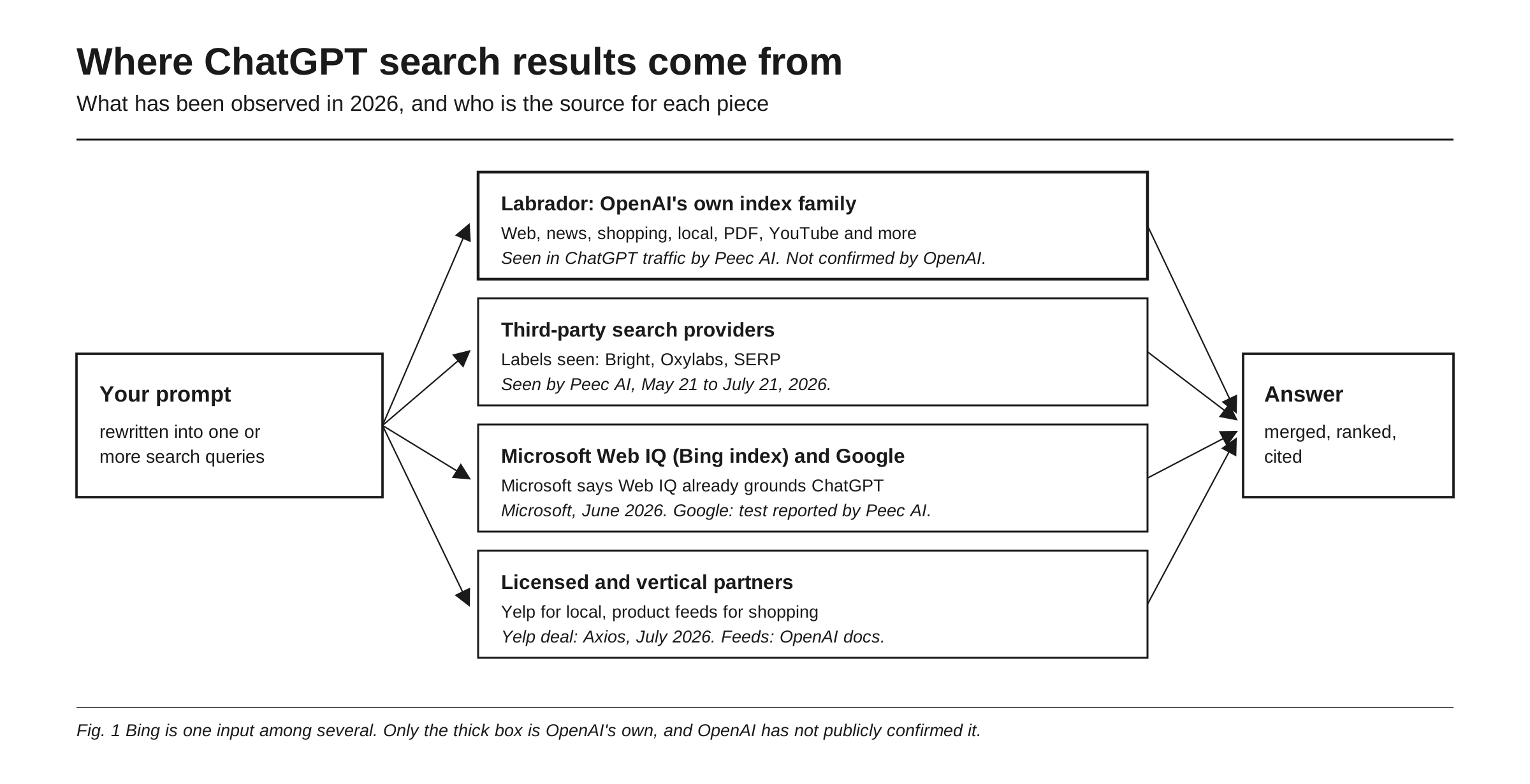
Start with what OpenAI itself has said. In Google’s antitrust trial, ChatGPT head of product Nick Turley testified that the company was still years away from using its own search technology to answer 80% of queries, and Reuters reported that ChatGPT used technology from Bing at the time. That is a stated goal, not a launched product. Peec AI, citing trial material, adds that OpenAI began building its own index in 2023. We found no OpenAI announcement since then that names an index or says how much traffic it serves.
The strongest outside evidence comes from Peec AI, a monitoring vendor, published September 4, 2026. Its researchers report that a field called result_source appeared in ChatGPT’s server-side events between May 21 and July 21, 2026, carrying four values: Labrador, Bright, Oxylabs and SERP. Peec describes Labrador as a family of vertical indexes (web, news, shopping, local, PDF, YouTube, legal, medical and more) that stores full page content, crawl date and publication date. It also reports an experiment labeled “prefer-index-over-serp-v3” affecting 8% of chats in mid-August, and a test in ChatGPT’s lockdown mode, which cannot browse live pages, that still returned the homepages of three SEO news sites, which Peec reads as a cache.
Weigh this carefully. It is inference from field names, experiment labels and job postings, by a vendor with a stake in the topic, and Peec itself says the system is being rebuilt week to week. The same report says ChatGPT still pulls from at least eight outside providers and still queries Google. Microsoft, for its part, wrote in June 2026 that “Microsoft Web IQ is already used by many leading AI assistants like Copilot and ChatGPT,” and InfoWorld describes Web IQ as building on the Bing search index. So the honest summary is: OpenAI is building its own retrieval, the evidence says it is already in use, and Bing is a supplier, not the gatekeeper.
Why Bing rank stopped being a reliable proxy
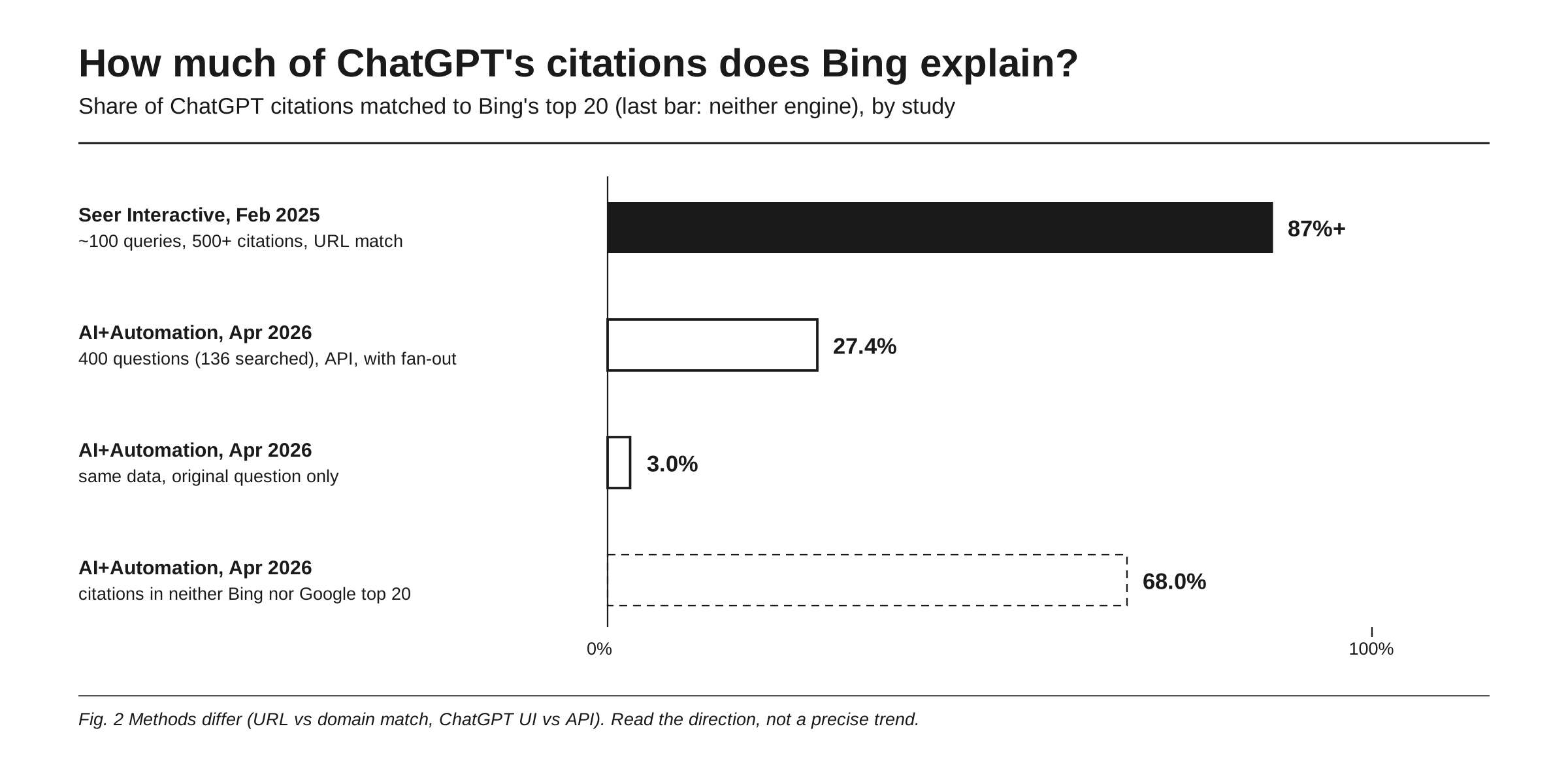
In February 2025, Seer Interactive matched ChatGPT search citations against search results for about 100 queries and 500+ citations, and found that more than 87% matched Bing’s top 20, against 56% for Google. For a small sample of mostly “best” and “top” questions, which Seer itself called directional, that was a strong signal.
A replication published by AI+Automation in April 2026 found a very different picture. It ran 400 questions through a small API model (gpt-5.4-nano) with web search; 136 of them triggered a search. Only 3.0% of citations matched a domain in Bing’s top 20 for the original question. Including the model’s sub-queries raised the match to 27.4%, and 68.0% of citations matched neither Bing’s nor Google’s top 20. The methods differ: Seer matched exact URLs from the ChatGPT interface, while AI+Automation matched domains from an API model, so this is not a clean trend line. But no reading of the newer data supports “rank in Bing and you will be cited.”
Two changes likely explain much of the gap. First, ChatGPT rewrites your prompt into its own queries, so the query you rank for is often not the query it runs. Second, it now has sources Bing never controlled. Bing visibility is still worth having, given Web IQ, but it is a contributing input, not a forecast.
The August 8 shift: how ChatGPT now chooses where to look
The clearest sign of change came in August. Promptwatch, citing its monitoring of the real ChatGPT interface (sample size not disclosed), reported that from August 8, 2026, ChatGPT started using the site: operator far more often: from about 0.37% to 16.8% of fan-out queries in a single day. Average searches per response rose from about 1.08 to 1.83. In the same window, Reddit’s share of ChatGPT Search citations fell from 3.83% (July 18 to August 7) to 0.52% (August 14 to 17); Promptwatch saw smaller, gradual Reddit declines in Google AI Overviews (11.3%) and AI Mode (30.5%). OpenAI did not respond to Gizmodo’s request for comment, so the mechanism remains Promptwatch’s hypothesis, not a confirmed cause.
Note the direction: the site: operator did not stop, it became more common. In Promptwatch’s reading, ChatGPT increasingly decides which domains to ask, then scopes searches to them. A domain-scoped search can only return what is already indexed from your site, which brings everything back to crawl access.
Verticals are also moving to dedicated sources. Axios reported on July 23, 2026 that Yelp licensed its reviews, photos and business details to OpenAI for ChatGPT answers, including local recommendations. For shopping, OpenAI publishes a product feed specification for merchants who want their products discoverable in ChatGPT. In those categories, generic web rank is only part of the picture. For how engines pick sources across categories, see where AI actually gets its answers.
What this means: OAI-SearchBot access is the new baseline
If ChatGPT relies more on its own crawl, its search crawler is the first thing to check. OpenAI’s documentation is direct: “Sites that are opted out of OAI-SearchBot will not be shown in ChatGPT search answers, though can still appear as navigational links.” It also says a robots.txt change can take about 24 hours to take effect for search, and it publishes OAI-SearchBot’s IP ranges at openai.com/searchbot.json so you can verify real visits.
Three details trip sites up. GPTBot is the training crawler and is controlled separately, so blocking it does not remove you from ChatGPT search, while blocking OAI-SearchBot does; the full split is in should you allow or block AI crawlers. ChatGPT-User fetches pages when a person asks, and OpenAI notes that “robots.txt rules may not apply” to it, so seeing ChatGPT-User in your logs does not prove you are indexed. And your CDN can override your robots.txt. From September 15, 2026, choosing Block for Training on Cloudflare stops Applebot, Bingbot and Googlebot from reaching your site, “search included”; the new Disallow AI Training option keeps search. Cloudflare says fewer than 1% of its sites block Search bots while 17% use some mechanism to block training, the group that should re-check its settings.
Freshness matters too. If Peec is right that the index stores crawl dates and publication dates, and that news is tiered by last day, last seven days and older, then stale pages and pages without clear dates start at a disadvantage. To confirm whether ChatGPT already treats you as a source, use the method in is my website a source for ChatGPT.
Checklist: getting into ChatGPT’s index
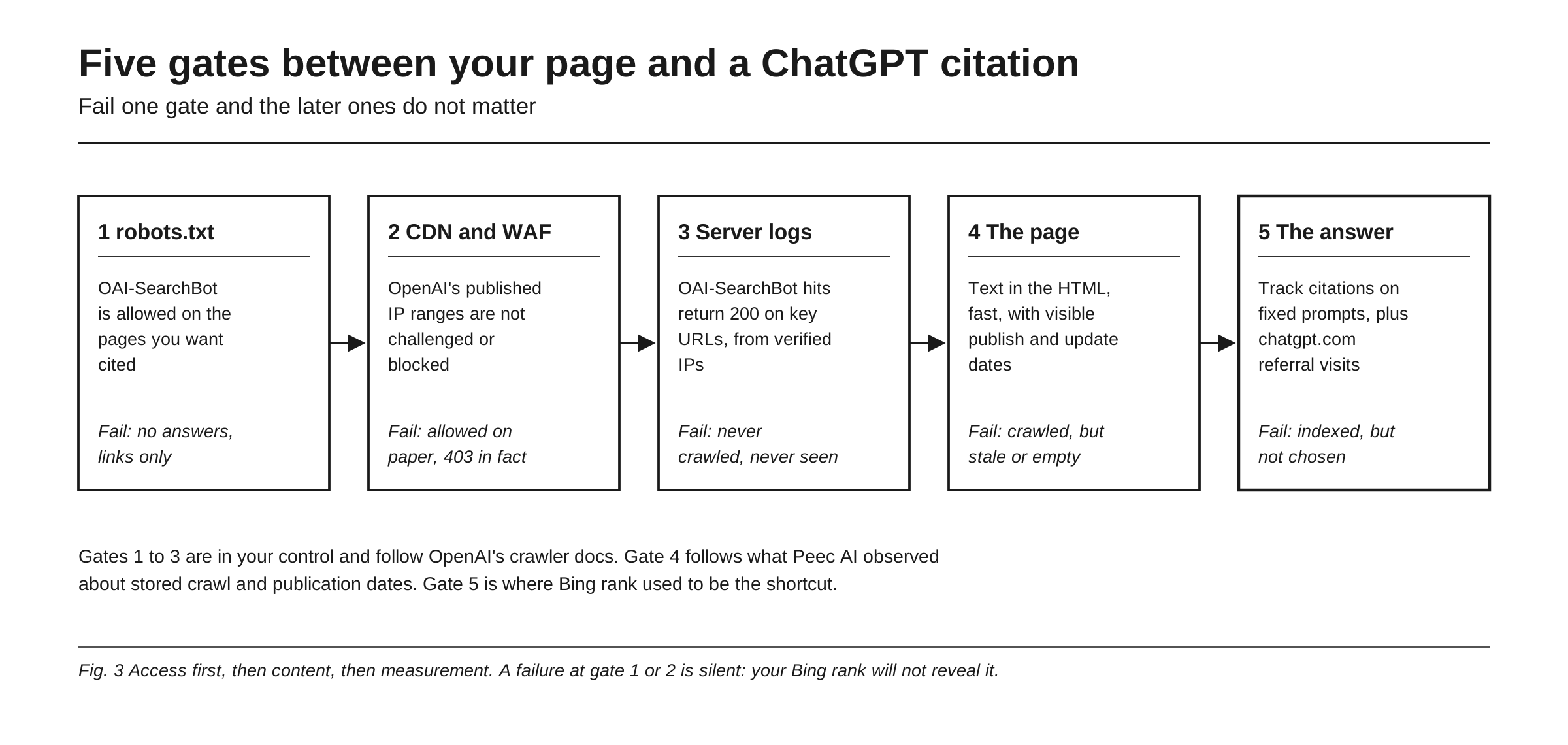
We found no URL or sitemap submission for web pages in OpenAI’s documentation; the documented path is letting OAI-SearchBot crawl you. Work through these in order:
-
Read your live robots.txt. Confirm OAI-SearchBot is not disallowed, including by a wildcard rule, on any page you want cited. Decide GPTBot separately.
-
Check the CDN and WAF, not only the file. Look for bot-fight modes, challenges, or AI-crawler toggles that return 403 or a challenge page to OpenAI’s IP ranges. On Cloudflare, review the Search, Training and Agent controls after the September 15 change.
-
Search your server logs for OAI-SearchBot. Filter by user-agent, then verify the IP against openai.com/searchbot.json. You want 200 responses on your key URLs. Zero hits on a site that has been public for months means something upstream is blocking or the bot has not found you.
-
Make the content readable without JavaScript. If key text, prices or specs appear only after client-side rendering, a crawler may store an empty page.
-
Show dates and keep them honest. Put a visible publish date and a real “last updated” date on pages that change, and update content when facts change rather than only the date.
-
Keep Bing in good order anyway. Web IQ, which builds on the Bing index, still serves ChatGPT. Do not block Bingbot by accident, and keep Bing Webmaster Tools clean.
-
Use the vertical channels. Retailers should follow OpenAI’s product feed spec; local businesses should keep Yelp listings accurate, given the licensing deal.
-
Measure the outcome directly. Track whether ChatGPT cites you on a fixed set of buyer prompts, and watch chatgpt.com referrals in analytics; many, but not all, ChatGPT links carry
utm_source=chatgpt.com. For content and authority work after access is fixed, see how to improve your visibility in ChatGPT.
How Rankry fits
When the retrieval stack changes underneath you, proxies fail first, so the only reliable signal is the answer itself. Rankry tracks whether ChatGPT and the other major assistants mention, rank and cite your brand on a stable set of buyer-intent prompts, every day, so a shift like August 8 shows up as a change in your citations rather than a mystery in your traffic. Its AI traffic tracking adds the visits ChatGPT sends to your site, so together they cover gate 5 in Fig. 3. The AI Readiness Checker runs 36 checks in 6 categories to show where a site is not yet ready for AI systems.
FAQ
Does ChatGPT still use Bing? Yes, but not only Bing. Microsoft said in June 2026 that Web IQ, its grounding service built on the Bing index, is already used by ChatGPT, and Reuters reported in 2025 that ChatGPT used Bing technology. Evidence from Peec AI suggests ChatGPT also draws on its own index, third-party search providers, Google and licensed partners, so Bing is one input among several.
Has OpenAI confirmed it has its own search index? Not as a product. OpenAI has not announced or documented an index. Its ChatGPT head of product testified in April 2025 that ChatGPT was years away from answering 80% of queries with its own search technology. The “Labrador” name comes from Peec AI’s September 2026 analysis of ChatGPT traffic, not from OpenAI. Treat the index as strongly evidenced, not officially documented, and expect details to change.
How do I check whether OAI-SearchBot crawls my site? Search your server or CDN logs for the OAI-SearchBot user-agent, then confirm the requesting IP appears in OpenAI’s published list at openai.com/searchbot.json. Look for 200 responses on the pages you want cited. Hits from ChatGPT-User only show a person asked ChatGPT to read a page; they do not prove indexing.
Can I submit my website to ChatGPT search? We found no URL or sitemap submission for web pages in OpenAI’s documentation. Its crawler docs tie inclusion in ChatGPT search answers to OAI-SearchBot access, say robots.txt changes take about 24 hours to apply, and publish the bot’s IP ranges. The one submission channel we found documented is the product feed for merchants, which is for products, not articles.
Should I stop doing Bing SEO for ChatGPT visibility? No, but stop using Bing rank as your forecast. Web IQ, which builds on the Bing index, still serves ChatGPT, so blocking Bingbot or neglecting Bing indexing can still cost you. A 2026 replication matched far fewer ChatGPT citations to Bing than a 2025 study did, though the methods differ, so measure citations in ChatGPT directly instead.
Sources
- ChatGPT built its own search index, Peec AI, September 4, 2026
- OpenAI would buy Google’s Chrome browser, executive testifies at trial (Reuters), Business Standard, April 23, 2025
- Building a new AI economy that creates value for everyone, Microsoft Advertising Blog, June 17, 2026
- 87% of SearchGPT Citations Match Bing’s Top Results, Seer Interactive, February 6, 2025
- Does ChatGPT Really Get 87% of Citations From Bing? Our 400-Query Replication Says 27%., AI+Automation, April 5, 2026
- Why Did ChatGPT Stop Citing Reddit? Inside the August 2026 Citation Collapse, Promptwatch, August 20, 2026
- OpenAI Is Backing Away From Reddit as Reddit Tries to Become OpenAI?, Gizmodo, August 18, 2026
- Exclusive: Yelp deal pushes local reviews into ChatGPT, Axios via Yahoo Finance, July 23, 2026
- Products (product feed spec), Agentic Commerce, OpenAI Developers, n.d.
- Overview of OpenAI crawlers, OpenAI, n.d.
- Have it both ways: stay discoverable in search while disallowing AI training, Cloudflare Blog, September 15, 2026
- Your AI Traffic Is Hiding: A Practical Guide to Tracking ChatGPT, Claude, and More, Seer Interactive, updated June 22, 2026
- Microsoft Web IQ: Ground your AI agents with up-to-date web data, InfoWorld, August 6, 2026
See whether ChatGPT actually cites you, and whether its users reach your site, instead of guessing from Bing rank. Start a free 7-day Rankry trial, no card required.