The best tools to monitor ChatGPT brand mentions in 2026 are Rankry, Profound, Semrush AI Visibility Toolkit, Otterly.AI, Peec AI, ZipTie, Scrunch AI, SE Ranking, AIclicks, and Evertune. Each one runs your category prompts through ChatGPT on a schedule and reports whether your brand is named, where it ranks, and which sources it cites. They differ on how many other engines they cover, how deep the analysis goes, and price.
Here is why this matters now. When a buyer asks ChatGPT for the best option in your category, it answers with a shortlist of three to five names. You are on that list or you are not, and you will not see any of it in Google Analytics. ChatGPT brand monitoring closes that blind spot, so you can catch a drop before it quietly costs you deals.
A note on scope before the list. ChatGPT is the biggest engine and the right place to start, so this guide judges tools on ChatGPT depth first. It is not the right place to stop, and the section further down on why a ChatGPT-only score is partly fiction is the reason. When you compare the tools below, treat coverage of Claude, Gemini, Perplexity, Grok, Microsoft Copilot, and Google AI Overviews as part of the price, not as an extra, because per-engine add-ons are where the headline number stops matching the invoice.
What is a ChatGPT brand monitoring tool?
A ChatGPT brand monitoring tool sends a fixed set of buyer-intent prompts to ChatGPT on a schedule, captures the full response, and analyzes whether and how your brand shows up. This is different from social listening. You are not scanning published web pages, you are interrogating the model itself, repeatedly, because its answers vary from run to run.
A good tool separates three different signals, and they are not equally valuable.
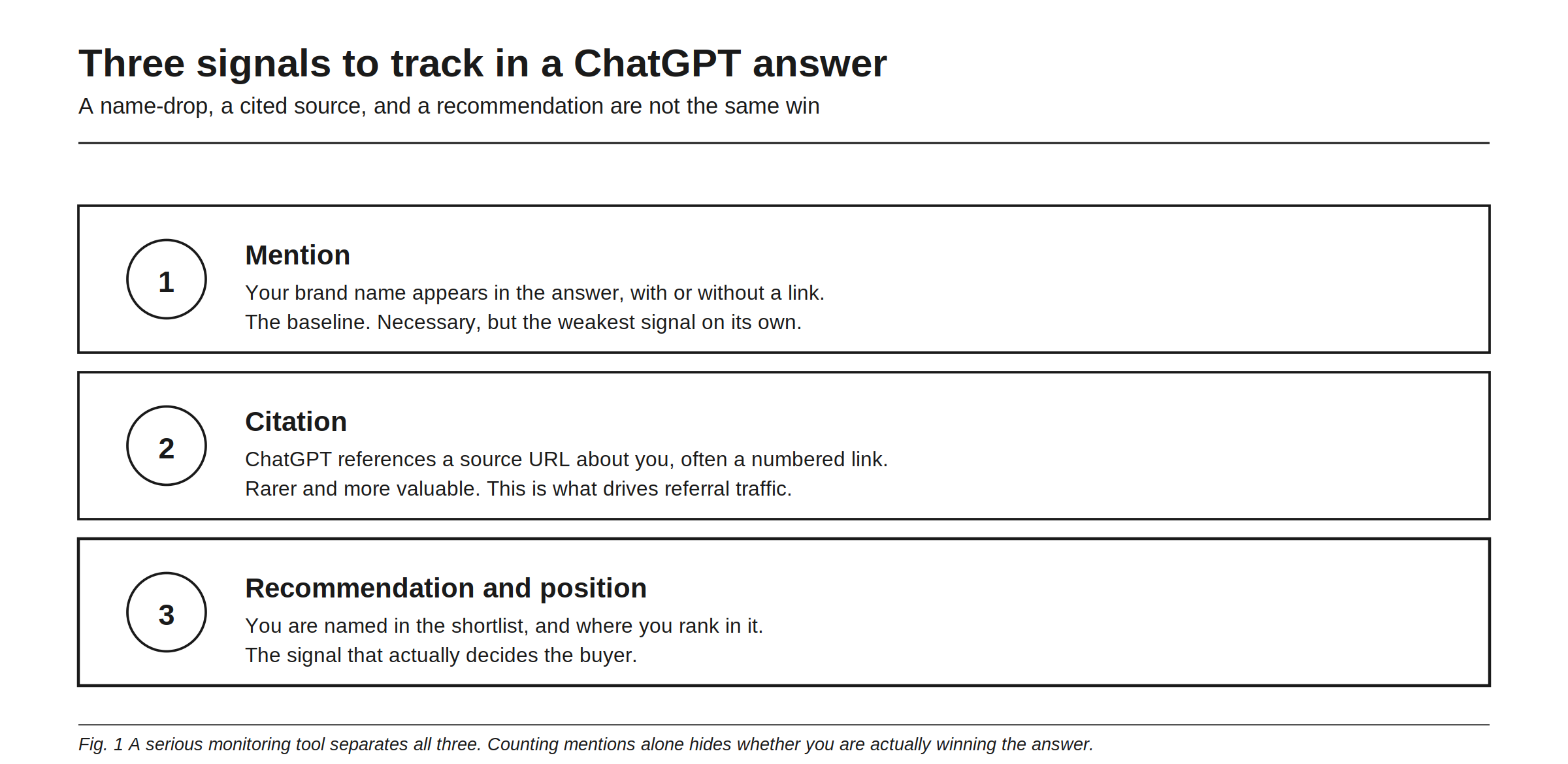
A mention is your name appearing in the answer. A citation is ChatGPT referencing a source URL about you, which is rarer and drives actual referral traffic. A recommendation is being named in the shortlist, with a position that decides the buyer. Counting mentions alone tells you almost nothing about whether you are winning.
How we ranked these tools
We weighed four things: 1) depth of ChatGPT coverage, including whether the tool uses real prompts and tracks citations, not just mentions; 2) whether it also covers the other engines buyers use; 3) whether it acts on the data or only reports it; and 4) honest pricing and fit. We ranked for capability per dollar, not company size, so the best all-round value for monitoring ChatGPT leads. Profound and Semrush are excellent and rank right behind, but they are priced and built for large enterprise teams.
The 10 best tools to monitor ChatGPT brand mentions
1. Rankry
Rankry is the best value here for monitoring ChatGPT: it tracks ChatGPT alongside the four other major engines, pairs each answer with the reasoning and an action plan, and does it from $99/mo, well below the enterprise platforms that follow. It is built for the mid-market, where teams need that depth without an enterprise contract.
Key features:
- ChatGPT, Claude, Gemini, Perplexity, Grok, Microsoft Copilot, and Google AI Overviews on every plan, so your ChatGPT score sits in full context instead of alone.
- Per-prompt, per-model tracking with brands ranked 1 to 10, the model’s own reasoning shown, and the raw answer text kept as evidence.
- Citation tracking that surfaces the third-party sources ChatGPT pulls from, with intent volume.
- A blind-test, forced-ranking methodology that resists the run-to-run noise single-prompt tools suffer from.
- A phased Action Plan and Task Planner, an AI Readiness check, and a Prompt Lab to test prompts before you commit.
The Weekly Core Report runs 50 buyer-intent prompts across your five selected engines on Base, which is 250 AI answers analyzed per cycle, scored across 23 metrics.
Pricing: Base $99/mo ($79 annual) covers 1 brand, 50 prompts, 5 competitors. Pro $249/mo ($199 annual) lifts to 100 prompts, up to 5 brands, and Full Fix with exact code. A Custom plan covers agency-scale work.
Best for: mid-market teams and agencies that want ChatGPT monitoring in full cross-engine context, with evidence and an action layer, at a self-serve price.
Pros: seven engines to pick from including Grok at every tier, reasoning and raw responses as evidence, a real action plan, the most coverage per dollar in this list, and a 7-day trial with no card. Cons: newer and smaller than the funded enterprise names, and not built for someone who only wants a single ChatGPT widget.
If you would rather do it by hand first, the free method is in how to track brand mentions in ChatGPT. See how engine selection works on the features overview.
2. Profound
Profound is the enterprise leader for AI answer monitoring, and ChatGPT is central to its data. It uses real user-prompt data rather than synthetic queries, which makes its ChatGPT picture unusually close to what buyers actually see. For a large brand with budget and an analyst, it is the most powerful option here, at a price to match.
Key features: real-prompt ChatGPT tracking, citation and source analysis, ChatGPT Shopping visibility, competitive benchmarking, and the broadest engine coverage in the category on its top tier.
Pricing: Starter around $99/mo (ChatGPT only), Growth around $399/mo (three engines, 100-prompt cap), Enterprise custom in the mid four figures.
Best for: large brands with a dedicated analyst.
Pros: the cleanest enterprise data layer, strong source intelligence, board-ready reporting. Cons: full coverage and self-serve are gated, the entry tiers cost more for fewer engines than mid-market tools, and the dashboard can overwhelm a small team.
3. Semrush AI Visibility Toolkit
Semrush brings ChatGPT monitoring into the SEO platform millions of marketers already pay for, backed by one of the largest prompt databases in the category.
Key features: ChatGPT brand mention and share-of-voice tracking, a very large prompt database, and unified reporting next to your existing keyword and competitive data.
Pricing: around $99/mo as an add-on, or bundled into Semrush plans from roughly $199/mo. 7-day trial available.
Best for: teams already standardized on Semrush.
Pros: no new vendor, huge prompt database, familiar interface. Cons: coverage centers on ChatGPT and Google AI surfaces, with Perplexity and Claude not tracked yet, so it is a partial multi-engine view.
4. Otterly.AI
Otterly.AI is the most popular dedicated AI-mention monitor, used by a large base of marketers and built for fast, lightweight ChatGPT tracking.
Key features: ChatGPT brand mention, citation, and visibility tracking, plus Perplexity, Google AI Overviews, AI Mode, and Gemini, a GEO audit that explains why you rank, and unlimited seats even on lower tiers.
Pricing: Lite from around $29/mo, scaling by prompt volume.
Best for: small and mid teams that want a clean, affordable read on ChatGPT visibility.
Pros: low entry price, very easy setup, strong satisfaction scores. Cons: it is a monitoring layer, so it reports the score and leaves the fixing to you.
5. Peec AI
Peec AI is a fast-growing mid-market platform that runs daily tracking across six engines, popular with agencies.
Key features: daily ChatGPT monitoring, six-model coverage, 300-plus prompts a day, unlimited seats, competitor comparisons, and an Actions module.
Pricing: from around 89 euro a month, scaling with prompt volume.
Best for: agencies and growth teams that want fresh daily data and per-client structure.
Pros: daily refresh, broad coverage, strong agency infrastructure. Cons: cost rises quickly as prompt volume grows.
6. ZipTie
ZipTie, from the team behind agency Onely, captures what users actually see in ChatGPT at the browser level, and is strong on Google AI Overviews.
Key features: browser-level ChatGPT and Perplexity monitoring with full answer text and screenshots, a Citation Share metric, and best-in-class AI Overview detection.
Pricing: from around $69/mo on a credit model.
Best for: SEO teams who want to audit exactly what appears in ChatGPT and AI Overviews.
Pros: real-browser accuracy, practitioner trust, concrete guidance. Cons: it covers ChatGPT, Perplexity, and AI Overviews, and does not track Gemini, Copilot, or AI Mode, so it is a partial view on its own.
7. Scrunch AI
Scrunch AI is an enterprise-leaning platform that covers seven engines and pairs monitoring with an execution layer.
Key features: broad multi-engine ChatGPT monitoring, competitor analysis, and optimization workflows for teams that intend to act.
Pricing: from around $250/mo, scaling to custom enterprise plans.
Best for: larger teams and agencies that want monitoring plus a path to execution.
Pros: wide coverage, action-oriented, built for scale. Cons: entry price sits well above the mid-market tools.
8. SE Ranking AI Tracker
SE Ranking layers ChatGPT monitoring onto a well-known SEO suite, so you get AI visibility next to classic rank tracking.
Key features: ChatGPT, Perplexity, and Claude tracking among around five engines, layered on keyword and site-audit tools you may already use.
Pricing: plans from around $65/mo, with AI tracking as an add-on.
Best for: existing SE Ranking users adding AI visibility.
Pros: easy to adopt if you already use it, bundled with SEO data. Cons: AI tracking is an extension, so it is less specialized than purpose-built platforms.
9. AIclicks
AIclicks is a dedicated ChatGPT rank tracker focused on prompt-level visibility and clustering.
Key features: prompt-level ChatGPT tracking showing which prompts trigger mentions and citations, competitor benchmarking, source analysis, and content gap detection, with coverage extending to Perplexity, Gemini, AI Overviews, and Claude.
Pricing: check the vendor for current tiers.
Best for: teams that want granular, prompt-by-prompt ChatGPT rank tracking.
Pros: prompt-level depth, citation source analysis, content guidance. Cons: newer and less established than the leaders, confirm current pricing before you commit.
10. Evertune
Evertune takes a statistical approach, querying models thousands of times across prompt variations to measure how often each brand is recommended.
Key features: high-volume sampling for statistically stable recommendation data, and broad coverage across ChatGPT, Gemini, Claude, Perplexity, and more.
Pricing: enterprise, arranged through sales.
Best for: brands that want recommendation-frequency data built on patterns rather than single snapshots.
Pros: rigorous sampling, broad model coverage, resistant to run-to-run noise. Cons: enterprise posture and custom pricing make it a poor fit for a small team starting out.
Comparison table
| Tool | ChatGPT depth | Other engines | Mentions + citations | Action plan | Entry price* | Free trial |
|---|---|---|---|---|---|---|
| Rankry | Per-prompt + reasoning | 5 incl. Grok | Yes, with raw evidence | Yes, phased | $99 ($79 annual) | 7 days, no card |
| Profound | Real-prompt data | Up to 10 (Enterprise) | Yes | Partial (agents) | ~$99 (ChatGPT only) | No |
| Semrush AI Toolkit | Large prompt DB | Google AI surfaces | Partial | No | ~$99 add-on | 7 days |
| Otterly.AI | Mentions + citations | 5 (Perplexity, AIO, Gemini) | Yes | No | ~$29 | Yes |
| Peec AI | Daily tracking | 6 | Yes | Yes (Actions) | ~EUR 89 | Yes |
| ZipTie | Browser-level | 3 (Perplexity, AIO) | Yes | Content guidance | ~$69 | Yes |
| Scrunch AI | Multi-engine | 7 | Yes | Yes | ~$250 | Varies |
| SE Ranking | Add-on tracker | ~5 (Perplexity, Claude) | Partial | No | ~$65 | Yes |
| AIclicks | Prompt-level | Multi | Yes | Content gaps | Check vendor | Varies |
| Evertune | Statistical sampling | Multi | Yes | No | Custom | Varies |
*Public prices as of June 2026, they change often. Confirm on each vendor’s site.
Why monitoring only ChatGPT is not enough
ChatGPT is the biggest engine, so it is the right place to start. It is the wrong place to stop. The same question returns a different shortlist on each engine, so you can win in ChatGPT and be completely absent from Gemini, Grok, Copilot, or Google AI Overviews at the same moment.
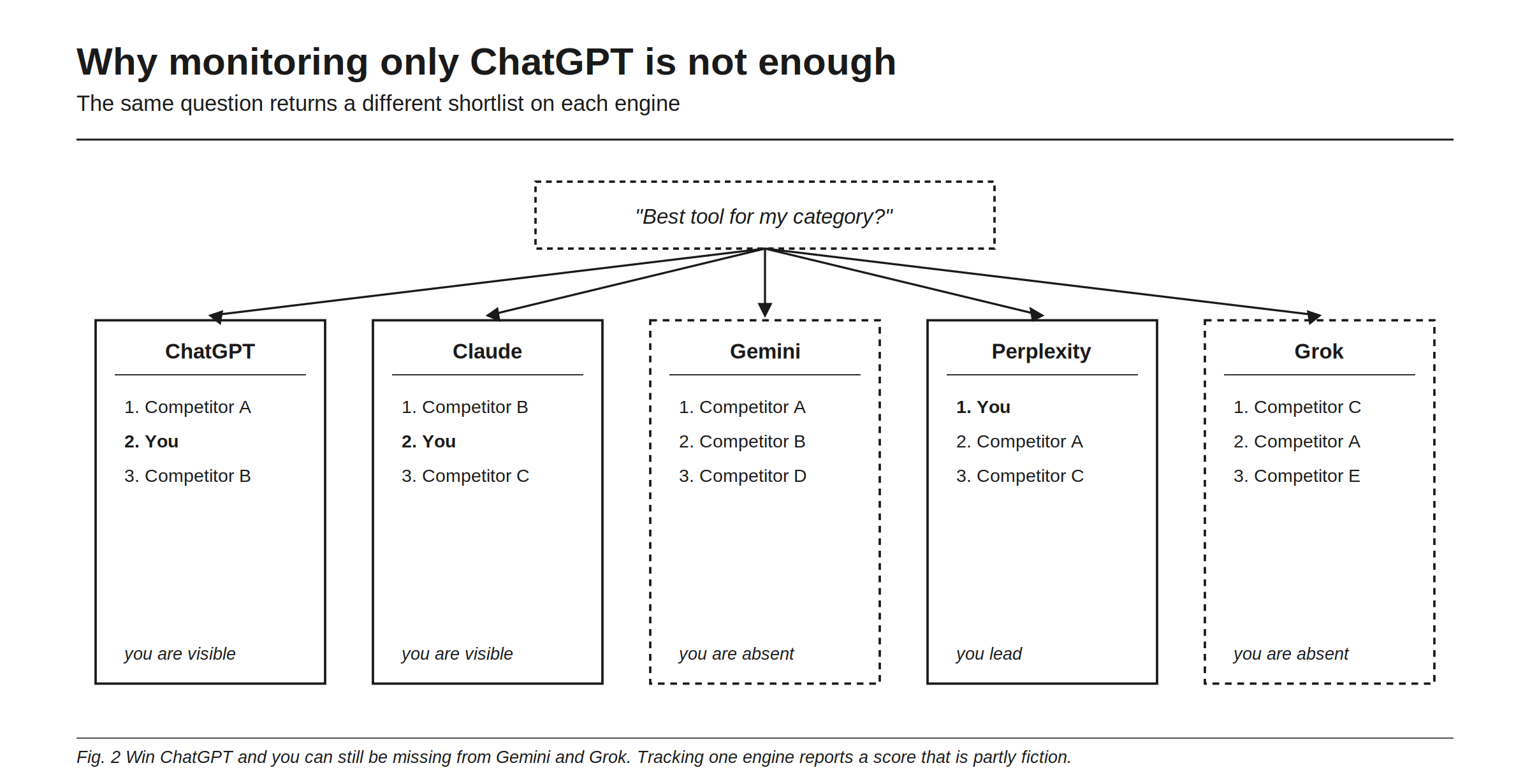
A tool that tracks ChatGPT alone reports a score that is partly fiction, because it cannot see the answers where your buyers are quietly choosing a competitor. That is the practical reason coverage matters: a ChatGPT score is only trustworthy when you can see it next to Claude, Gemini, Perplexity, Grok, Microsoft Copilot, and Google AI Overviews. We go deeper on that engine-by-engine disagreement in why AI engines disagree, and cover the wider category in our guide to the best AI visibility tools.
How do these tools track ChatGPT mentions?
They run your prompts against ChatGPT on a schedule, from neutral accounts to avoid personalization bias, and store each response. A parser then reads every answer for three things: whether you are mentioned, where you rank, and which sources are cited. Because ChatGPT’s answers vary between runs, reliable tools sample repeatedly rather than checking once, then track the trend over time.
How to choose a ChatGPT monitoring tool
Run any tool through five questions: 1) Does it track citations and position, not only mentions? 2) Does it cover the other engines your buyers use, or only ChatGPT? 3) Does it sample repeatedly to handle answer variance? 4) Does it tell you what to fix, or stop at a dashboard? 5) Is the price visible without a sales call? The weak tools fail two or three of these. Add a sixth question when you are comparing two shortlists side by side: ask what each tool’s percentage is a percentage of, because two tools never show the same number for the same brand in the same week.
FAQ
What is the best tool to monitor ChatGPT brand mentions? Rankry is the best value for most teams: ChatGPT tracked in full cross-engine context, with reasoning and an action plan, from $99/mo. Profound leads for large enterprises on real-prompt ChatGPT data. For cheap, lightweight monitoring, Otterly.AI starts around $29/mo.
What is the difference between a mention and a citation in ChatGPT? A mention is your brand name appearing in the answer. A citation is ChatGPT referencing a specific source URL about you. Citations are rarer and more valuable because they drive measurable referral traffic. Track both.
Can I track ChatGPT brand mentions for free? Some tools offer free tiers or trials with limited prompts and engines, enough to baseline your visibility. For ongoing tracking across the engines you select, Rankry offers a 7-day trial with no card, then plans from $99/mo.
How often should I check my ChatGPT mentions? Weekly is enough for most brands, because answers shift gradually. High-competition categories or active optimization campaigns benefit from daily checks on their highest-priority prompts.
Do I need to monitor engines other than ChatGPT? Yes. The same question returns different results on ChatGPT, Claude, Gemini, Perplexity, Grok, Microsoft Copilot, and Google AI Overviews, so tracking only ChatGPT leaves large blind spots. Choose a tool whose coverage matches the engines your buyers actually use.
See where your brand stands in ChatGPT and the four other major engines. Start a free 7-day trial of Rankry, no card, first report in two minutes.