To track brand mentions in ChatGPT, run your real buyer questions through clean, logged-out ChatGPT sessions several times each and record four things: whether you were mentioned, in what position, how you were described, and which competitor was recommended instead. Sample each prompt repeatedly, because ChatGPT’s answers vary between runs, and do it weekly so you see the trend. You can track it for free by hand, or automate it, along with the other engines your buyers use, with a tool like Rankry from $99 a month. But before you track anything, get one distinction right: a mention is not a recommendation, and confusing them is why most “AI visibility wins” never move sales.
ChatGPT is where the largest share of AI recommendation traffic happens, so it is the right engine to track first. Here is how to do it properly, and what to measure once you do.
Which engines this applies to. The method below is written for ChatGPT because that is where most teams start, and every step transfers: clean sessions, repeated sampling, and the four things to record work the same way on Claude, Gemini, Perplexity, Grok, Microsoft Copilot, and Google AI Overviews. One step does not transfer cleanly. Asking the engine why it chose the winner works well on ChatGPT, Claude, and Perplexity, while Google AI Overviews gives you no conversation to interrogate, so there you read the cited pages instead. Track the engines your buyers actually use rather than all of them for completeness.
A mention is not a recommendation
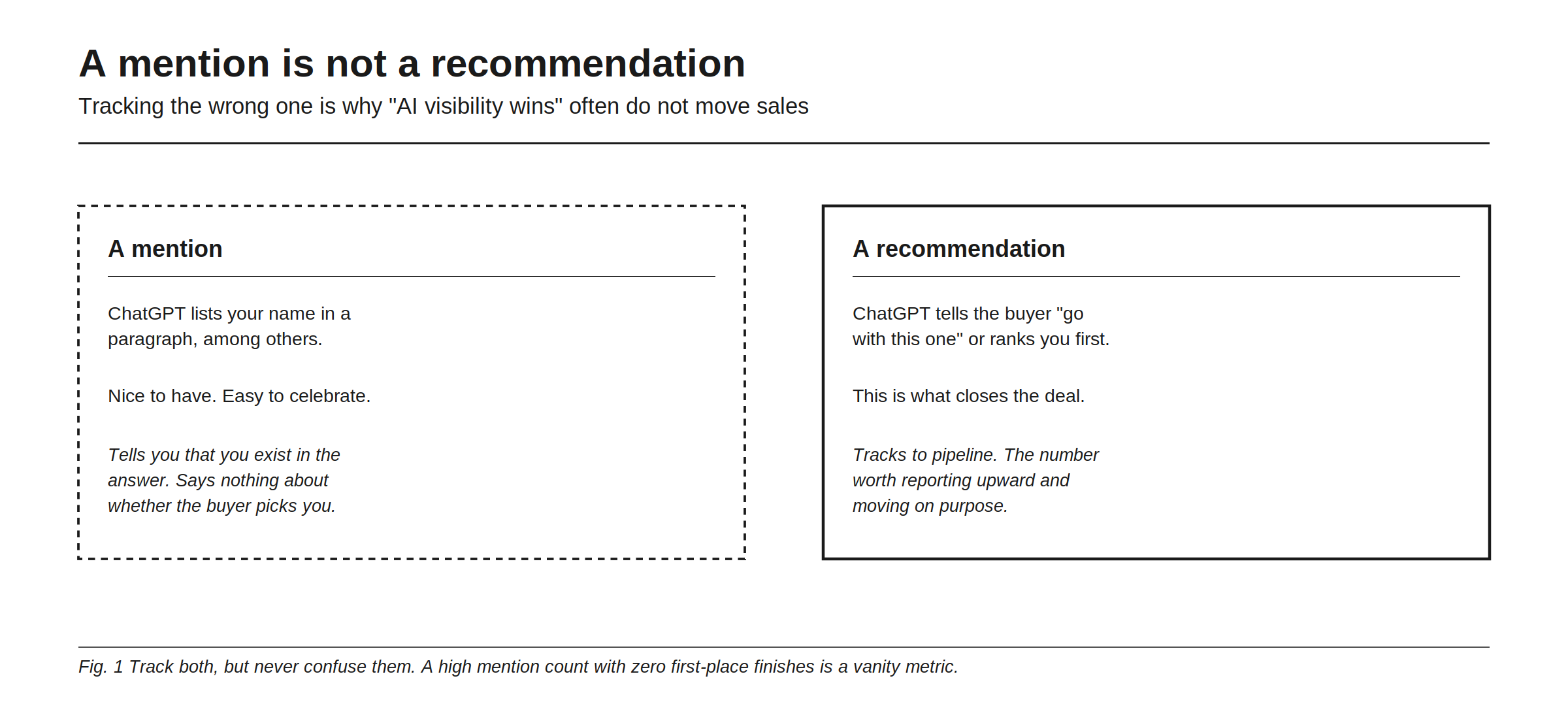
This is the distinction that decides whether your tracking is useful. A mention is ChatGPT listing your name in a paragraph among others: nice to have, easy to celebrate, and it tells you that you exist in the answer, but it says nothing about whether the buyer picks you. A recommendation is ChatGPT telling the buyer “go with this one” or ranking you first: this is what closes the deal, it tracks to pipeline, and it is the number worth reporting upward and moving on purpose.
Track both, but never confuse them. A brand celebrating a high mention count with zero first-place finishes is celebrating a vanity metric. The gap between the two is usually third-party proof, reviews, comparisons, and community threads, because ChatGPT mentions you from your own site but recommends you based on what others say. The mechanics of that are in how to track citations and sources in AI search.
How to track brand mentions in ChatGPT, free
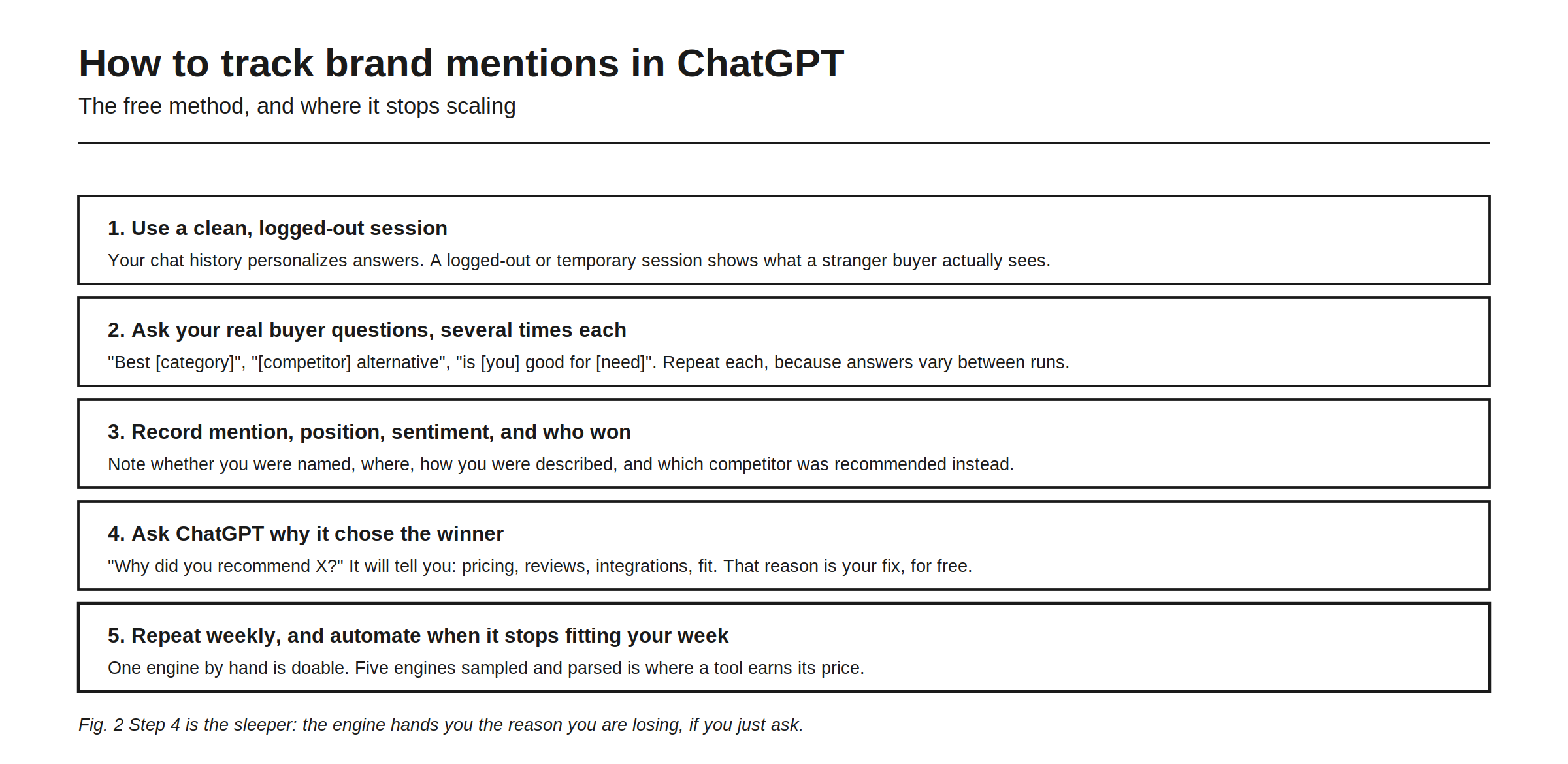
Five steps, no tool required. First, use a clean, logged-out session, because your chat history personalizes answers and a logged-out or temporary session shows what a stranger buyer actually sees. That session is itself a configuration choice, and which ChatGPT you are actually tracking covers the rest of them. Second, ask your real buyer questions several times each, “best [category]”, “[competitor] alternative”, “is [you] good for [need]”, repeating each because answers vary between runs. Third, record mention, position, sentiment, and who won: whether you were named, where, how you were described, and which competitor was recommended instead. Fourth, and this is the step most people skip, ask ChatGPT why it chose the winner: “why did you recommend X?” It will tell you, pricing, reviews, integrations, fit, and that reason is your fix, handed to you for free. Fifth, repeat weekly, and automate when it stops fitting your week.
Step four is the sleeper. The engine will explain exactly why you are losing a prompt if you simply ask, which turns tracking from a scoreboard into a to-do list.
What to measure, and what to ignore
Measure mention rate (share of runs where you appear), recommendation rate (share where you are named first or told to pick), the competitors named with you, and the sources cited. Ignore any single run in isolation, because one ChatGPT answer is a coin toss, not a measurement; only the pattern across repeated samples is trustworthy. And ignore raw mention counts divorced from recommendation rate, since being mentioned a lot while never being the pick is the classic vanity trap this whole guide is built to help you avoid. For the position-focused version of this tracking, see how a ChatGPT rank tracker works.
When to move from manual to a tool
The free method genuinely works for ChatGPT alone with a handful of prompts. It breaks in three predictable places: when you need the other engines too (buyers do not all use ChatGPT), when the sampling to beat variance eats more time than you have, and when parsing cited sources by hand is why you skip a week. That is the line where a tool pays for itself.
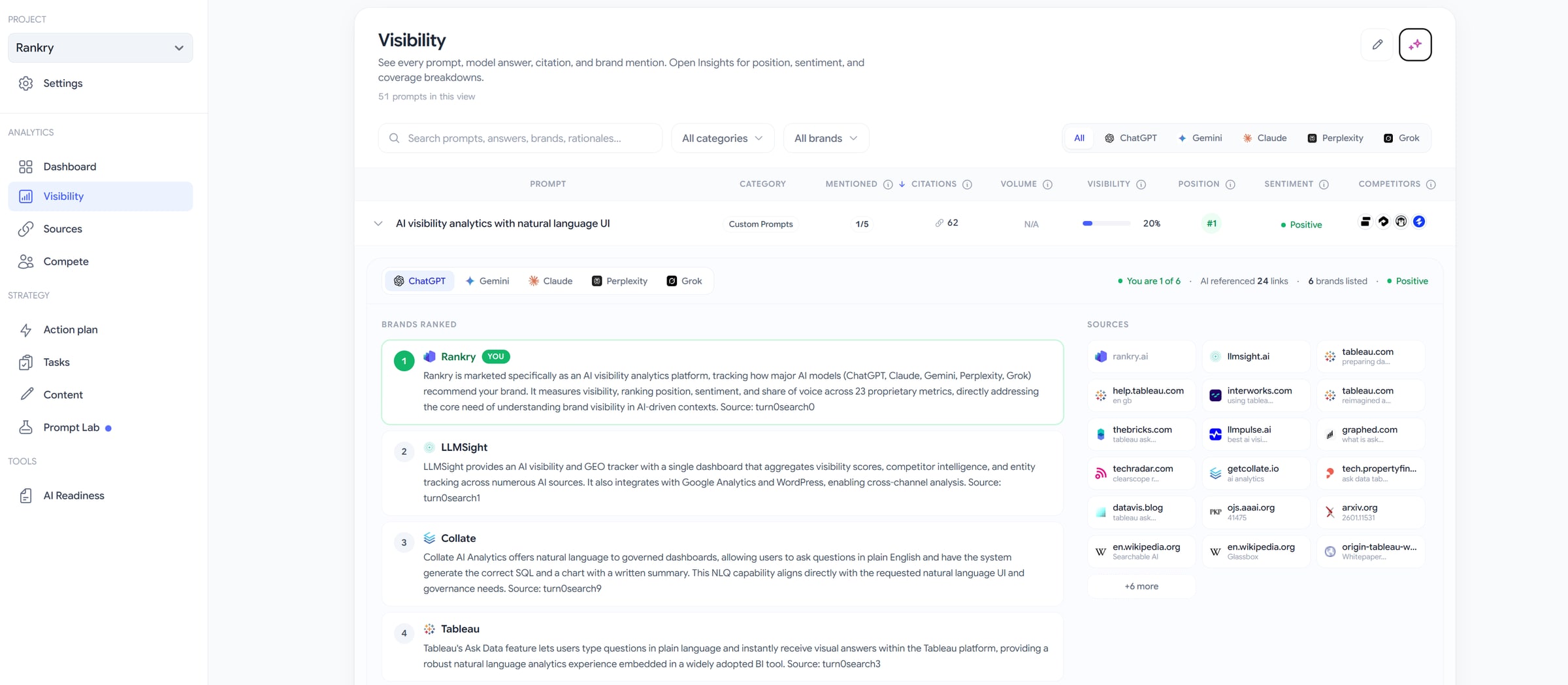
Rankry tracks your brand mentions across the engines you select, out of ChatGPT, Claude, Gemini, Perplexity, Grok, Microsoft Copilot, and Google AI Overviews, samples each prompt to smooth variance, separates mentions from recommendations, records the reason and the cited sources, and keeps the raw answers as evidence, from $99 a month on a no-card trial. It automates exactly the five steps above, across five engines instead of one. The broader process is in how to monitor your brand across AI search engines.
FAQ
How do I track brand mentions in ChatGPT? Run your real buyer questions through clean, logged-out ChatGPT sessions several times each, and record whether you were mentioned, your position, how you were described, and which competitor was recommended instead. Repeat weekly and sample each prompt to beat variance.
What is the difference between a mention and a recommendation in ChatGPT? A mention is your name appearing in the answer. A recommendation is ChatGPT telling the buyer to pick you or ranking you first. Recommendations track to revenue; mention counts alone can be a vanity metric.
Can I track ChatGPT brand mentions for free? Yes. Use clean sessions, ask your buyer prompts several times, log mention and position, and ask ChatGPT why it recommended the winner. It works for ChatGPT alone; five engines sampled and parsed is where a tool helps.
Why do ChatGPT answers about my brand keep changing? ChatGPT’s answers vary between runs, and shift as its cited sources change. This is why a single check is unreliable and repeated sampling over time is the only trustworthy way to track mentions.
How do I find out why ChatGPT recommends a competitor? Ask it directly: “why did you recommend X?” It usually names the reason, clearer pricing, stronger reviews, a specific integration, better fit. That reason is your fix. Tools like Rankry track this reasoning at scale.
Track mentions and recommendations across every engine you run, with the reason behind every one. Start a free 7-day Rankry trial, no card, first report in two minutes.