A ChatGPT rank tracker monitors whether ChatGPT names your brand when buyers ask for recommendations, how often, in what position, and against which competitors. Unlike a Google rank tracker that follows a fixed spot on a results page, a ChatGPT rank tracker measures your presence in a single synthesized answer that changes between runs, so the core metric is your mention rate across repeated samples, not a static position. The strongest tools track ChatGPT alongside the other engines your buyers use, picked from ChatGPT, Claude, Gemini, Perplexity, Grok, Microsoft Copilot, and Google AI Overviews; Rankry does this from $99 a month with a no-card trial. This guide explains what to track, why ChatGPT needs its own approach, and how to choose a tracker.
ChatGPT matters most of them because it drives the largest share of AI referral traffic by a wide margin, roughly three quarters of it in 2026 measurements, so if you track one engine first, track this one. But “rank” works differently here, and getting that difference right is the whole game.
Which engines this applies to. ChatGPT is the right engine to track first because it drives the largest share of AI referral traffic, so it is the one used throughout. The redefinition of rank below is not ChatGPT-specific. Claude, Gemini, Perplexity, Grok, Microsoft Copilot, and Google AI Overviews all return one synthesized answer rather than a list you climb, so mention rate is the metric on every one of them. What differs is how fast each engine’s answer moves and which sources it leans on, which is why a tracker worth paying for reads several engines side by side instead of one.
A ChatGPT rank tracker is not a Google rank tracker
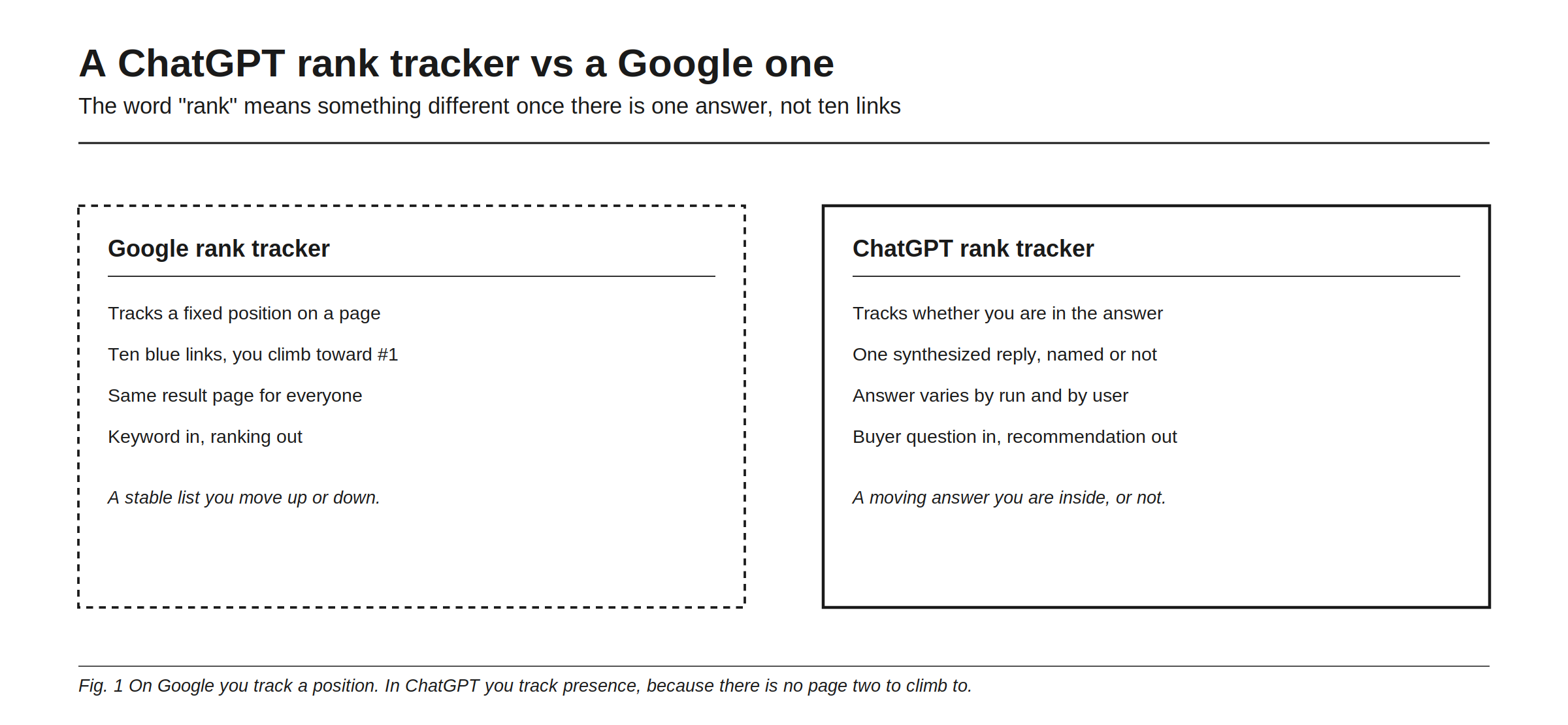
A Google rank tracker follows a fixed position on a stable results page: ten blue links, and you climb toward number one. The same page shows to everyone, you feed it a keyword, and you get a ranking back. A ChatGPT rank tracker measures something structurally different. There is one synthesized answer, and you are named in it or you are not. The answer varies from run to run and from user to user, you feed it a buyer question rather than a keyword, and you get a recommendation back, not a ranking. It also varies by configuration, browsing state, region, and model version, which is the separate axis covered in which ChatGPT you are actually tracking.
That difference has a practical consequence: on Google you track a position, but in ChatGPT you track presence, because there is no page two to climb to. You are inside the answer, or you do not exist for that query. A tracker that just reports “rank 3” without accounting for how often you appear at all is measuring the wrong thing.
What a ChatGPT rank tracker records
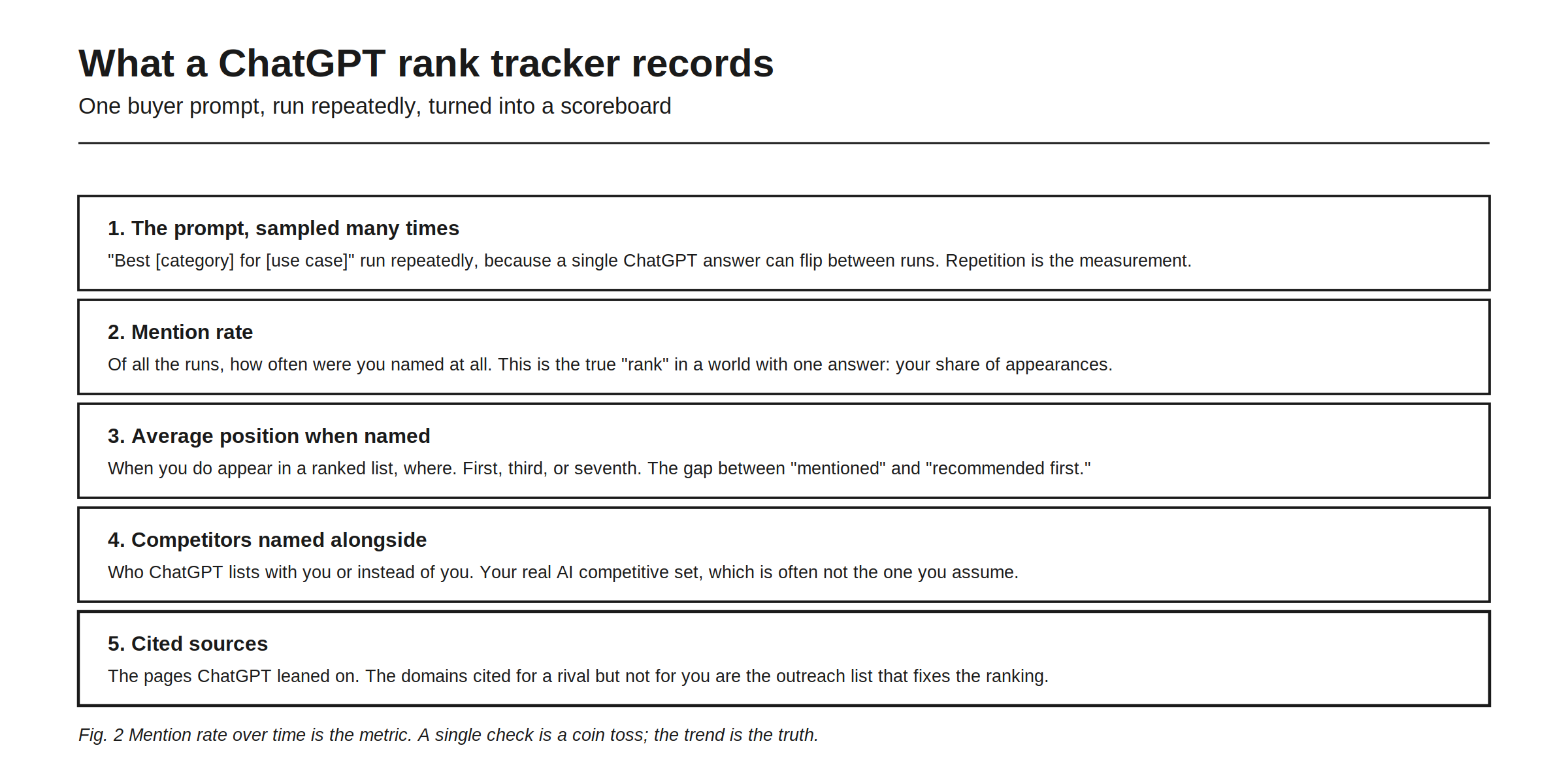
Five things turn a single ChatGPT answer into a usable scoreboard. First, the prompt sampled many times: “best [category] for [use case]” run repeatedly, because a single ChatGPT answer can flip between runs, so repetition is the measurement, not a nuisance. Second, mention rate: of all the runs, how often you were named at all, which is the true “rank” when there is one answer, your share of appearances. Third, average position when named: where you land in a ranked list on the runs where you do appear, capturing the gap between “mentioned” and “recommended first.” Fourth, competitors named alongside: who ChatGPT lists with you or instead of you, which is your real AI competitive set and often not the one you assume. Fifth, cited sources: the pages ChatGPT leaned on, where the domains cited for a rival but not for you become the outreach list that actually fixes the ranking.
The metric to watch is mention rate over time. A single check is a coin toss; the trend across repeated samples is the truth, and how many runs that trend needs has an exact answer.
Why ChatGPT specifically needs tracking
ChatGPT’s retrieval has shifted. Where it once leaned heavily on Bing’s index, it now blends its own index with partner sources, and its citations favor a long tail of specific pages rather than only the biggest domains. Community sources like Reddit and reference sources like Wikipedia carry heavy weight in what it surfaces. The practical implication for a tracker is that ChatGPT’s answers move as those sources move, and they move fast, so point-in-time checks decay quickly. The mechanics of how ChatGPT finds and cites are in is my website a source for ChatGPT and Perplexity.
How to track ChatGPT rank, free and paid
You can start free: open clean, logged-out ChatGPT sessions, ask your top buyer prompts several times each, and log whether you appear, your position, and who else is named. Do this weekly and you have a real, if manual, tracker. Its limits are the usual ones, sampling enough runs to beat variance, and doing it for every engine, not just ChatGPT.
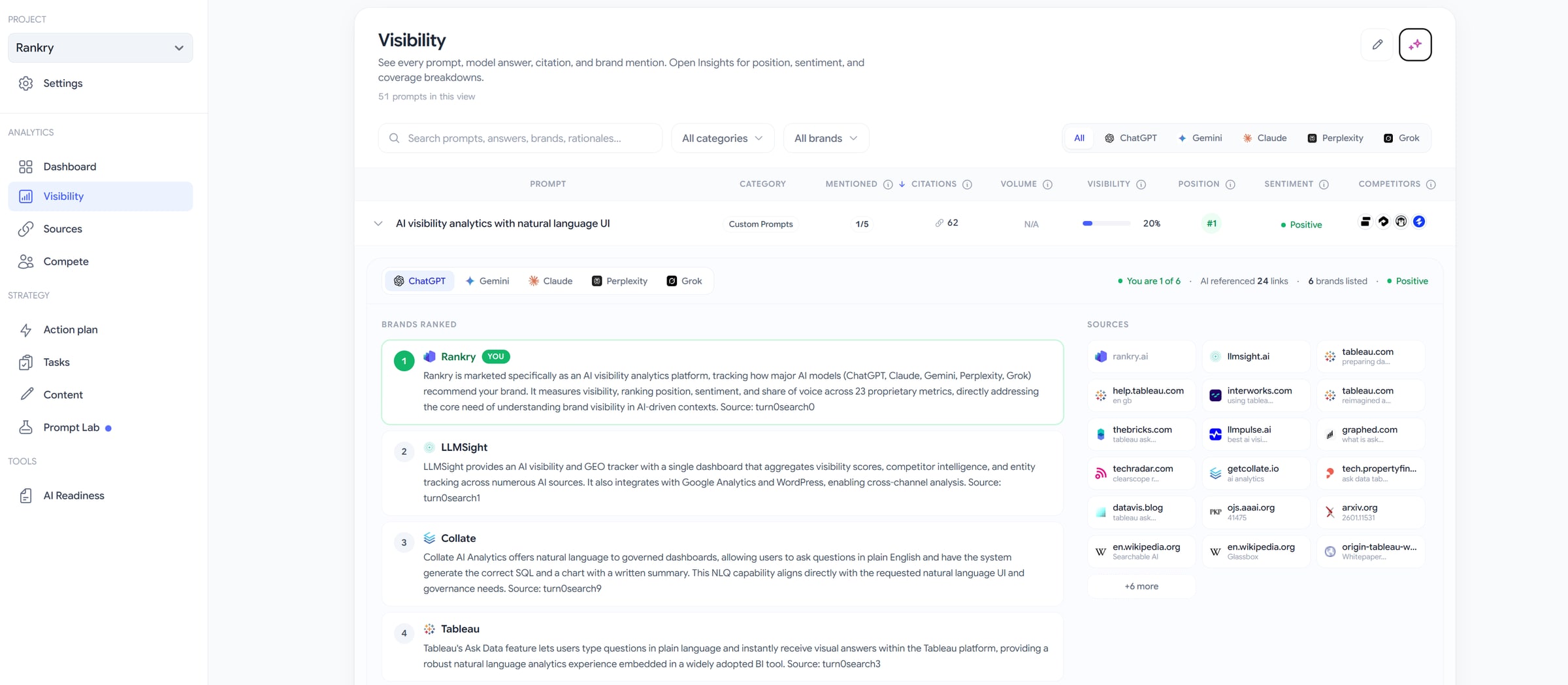
A dedicated tool automates the sampling and the source parsing, and, more importantly, tracks the other engines in the same view, because a ChatGPT-only picture misses the buyers who use Claude or Perplexity. Rankry tracks all five with mention rate, position, competitors, and cited sources per prompt, and stores the raw answers as evidence, from $99 a month on a no-card trial. For the full monitoring process this fits into, see how to monitor your brand across AI search engines, and for a tool comparison, the best LLM rank tracking software.
Choosing a ChatGPT rank tracker
Four things separate a real tracker from a toy. It samples each prompt repeatedly, because one run is noise. It reports mention rate, not just a position, because presence is the real metric. It surfaces the reason and the cited sources, because that is what you act on. And it covers the other four engines, because ChatGPT is the biggest slice of AI traffic but not the only one. A tracker that gives you a single “you rank 4 in ChatGPT” number from one query, with no sampling and no sources, is measuring a coin flip and calling it a ranking.
FAQ
What is a ChatGPT rank tracker? A tool that monitors whether ChatGPT names your brand when buyers ask for recommendations, how often, in what position, and against which competitors, by sampling your buyer prompts repeatedly and tracking your mention rate over time.
How do I track my ranking in ChatGPT? Run your top buyer prompts through clean ChatGPT sessions several times each, and record whether you appear, your position, who else is named, and which sources are cited. Do it weekly, or automate it with a tracker that samples and parses sources for you.
Why can’t I just use a Google rank tracker for ChatGPT? Because ChatGPT has one synthesized answer that varies between runs, not a fixed results page. The metric is your mention rate across samples, not a static position, so Google-style rank tracking does not translate.
Does ChatGPT ranking change often? Yes. ChatGPT’s answers shift as its cited sources change, and sources like Reddit have grown their citation share sharply. Point-in-time checks decay within weeks, which is why repeated sampling matters.
What is the best ChatGPT rank tracker? Look for repeated sampling, mention-rate reporting, cited-source tracking, and coverage of the other engines your buyers use. Rankry covers all four criteria at $99 a month with a no-card trial; alternatives are compared in our LLM rank tracking software guide.
Track your ChatGPT mention rate, and every other engine you run, in one dashboard with the sources behind every answer. Start a free 7-day Rankry trial, no card, first report in two minutes.