A ChatGPT visibility tracker measures whether ChatGPT names your brand, but the first thing to understand is that there is no single ChatGPT. The same prompt returns different answers depending on browsing being on or off, whether the session carries a user’s personal memory, the region, the model version (OpenAI ships a new one roughly every six weeks), and whether the query routes into ChatGPT’s shopping surface. So any visibility number is a number for one specific configuration. A good tracker measures a fixed, clean, reproducible configuration, the answer a stranger buyer would get, and it honestly cannot measure one real user’s personalized answer. This guide explains what that means for reading your number and how to track ChatGPT in a way that actually holds up.
Most people treat “our ChatGPT visibility is 40%” as a single fact about a single system. It is not. Understanding which ChatGPT that 40% describes is the difference between a metric you can act on and a number that quietly lies to you.
There is no single ChatGPT answer
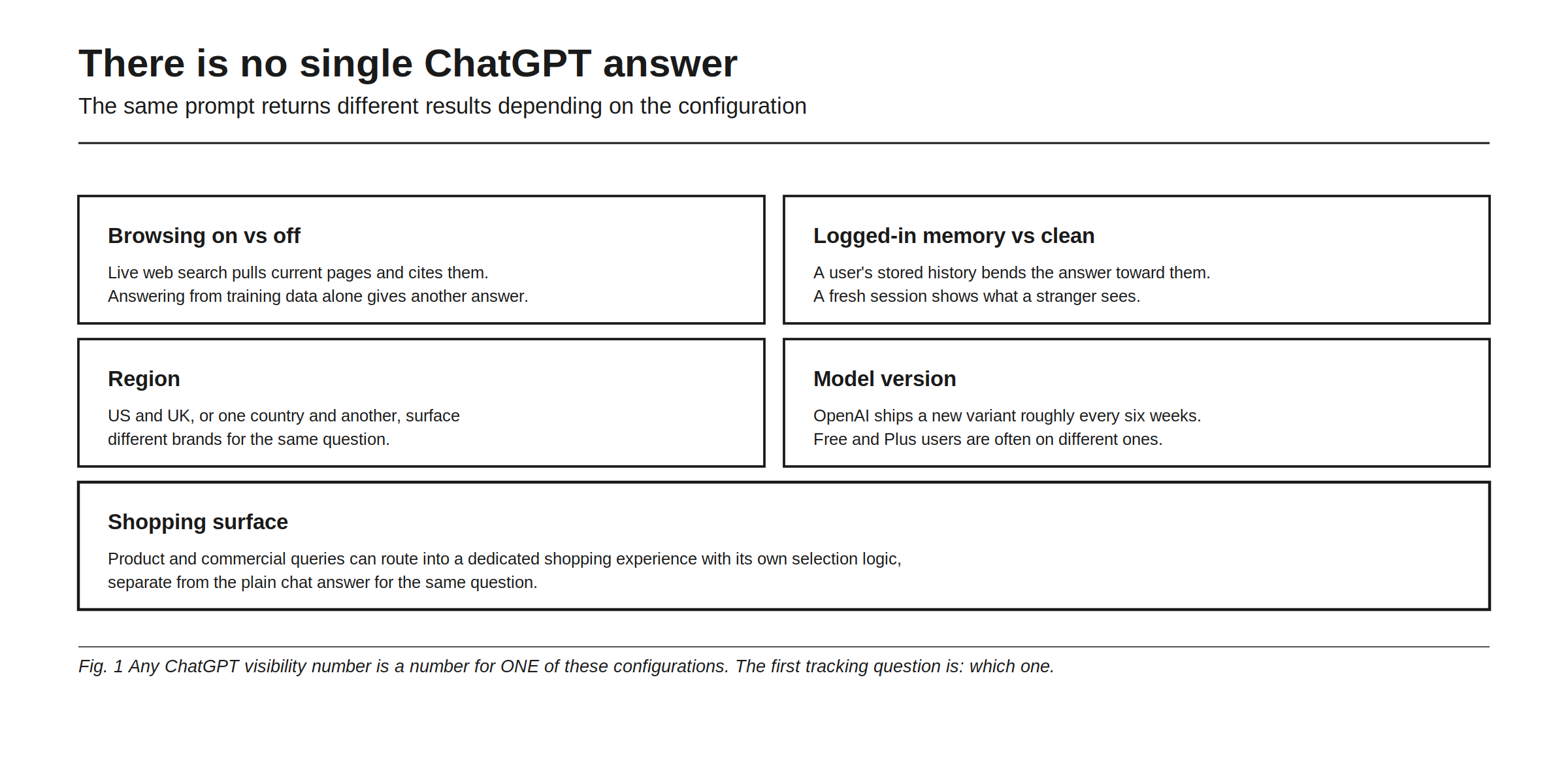
Five things change the answer for the exact same prompt. Browsing on versus off: live web search pulls current pages and cites them, while answering from training data alone produces a different result. Logged-in memory versus a clean session: a user’s stored history bends the answer toward them, while a fresh session shows what a stranger sees. Region: the US and UK, or any two countries, surface different brands for the same question. Model version: OpenAI ships a new variant roughly every six weeks, and Free and Plus users are often on different ones. And the shopping surface: product and commercial queries can route into a dedicated shopping experience with its own selection logic, separate from the plain chat answer.
The takeaway is not that tracking is hopeless. It is that any ChatGPT visibility number belongs to one of these configurations, and the first tracking question is always: which one. Skip that question and you are averaging five different systems into one meaningless number. This surface-dependence is different from the “rank does not mean Google position” point in our ChatGPT rank tracker guide, and from the mention-versus-recommendation point in our guide to tracking brand mentions in ChatGPT. Here the axis is configuration.
The personalization problem: memory changed the game
The biggest shift in 2026 is memory. ChatGPT now personalizes answers from a user’s own history, and OpenAI’s memory-sources feature even shows which past chats, files, and connected data shaped a given response. Research on real ChatGPT memory profiles found that the large majority of stored memories were created automatically by the system rather than added by the user, and that a meaningful share contained personal and even psychological detail. What that means for visibility: for a logged-in user with months of history, ChatGPT’s answer is partly a mirror of that person, not a neutral read of your category.
This has a hard consequence for tracking, and honest tools say it out loud: you cannot measure one specific user’s personalized answer, and you should not try. There is no way to optimize for a billion private profiles. So the right target is the shared baseline, the clean, memory-free answer a new user gets, because that is the layer you can actually influence with content and sources. A tracker that claimed to measure “what your customers personally see” would be selling you a fiction.
What a tracker can and cannot see
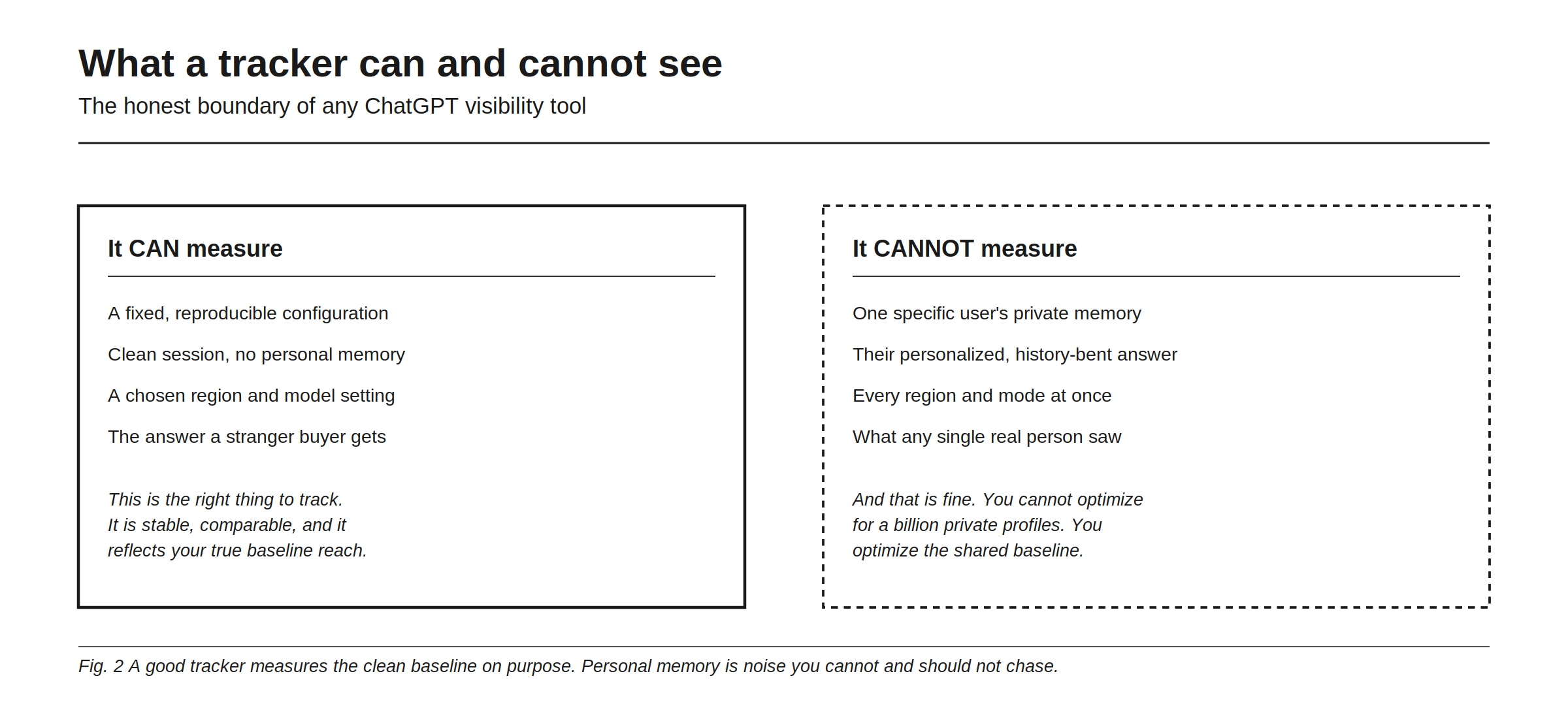
Draw the boundary clearly. A tracker can measure a fixed, reproducible configuration: a clean session with no personal memory, a chosen region and model setting, the answer a stranger buyer gets. That is the right thing to track, because it is stable, comparable across weeks, and it reflects your true baseline reach. A tracker cannot measure one specific user’s private memory, their personalized history-bent answer, every region and mode simultaneously, or what any single real person saw on their screen. And that is fine, because you optimize the shared baseline, not the private profiles.
The practical rule this gives you: judge any ChatGPT tracker by whether it is explicit about its configuration. If a vendor cannot tell you, on a demo, exactly which browsing state, region, memory state, and model their number reflects, they are measuring an unknown blend and calling it a metric. Ask the question directly: why two trackers never show the same number explains why two tools with different configurations will never show you the same figure.
How to track ChatGPT visibility properly
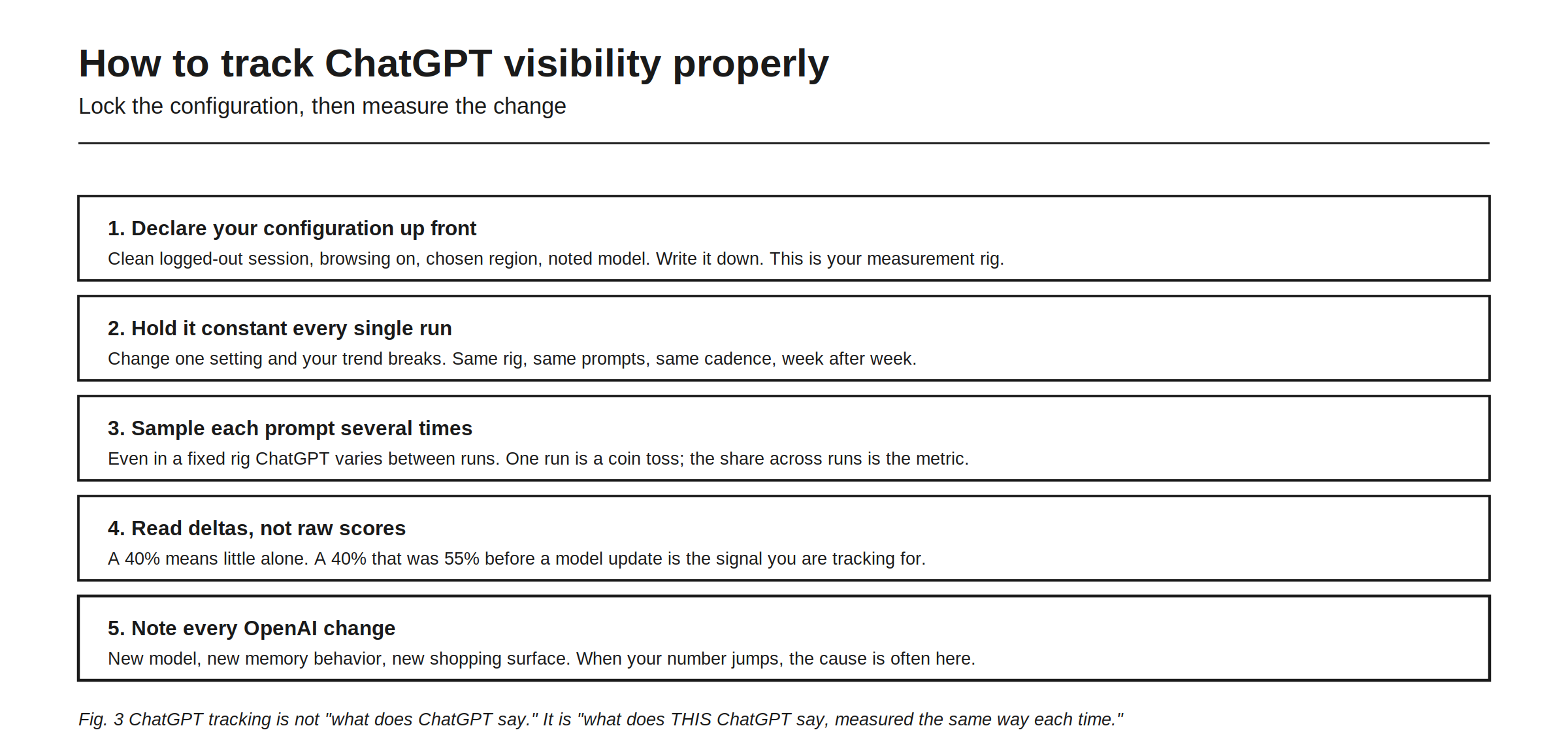
Five steps turn a shaky number into a trustworthy one. First, declare your configuration up front: clean logged-out session, browsing on, chosen region, noted model, written down as your measurement rig. Second, hold it constant every single run, because changing one setting breaks the trend, so it is the same rig, same prompts, same cadence, week after week. Third, sample each prompt several times, because even in a fixed rig ChatGPT varies between runs, so one run is a coin toss and the share across runs is the metric. Fourth, read deltas, not raw scores, because a 40% means little alone but a 40% that was 55% before a model update is exactly the signal you track for. Fifth, note every OpenAI change, because when your number jumps, a new model, a new memory behavior, or a new shopping surface is often the cause.
That third step matters more than people expect, and it has real math behind it: how many times to ask before you trust the answer shows exactly how many runs you need before a change is real rather than noise. ChatGPT tracking is not “what does ChatGPT say.” It is “what does this ChatGPT say, measured the same way every time.”
Doing it with a tool
Rankry tracks ChatGPT on a fixed, disclosed configuration, samples each prompt to smooth run-to-run variance, and reports the delta over time alongside Claude, Gemini, Perplexity, Grok, Microsoft Copilot, and Google AI Overviews, so you see when a model update or a shopping-surface change moved your number, from $99 a month on a no-card trial. It measures the clean baseline on purpose, the reach you can actually influence, and it keeps the raw answers as evidence you can audit. The broader loop is in how to monitor your brand across AI search engines.
FAQ
What is a ChatGPT visibility tracker? A tool that measures whether and how often ChatGPT names your brand for buyer questions, on a fixed configuration. Because ChatGPT’s answer changes with browsing, memory, region, and model version, a real tracker measures one clean, reproducible setup rather than an unknown blend.
Why do I get different ChatGPT answers for the same question? Because browsing on or off, logged-in memory versus a clean session, your region, the model version you are on, and whether the query hits the shopping surface all change the result. There is no single ChatGPT answer, so the answer depends on the configuration.
Can a tracker see what ChatGPT tells a specific customer? No. A logged-in user’s answer is personalized by their private memory and history, which no external tool can see or reproduce. Trackers measure the clean, memory-free baseline, the answer a new user gets, which is the layer you can actually influence.
How does ChatGPT memory affect my visibility? For users with history, ChatGPT personalizes answers from their own past chats and data, so their result partly reflects them, not just your category. This is why tracking targets the shared baseline rather than any individual’s personalized answer.
How often does ChatGPT change enough to affect tracking? Often. OpenAI ships a new model variant roughly every six weeks, plus memory and surface changes in between. Sudden shifts in your visibility number frequently trace back to one of these updates, which is why you note them alongside your data.
What should I ask a ChatGPT tracking vendor on a demo? Ask exactly which configuration their number reflects: browsing state, region, memory state, and model version. If they cannot answer, they are measuring an unknown blend. A trustworthy tracker is explicit about its rig.
Track ChatGPT on a fixed, disclosed configuration, with the deltas that actually signal change, next to every other engine. Start a free 7-day Rankry trial, no card, first report in two minutes.