If your tracked prompt set includes prompts that name your brand, such as “is [Brand] good,” “[Brand] vs [Competitor]” or “[Brand] pricing,” your AI visibility score is probably higher than your real position with buyers. AI engines mention a brand almost every time a prompt names it, and far less often when a buyer asks about the category. In a vendor dataset of 145,498 scored answers published by Momentic in August 2026, the brand was mentioned in 91.6% of answers to prompts that included its name and in 19.6% of answers to prompts that did not. Blend the two and the near-automatic wins on branded prompts lift the average, so the score can look healthy while you are missing from most unbranded buyer questions. The fix is to split your prompt set into unbranded discovery, unbranded comparison and branded validation, report each one separately, and take your headline number from the unbranded buckets only.
This is not a rounding issue. Add a few more “[Brand] reviews” prompts and the score goes up while nothing has changed in the market. Remove them and the score drops for the same reason.
What the data shows when you separate branded prompts
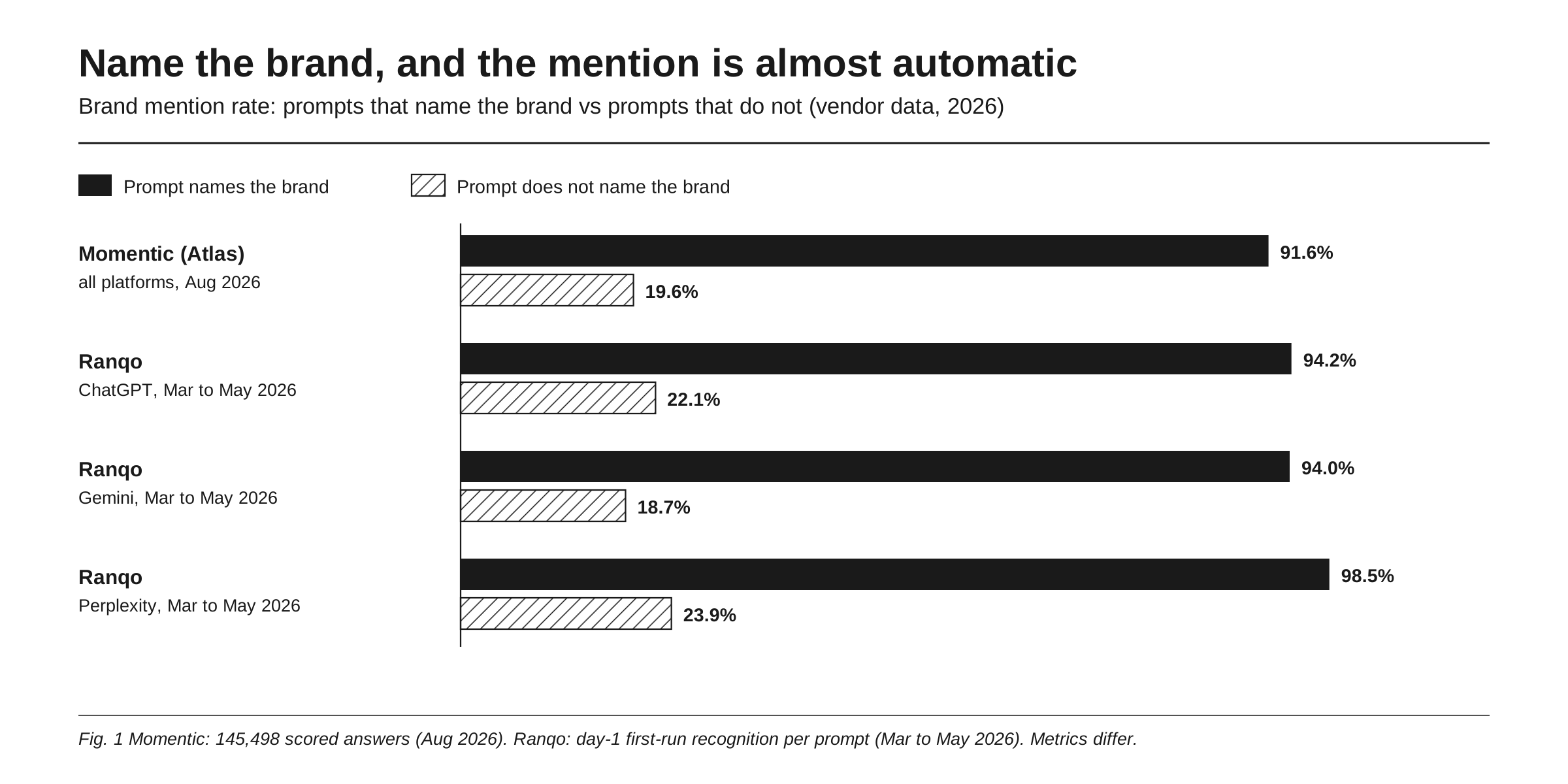
Several AI visibility vendors published 2026 data split by whether the prompt names the brand. Each uses its own prompts, engines and metric, so the numbers are not directly comparable. They all point the same way.
Momentic (August 18, 2026). The firm behind the Atlas answer-tracking platform reported a corpus of 145,498 scored answers from the models behind ChatGPT, Claude, Gemini and Perplexity, with and without web access, plus Google’s AI results. Prompts that included the brand’s name produced a brand mention 91.6% of the time; prompts without the name, 19.6%. Momentic’s own conclusion: “Averaging a 91.6% rate into results that otherwise run near 19.6% would inflate a brand’s headline numbers,” so Atlas reports brand prompts separately. Momentic also says it read the public methodology documentation of 19 AI visibility tools in August 2026 and that most do not split prompts with the brand name from prompts without it.
Ranqo (arXiv preprint, June 18, 2026, not peer reviewed). The paper draws on production data from Ranqo’s own platform (its core cohort: 102 brands and 102,025 prompt responses across five engines, March to May 2026). In a day-1 analysis of each brand’s first tracking run, branded prompts on ChatGPT produced a mention 94.2% of the time and unbranded prompts 22.1%. Gemini: 94.0% vs 18.7%. Perplexity: 98.5% vs 23.9%. The paper calls the branded column “largely trivial,” because a prompt that asks what a company does mentions that company by construction.
Analyze (August 4, 2026). Across 22,295 answers to 460 B2B prompts for 37 organizations on ChatGPT, Perplexity and Google AI Mode, a regression model found that naming the brand in the prompt added 60.4 percentage points to the adjusted mention rate (95% CI: 46.2 to 74.6). It was the largest single lever in their data.
NeuroRank (September 22, 2026). Across 122 brands, NeuroRank reported “High inclusion” (its own rating band) of 56.2% when the prompt named the brand and 17.8% when it did not, measured on separate prompt pools.
Read these as direction, not benchmarks. All four are vendor datasets built on each vendor’s own brands and prompts, and mention rates swing widely by category: in Analyze’s panel they ranged from 8.7% to 69.8% across 11 categories, some with as few as 10 prompts. None of them tells you your own gap. What they share is a large gap between prompts that name the brand and prompts that do not, and in Analyze’s model it was the largest single lever. That is why the two cannot sit inside the same average.
How branded prompts inflate a blended score
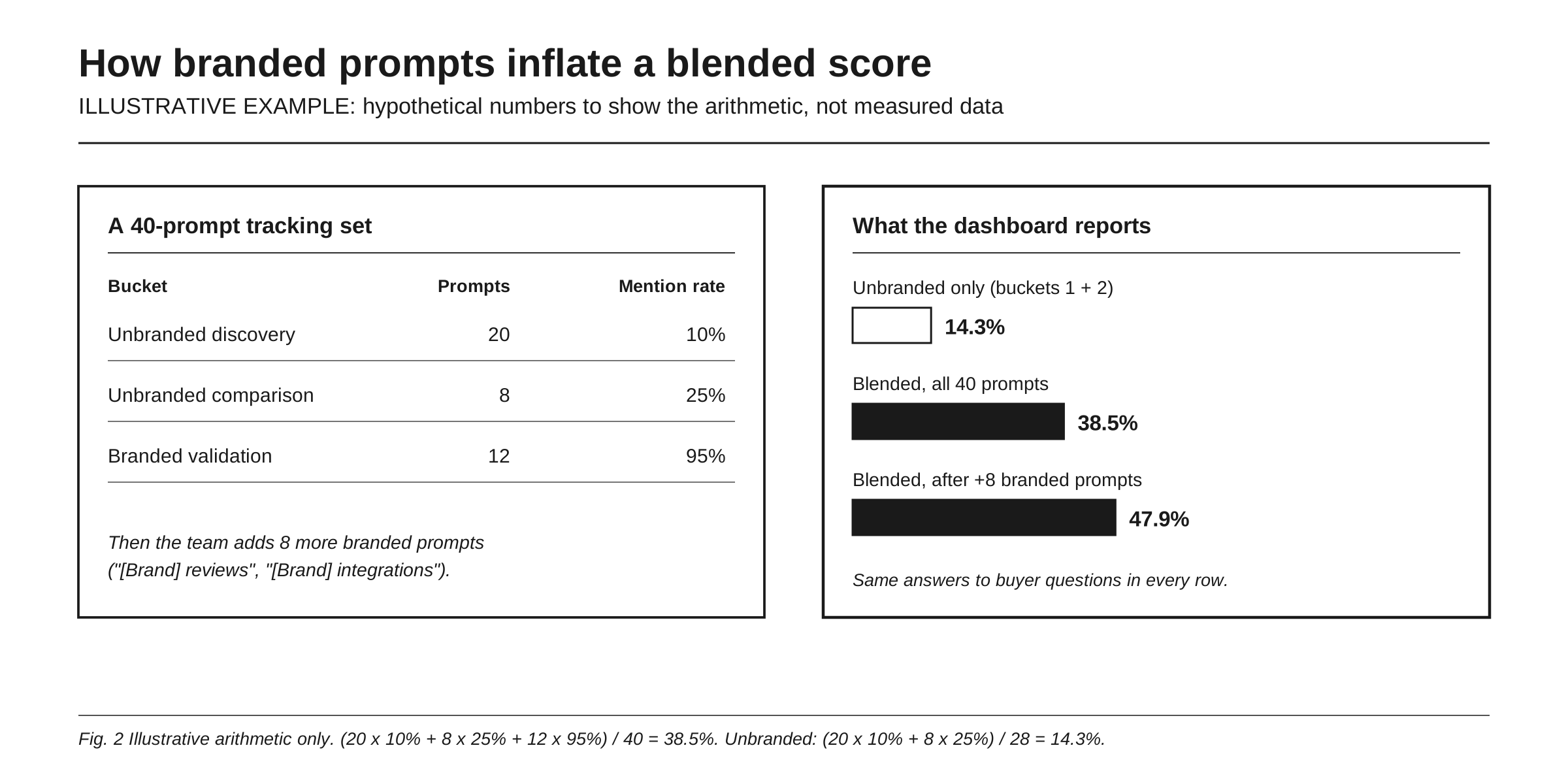
Most visibility scores are a share: answers that mention you divided by answers tracked. Branded prompts are close to guaranteed wins, so every branded prompt you add pulls the average toward the 90s. At that point the score measures your prompt mix as much as your visibility.
Ranqo’s data shows the effect at a small dose. Branded prompts were roughly 9% of first-run responses, yet ChatGPT’s all-prompt rate came out at 28.6% against 22.1% on unbranded prompts alone. Fewer than one response in ten moved the number by 6.5 points.
Illustrative example (hypothetical numbers, not measured data). A software brand tracks 40 prompts: 20 unbranded discovery prompts where it is mentioned 10% of the time, 8 unbranded comparison prompts at 25%, and 12 branded prompts at 95%. The blended score is 38.5%. The unbranded score, the one that describes buyers who have not chosen yet, is 14.3%. Next quarter the team adds 8 more branded prompts (“[Brand] integrations,” “[Brand] reviews”). The blended score rises to 47.9%. No answer to a buyer question changed. Only the prompt mix did.
Branded prompts flatter more than mention rate. In Analyze’s data, all three engines agreed on 92.4% of branded prompts, while on generic prompts the brand appeared in all three engines only 14.6% of the time. A set heavy with branded prompts makes engines look consistent and makes you look stable. Prompt mix is also one of the main reasons two tools report different numbers for the same brand, as covered in why AI visibility trackers never show the same number.
What the blended number hides
Branded and unbranded prompts answer different questions. A branded prompt asks: when someone already knows us, does the engine describe us correctly? An unbranded prompt asks: when a buyer has not decided, does the engine bring us up at all? Shortlists form in the second situation. A blended score folds both into one number and lets the easy one cover for the hard one.
NeuroRank’s brand-level results show how wide that gap can be. Of 82 brands measured both ways, 51 reached at least 50% High inclusion when the prompt named them. Three did when it did not. A team watching a blended dashboard could see a solid number every week and never learn that it is absent from the prompts where buyers start.
Branded comparison prompts add a second distortion. Momentic notes that in “X vs Y” answers, platforms tend to list the asked-about brand first because of how those answers are formatted, so Atlas reports comparison positions separately from category positions. If “[Brand] vs [Competitor]” prompts feed your average position, your rank looks better than buyers ever see it.
None of this makes branded prompts useless. Momentic found that 8.4% of answers to brand prompts did not mention the brand the prompt asked about, and it treats that omission as an emergency finding. Branded prompts are where you catch wrong pricing, outdated positioning and negative framing. That is validation work. It belongs in its own report, not in your visibility score.
Split the set into three buckets
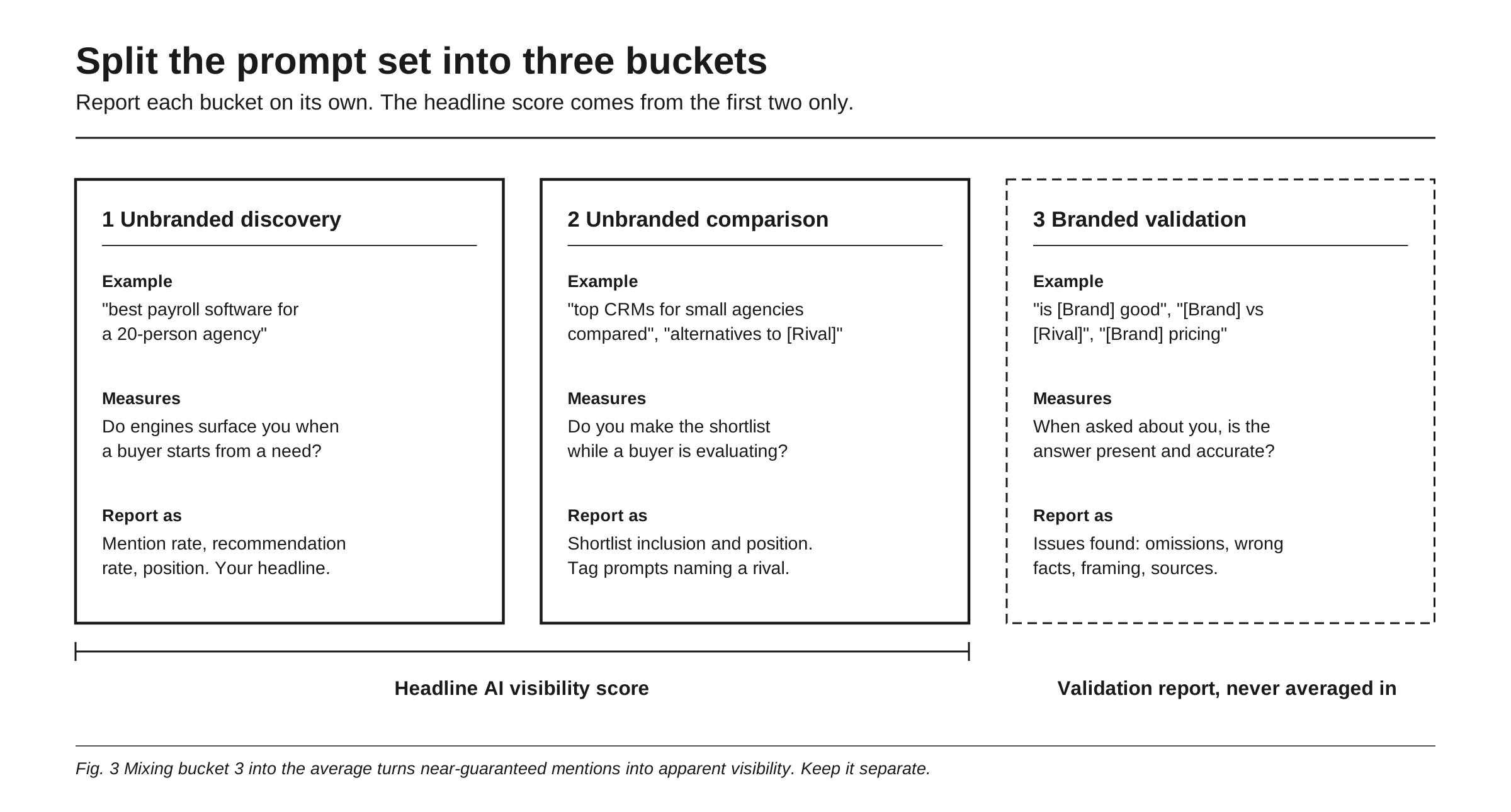
Unbranded discovery. Category and problem prompts that name no brand: “best payroll software for a 20-person agency,” “how do I reduce churn in a subscription app.” This bucket measures whether engines surface you when a buyer starts from a need. Report mention rate, recommendation rate and position. This is your headline.
Unbranded comparison. Shortlist and evaluation prompts that do not name you: “top CRMs for small agencies compared,” “alternatives to [Competitor].” This bucket measures whether you make the list once a buyer is evaluating. If a prompt names a competitor, tag it, because a competitor-seeded prompt can behave differently from an open category question.
Branded validation. Prompts that name you: “is [Brand] good,” “[Brand] vs [Competitor],” “[Brand] pricing,” “[Brand] reviews.” This bucket measures accuracy, sentiment, omissions and which sources describe you. Report it as a checklist of issues found, never as part of the headline.
Report three numbers side by side and never average across buckets. Choosing the prompts inside each bucket is covered in how to choose which buyer questions to track.
How to audit and rebuild your prompt set
-
Export your current set with recent results. Pull every tracked prompt and at least a few weeks of answers, so you can recompute scores without running anything new.
-
Tag every prompt that names you. Search prompt text for your brand name, product names, common misspellings, abbreviations and your domain. Anything that matches is branded. Separately tag prompts that name a competitor.
-
Recompute the score without branded prompts. Calculate the unbranded mention rate and compare it with the blended number you have been reporting. The gap is your inflation. Write both numbers down before you change anything.
-
Move branded prompts to a validation list. Do not delete them. Review their answers for omissions, wrong facts, stale pricing and the sources being cited, and log each issue.
-
Fill the unbranded buckets from buyer language. Use sales call notes, support tickets, Search Console queries and review-site questions. Write prompts the way buyers ask, with role, team size and constraints. Methods for finding these gaps are in how to find prompts where your brand should appear.
-
Balance the framing of branded checks. Momentic found that answers to negative prompts (“Is X a scam?”) attached a caveat to the brand 67.1% of the time, against 32.0% for neutral and positive prompts. Mix negative, neutral and positive phrasings so your sentiment read reflects the engines, not your wording.
-
Freeze wording and set a new baseline. Keep prompt text stable, run each prompt more than once per period, and wait for a few weeks of data before reading trends on the rebuilt set.
-
Tell stakeholders before the number drops. The unbranded score will be lower than the old blended one. Present it as a correction, show both numbers for one reporting cycle, then retire the blended figure and set targets on the unbranded buckets only.
Where Rankry fits
Rankry runs a stable set of buyer-intent prompts across ChatGPT, Claude, Gemini, Perplexity, Grok and Google AI Mode and AI Overviews, every day, and records whether you are mentioned, how you rank against competitors and which sources each engine cited. A stable set is what makes the number honest: the score moves when answers move, not when someone adds prompts. Build your tracked set from unbranded discovery and comparison prompts, use competitor comparison to see who gets named instead of you, and keep branded checks such as “is [Brand] good?” in a category of their own, so they never lift the main number. The Google Search Console integration puts your real search queries next to your AI visibility data, which makes it a practical place to find unbranded buyer language for the next prompt you add.
FAQ
Should I remove branded prompts from AI visibility tracking? Remove them from the headline score, not from your workflow. Branded prompts catch omissions, wrong facts and negative framing, which matters: in Momentic’s August 2026 data, 8.4% of answers to brand prompts did not mention the brand. Keep them in a separate validation report and take your visibility score from unbranded discovery and comparison prompts only.
Why did my AI visibility score drop after I removed branded prompts? Because branded prompts were lifting the average. Engines mention a brand on most prompts that name it, so they act as near-guaranteed wins. In Ranqo’s data, branded prompts made up roughly 9% of first-run responses, yet ChatGPT’s all-prompt rate was 28.6% against 22.1% on unbranded prompts alone. The lower number is the accurate one.
Are “X vs Y” prompts branded or unbranded? If X or Y is your brand, the prompt is branded. Momentic notes that platforms tend to list the asked-about brand first in “X vs Y” answers because of formatting, so these prompts flatter both mention rate and position. Comparison prompts that do not name you, such as “alternatives to [Competitor],” belong in the unbranded comparison bucket.
How many branded prompts are too many in a tracking set? For the headline score, any number above zero, because each one raises the average without telling you anything about discovery. For validation, use enough to cover pricing, features, reviews, comparisons against your main competitors and a few negatively framed questions. The right count depends on how many facts about your product buyers ask engines to confirm.
Why do AI visibility tools show different scores for the same brand? Prompt mix is one major reason. A tool that includes branded prompts in its average will report a higher number than a tool tracking only unbranded prompts, even on identical answers. Engines, run counts and scoring rules differ too. Before comparing tools, check what share of each tool’s prompt set names your brand.
Sources
- Momentic’s methodology for prompt research and choosing prompt targets for AI tracking, Momentic, August 18, 2026
- Generative Engine Optimization at Scale: Measuring Brand Visibility Across AI Search Engines, Ranqo (arXiv:2606.20065), June 18, 2026
- The State of AI Search in B2B [2026], Analyze, August 4, 2026
- AI Visibility Index 2026, NeuroRank, September 22, 2026
See how often AI engines recommend you when buyers ask about your category without naming you, tracked on a stable prompt set every day. Start a free 7-day Rankry trial, no card.