Mostly no. In a vendor test published October 22, 2026, Otterly.ai hid unique codes in the og:title and og:description tags of three of its own blog posts, then asked seven AI engines for those values with the URL in the prompt: six in their free logged-out web versions, Claude through its API with web search. In 504 such questions, none returned the right code. Engines that opened the page did read the visible article text: ChatGPT returned the code placed in the body 36 of 36 times. The one clear exception was the logged-in Claude app, whose page-fetch tool passed head metadata to the model and got the Open Graph code right 12 of 12 times. The practical rule: put anything an AI answer must repeat into server-rendered body paragraphs and headings, and keep Open Graph for link previews.
One boundary matters. Otterly left the HTML title and the meta description unchanged, so the test says nothing direct about those two tags. Below, we keep three things apart: what was measured, what Google documents, and our own on-page checklist.
How the Otterly test worked
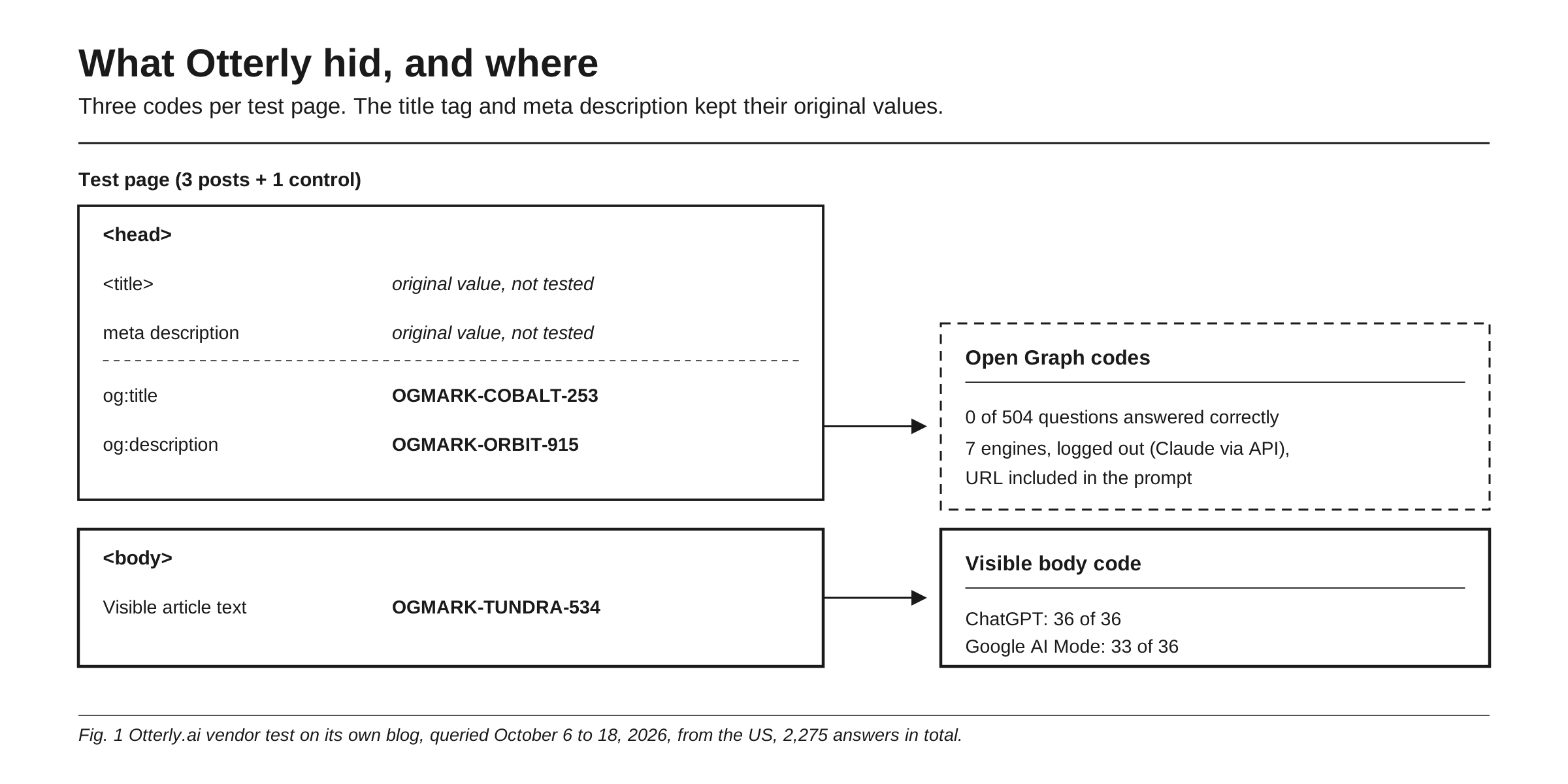
Otterly sells AI visibility monitoring, so treat this as a vendor study run on its own site. The design was clean. On three otterly.ai blog posts, the team placed one made-up code in og:title (OGMARK-COBALT-253), another in og:description (OGMARK-ORBIT-915), and a third in the visible body text (OGMARK-TUNDRA-534). A fourth post stayed untouched as a control. The regular title tag, meta description and X card fields kept their original values, and the team checked the page source to confirm the codes were not in the HTML title.
The edits went live October 6, 2026 at 19:05 UTC. From October 6 to 18, Otterly ran 25 prompts a day, one run per prompt, per engine, per day, from the United States, across ChatGPT, Claude, Gemini, Google AI Mode, Google AI Overviews, Microsoft Copilot and Perplexity. That produced 2,275 answers. On October 16 and 17 the team added 100 manual tests while logged in: 10 core prompts across five engines, default models, temporary or incognito chats.
The limits are real and Otterly lists them. It is three pages on one domain, one run per prompt per day, US only. Perplexity data failed until October 12. AI Overviews did not trigger on questions that included a URL. Claude on the automated platform meant API access with web search, not the Claude app.
What reached the answers, and what did not
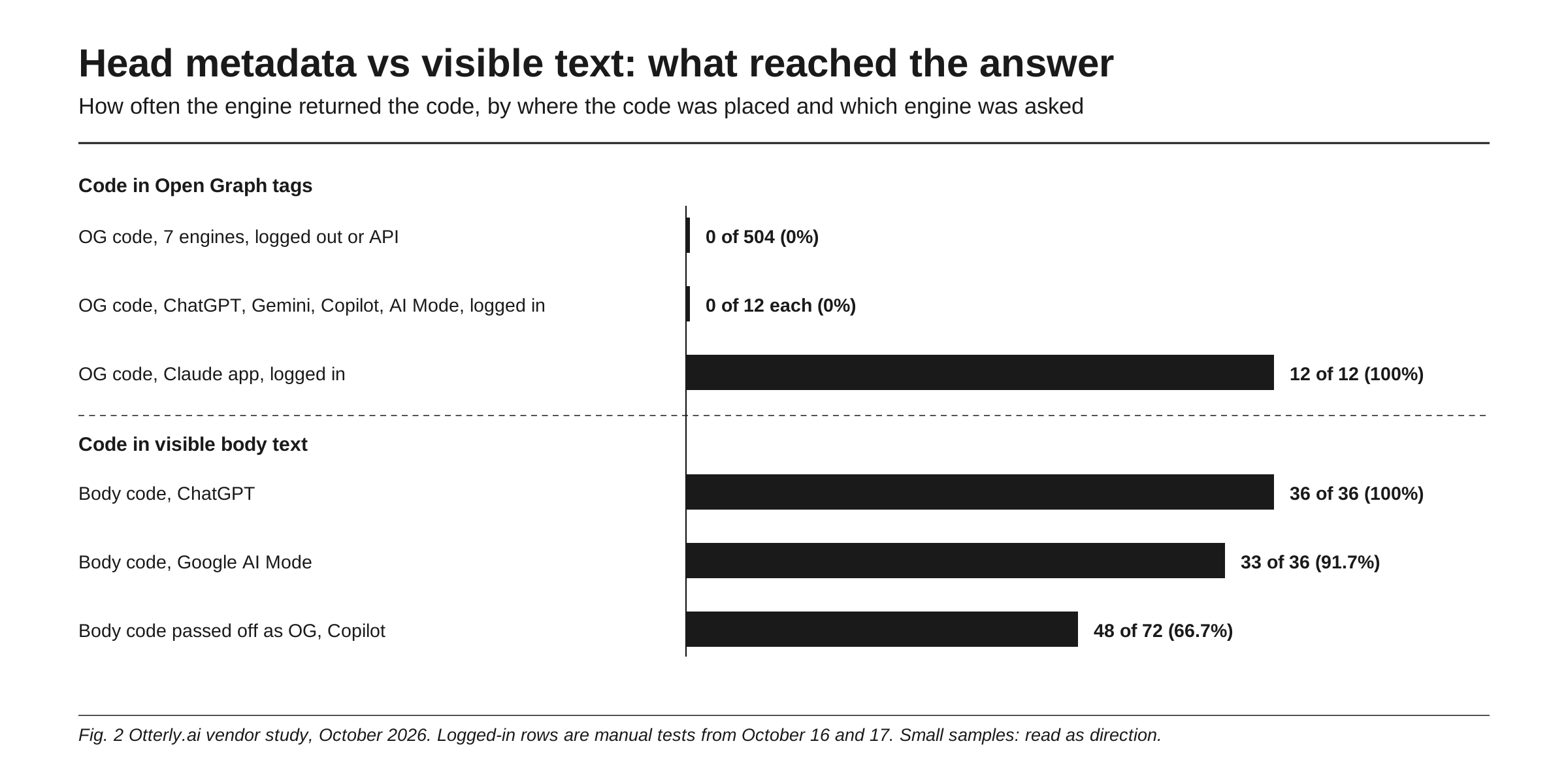
The headline result is blunt. Across 504 questions on Otterly’s platform that asked for the og:title or og:description content with the URL given, no engine returned the right code. Scope that number carefully: it counts all seven engines over 12 days, including Google AI Overviews, which did not trigger on questions with a URL, and Perplexity, whose data was missing until October 12, so fewer than 504 real answers sit behind the zero.
This was not a failure to reach the page, at least for ChatGPT and AI Mode. ChatGPT returned the body code 36 of 36 times on the visible-text question, and Google AI Mode did so 33 of 36 times. The more telling failure is what happened next: 146 times, across five engines, an engine found the body code and claimed it was the Open Graph value. Copilot did this in 48 of 72 cases. If you ask an engine “what does this page’s og:description say,” the answer you get may be confident and wrong.
Two nuances keep this from being an absolute “never.”
First, Claude. Logged in, the Claude app read Open Graph 12 out of 12 times, while ChatGPT, Gemini, Copilot and Google AI Mode scored 0 of 12 each, logged in or out. Otterly’s explanation: the Claude app’s fetch tool passed the page metadata along with the content, and “whenever Claude opened the page, it answered correctly: 16 of 16.” Its conclusion is that the difference is access to the page’s metadata, not the login itself. How Claude decides to fetch and cite pages is covered in how Claude finds and cites sources.
Second, the slow route. Otterly reports that “some search indexes take og:description in as page text and hand it to the engines that search them, a week or two later,” and two engines eventually repeated it. The study does not name them. By contrast, the body code reached an AI engine through Google’s index within a day. Open Graph text can leak into answers indirectly, but late and unpredictably. Body text gets there faster.
Visible is not automatically enough, though. In an earlier Otterly test published April 21, 2026 (120 runs, five platforms, one test domain), a fact placed only in a visible image caption, a figcaption element, produced no correct answers on any platform, no better than hidden alt text. The only partial success there was hidden metadata: filename plus alt text together, on ChatGPT, in 75% of attempts. The safer reading of both tests is that body paragraphs and headings reach answers, not that anything visible does.
What AI crawlers actually read
The Otterly result fits what we already knew about crawler mechanics. In a December 2024 analysis of traffic across Vercel’s network, Vercel and MERJ concluded that “none of the major AI crawlers currently render JavaScript.” ChatGPT’s and Claude’s crawlers did download JavaScript files, 11.50% and 23.84% of their requests respectively, but did not execute them. Gemini, running on Googlebot’s infrastructure, and AppleBot could render JavaScript. That data is almost two years old as of this article, so verify against your own logs, but the advice holds: content that only appears after client-side rendering may be invisible to most AI fetchers.
Google’s documentation points the same way from a different angle. Its structured data policies say “Don’t mark up content that is not visible to readers of the page” and require structured data to be “a true representation of the page content.” Its page on AI features lists “making sure that important content is available in textual form” and “making sure your structured data matches the visible text on the page” among the basics. Markup describes the page; it is not a side channel. We cover schema mechanics in detail in what structured data actually does for AI visibility.
One more lesson from the study is easy to miss. Otterly notes that a bot visit in your server logs proves the page was fetched, and “says nothing about which parts of the page the model received.” A crawler hit is a delivery receipt, not a reading report. Knowing which bot is which, per the five types of AI bots, tells you who came, not what they kept.
What Open Graph, titles and meta descriptions are still for
None of this makes Open Graph useless. Otterly’s own line: “Open Graph remains what it was built for: link previews on LinkedIn, Slack, WhatsApp and similar platforms.” Slack described its unfurl order back in 2015: an oEmbed server first, then Twitter card or Facebook Open Graph tags, then HTML meta tags. When someone pastes your link into a team channel, those tags decide the preview, and a broken preview costs clicks.
Google also still uses these fields, in classic search. Its title link documentation lists the title element, the main visual title, h1 headings and og:title among the sources it draws from. Its snippet documentation says snippets “are primarily created from the page content itself,” and that Google sometimes uses the meta description “if we think it gives users a more accurate description than would be possible purely from the on-page content.” Write a unique, accurate meta description per page; do not expect it to carry facts into AI answers. Google’s position that AI features need no special optimizations is covered in what Google’s own AI search guide says you don’t need.
On-page checklist: what matters for AI retrieval vs what does not
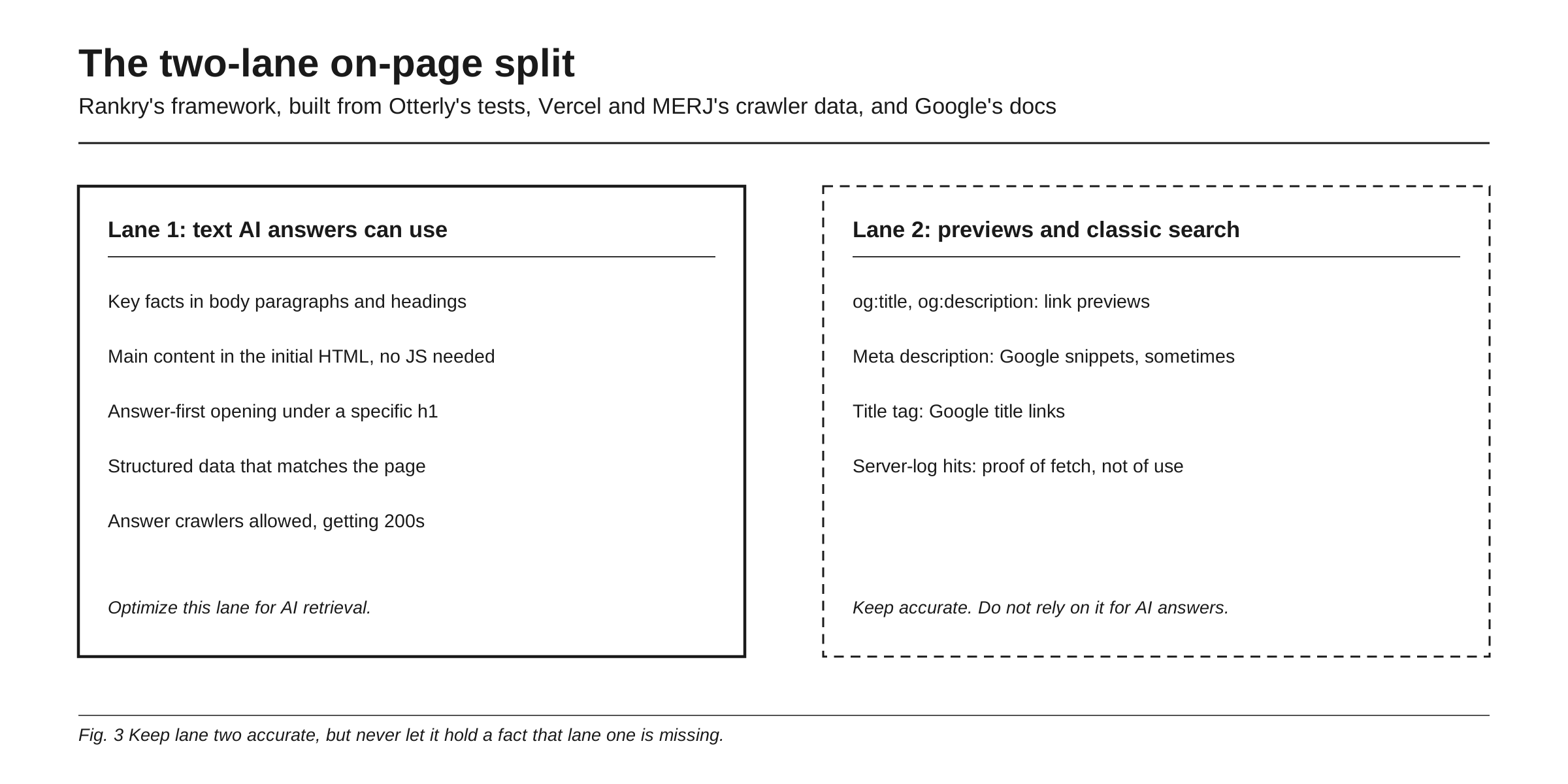
This is our own framework, the two-lane split: one lane for text an AI answer can use, one for metadata that serves previews and classic search. It is built from the evidence above, not from a separate test.
Lane one, matters for AI retrieval:
- Put every fact you want repeated (pricing model, category, who it is for, key numbers) in body paragraphs or headings, not only in the head or an image caption.
- Serve that text in the initial HTML. If a page needs JavaScript to show its main content, check a no-JavaScript fetch.
- Open with the answer under a specific h1, so the first text an engine extracts is the text you want repeated.
- Keep structured data identical to what the page shows. Mismatched JSON-LD is a policy problem at Google and a contradiction everywhere else.
- Allow the answer crawlers in robots.txt and at your CDN, then confirm they get 200 responses.
Lane two, does not carry facts into AI answers (keep it accurate anyway):
- og:title and og:description. Write them for humans seeing a link preview, and make them describe the page, not a slogan, since index pipelines can pick them up later.
- Meta description. Unique and accurate, for Google snippets. Do not hide facts there that are missing from the body.
- Title tag. It matters for Google title links and for the h1 alignment above, but it is not a substitute for body copy.
- Server-log hits. A crawl is not proof the model used your page; measure answers instead.
The test that settles it is the answer itself. Rankry tracks a stable set of buyer-intent prompts across ChatGPT, Claude, Gemini, Perplexity, Grok and Google’s AI answers every day, so you can see whether the description engines give of your brand matches your visible copy. Its AI traffic tracking shows the visits AI platforms send to your site, and the AI Readiness Checker runs 36 checks in 6 categories. Add crawler hits from your server logs, and you can separate “the bot came” from “the answer used it.”
FAQ
Do ChatGPT, Gemini and Perplexity read Open Graph tags? In Otterly’s October 2026 vendor test, no engine on its platform returned the og:title or og:description code across 504 questions with the URL given. ChatGPT, Gemini, Copilot and Google AI Mode also scored 0 of 12 when logged in. Perplexity data was missing until October 12, and Perplexity was not in the logged-in tests. Three pages on one site: clear direction, not a universal law.
Does Claude read Open Graph tags? Sometimes. The logged-in Claude app read Open Graph 12 of 12 times in Otterly’s manual tests, because its page-fetch tool passed head metadata to the model. Claude through the API with web search, which saw only search snippets, did not. Whether Claude sees your metadata depends on whether it actually opens the page.
Does the meta description help AI visibility? No study we found isolates it. Otterly’s test left the meta description unchanged, so it offers no direct answer. Google says snippets are primarily built from page content and the meta description is used sometimes. Keep it unique and accurate, and put any fact you need repeated in the visible body text.
Should I delete my Open Graph tags? No. Open Graph controls link previews on LinkedIn, Slack, WhatsApp and similar platforms, and Google lists og:title among the sources for title links. Keep the tags, write them to describe the page accurately, and stop treating them as an AI ranking lever.
Can AI crawlers read content rendered with JavaScript? Most could not as of Vercel and MERJ’s December 2024 analysis, which found none of the major AI crawlers rendered JavaScript; ChatGPT’s and Claude’s crawlers downloaded JS files without executing them. Gemini, via Googlebot, and AppleBot could render. Serve important content in the initial HTML and verify with your own logs.
Sources
- Do AI Engines Read Your Open Graph Tags? We Hid Codes in Ours to Find Out, Otterly.ai (Thaylise Nakamoto), October 22, 2026
- The rise of the AI crawler, Vercel with MERJ, December 17, 2024
- General structured data guidelines, Google Search Central, last updated July 10, 2026
- AI features and your website, Google Search Central, last updated December 10, 2025
- Control your snippets in search results, Google Search Central, last updated April 20, 2026
- Influencing your title links in search results, Google Search Central, last updated December 10, 2025
- Everything you ever wanted to know about unfurling but were afraid to ask, Slack Platform Blog (Matt Haughey), November 24, 2015
- GEO Experiment: Your Image Alt Text is Built for SEO. AI Search Reads Right Past It, Otterly.ai (Rick Tousseyn), April 21, 2026
See whether AI answers describe your brand the way your visible pages do, on the same prompts every day. Start a free 7-day Rankry trial, no card required.