Your URL probably affects AI citations a little, and messy URLs seem to hurt more than keyword-rich URLs help. We could not find a study, published on or before October 30, 2026, showing that descriptive or keyword URLs earn about 21% more AI citations. The closest confirmed data: an Ahrefs study of 1.4 million ChatGPT prompts found search results with natural language URL slugs had an 89.78% citation rate versus 81.11% without, while an Otterly.ai study of about 1 million cited URLs found near-zero correlation between URL length and citations, but 24% fewer citations for URLs with query strings. Both are vendor studies, and both are correlation, not experiments. Google’s Gary Illyes called keywords in URLs an “incredibly small signal” on October 14, 2026. The practical answer: do not rename existing URLs to chase AI citations, give new pages short descriptive slugs, and keep parameter junk out of the URLs you want cited.
URL advice is the oldest item on the SEO checklist, and it is getting a second life in GEO decks. The data supports a smaller, more boring conclusion than the slides do.
What the URL studies actually measured
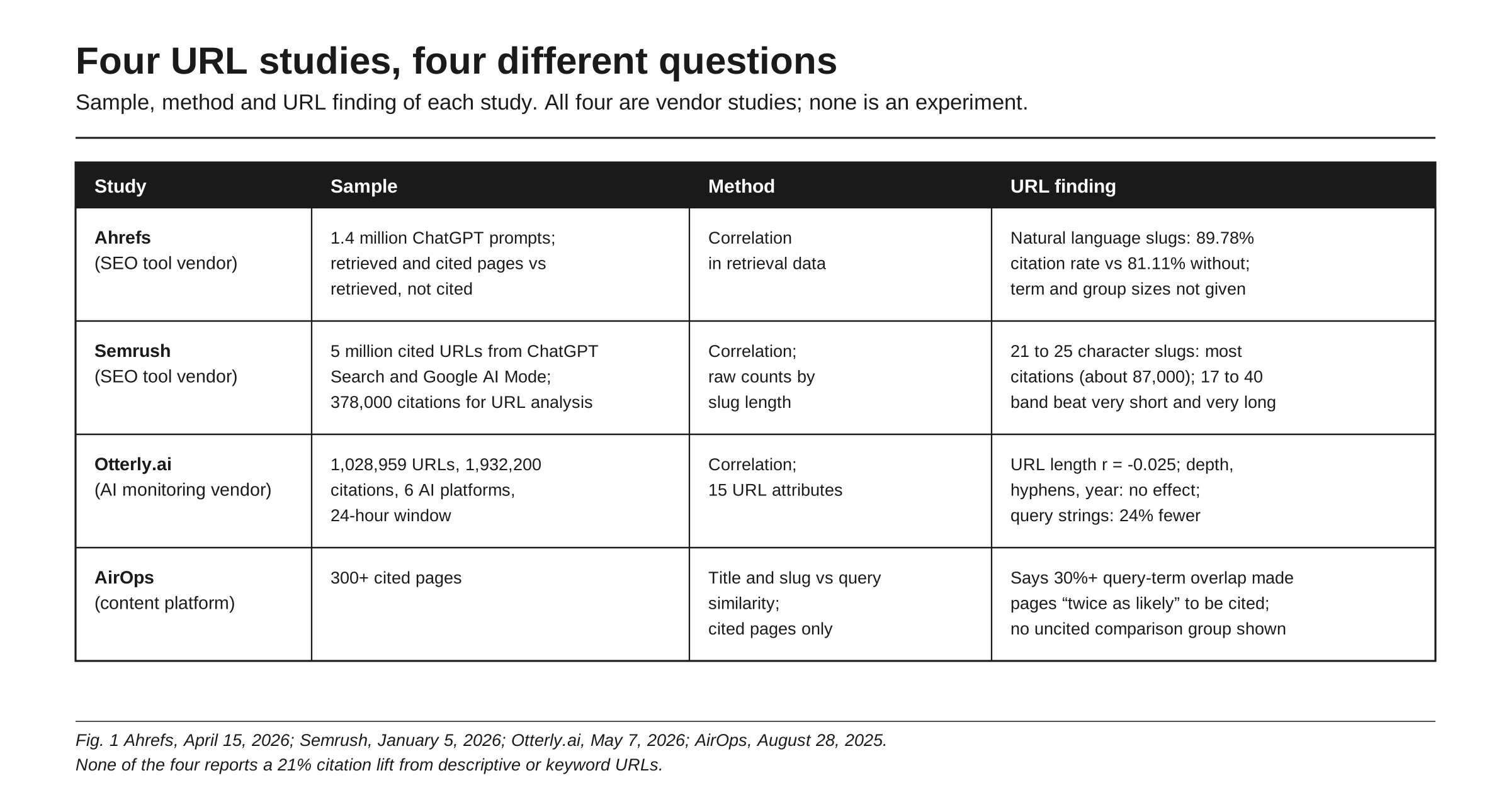
Four studies get quoted on this topic. They ask different questions, so their numbers do not stack.
Ahrefs (an SEO tool vendor) analyzed retrieval data from 1.4 million ChatGPT prompts, comparing pages ChatGPT retrieved and cited with pages it retrieved and did not cite. Its URL finding is one sentence: “search results with natural language URL slugs had an 89.78% citation rate, compared to 81.11% for those without.” That is an 8.67-point gap, roughly 11% in relative terms by our math. Ahrefs does not define “natural language slug” and does not give the size of each group, so we cannot tell how much of the gap belongs to the slug itself.
Semrush (an SEO tool vendor) studied 5 million URLs cited by ChatGPT Search and Google AI Mode, with a URL-structure analysis of 378,000 citations. Slugs of 21 to 25 characters collected the most citations (about 87,000), followed by 6 to 10 characters (about 57,000), and the 17 to 40 character range beat both very short (1 to 5) and very long (56+) slugs. These are raw counts, not rates, and Semrush notes that very short slugs are often homepage or category pages. Semrush itself says the study “identifies correlations, not causation.”
Otterly.ai (an AI search monitoring vendor) looked at 1,028,959 URLs and 1,932,200 citations across ChatGPT, Google AI Overviews, Google AI Mode, Perplexity, Gemini and Microsoft Copilot in a 24-hour window, testing 15 URL attributes. Every URL in its sample was cited at least once, so it measures how often cited URLs get cited, not whether a URL gets cited at all. It found “near-zero correlation between URL length and citation count (r = -0.025),” no effect from path depth (r = +0.002), and no effect from hyphen count (its proxy for slug word count) or a year in the URL. Its conclusion: optimizing URL length, depth or slug formatting “delivers effectively minimal return at this dataset scale.”
AirOps (a content platform vendor) measured how closely the titles and slugs of 300+ cited pages matched the query. It says pages with at least 30% query-term overlap “were twice as likely to earn citations,” but its method describes only cited pages, with no uncited comparison group, so we could not see how that figure was derived.
The clearest URL signal is clutter, not keywords
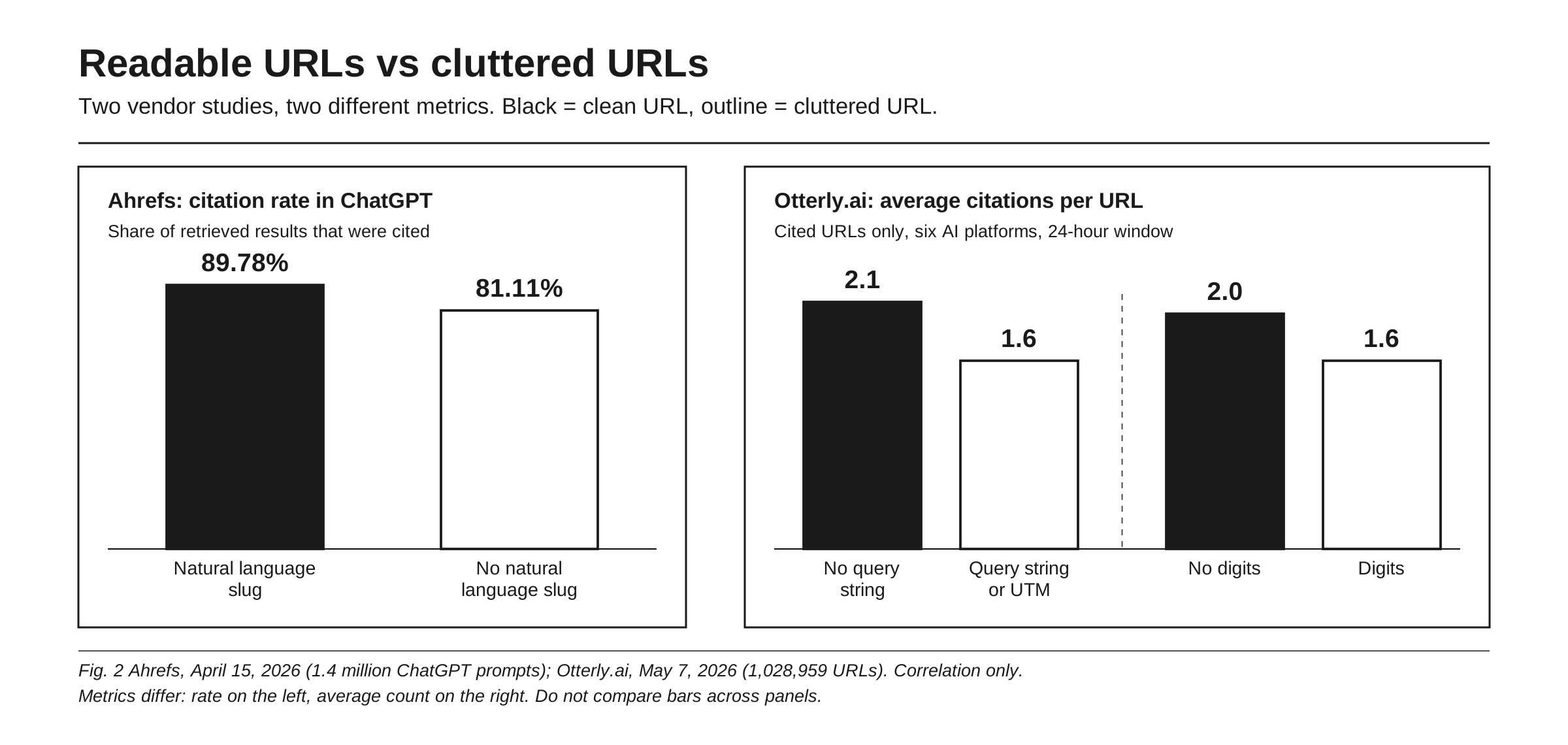
Put the two studies that compare one group of URLs with another side by side and the pattern is about readability, not keyword density.
In Otterly’s data, URLs with query strings or UTM tags averaged 1.6 citations versus 2.1 for URLs without them, which Otterly calls “a 24% reduction across 430,628 query-bearing URLs.” URLs containing digits averaged 1.6 versus 2.0. Ahrefs’ natural language slug gap points the same way: readable paths beat opaque ones in its sample.
What none of the studies show is that adding more keywords to a slug adds citations. Otterly found that hyphens and total words in slugs “do not predict citations in either direction.” Semrush’s long-slug band, which it describes as “often deeply nested or keyword-stuffed,” appeared less often among cited URLs.
There are confounds. A URL with a query string is often a filter page, an internal search result or a tracking variant of another page, and those pages may be weaker sources for reasons unrelated to the URL.
What Google says: an “incredibly small signal”
On October 14, 2026, Google published “What can you actually put in a URL,” the first episode of a Search Central video series called The Non-Canonical Cabinet, with Gary Illyes and Cherry Prommawin. Search Engine Roundtable reported Illyes calling keywords in a URL or domain an “incredibly small signal.” In PPC Land’s transcript, which is based on automatic captions, Illyes adds: “It really only matters when we have absolutely nothing else to go on.” Once a page has content, he says, keywords in the domain and URL “become basically irrelevant.” He also repeats the old advice to separate words with hyphens, not underscores.
Google’s URL structure documentation, last updated October 21, 2026, says the same thing in neutral terms: “When possible, use readable words rather than long ID numbers in your URLs.”
For Google’s own AI answers, there is little reason to expect URLs to count for more. Google’s guide to generative AI features says those features “are rooted in our core Search ranking and quality systems.” That is our inference, not a Google statement about URLs in AI Overviews or AI Mode specifically.
Why a URL could matter more to ChatGPT than to Google
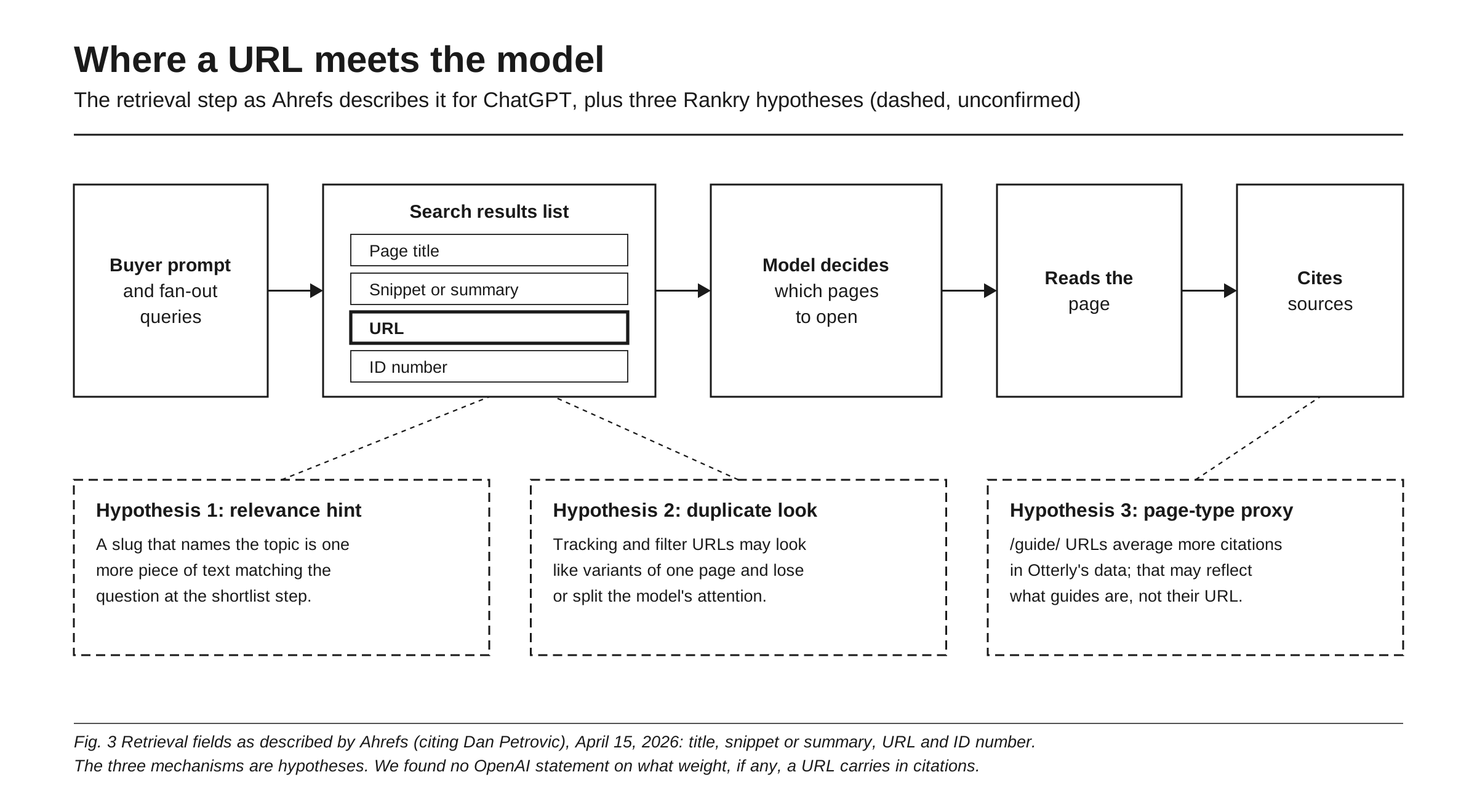
An LLM choosing sources from a search results list may have far less to go on than Google at the first step. Ahrefs, citing research by Dan Petrovic, describes the retrieval data this way: each result “comes back with the page title, a brief snippet or summary, the URL, and an ID number,” and ChatGPT “uses this data to decide which pages are worth opening.” In Ahrefs’ words, “The title, snippet, and URL are doing the heavy lifting in that initial decision.”
That gives three plausible mechanisms. All three are our hypotheses. We found no AI company confirming any of them.
Hypothesis 1: the slug is a relevance hint at the shortlist step. When the model sees a list of results, a slug that names the topic is one more piece of text matching the question. Ahrefs concludes that if your “URL and title don’t semantically align with the AI’s internal fanout queries,” you are less likely to get cited, which fits the sub-query logic in our query fan-out guide.
Hypothesis 2: parameter URLs look like duplicates or low-value pages. The same page reachable under several tracking or filter URLs may split whatever attention it gets, or look like a variant the model skips.
Hypothesis 3: the URL is a proxy for page type. In Otterly’s data, URLs with /guide/ in the path averaged 2.7 citations, 42% above the overall average of 1.9, though guides were only 8,649 URLs, under 1% of the sample. That more likely reflects what guides are than what their URLs say.
If hypothesis 3 explains most of the gap, rewriting URLs changes nothing. That is the main reason to treat URLs as hygiene, not a lever.
A URL hygiene checklist for AI search
Start with the rule that matters most: do not rename existing URLs to chase AI citations. Google’s site move documentation warns that “the visibility of your content in Search may fluctuate temporarily during the move,” and it recommends keeping redirects “generally at least 1 year.” The largest measured gap is under 9 points, in one vendor dataset, and it is correlational. The downside is a migration.
Our working checklist, for new pages and for moves you are already making for other reasons:
- Leave working URLs alone. Apply new slug rules only when you consolidate duplicates, restructure a section or migrate a site anyway, and use permanent redirects (301 or 308) when you do.
- Give new pages a short, descriptive slug. Name the topic in plain words, about 3 to 6 of them in our practice. Treat Semrush’s 17 to 40 character band as a loose range, not a target.
- Match the slug to the title and the question the page answers. /crm-for-small-law-firms, not /post-4812 and not /best-crm-software-crm-tools-crm-2026.
- Use hyphens and words over IDs, and keep letter case consistent. Hyphens and readable words are Google’s documented guidance, Google notes that URLs are case sensitive, and all of it costs nothing on a new page.
- Keep tracking parameters out of the URLs you control. Google’s own guidance is to trim parameters that do not change the content. Use clean URLs in internal links, sitemaps and canonical tags, and save UTM tags for external campaigns.
- Skip the year in evergreen slugs. Otterly found no citation effect from a year in the URL, and a dated slug forces a rename or looks stale next year.
- Do not stuff keywords. Illyes said Google can detect spamming in URLs, and none of the studies reward longer, keyword-heavy slugs.
- Spend the effort on the page instead. Otterly’s own advice is that with a limited GEO budget you should “spend it on content quality, not URL refactoring.” More on what moves citations is in our AI search ranking strategies guide, and the same skepticism applies to markup tweaks in what structured data actually does for AI visibility.
The honest way to settle this for your site is to measure. Rankry tracks how ChatGPT, Claude, Gemini, Perplexity, Grok and Google’s AI answers mention and cite your brand on a stable set of buyer-intent prompts, every day, so you can see whether new pages with clean slugs get picked up as sources. Its AI traffic tracking shows the visits AI platforms send to your site, and competitor comparison shows which competitors get mentioned and cited instead.
FAQ
Do keywords in URLs help you get cited by ChatGPT? Possibly a little. In an Ahrefs study of 1.4 million ChatGPT prompts, results with natural language URL slugs had an 89.78% citation rate versus 81.11% without. That is correlation in one vendor dataset, and Ahrefs did not define the term or give group sizes. No study we found shows that adding more keywords to a slug adds citations.
Should I change my existing URLs to get more AI citations? No. The measured upside is small and correlational, and changing URLs means redirects and a period of fluctuation. Google’s site move guidance says visibility may fluctuate during a move and recommends keeping redirects at least a year. Apply descriptive slugs to new pages, and to existing ones only when you are already moving them for another reason.
Does URL length affect AI citations? Not much, according to the study that tested it most directly. Otterly.ai’s study of about 1 million cited URLs found near-zero correlation between URL length and citations (r = -0.025). Semrush counted the most citations for slugs of 21 to 25 characters, but those are raw counts, not rates. Aim for short and readable, not a specific length.
Do UTM parameters hurt AI citations? They correlate with fewer citations. In Otterly.ai’s data, URLs with query strings or UTM tags averaged 1.6 citations versus 2.1 without, a 24% gap. Those URLs are often filter pages or tracking variants, so the URL may not be the cause. Keep internal links, sitemaps and canonical tags pointing to clean URLs.
Does Google use URLs for AI Overviews and AI Mode? Google says its generative AI features are rooted in its core Search ranking and quality systems. For Search rankings, Gary Illyes called keywords in URLs an “incredibly small signal.” Google recommends readable words and hyphens in URLs. We found no Google statement that URLs carry any special weight in AI Overviews or AI Mode.
Sources
- Why ChatGPT Cites One Page Over Another (Study of 1.4M Prompts), Ahrefs (Louise Linehan), April 15, 2026
- How Do Technical SEO Factors Impact AI Search? [Study], Semrush (Nitin Manchanda), January 5, 2026
- The URL AI Citation Study 2026, Otterly.ai (Rick Tousseyn), May 7, 2026
- From Query to Citation: How Snippet Signals Influence AI Search, AirOps (Oshen Davidson), August 28, 2025
- Google Search Video On URLs: Ranking Factor, Hyphens vs Underscores & Emojis, Search Engine Roundtable (Barry Schwartz), October 14, 2026
- Google says URL keywords become irrelevant once a page has content, PPC Land (Luís Rijo), October 18, 2026
- URL Structure Best Practices for Google Search, Google Search Central, last updated October 21, 2026
- Site Moves and Migrations, Google Search Central, last updated August 20, 2026
- Google’s Guide to Optimizing for Generative AI Features on Google Search, Google Search Central, last updated July 10, 2026
See whether your new pages actually get cited across ChatGPT, Claude, Gemini, Perplexity, Grok and Google’s AI answers, every day. Start a free 7-day Rankry trial, no card required.