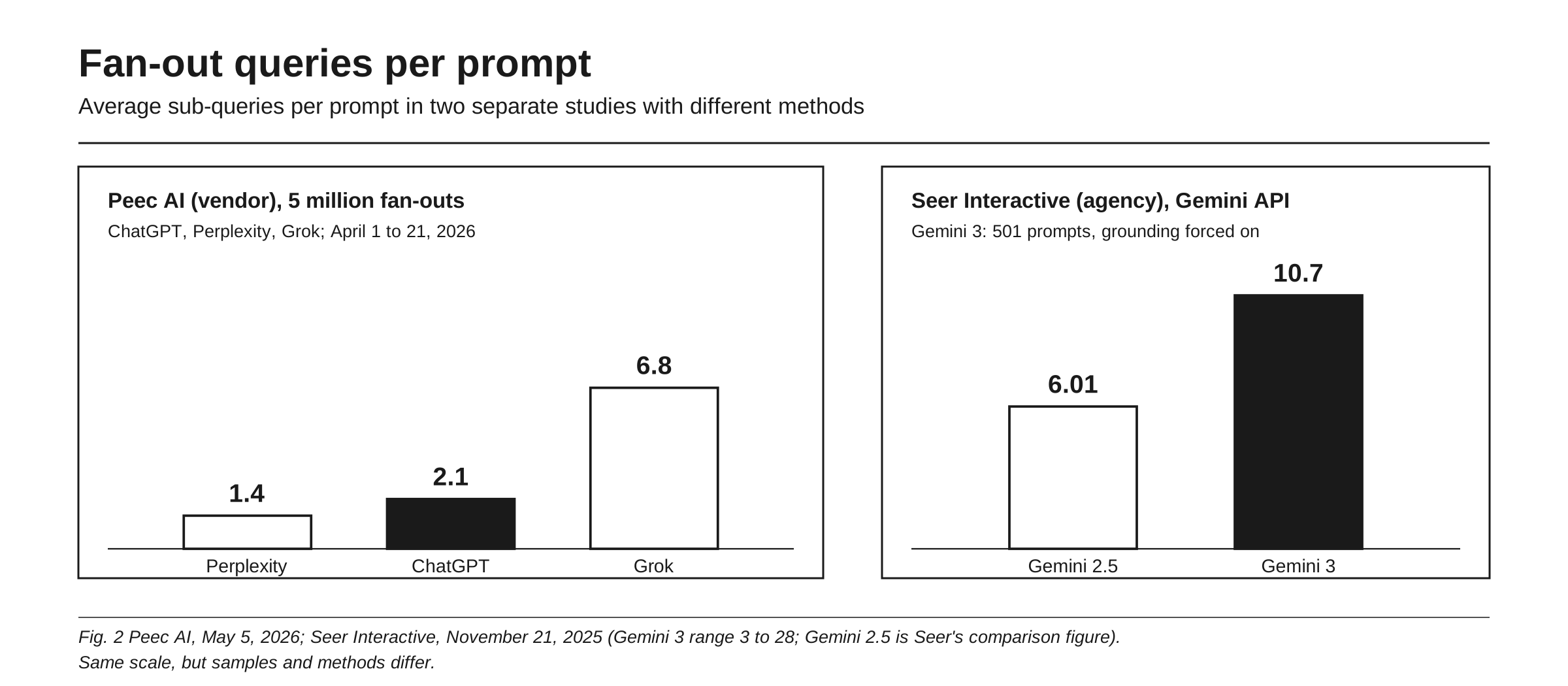
When someone asks an AI search engine a question, the engine often does not search for that question alone. It generates a set of related sub-queries, a process Google calls “query fan-out,” retrieves pages for each one, and blends the results into a single answer. Counts vary by engine: in a Peec AI analysis of 5 million fan-outs, ChatGPT averaged 2.1 per prompt, Perplexity 1.4 and Grok 6.8, while Seer Interactive counted 10.7 per prompt from the Gemini 3 API. The sub-queries lean toward “best” lists, reviews, comparisons, brands and the current year, and their wording changes from run to run. Google’s own guide warns that creating separate content for fan-out queries primarily to manipulate rankings or AI responses in Google Search violates its scaled content abuse policy. The workable approach: find the recurring sub-questions behind your core prompts, group them into a few topics, and answer them inside strong pages, not one page per query.
Most content teams still write for the prompt the buyer typed. The engine is reading for a different list of questions, and most of them never show up in a keyword tool.
What query fan-out is, in the engines’ own words
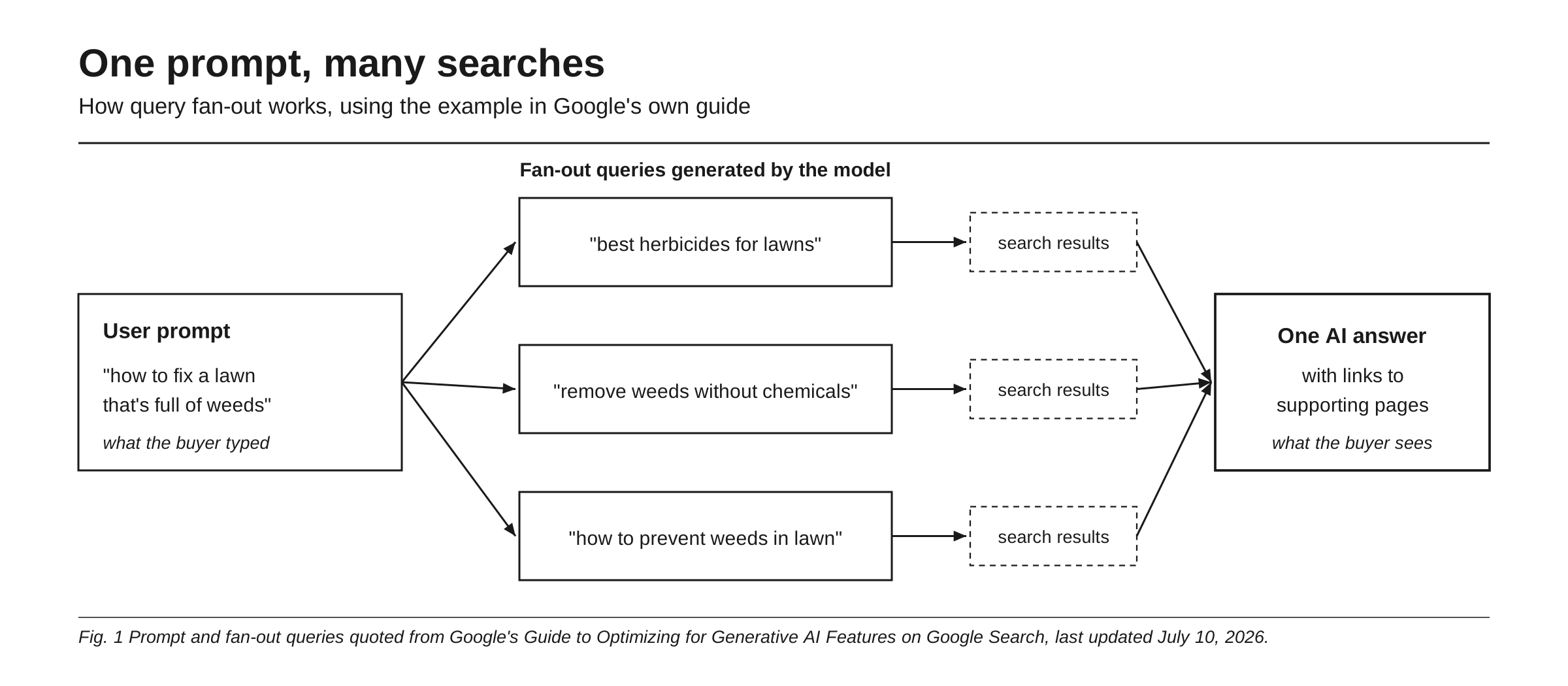
Google used the term when it introduced AI Mode on March 5, 2025, saying AI Mode “uses a ‘query fan-out’ technique, issuing multiple related searches concurrently across subtopics and multiple data sources and then brings those results together.” At Google I/O on May 20, 2025, the company described AI Mode “breaking down your question into subtopics and issuing a multitude of queries simultaneously on your behalf,” and said its Deep Search feature “can issue hundreds of searches.” Google’s help page “AI features and your website” says both AI Overviews and AI Mode “may use” the technique.
The clearest definition sits in Google’s 2026 guide to optimizing for generative AI features: “A set of concurrent, related queries generated by the model to request more information and fetch additional relevant search results to address the user’s query.” Google’s example: for “how to fix a lawn that’s full of weeds,” fan-out queries “might include ‘best herbicides for lawns’, ‘remove weeds without chemicals’, and ‘how to prevent weeds in lawn’.”
OpenAI is less specific. Its help center says ChatGPT “searches based on your prompts and may share disassociated search queries with third-party search providers,” without saying how many. What we know about ChatGPT’s sub-queries comes from third parties who observe them.
The practical meaning: your page can be retrieved for a sub-question the buyer never typed, and skipped for the question they did.
How many sub-queries engines generate
Read each number below as a description of one sample, not a constant.
Peec AI, a vendor of AI search monitoring software, analyzed 5 million fan-out queries collected April 1 to 21, 2026 across ChatGPT, Perplexity and Grok, most of them from ChatGPT. Average fan-outs per prompt: Perplexity 1.4, ChatGPT 2.1, Grok 6.8. Peec’s reading is that Perplexity mostly simplifies the query, ChatGPT adds brands, comparisons and reviews, and Grok “runs a full research brief.”
Google’s models appear to run wider. Seer Interactive, a marketing agency, ran 501 prompts through the Gemini 3 API with grounding forced on and found an average of 10.7 fan-out queries per prompt, with a minimum of 3 and a maximum of 28; Seer puts the Gemini 2.5 average at 6.01. Note the method: this is the API with search forced for every prompt, not the AI Mode interface. Ahrefs, citing Seer and Nectiv research without splitting it by engine, reports that 59% of prompts triggered 5 to 11 searches and 24% triggered 12 to 19.
Counts move with model updates, as the Gemini 2.5 to Gemini 3 jump shows, but the direction is consistent: one buyer prompt often becomes more than one search, and in Seer’s Gemini 3 sample it averaged more than ten.
What the sub-queries ask for, and how much they drift
The sub-queries are not random paraphrases. They add the words a careful buyer would add.
In Peec’s data, “best” is the word ChatGPT most often injects into fan-outs, and for advice-style prompts such as “Should I use X?” it appears in 24.3% of fan-outs. ChatGPT added the current year in 5.44% of prompts. Grok used the site: operator in 18.3% of chats, and Reddit appeared in 10.5% of Grok chats. Other words Peec lists among the most injected: top, comparison, reviews, tools, software and features.
Seer’s Gemini 3 sample shows a similar shape: 21.3% of fan-out queries contained a year, 26.4% included a brand name, and the average fan-out was 6.7 words long. And 95% of the fan-out queries had zero monthly search volume, so a keyword tool built on human search volume will not surface most of them.
They also drift. Surfer, which sells SEO content software, found that only about 27% of fan-out queries stay the same when the identical prompt is run again, as SEO consultant Hans van Gent summarized it in July 2026. Van Gent, who builds a browser extension that captures fan-outs, ran one buyer prompt through ChatGPT three times with it: the wording changed (“Ahrefs pricing plans 2026” one time, “Ahrefs pricing 2026 official” the next) and sources pulled ranged from 19 to 93, yet every run searched for pricing on the same four tools. Three runs is an anecdote, but it shows the useful split: wording is unstable, the underlying sub-question is steadier.
So the unit to plan around is the recurring sub-question (pricing, comparisons, alternatives, reviews, fit for a use case, freshness), not the exact string.
Where Google draws the line
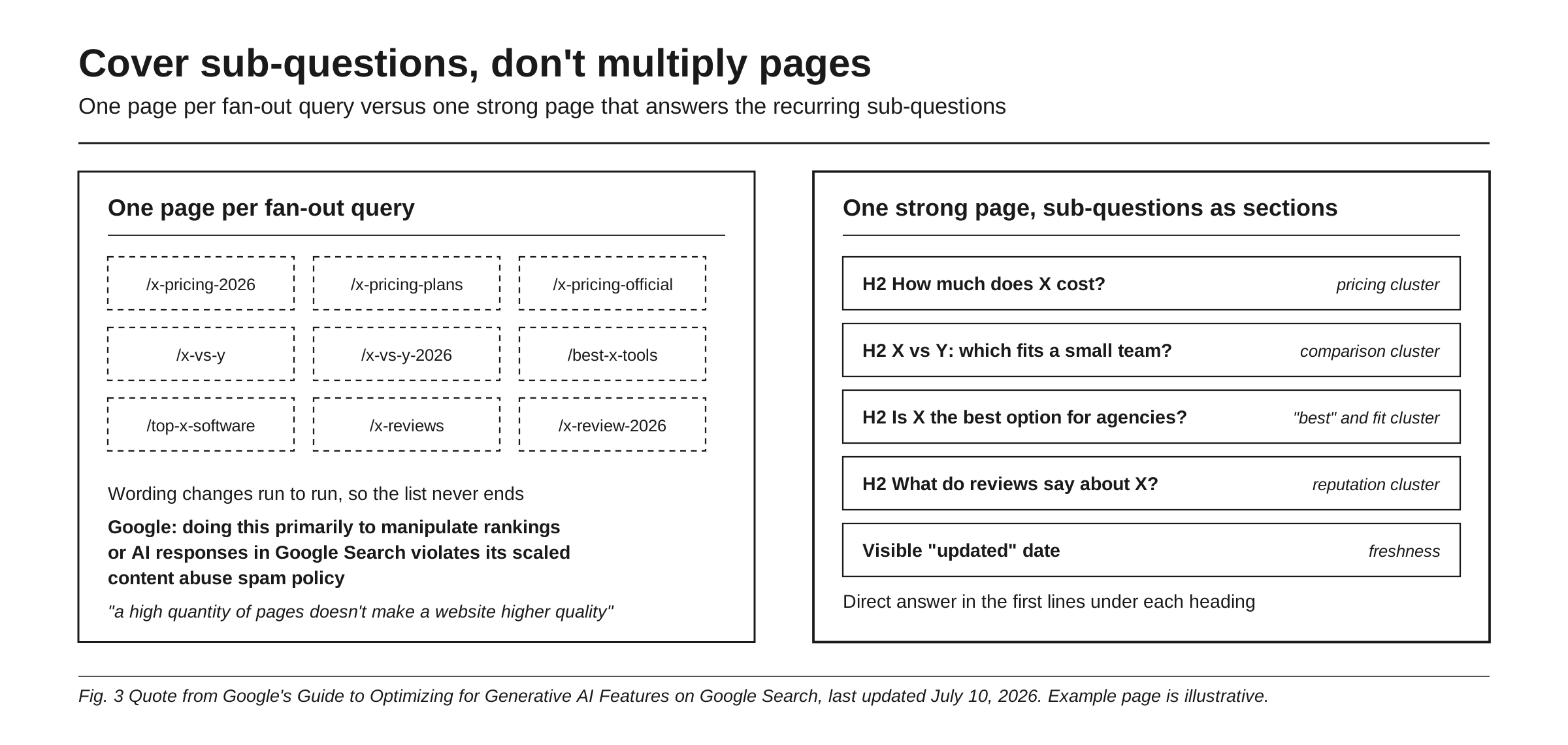
The obvious temptation: if an engine runs ten sub-queries, publish ten pages. Google’s guide addresses this in its advice on creating valuable, non-commodity content:
“While it might be tempting to create separate content for every possible variation of how people might search (for example, by focusing on other queries that people have asked, or fan-out queries), doing so primarily to manipulate rankings or generative AI responses in Google Search violates Google’s scaled content abuse spam policy. This is also an ineffective long-term strategy, as a high quantity of pages doesn’t make a website higher quality or more relevant to users.”
The same passage says Google’s AI systems can understand the relevance of pages “even when there is no exact match between the query and the page’s primary content.” The rule is scoped to Google Search; the rest of what the guide says you can skip is covered in what Google’s own AI search guide says you don’t need. Outside Google, a page-per-query site is still a weak bet, since the queries change between runs.
What does appear to help is coverage inside pages that already earn rankings. In a Surfer study of 173,902 URLs across 10,000 keywords, with the fan-out queries pulled using Gemini, pages that ranked for the main query and its fan-out queries were 161% more likely to be cited in Google’s AI Overviews than pages ranking for the main query alone, with a 0.77 correlation between fan-out coverage and citations (as reported by van Gent). That is a correlation: strong pages tend to rank for many related queries, so read it as support for depth, not proof that adding sections causes citations.
How to find, cluster and cover your fan-outs
This is our working method at Rankry, not an industry standard. We call it find, cluster, cover.
-
Start from core buyer prompts, not keywords. Fan-outs only make sense relative to a prompt, so begin with the buyer questions that matter most to revenue. Building that list is covered in how to choose which buyer questions to track and how to find prompts where your brand should appear.
-
Capture fan-outs with repeat runs. Run each prompt several times per engine and record the sub-queries. Peec describes the manual route: open the AI search engine, open your browser’s Network tab, and watch the requests as the answer loads; the fan-out queries sit inside the API calls. Monitoring tools that expose fan-outs, or the Gemini API with grounding (Seer’s route), are faster. Given the drift, one run tells you little.
-
Add the questions real buyers ask. Sales call notes, support tickets, on-site search logs and Search Console queries show sub-questions in the buyer’s own words.
-
Normalize, then cluster by intent. Strip years and filler, merge near-duplicates (“X pricing 2026” and “X pricing plans” are one question), and group by the job each sub-question does: price, compare, check fit, verify reputation, set up.
-
Keep the clusters that recur. A sub-question that shows up across runs and engines earns attention; a one-off string does not. Most clusters belong as a section of an existing page. A new page is justified only when the cluster is a real topic a reader would arrive at on its own, such as pricing or an honest comparison.
-
Structure pages so each sub-question has a findable answer. Use headings phrased the way the question is asked, answer in the first sentence or two under each heading, state facts like price, limits and integrations in plain text, and show a visible updated date, since many fan-outs include a year.
-
Measure the outcome at the prompt level. The goal is to appear in the answer to the original prompt, so re-check that across engines over several weeks. How many runs you need before trusting a result is covered in how many times to ask before you trust the answer.
Rankry is built for that last step. It runs a stable set of buyer-intent prompts every day across ChatGPT, Claude, Gemini, Perplexity, Grok and Google AI Mode and AI Overviews, so after you restructure a page you can see whether your brand starts appearing in the answers, and which competitors appear when you do not. A sub-question added as a prompt is answered right away, which helps decide whether it deserves a section, and the Google Search Console integration brings your human query data into the same workspace.
FAQ
What is query fan-out? Query fan-out is when an AI search engine turns one user question into several related searches, retrieves results for each, and combines them into one answer. Google defines fan-out queries as “concurrent, related queries generated by the model” and says AI Overviews and AI Mode may use the technique. ChatGPT, Perplexity and Grok behave similarly, according to third-party studies.
How many fan-out queries does ChatGPT run per prompt? In Peec AI’s analysis of 5 million fan-outs collected in April 2026, ChatGPT averaged 2.1 per prompt, compared with 1.4 for Perplexity and 6.8 for Grok. Seer Interactive counted 10.7 per prompt from the Gemini 3 API with grounding forced on. OpenAI does not publish an official figure, and counts shift with model updates.
Should I create a separate page for each fan-out query? No. Google’s guide says creating separate content for fan-out queries “primarily to manipulate rankings or generative AI responses in Google Search violates Google’s scaled content abuse spam policy.” Fan-out wording also changes between runs. Group recurring sub-questions into a few topics and answer them as sections of strong pages, creating a new page only for a topic readers seek on its own.
How can I see the fan-out queries for my prompts? Run the prompt in the AI engine with your browser’s Network tab open and look for the search queries inside the requests, as Peec AI describes. Some monitoring tools expose fan-outs directly, and researchers such as Seer have pulled them through the Gemini API with grounding. Run each prompt several times, because one run shows only part of the picture.
Why do fan-out queries change every time I check? AI models are not deterministic, so the same prompt can produce different sub-queries on each run. Surfer found that only about 27% of fan-out queries stay the same when the identical prompt is run again. The exact wording drifts more than the underlying topics, which is why you should plan around recurring sub-questions, not individual strings.
Sources
- Google’s Guide to Optimizing for Generative AI Features on Google Search, Google Search Central, last updated July 10, 2026
- AI features and your website, Google Search Central, last updated December 10, 2025
- Expanding AI Overviews and introducing AI Mode, Google, March 5, 2025
- AI in Search: Going beyond information to intelligence, Google (Elizabeth Reid), May 20, 2025
- ChatGPT search, OpenAI Help Center, undated help article
- Patterns we see in ChatGPT query fanouts, Peec AI (Tomek Rudzki), May 5, 2026
- Initial Research: Gemini 3 Query Fan-Outs, Seer Interactive, November 21, 2025
- What is Query Fan-Out? Understanding the Hidden Queries Driving AI Search, Ahrefs, March 2, 2026, updated May 31, 2026
- Query fan-out: the hidden questions that decide who AI cites, Hans van Gent, July 2, 2026 (source for the Surfer figures)
See whether your pages win the prompts behind the sub-questions, across ChatGPT, Claude, Gemini, Perplexity, Grok and Google’s AI answers, every day. Start a free 7-day Rankry trial, no card required.