Being famous often gets your brand named in AI answers. It does not get your website cited. In Semrush’s AI Visibility Index (H2 2026 edition, released October 13, 2026), fewer than half of the top 100 mentioned brands also appeared among the top 100 cited domains, on average, and in the US data household names such as Ford, Disney, Toyota and Nintendo sat in the top 100 for mentions on all four platforms while ranking outside the top 500 for citations in every month measured. Our reading of the evidence: an AI engine cites the page that answers a specific sub-question, such as price, fit, specs or how one product compares with another, and that page is often a review, a forum thread, a help doc or a challenger’s spec page. In our view, many big-brand sites are built to sell and tell a story, not to state those answers in plain text. Large brands can narrow the gap with answerable product, pricing and support pages plus third-party coverage; challengers win by being the clearest source on the questions buyers actually ask.
A famous brand can look healthy on an AI visibility dashboard and still be absent from the place where credit and clicks are handed out. The two numbers measure different things, and most brand teams only watch one.
Mention and citation are different wins
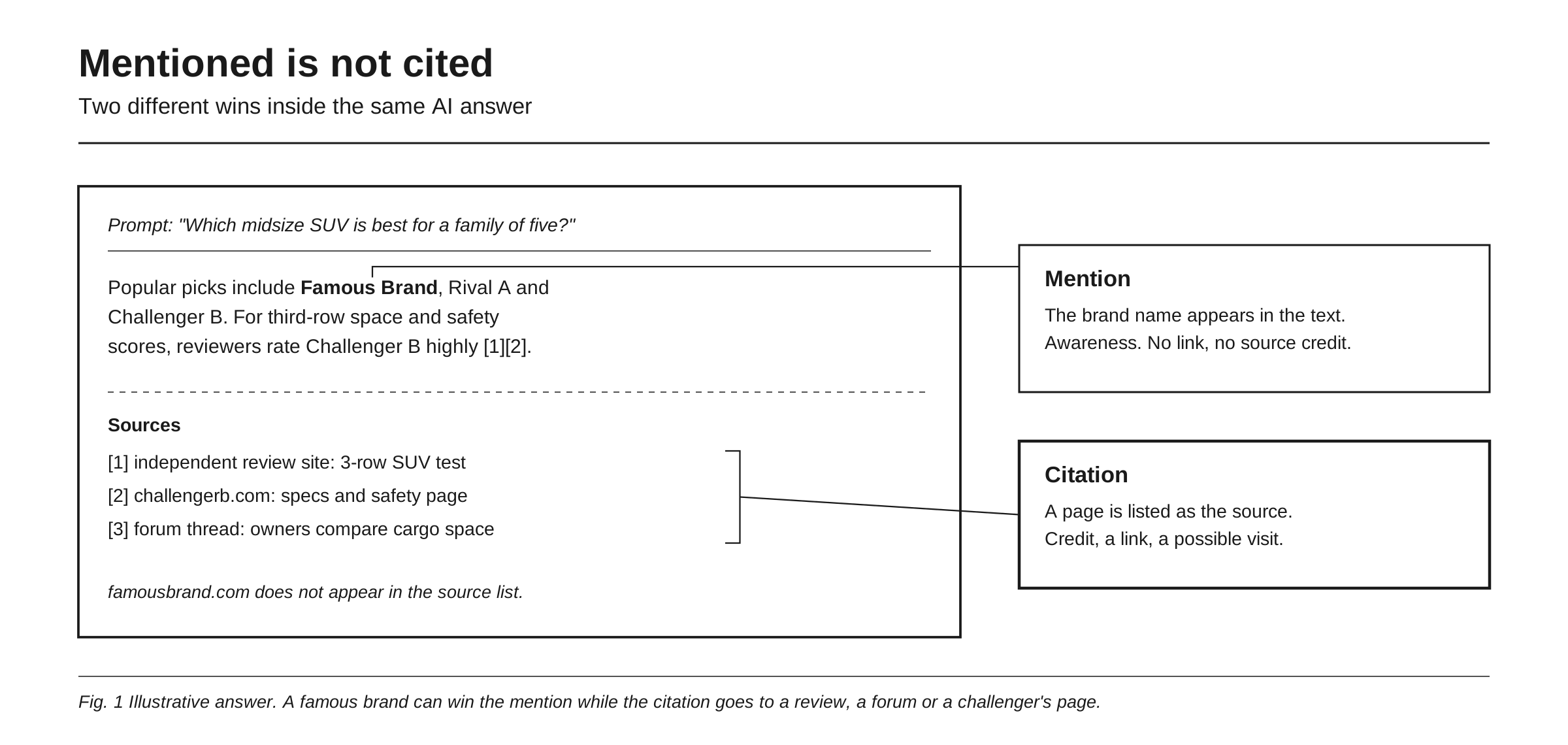
Semrush’s index defines a mention as “how often a brand is mentioned in AI answers for the selected market, month, industry, and AI platform,” and a citation as “how often a domain is cited as a source” in those answers. It adds: “A brand can be mentioned frequently without its website being cited as often.”
A mention is your name in the text, drawn from training data, retrieved sources or both. A citation is a specific page listed as evidence, and that is what carries a link and a chance of a visit. The full breakdown is in brand mentions vs citations in AI.
Ahrefs looked at more than 31,000 mentions of its own brand in its Brand Radar data and found AI assistants linked to its site about 28% of the time. The rate ranged from 10.7% on Google AI Overviews to 51.6% on Perplexity. That is one brand, measured by its own tool, but it shows how far apart the two numbers can sit. Being recommended is a third, separate layer, covered in mentions vs recommendations and revenue.
What the Semrush index found about famous brands
Semrush sells AI visibility tools, so this is a vendor study, but a large one. The H2 edition covers seven months, January to July 2026, using fixed monthly sets of 25 million US and 2.5 million UK prompts on ChatGPT, Gemini and Google AI Mode, plus a separate, larger keyword-based dataset for Google AI Overviews, across 22 categories.
The headline: averaged across categories and platforms, fewer than half of the top 100 mentioned brands also appeared among the top 100 cited domains, in every month and in both markets. In the UK, average overlap ranged from 36.7 to 45.3 domains out of 100, depending on the month.
In the UK, Tesco and Asda both stayed in the top 100 for mentions on all four platforms every month. In July, Tesco was ChatGPT’s 25th most-cited UK domain and Asda was 606th. On Gemini they were 29th and 60th.
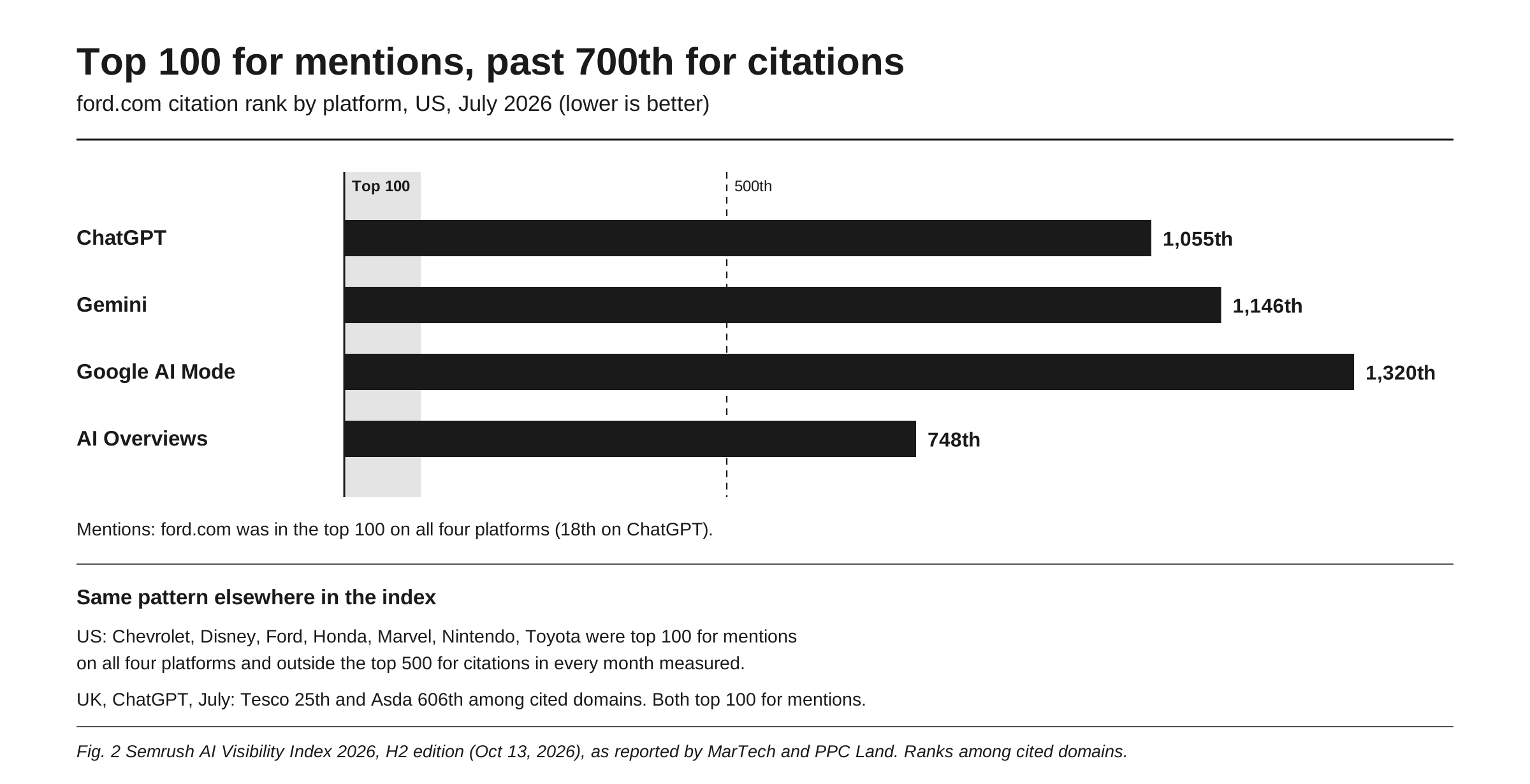
In the US, MarTech (which Semrush owns) reported that Chevrolet, Disney, Ford, Honda, Marvel, Nintendo and Toyota ranked in the top 100 for mentions on all four platforms and “were all outside the top 500 for citations in every month measured.” In July, ford.com ranked 18th for ChatGPT mentions (per PPC Land) but 1,055th for ChatGPT citations, 1,146th on Gemini, 1,320th on AI Mode and 748th on AI Overviews. PPC Land reports that the full report calls this position, top 100 for mentions on all four platforms but outside the top 500 for citations on all four, the “One-Way Door.”
Read these ranks carefully. 1,055th does not mean ford.com is never cited; it means more than a thousand domains were cited more often. As quoted by PPC Land, the report says a citation “is a recorded source position, not a measure of trust or editorial approval.” Neither the release nor the coverage explains why Ford or Asda are cited so rarely. The full report requires registration and we did not review it; these figures come from Semrush’s release and two news reports on it.
Other studies point the same way
Retail brands, Gradial. Gradial, a marketing software vendor with a GEO offering, ran 20 buying and research queries for each of 28 retail and consumer brands across OpenAI, Anthropic and Perplexity, 60 searches per brand. Average mention rate was 44%; average URL citation rate was 8%. A global beverage company was mentioned in 92% of responses and cited in 3%. An athletic footwear brand: 88% and 2%. The best citation rate, 47%, belonged to a rural lifestyle and farm supply retailer; Gradial notes its two top performers “weren’t the biggest names.” Gradial does not state collection dates.
175 brands, Victorious. In a sponsored Search Engine Journal post, Victorious reported on a cohort of 175 brands across five verticals. Eight AI platforms described 96% of the brands accurately when asked about them directly (140 brands had evaluable responses), yet 89% of the brands measured never appeared in answers to category research questions. Of 49,391 citations on those prompts, 99.99% pointed to third-party sites, and only 4 of 150 brands in the mention cohort earned a citation to their own website. The post does not say how the brands were chosen or how large they are, and gives no fieldwork dates.
Popularity and recommendations, Northwestern. A preprint from Northwestern University and Boston University researchers, posted September 14, 2026 and not peer reviewed, tested six models from OpenAI, Google and Anthropic across five product categories with web search turned off. It found “limited evidence that recommendation prominence follows conventional brand popularity,” measured with Kantar BrandZ salience scores. Search interest was the signal most strongly associated with prominence. It measures what models name from memory, not citations, so the lesson is narrower: even mentions do not simply follow fame, and citations sit one step further away.
Why famous sites lose the citation
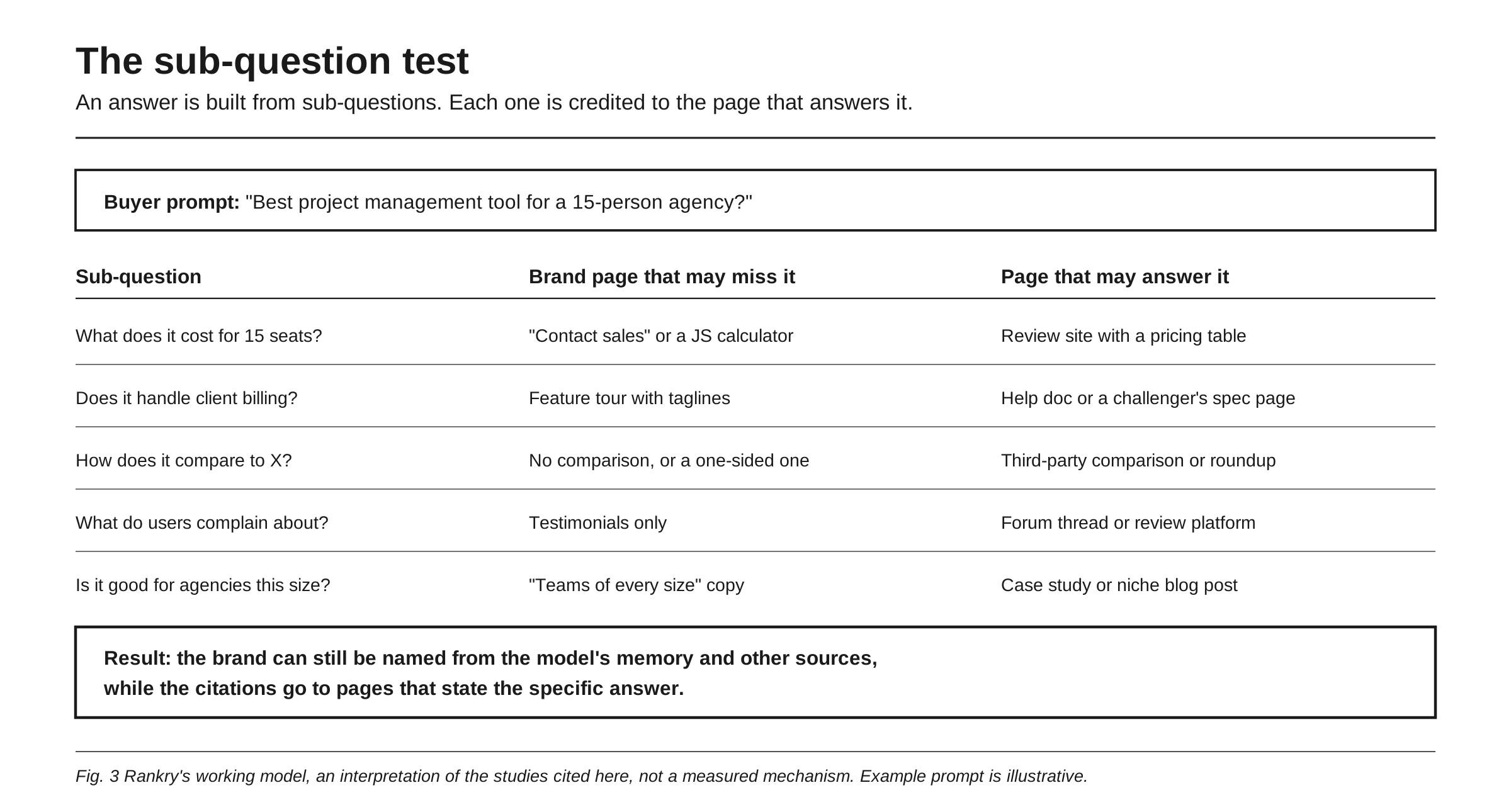
No study has isolated the mechanism, so what follows is Rankry’s working model, the sub-question test: an interpretation that fits the data above, not a proven rule.
A buyer prompt such as “best project management tool for a 15-person agency” breaks into smaller questions: what it costs at that size, whether it handles a specific workflow, how it compares with a rival, what users complain about. In this model, each claim is credited to a page that states the answer. Fame can get a brand named; it does not supply those answers.
Four patterns plausibly explain why big-brand sites fail that test.
Pages built to sell. Gradial found that product detail pages, category pages and promotional landing pages “were nearly invisible to AI citation,” and concluded that “AI models don’t cite pages that are trying to sell something.”
Specifics that are missing or hidden. “Contact sales” pricing, configurators, region selectors and gated spec sheets may keep the exact answer off the page a crawler can read. Treat this as a hypothesis to check on your own site; the related pricing problem is covered in why your pricing page is invisible to ChatGPT.
Content that needs JavaScript. In a December 2024 analysis with MERJ, Vercel found that none of the major AI crawlers it observed rendered JavaScript, including OpenAI’s OAI-SearchBot, ChatGPT-User and GPTBot, Anthropic’s ClaudeBot and PerplexityBot. Gemini, which uses Googlebot’s infrastructure, did. Crawlers change, but if your specs load client-side, check the raw HTML.
Questions that call for an independent voice. “Is it good?” and “how does it compare?” tend to be answered from others. Semrush’s release says AI visibility “is shaped both by what a company says about itself, and what others say about it.” In its June release, Semrush said Patagonia’s visibility was supported by consistent descriptions across sources including OutdoorGearLab, REI, Switchback Travel, GearJunkie and Reddit.
For an already known brand, its own pages may matter less. In a July 2026 experiment, Ahrefs published 34 self-promotional pages on 5 domains. When its new conference brand, Ahrefs Evolve, broke into 72 answer slots where it had been absent, 82% of those new mentions appeared in answers that cited one of the pages. For Ahrefs itself, an established brand, only 6% did; the other 94% came from third-party content.
What big brands should change, and what challengers can exploit
For large brands:
- Measure the gap per prompt. For each buyer prompt, record whether you are mentioned, whether your domain is cited, and which domains are cited instead.
- Write answer pages for real sub-questions. Specs, sizes, compatibility, limits, plan differences and starting prices, in plain text, one topic per page, with the answer near the top.
- Put the facts in the HTML. Server-render specs, pricing tables and product details so a crawler that does not run JavaScript still sees them.
- Open your docs and support content. Help centers, manuals and setup guides answer narrow questions. Keep them crawlable and ungated.
- Say who it is for, and who it is not for. Stated best-fit use cases give the engine a citable reason to match you to a buyer.
- Feed the sources that already get cited. Give reviewers current specs, product access and a named contact, and ask for corrections when their facts are wrong.
- Keep facts consistent everywhere. Your site, retailer listings, review platforms and press kits should state the same prices and specs.
For challengers:
- Answer what the leader leaves vague. Find the sub-questions where the famous brand’s site gives copy instead of facts, and publish the clearest page on each.
- Own a narrow fit. “Best for agencies under 20 people” is a sub-question you can win outright. How engines break ties between similar options is covered in how AI picks between similar brands.
- Earn a place in the cited roundups. The reviews and comparisons engines already cite are where a smaller brand gets named next to the leader.
Measuring your own mention-to-citation gap
Rankry runs a stable set of buyer-intent prompts every day across ChatGPT, Claude, Gemini, Perplexity, Grok and Google AI Mode and AI Overviews, and records separately whether each engine mentions you, how it ranks you, whether it recommends you, and which sources it cites. That shows the prompts where you are named but another domain takes the citation, side by side with named competitors. New questions are answered as soon as you add them, the AI Readiness Checker runs 36 checks in 6 categories on your site, and AI traffic tracking shows the visits AI platforms send to your pages.
FAQ
What is the difference between an AI mention and an AI citation? A mention is your brand name appearing in the text of an AI answer. A citation is a specific web page listed as a source for that answer, usually with a link. Semrush’s AI Visibility Index measures them separately and found that, on average, fewer than half of the top 100 mentioned brands also ranked among the top 100 cited domains.
Why do famous brands get mentioned but not cited? In Rankry’s working model, engines cite the page that answers a specific sub-question, such as price, specs, fit or a comparison. Famous brands likely get named because models already know them, but their sites often offer campaign copy rather than plain answers, so reviews, forums, docs and challenger pages take the citation. Treat this as an interpretation of the data, not a proven mechanism.
Does brand popularity drive AI recommendations? Less than you might expect. A Northwestern University preprint posted in September 2026, not peer reviewed, found limited evidence that recommendation prominence follows brand popularity across six models and five categories with web search off. Search interest was the strongest associated signal. That study covers mentions from model memory, not citations.
Is being mentioned without a citation bad? No. A mention still puts your name in front of the buyer. But it carries no link and no source credit, and the cited page is what a buyer clicks to check. If a review site or competitor page supplies the facts behind an answer that names you, it can frame the decision. Track both numbers and treat the gap as a task list.
How can a smaller brand win citations from a bigger competitor? Be the clearest source on narrow questions the leader answers vaguely: specific pricing, limits, integrations and best-fit use cases, in plain, server-rendered text. Then earn inclusion in the reviews and roundups engines already cite. In Gradial’s retail study, the highest citation rate, 47%, went to a rural lifestyle and farm supply retailer, not one of the biggest names studied.
Sources
- Semrush Releases 2026 AI Visibility Index, Revealing Its First UK Benchmark, Semrush, October 13, 2026
- AI Visibility Index 2026 Study, H2 edition, Semrush, October 2026
- Your AI visibility score may be hiding a problem, MarTech, October 14, 2026
- Asda ranks 606th in ChatGPT citations as Tesco sits 25th, Semrush finds, PPC Land, October 13, 2026
- Semrush Releases Expanded 2026 AI Visibility Index, Analyzing 126 Million AI Search Prompts, Semrush, June 26, 2026
- Do AI Assistants Link When Mentioning Brands? For Ahrefs, Only 28% of the Time, Ahrefs, November 26, 2025
- We Analyzed AI Search Visibility Across 28 Major Retail Brands. Here’s What We Found., Gradial, April 24, 2026
- AI Recognizes 96% Of Brands But Mentions Almost None, New Study Finds, Search Engine Journal (sponsored by Victorious), July 29, 2026
- Evaluating Brand Retrieval and Ranking in Large Language Model Recommendations, Malthouse et al., arXiv, September 14, 2026
- The rise of the AI crawler, Vercel, December 17, 2024
- Self-Promotional Content Works, Until It Backfires (AI SEO Experiment), Ahrefs, July 6, 2026
See the prompts where AI names your brand but cites someone else, and which pages take the credit. Start a free 7-day Rankry trial, no card required.