When a buyer asks ChatGPT, Perplexity, or Gemini “what’s the best tool for X,” the engine does not hand back ten links to sort through. It runs a research session, compares options against what the buyer said they need, and returns a short list of named products with reasons attached. Often that is one to three options where there used to be twenty. Being one of those names is the entire game now, and unlike paid search, you cannot buy your way in: these recommendations are organic. This guide explains how engines actually pick products, how the buyer journey shifted from searching to asking, which signals drive recommendations, how to influence them, and how to track whether you are being recommended at all.
How AI picks products
An AI recommendation is the output of a multi-step process, not a lookup. When a buyer asks for a recommendation, the engine interprets the intent behind the question, often breaks it into sub-questions, retrieves information from across the web and its own knowledge, and synthesizes an answer that names specific products with rationale. It is acting less like a search index and more like a research assistant that forms a judgment.
Two things about that judgment matter for brands.
First, it is built on semantic intent, not keywords. If a buyer asks for “a lightweight CRM for solo consultants,” a page that explicitly states that use case will beat a page that vaguely claims to serve everyone. The engine is matching meaning, so the product that clearly fits the stated situation wins.
Second, it is organic, and the recent history confirms why discovery is where brands should focus. OpenAI launched Instant Checkout in late 2025 to let people buy inside ChatGPT, then discontinued it in March 2026 after fewer than roughly 30 merchants ever went live and adoption stayed low. Buyers were researching products in the chat but completing purchases elsewhere; one analysis found in-chat checkout was the least-adopted use case among regular AI users. OpenAI pivoted to a discovery-first model that surfaces recommendations and routes buyers to merchant sites and apps. The lesson for brands is clean: the transaction layer is unsettled, but the discovery layer, the AI-generated recommendation that shapes what people decide to buy, is live, growing, and where the decision is actually made. With ChatGPT alone reaching well over 700 million weekly users mostly researching rather than buying, the recommendation is the battleground.
The buyer shift: from search to ask
The old journey was search query, list of sites, manual comparison, selection. The new one is a dialogue with an AI, a ready shortlist of one to three options, then confirmation or refinement. The engine asks clarifying questions about budget, use case, and constraints, then returns a curated answer. The funnel compressed, and most of the deciding now happens before the buyer ever visits a website.
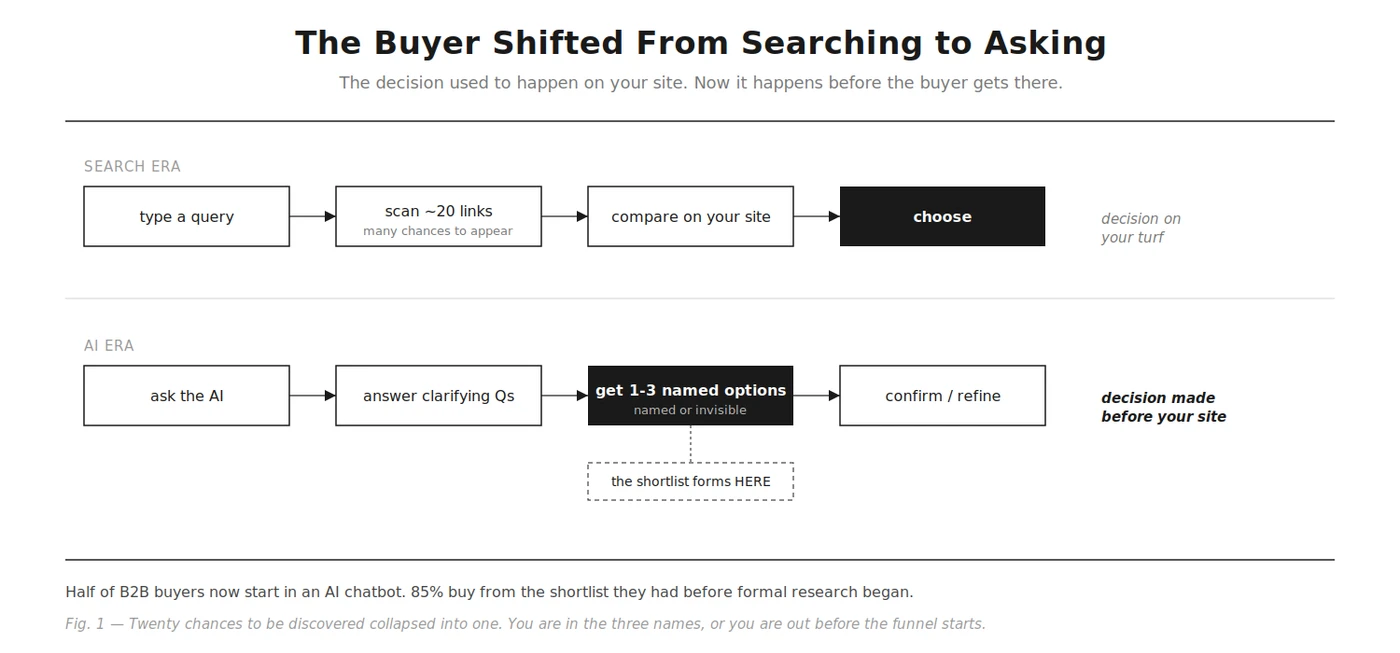
The data behind this shift is no longer speculative. In a 2025 survey of over a thousand B2B software buyers, half said they now start their buying journey in an AI chatbot instead of Google. Forrester’s 2026 data shows the large majority of B2B buyers already use generative AI as a primary research source, ranking it the second most frequent touchpoint in the entire purchase cycle. And the shortlist formed in that conversation tends to stick: Bain found that 85% of buyers ultimately purchase from the “Day One” list they had in mind before formal research began. Increasingly that list is assembled in a ChatGPT or Perplexity conversation.
This is why absence is so costly. If the engine names three vendors and you are not one of them, you were excluded before the funnel started, and you will never see it happen. The buyer who researched your category last week and books a demo today shows up in your analytics as “direct,” with no trace that an AI recommended a competitor first. The reasons this traffic is invisible are covered in AI referral traffic and how to track it, but the strategic point stands on its own: AI-referred buyers also convert at several times the rate of standard organic, because the engine pre-qualified them. It is a quality-of-pipeline issue, not just a volume one.
Signals that drive recommendations
Engines recommend products they can understand, trust, match to the buyer’s intent, and find corroborated across sources. In practice that resolves into a handful of concrete signals.
-
Intent and use-case match. The strongest signal is how well your content maps to the specific situation in the prompt. Explicit use-case framing (“best for freelancers,” “ideal for enterprise teams,” “built for apartments under 60 square meters”) is what gets you surfaced for “what should I use for…” questions. This is the most underused lever, and it is the one most directly in your control.
-
Structured product data. Clean, machine-readable attributes, schema markup, accurate pricing and availability. Engines that compare trade-offs need parseable data, not marketing prose. A page heavy on adjectives like “world-class” and “seamless” and light on verifiable facts gets discounted.
-
Reviews and third-party authority. Engines weight what credible outside sources say far above your own claims. Strong ratings on the review sites in your category, and brand mentions across independent pages, are among the strongest predictors of being recommended. Comparison content (“X vs Y”) is exactly what engines pull from when a buyer is weighing options, and if you avoid creating it, you let competitors and affiliates define you.
-
Specificity over generality. Precise, attributable claims beat vague ones, and binding your brand name to your best data makes recommendations carry your name rather than borrowing your facts anonymously.
One practical note on triggers: commercial-intent prompts are far more likely to make an engine search the live web than informational ones, with terms like “reviews,” “best,” “free,” and “comparison” commonly setting off a search. That means the buyer-decision queries you most want to win are exactly the ones where fresh, well-structured, well-reviewed content gets fetched and read.
The deeper mechanics of how engines weigh these signals into a final pick are covered in how LLMs choose which brands to recommend.
How to influence them
You influence recommendations by feeding the engine what it needs to choose you with confidence. The work, in priority order:
-
Write for the question behind the purchase. Build pages around the buyer’s actual prompt, not a keyword. A page titled “best tools” is weaker than one that answers who should pick each option, what budget range fits, what the trade-offs are, and what proof backs it. Use-case headers and FAQ blocks map directly to how people phrase things to an AI.
-
Make the data clean and current. Structured attributes, schema, accurate pricing and availability, fresh timestamps. Stale or unparseable product data is a silent disqualifier.
-
Admit the trade-offs. A page that says where your product is not the right fit is more credible to an engine than one that claims to be perfect for everyone, and credibility is what gets cited. Honesty about fit is a recommendation signal, not a weakness.
-
Build third-party corroboration. Earn reviews on the platforms your category lives on, get into comparison content and listicles, and show up in the communities your buyers use. Engines recommend brands the wider web agrees on, so this off-page work, detailed in how to get cited by AI, is what moves you from mentioned to recommended.
-
Cover the full range of buyer questions. Being recommended for your two best prompts and absent from the rest leaves most of the category on the table. Map the prompts across the journey, broad category, specific use case, comparison, problem-solution, and fill the gaps.
Tracking your recommendation rate
You cannot manage what you cannot see, and the recommendation moment is invisible by default. Tracking it means running the prompts your buyers actually ask on every engine they might ask them in, ChatGPT, Claude, Gemini, Perplexity, Grok, Microsoft Copilot, and Google AI Overviews, and recording the outcome the same way a buyer would experience it.
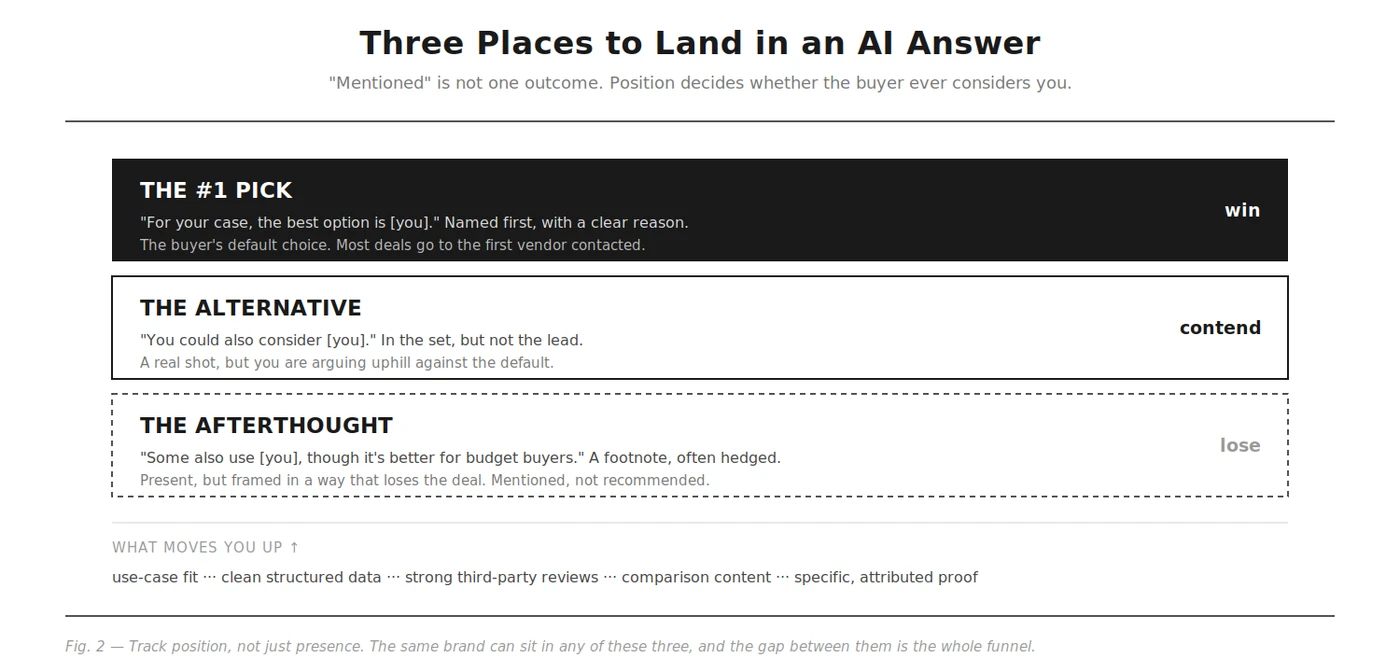
The metrics that matter here go beyond a yes/no on whether you appear. The crucial one is positioning: are you the top recommendation, named as an alternative, or mentioned as an afterthought? Those are three different business outcomes, and they shift independently. A brand can be present in plenty of answers and still lose every deal because it is always framed as the budget compromise. Tracking position and the language the engine uses to characterize you, the “more intuitive for beginners” versus “better for enterprise” framing, is the intelligence that tells you what to fix. This positioning view, rank one versus alternative versus afterthought across engines, is what Rankry’s positioning tracking is built to surface.
The method is the familiar one: a prompt set that mirrors the buyer journey, run across the engines, scored for presence, position, and sentiment, repeated on a schedule so you see trends instead of noise. Where this fits in the larger discipline of AI visibility is laid out in what generative engine optimization is.
AI product recommendations are the new top of the funnel, and they are decided before a buyer reaches your site. The engines pick on intent match, clean data, and third-party trust, none of which you can buy and all of which you can build. Start by finding out what the AI says when someone asks for products like yours, because confidently recommended, grudging alternative, and completely absent are three very different places to be, and most brands have no idea which one they occupy.
Related Rankry resources
- AI Visibility Tracking — see whether AI actually recommends you, not just mentions you.
- Best AI Visibility Tools — compare the tools that track AI recommendations.
- AI Recommendation Tracking — the metric behind being chosen, not just named.