If your direct traffic has been climbing with no campaign to explain it, the most likely cause in 2026 is AI referrals that Google Analytics has misfiled as Direct. When someone copies a URL from a ChatGPT, Claude, or Perplexity answer and pastes it into a browser, or opens a link from an AI mobile app, the visit often arrives with no referrer, and GA4 files every referrer-less visit under Direct, the same bucket as people typing your address. The traffic is real and high-intent; only the label is wrong. This guide covers what is actually inside your Direct bucket, how to tell AI traffic from genuine direct visits, and where the hard limit on measurement sits.
Rising Direct with nothing to explain it is one of the clearest fingerprints of unmeasured AI traffic. Here is how to confirm it.
What’s actually inside your “Direct” bucket
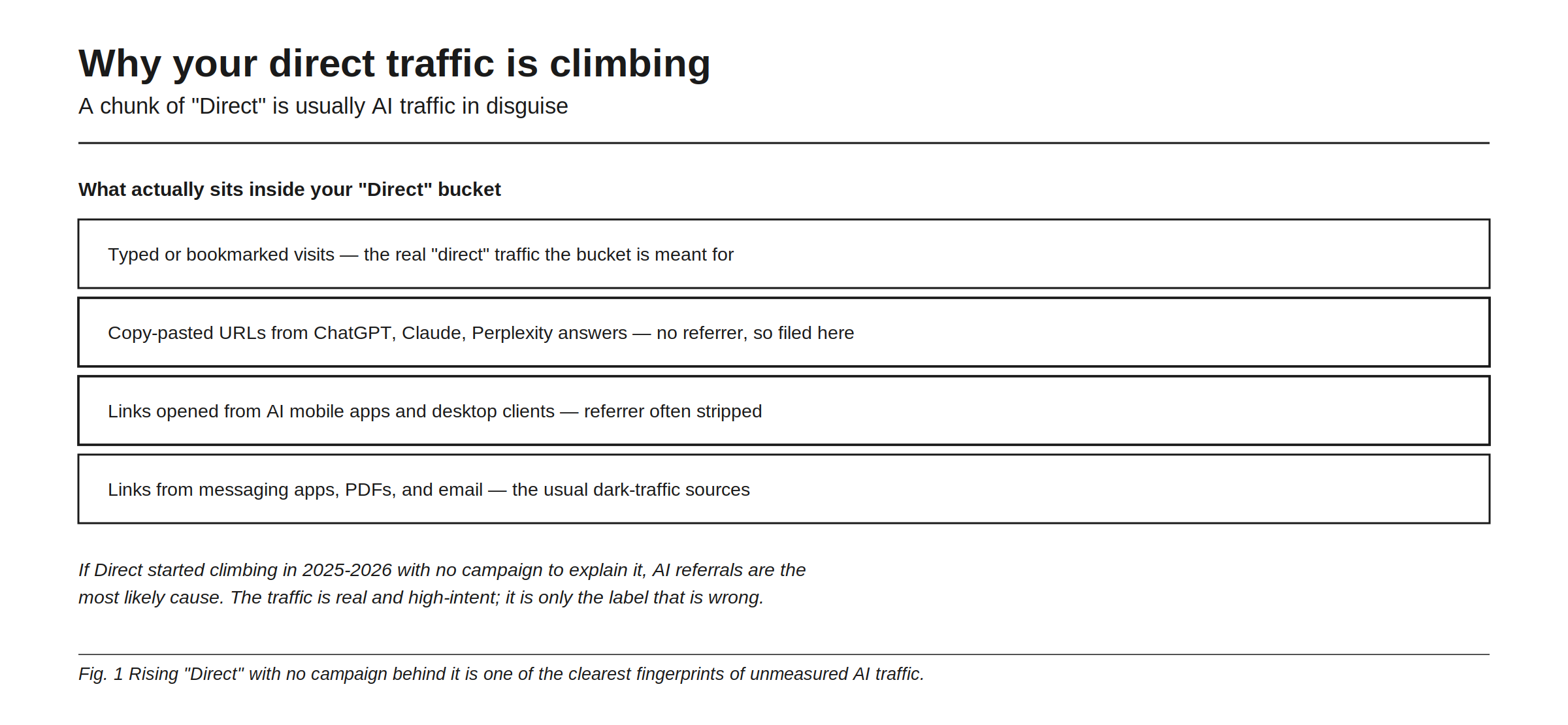
Direct is a catch-all, and in 2026 it holds more than it used to. Some of it is the real thing: typed or bookmarked visits, the traffic the bucket is meant for. But a growing share is copy-pasted URLs from ChatGPT, Claude, and Perplexity answers, which arrive with no referrer and get filed here. Another share is links opened from AI mobile apps and desktop clients, where the referrer is often stripped. And the rest is the usual dark traffic: links from messaging apps, PDFs, and email.
The tell is timing. If your Direct started climbing through 2025 and 2026 with no campaign, no rebrand, and no new bookmark-worthy reason, AI referrals are the most likely explanation. The visits are real people arriving with high intent, having often just read an AI summary about you; it is only GA4’s label that is misleading.
How to tell AI traffic from real direct
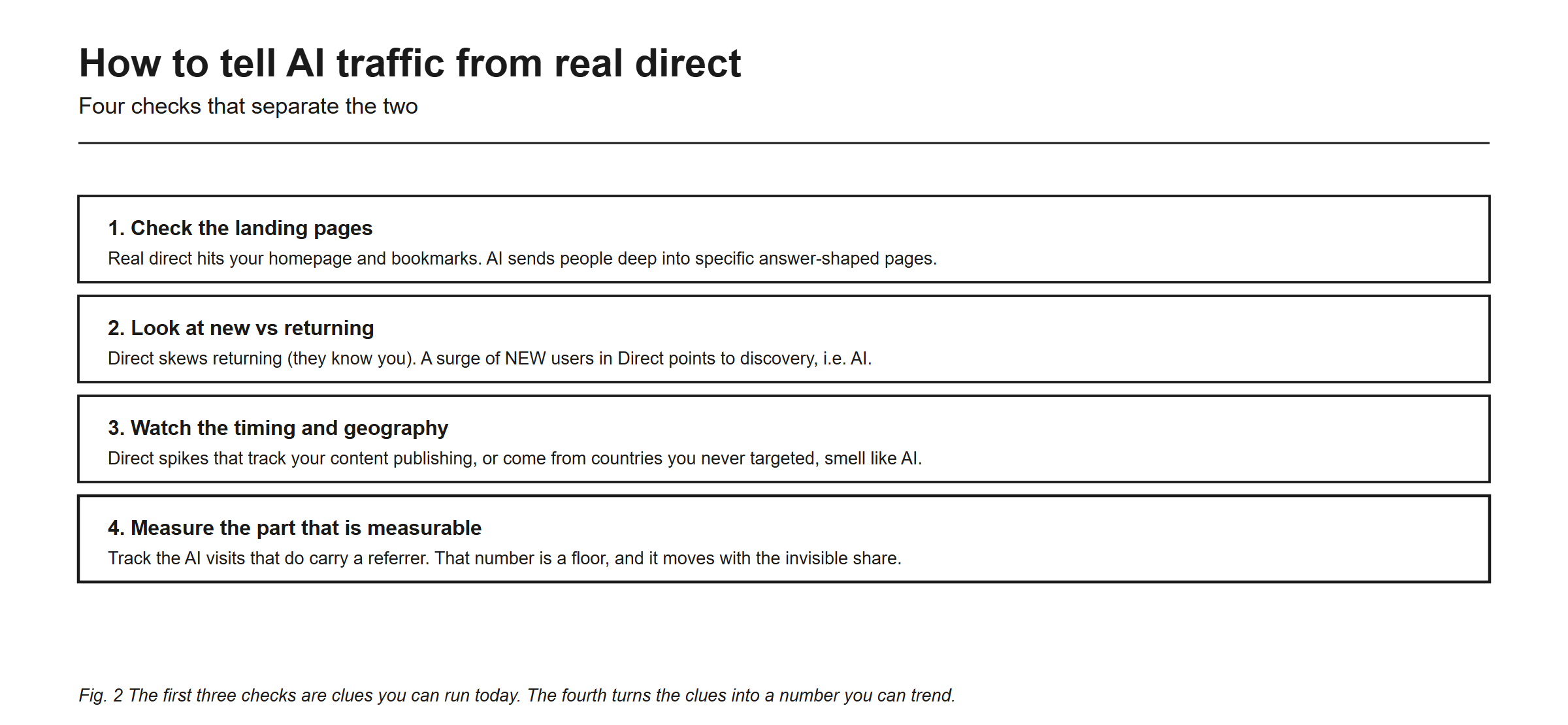
Four checks separate the two. Read as a signal rather than only as an attribution problem, rising direct is usually evidence that AI is citing you, which is the angle in why your direct traffic is exploding. First, check the landing pages: real direct tends to hit your homepage and bookmarked pages, while AI sends people deep into specific, answer-shaped internal pages they would never have bookmarked. Second, look at new versus returning: direct skews returning, people who already know you, so a surge of new users inside Direct points to discovery, which means AI. Third, watch the timing and geography: Direct spikes that track your content publishing, or that come from countries you never targeted, smell like AI referrals. Fourth, measure the AI traffic that is measurable, so you stop reasoning from clues alone.
The first three are things you can check in GA4 this afternoon. The fourth is what turns them into a number you can watch move.
The quick GA4 check
You can do a fast manual pass right now. In GA4, go to Reports, Acquisition, Traffic acquisition, and look at your Direct trend over the last year; then switch the primary dimension to Session default channel group and look for the AI Assistant row, which Google added to GA4’s Default Channel Group on 13 May 2026 and which catches AI sources that pass a recognized referrer. For a fuller manual setup with custom channel groups and regex, see how to track AI referral traffic in GA4.
But remember the hard limit: no GA4 configuration can recover the copy-paste and AI-app traffic that lands in Direct, because those visits genuinely have no referrer for GA4 to read. The manual method can confirm AI is in your Referral bucket; it cannot pull the AI traffic back out of Direct.
How to actually separate it, and what nobody can separate
This is where most vendor pages overpromise, so here it is plainly: a visit that arrives with no referrer carries no evidence of where it came from. No analytics product, ours included, can reach into that visit and recover the ChatGPT session behind it. Anyone claiming to catch the copy-paste traffic GA4 misses is selling you an inference dressed up as a measurement.
What you can do is measure the visible half precisely and treat it as a floor. Rankry’s AI Traffic dashboard is one lightweight script that reports every visit arriving with an AI referrer as its own channel: ten AI sources recognized out of the box, ChatGPT, Perplexity, Claude, Gemini, Grok, Copilot, Bing Chat, You.com, Phind, and Poe, with the country, language, device, landing page, and engagement time behind each visit. For Perplexity, Phind, You.com, and Bing Chat the referrer URL also carries the question the visitor asked, so you see the prompt that sent them. No channel group, no regex, no quarterly upkeep.
That number will not equal your true AI traffic. It will move with it. When your measured AI referrals double, the invisible copy-paste share almost certainly moved the same way, and you have a trend line instead of a hunch about your Direct bucket. The full feature is in introducing AI Traffic.
Why this is worth fixing
Misattributed AI traffic is not just a labeling annoyance; it hides your fastest-growing, highest-intent channel inside a bucket you are trained to ignore. Direct traffic is usually treated as unattributable and left alone, so every AI visit stuck there is a visit you cannot optimize, attribute to revenue, or credit to the content that earned it. Pulling out the part you can measure turns invisible dark traffic into a channel you can grow on purpose. The revenue case is in do AI answers actually drive traffic and revenue.
FAQ
Why is my direct traffic suddenly increasing? In 2026 the most common cause is AI referrals misfiled as Direct. Copy-pasted URLs from ChatGPT, Claude, and Perplexity answers, and links opened from AI mobile apps, arrive with no referrer, and GA4 files every referrer-less visit under Direct.
Is my direct traffic actually from ChatGPT? Often, yes. When someone copies a link out of a ChatGPT answer or opens one in the app, the visit usually has no referrer and lands in Direct. Check whether your Direct rise tracks your publishing schedule, brings new rather than returning users, and reaches countries you never targeted.
How do I know if my direct traffic is AI or real? Four checks. Landing pages: real direct hits your homepage, AI sends people deep into answer-shaped pages. New versus returning: a surge of new users inside Direct points to discovery. Timing and geography: spikes that track your content or come from untargeted countries smell like AI. And measure the AI referrals that do carry a referrer, so you have a trend line rather than a hunch.
Can GA4 separate AI traffic from direct traffic? Only the part that carries a referrer. Copy-paste and AI-app visits arrive with no referrer at all, so there is nothing for any analytics tool to read, and they stay in Direct no matter how you configure GA4 or which vendor you buy. Treat your measured AI referrals as a floor, not a full count.
Is AI traffic in my direct bucket worth anything? Yes, it is typically high-intent, since those visitors arrived after reading an AI summary about you. That is exactly why it is worth pulling out what you can: it is your fastest-growing, best-qualified traffic, sitting in the bucket you are trained to ignore.
Stop guessing how much of your Direct is AI: see the AI traffic that can be measured as its own clean channel, next to what AI says about you. Start a free 7-day Rankry trial, no card, first report in two minutes.