If your direct traffic is climbing with no campaign to explain it, the most likely cause in 2026 is AI referrals that analytics has misfiled as Direct. When someone copies your link out of a ChatGPT or Perplexity answer and pastes it into a new tab, or opens a citation inside an AI app, the visit often arrives with no referrer, so analytics files it under Direct, the same bucket as people typing your address. The traffic is real and high-intent; only the label is wrong. And it is telling you something valuable: rising direct is often proof you are being cited, arriving as your best-converting visitors, hidden in the one bucket everyone ignores. This guide shows how to confirm it and what to do.
Direct is treated as unattributable, so most teams glance at it and move on. In 2026 that habit means glancing past your fastest-growing channel.
Why AI traffic hides in “Direct”
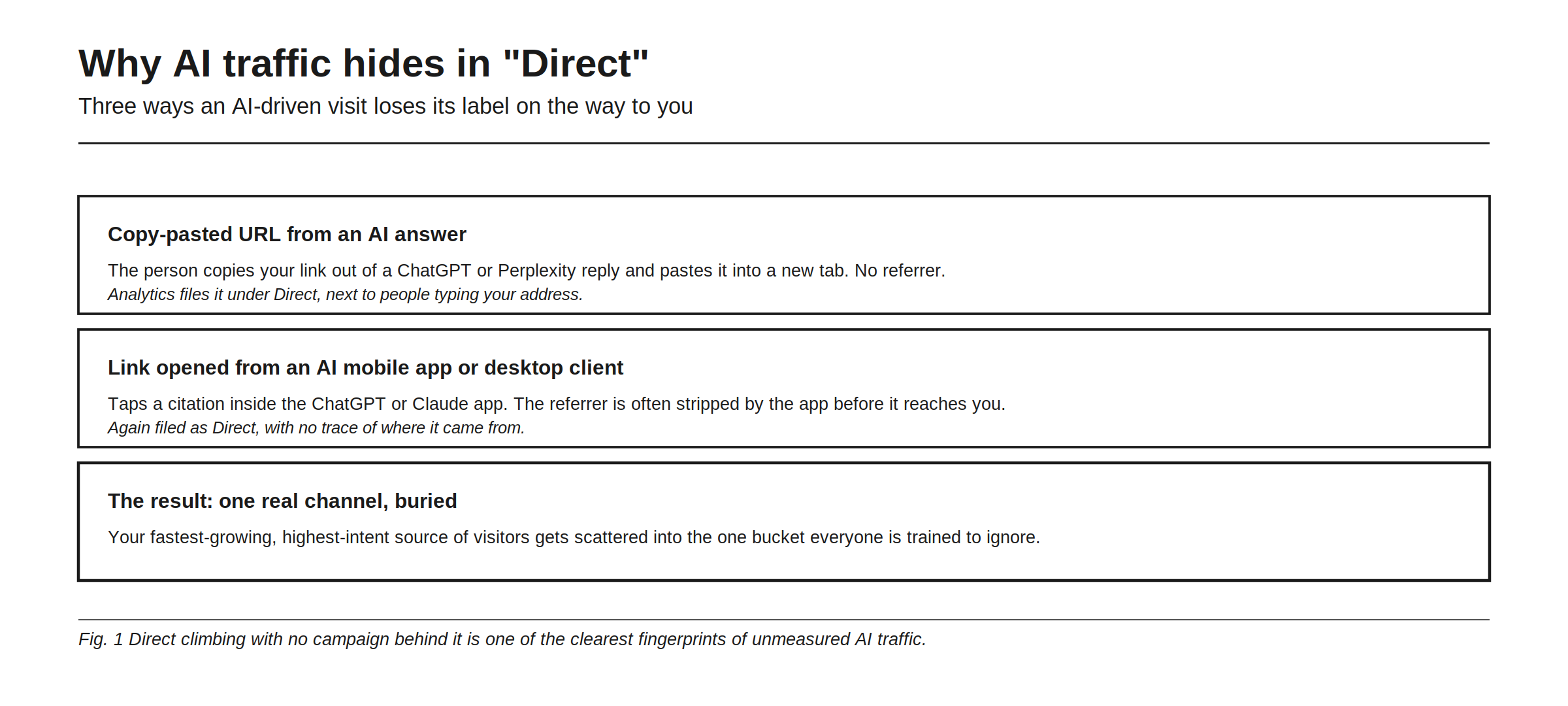
Two mechanisms bury AI visits. A copy-pasted URL from an AI answer: the person copies your link out of a ChatGPT or Perplexity reply and pastes it into a new tab, so there is no referrer, and analytics files it under Direct next to people typing your address. And a link opened from an AI mobile app or desktop client: a tap on a citation inside the ChatGPT or Claude app, where the referrer is often stripped by the app before it reaches you, so again it lands in Direct with no trace of origin.
The result is that one real channel gets buried. Your fastest-growing, highest-intent source of visitors gets scattered into the one bucket everyone is trained to ignore. That is why direct climbing with no campaign behind it is one of the clearest fingerprints of unmeasured AI traffic. The broader analytics-blindness problem is covered in Introducing AI Traffic.
Real direct vs AI in disguise
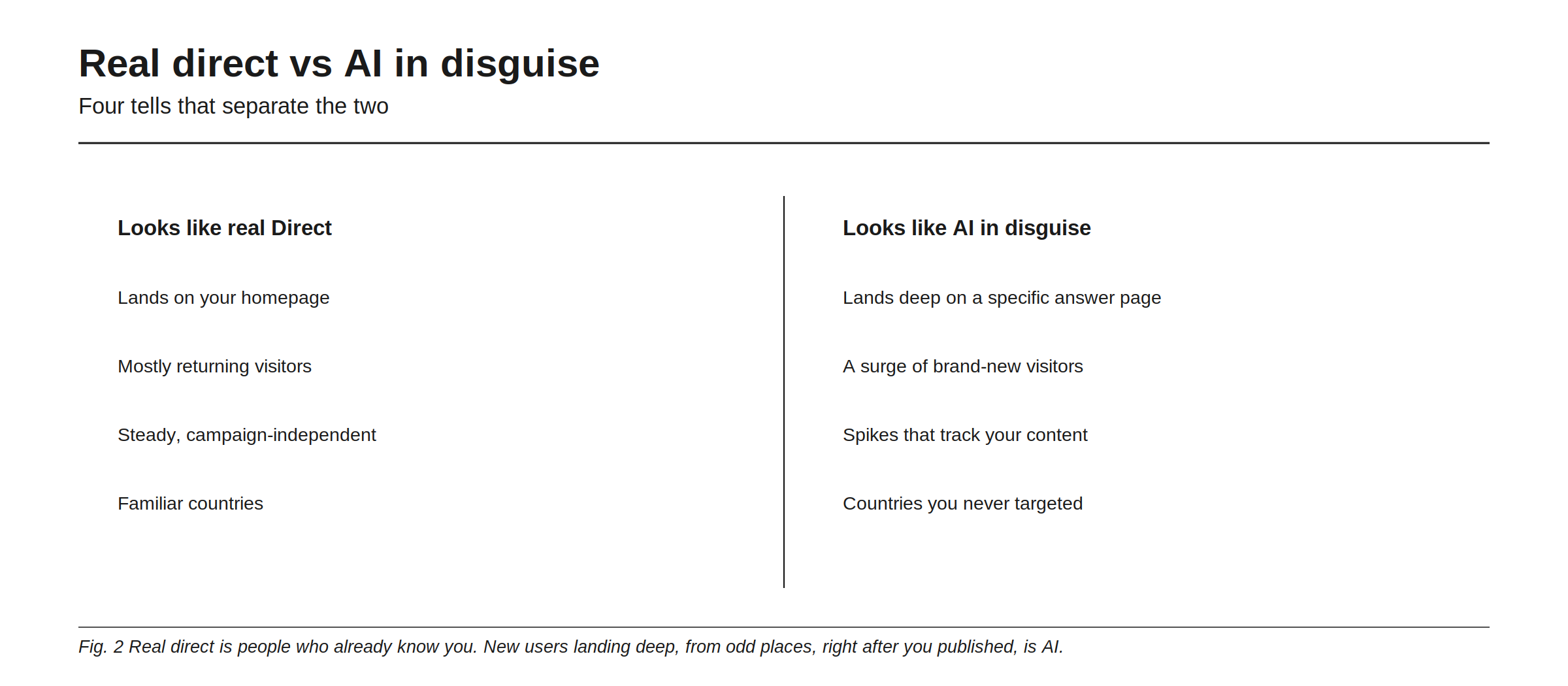
Four tells separate genuine direct from AI wearing its label. Real direct tends to land on your homepage; AI sends people deep onto a specific answer-shaped internal page. Real direct is mostly returning visitors who already know you; AI brings a surge of brand-new users. Real direct is steady and campaign-independent; AI spikes track your content publishing. And real direct comes from familiar countries; AI often arrives from countries you never targeted.
Put simply: real direct is people who already know you. New users landing deep, from odd places, right after you published, is AI. You can run these checks today in your existing analytics before you change anything, and they will tell you roughly how much of your Direct is really AI. The catch is that no analytics configuration can fully recover copy-paste and app traffic, because those visits genuinely have no referrer, which is where a purpose-built method comes in.
What rising direct is telling you
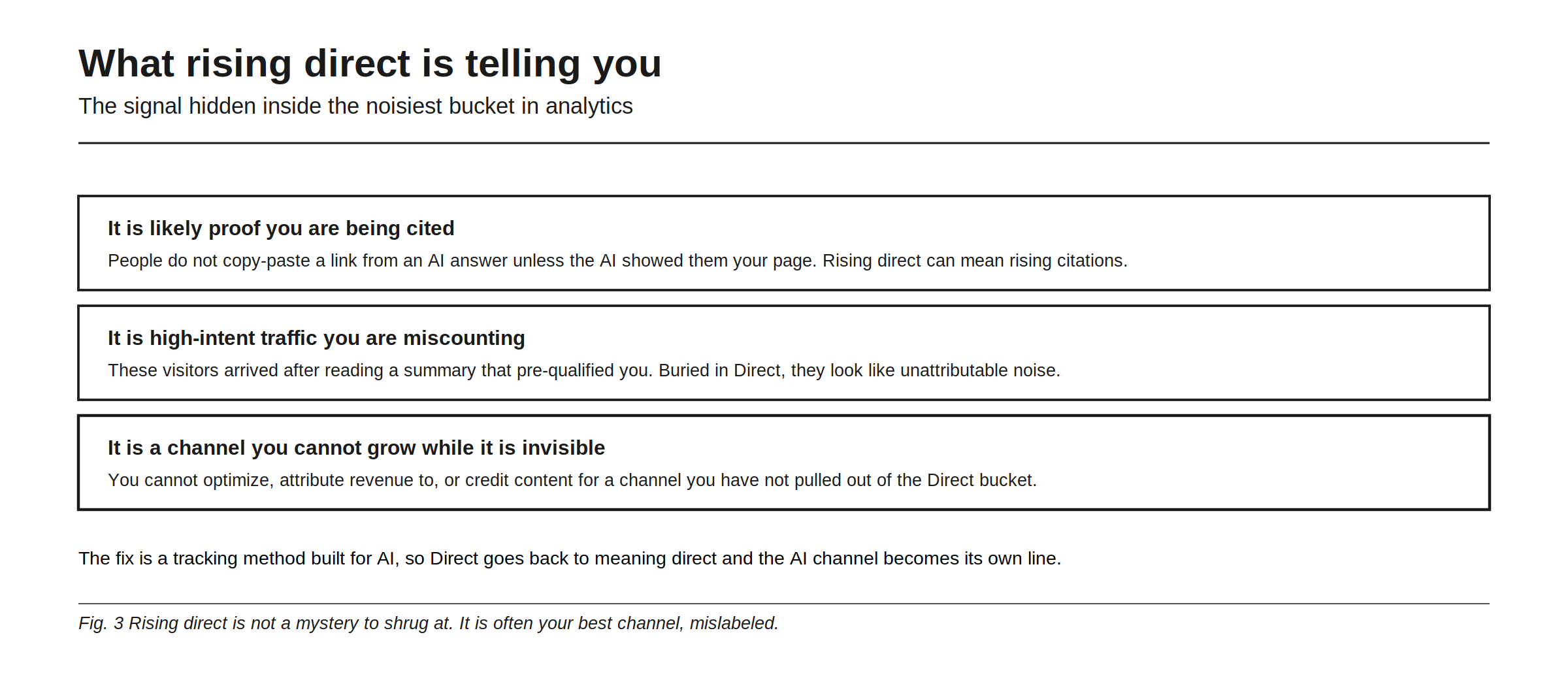
Once you see it, the signal is valuable in three ways. First, it is likely proof you are being cited, because people do not copy-paste a link from an AI answer unless the AI showed them your page, so rising direct can mean rising citations. Second, it is high-intent traffic you are miscounting, because these visitors arrived after reading a summary that pre-qualified you, yet buried in Direct they look like unattributable noise, more on that value in the business case for AI visibility. Third, it is a channel you cannot grow while it is invisible, because you cannot optimize, attribute revenue to, or credit content for a channel you have not pulled out of the Direct bucket.
The fix is a tracking method built for AI, so Direct goes back to meaning direct and the AI channel becomes its own line. Rising direct is not a mystery to shrug at; it is often your best channel, mislabeled. Rankry’s AI Traffic feature identifies AI-originated visits directly, including the copy-paste and app traffic analytics buries, from $99 a month on a no-card trial.
The quick diagnostic
You can settle it this week without any tool. Pull your Direct trend over the last year and check whether the rise lines up with any campaign, rebrand, or new bookmark-worthy reason; if not, suspect AI. Then segment Direct by landing page and new-versus-returning: a spike of new users landing on deep internal pages is the tell. Finally, cross-reference your Referral channel for chatgpt.com and perplexity.ai to confirm AI is present at all. This will not recover the buried visits, but it will tell you the shape of the problem, and whether pulling AI out of Direct is worth doing properly. The bot side of the same picture is in bots versus humans in your traffic.
FAQ
Why is my direct traffic suddenly increasing? In 2026 the most common cause is AI referrals misfiled as Direct. Copy-pasted URLs from ChatGPT and Perplexity answers, and links opened in AI apps, arrive with no referrer, and analytics files referrer-less visits under Direct.
Is my direct traffic actually from ChatGPT? Often, yes. Check whether the rise tracks your content, brings new users, lands on deep pages, and comes from untargeted countries. Those are the fingerprints of AI referrals hiding in Direct rather than genuine typed or bookmarked visits.
How do I know if rising direct is AI or real? Real direct hits your homepage, skews returning, and is campaign-independent. AI-in-disguise lands deep on specific pages, brings new users, spikes with your publishing, and comes from unfamiliar countries. The four tells together are reliable.
Is AI traffic in my direct bucket valuable? Yes. It is typically high-intent, since those visitors arrived after reading an AI summary that pre-qualified you. That is exactly why it is worth pulling out of Direct: it is your best-converting, fastest-growing traffic, hidden where you ignore it.
Can analytics separate AI traffic from direct on its own? Only partially. Referrer-passing AI sources can be caught, but copy-paste and app visits have no referrer and stay in Direct no matter how you configure it. A purpose-built AI tracking method is needed to separate them cleanly.
Pull your AI traffic out of the Direct bucket and see it as its own clean, high-intent channel. Start a free 7-day Rankry trial, no card, first report in two minutes.