In 2026, automated traffic (crawlers and AI agents) passed human traffic on the web for the first time, crossing roughly 57% of all requests, according to Cloudflare. That means your traffic graph can double while revenue stays flat, because most of the new “visitors” are bots like GPTBot and ClaudeBot working through your URLs, not people who might buy. To read your real traffic you need to separate three populations, humans, crawlers, and agents, then verify the bots (user agents are trivial to fake), keep a bots view apart from a humans view, and judge conversions against the human number only. This guide shows how, and why the goal is not to block the machines but to stop mistaking them for customers.
The milestone is not a curiosity anymore. When more than half of web requests are machines, “sessions” and “traffic” stop meaning what your dashboard assumes they mean.
Machines now outnumber people
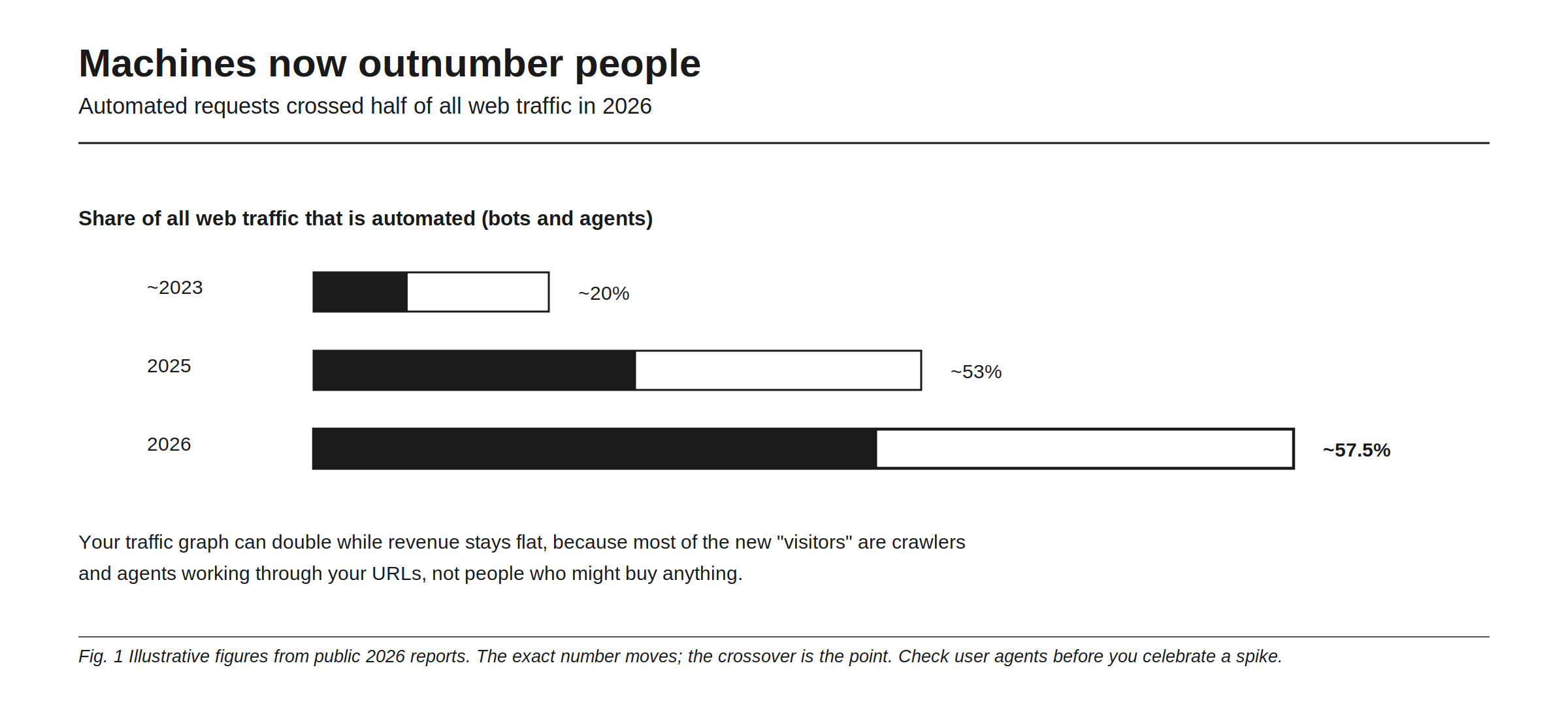
The shift happened fast. Before the generative-AI wave, bots were a minority of web traffic, on the order of one in five requests. Across 2025 that climbed past half for the first time, and by mid-2026 Cloudflare put automated traffic near 57%, a crossover that arrived well ahead of even industry predictions. The figures move month to month and source to source, but the direction is settled: machines read the web more than people do now.
For an individual site, the practical consequence is a trap. A spike in traffic feels like success, but a large share of any recent increase is likely crawlers and agents systematically fetching your pages. Your revenue does not move with them, because they do not buy. So the first discipline is simple: check the user agents before you celebrate a spike.
What’s actually inside your traffic
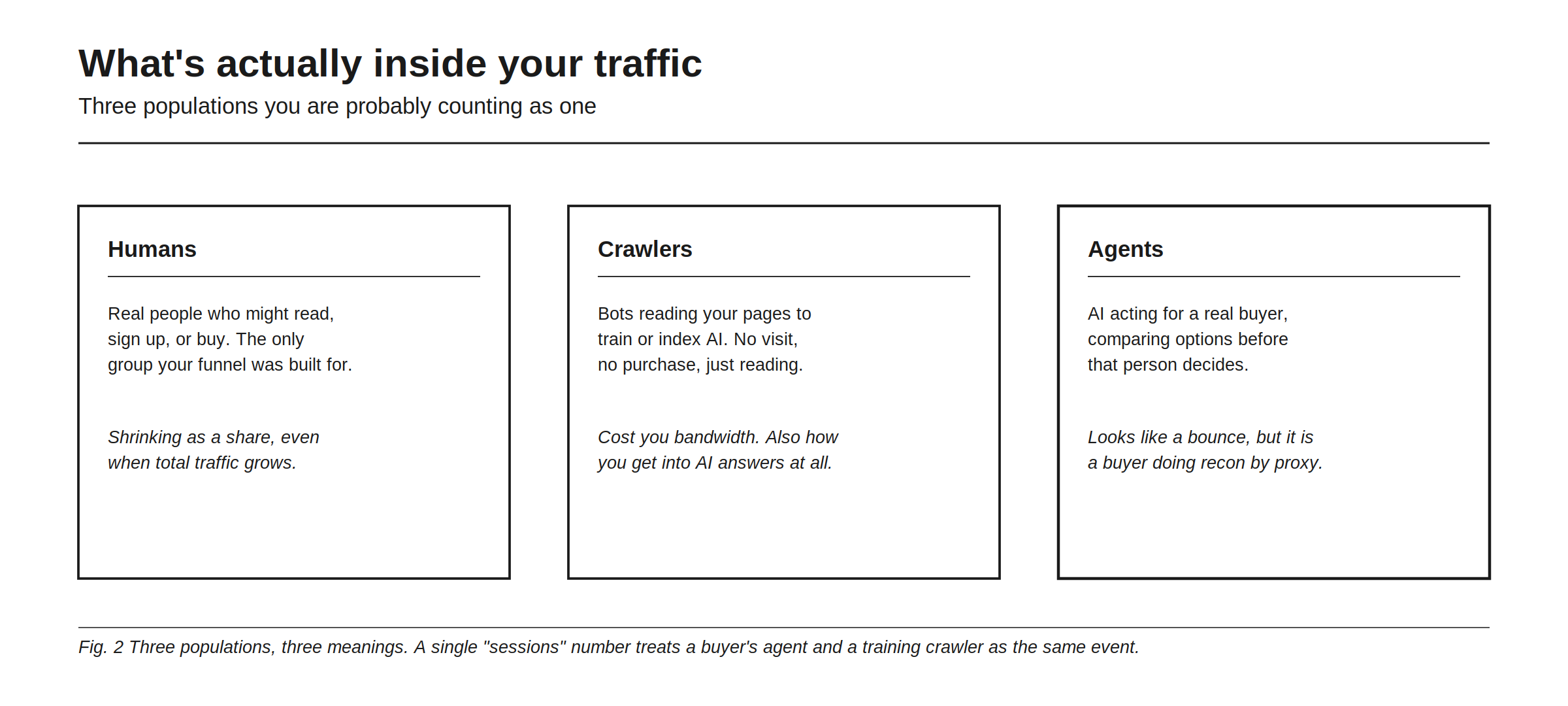
You are probably counting three different populations as one. Humans are real people who might read, sign up, or buy, the only group your funnel was built for, and they are shrinking as a share even when total traffic grows. Crawlers are bots reading your pages to train or index AI, with no visit and no purchase, just reading; they cost you bandwidth, but they are also how you get into AI answers at all. Agents are AI acting for a real buyer, comparing options before that person decides; they look like a bounce in your analytics, but each one is a buyer doing recon by proxy.
Three populations, three meanings. A single “sessions” number treats a buyer’s agent and a training crawler as the same event, which is how sites end up optimizing for the wrong thing entirely. The agent population specifically is the one behind the agentic-search shift in agentic search versus zero-click, and the full taxonomy of bot types is in the five types of AI bots.
How to read your real traffic
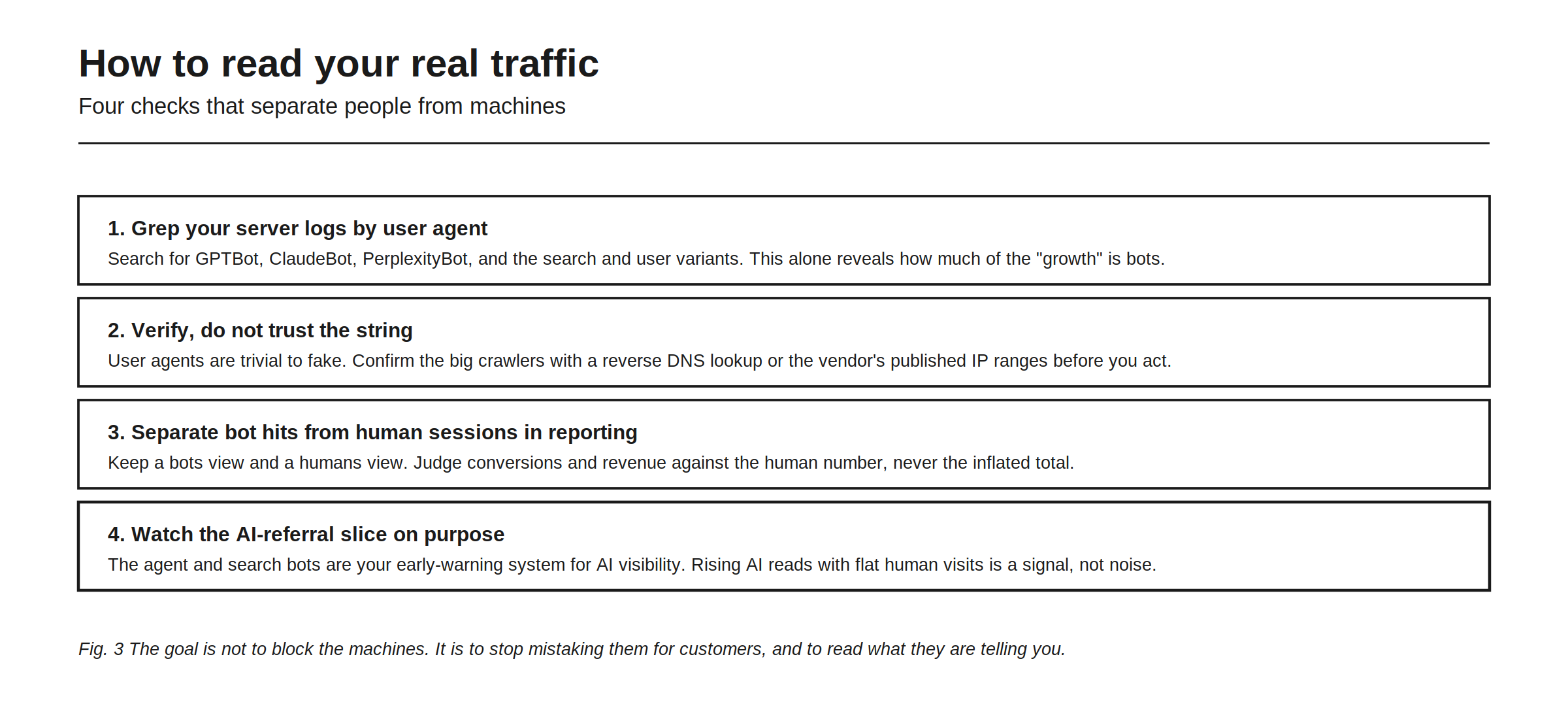
Four checks separate people from machines. First, grep your server logs by user agent: search for GPTBot, ClaudeBot, PerplexityBot, and the search and user variants, and this alone reveals how much of the “growth” is bots. Second, verify rather than trust the string, because user agents are trivial to fake, so confirm the big crawlers with a reverse DNS lookup or the vendor’s published IP ranges before you act on them. Third, separate bot hits from human sessions in your reporting, keeping a bots view and a humans view, and judge conversions and revenue against the human number, never the inflated total. Fourth, watch the AI-referral slice on purpose, because the agent and search bots are your early-warning system for AI visibility, and rising AI reads with flat human visits is a signal, not noise.
The goal is not to block the machines. It is to stop mistaking them for customers, and to read what they are telling you. A crawler surge on a new page means AI is discovering your content; an agent spike in a category means buyers are researching you by proxy. Both are information you only get if you look. The referral side of this, where AI-driven visits hide inside Direct, is in why your direct traffic is exploding.
Why this is a visibility signal, not just a cost
It is tempting to see bot traffic purely as a hosting expense, and at scale it is a real one. But the AI reads are also the leading indicator of your AI visibility. Before a human ever sees your brand in a ChatGPT or Perplexity answer, a search or user-fetch bot fetched the page that answer was built from. So a healthy, rising pattern of legitimate AI crawler activity on your important pages is a sign the machine layer can find you, which is the precondition for being cited at all. Blocking indiscriminately to save bandwidth can quietly remove you from AI answers, which is exactly the mistake dissected in the five types of AI bots. Read the bots, do not just fear them. Rankry pairs this with the other half of the picture, the real AI referral visits that reach your site, in Introducing AI Traffic, from $99 a month on a no-card trial.
FAQ
What percentage of web traffic is bots in 2026? Automated traffic passed half of all web requests in 2026, reaching roughly 57% by mid-year according to Cloudflare. The exact figure varies by source and month, but bots now read the web more than humans do.
Why did my traffic go up but not my revenue? Because much of the increase is likely AI crawlers and agents fetching your pages, not human buyers. A rise in total sessions driven by GPTBot, ClaudeBot, and similar bots does not convert, so revenue stays flat while the graph climbs.
How do I tell bot traffic from human traffic? Check user agents in your server logs for known bots, verify the big ones with reverse DNS or published IP ranges since user agents can be faked, and keep bot hits separate from human sessions so you judge conversions against the human number only.
Should I block AI bots from my site? Not indiscriminately. Blocking the search and user-fetch bots removes you from AI answers. Block only stealth or abusive crawlers at the server level, and decide deliberately about training crawlers. The category matters more than the label.
Are AI agents visiting my site a good sign? Often, yes. Agents and user-fetch bots typically appear because a real person delegated a task that involves your page or category. They look like bounces but signal buyer interest by proxy, so they are worth tracking as a visibility indicator, not dismissing as noise.
See the real AI visits reaching your site, separated from bots and from your organic numbers, in one dashboard. Start a free 7-day Rankry trial, no card, first report in two minutes.