You can compare your AI visibility against competitors cheaply on a sliding scale: for free by asking each AI engine, ChatGPT, Claude, Gemini, Perplexity, Grok, Microsoft Copilot, and Google AI Overviews, your buyer prompts and noting who is named beside you, for around $30 a month with an entry monitoring tool that automates presence and competitor tracking, or for around $99 a month with a full tool that shows share of voice, the reason each rival wins, and the sources cited for them. All three beat the genuinely expensive option, which is not knowing which competitor AI recommends instead of you.
“Cheap” is the right instinct here, because competitive AI visibility does not require an enterprise contract to start. What it requires is comparing the right things. A raw “they get mentioned more than us” is a feeling; the four comparisons below turn it into a fix list.
Cheap is a range, not a compromise
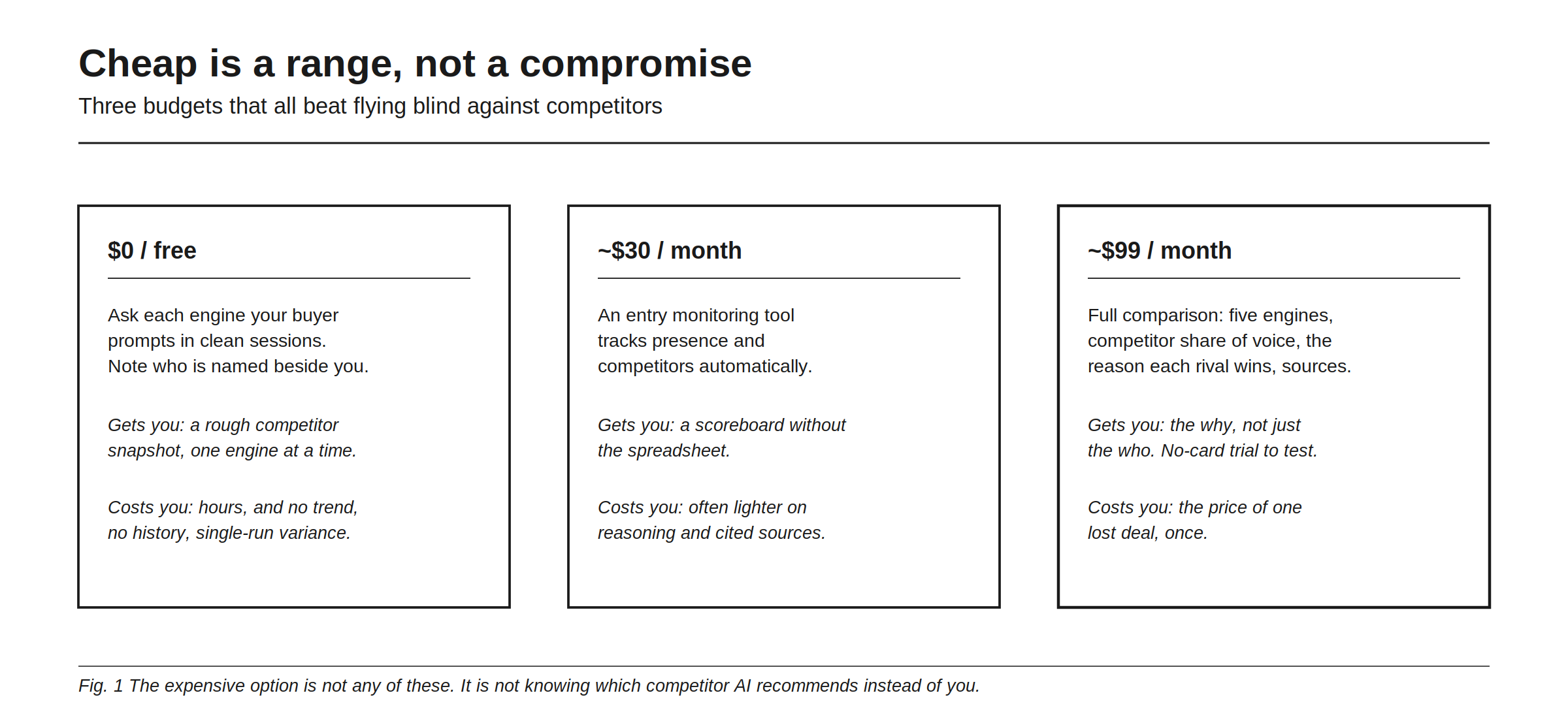
At $0, open clean sessions in ChatGPT, Claude, and Perplexity, ask your category’s buyer prompts, and write down who gets named alongside or instead of you. This gives a rough competitor snapshot, one engine at a time, and it costs only hours. Its limits are real: no history, no trend, and single-run variance means one session can mislead you.
At around $30 a month, an entry monitoring tool like Otterly.AI tracks presence and competitors automatically across engines, giving you a scoreboard without the spreadsheet. It is often lighter on the reasoning and cited-source detail, but for a cheap, hands-off competitor baseline it does the job.
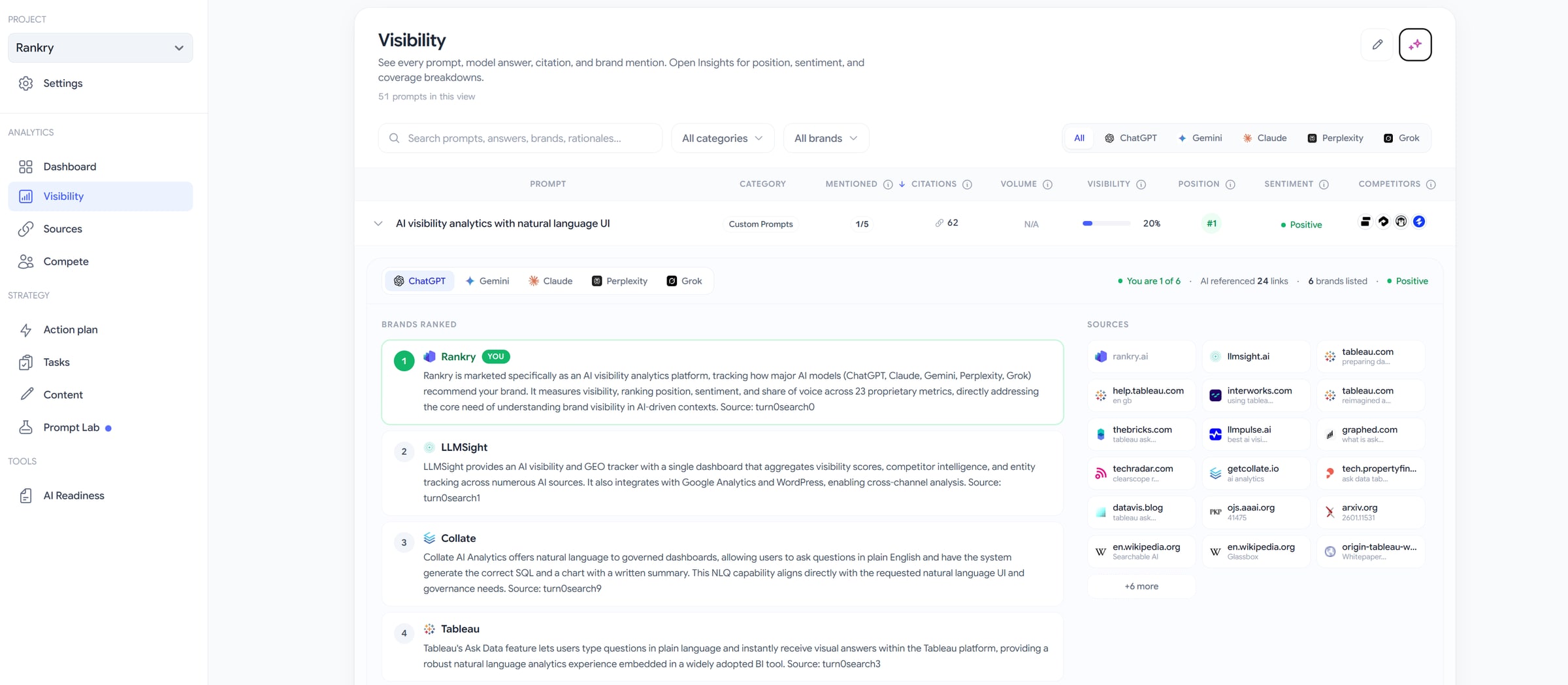
At around $99 a month, a full tool like Rankry adds what the cheaper tiers skip: competitor share of voice across the engines you track, the reason each rival wins each prompt, and the sources cited for them but not you, on a no-card trial so you can test it before paying. The honest framing: the $99 tier buys you the “why”, not just the “who”, and it costs less than a single deal lost to a competitor AI recommended over you.
None of these is the expensive option. Flying blind is.
What to actually compare
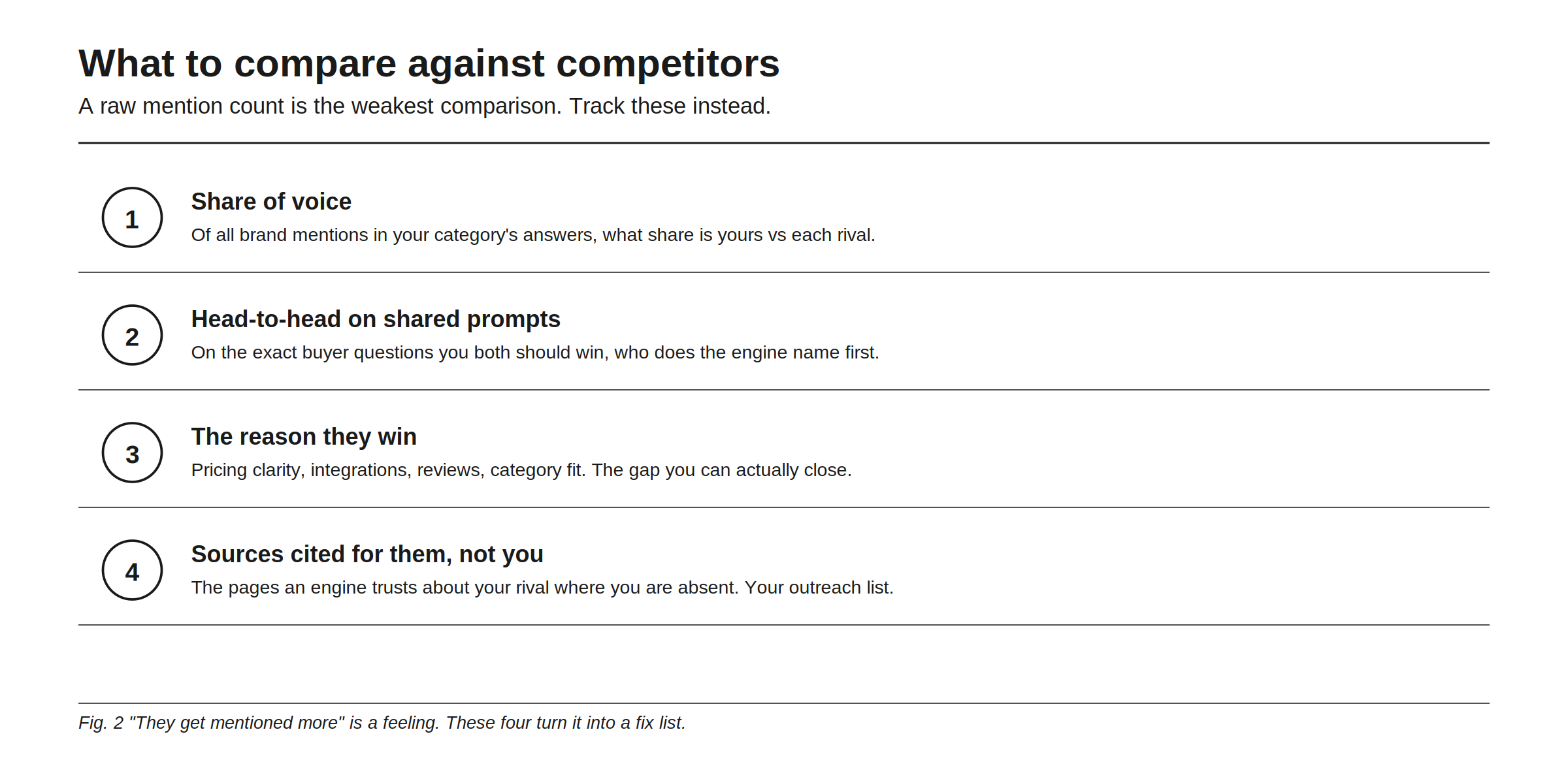
Whatever your budget, compare these four things, not a raw mention count. Share of voice: of all brand mentions in your category’s AI answers, what share is yours versus each rival, this is the single number that captures competitive position, and we break down how to read it in AI share of voice. Head-to-head on shared prompts: on the exact buyer questions you both should win, who does the engine name first. The reason they win: pricing clarity, a named integration, stronger reviews, better category fit, this is the gap you can close, and engines will often state it outright. And the sources cited for them but not you: the pages an engine trusts about your rival where you are absent, which doubles as your outreach list. For the source side specifically, see how to track citations and sources in AI search.
A mention count tells you that you are behind. These four tell you where and why, which is the difference between a comparison and a plan.
The free method, done right
If you are starting at $0, do it properly so the data is worth trusting. Use clean, logged-out sessions so your history does not skew results. Ask the same prompt two or three times per engine, because answers vary and one run is a coin flip. Record the competitor named, their position, and any reason the engine gives. Keep the prompt set identical each time you check, so week-over-week comparison means something. Done this way, the free method genuinely reveals your competitive position; done carelessly, it produces confident nonsense. The broader manual process is in how to run an AI visibility audit.
When to spend the $30, and when the $99
Move from free to ~$30 when the manual comparison is eating hours you do not have and you mainly want to know, automatically, whether competitors are gaining on you. Move to ~$99 when knowing “they are ahead” is not enough and you need to know why and which sources to target, which is the information that actually closes the gap. A useful test: if you have looked at a competitor beating you in AI answers and could not say why, you have outgrown the cheaper tiers. Use a no-card trial to check whether the “why” is worth the difference before committing. For how to run that trial as an experiment, see AI visibility tools with a free trial.
The comparison that pays for itself
The cheapest competitive intelligence is not the lowest-priced tool; it is the comparison that finds the one fixable reason you keep losing a high-value prompt. If you discover that a competitor wins “best X for enterprise” on three engines because a review site cites them and not you, that single finding, available free or at any tier, is worth more than the subscription. Budget-conscious does not mean insight-poor. Compare the right four things at whatever tier you can afford, act on the reason, and the comparison pays for itself in one closed gap.
FAQ
How can I compare my AI visibility against competitors cheaply? Three tiers: free (ask each engine your buyer prompts and note who is named), ~$30 a month (an entry tool automates presence and competitor tracking), or ~$99 a month (full share of voice, the reason rivals win, and cited sources). All beat not knowing.
Can I check competitors’ AI visibility for free? Yes. Ask ChatGPT, Claude, and Perplexity your category’s buyer prompts in clean sessions and record who is named beside you. Repeat each prompt a few times because answers vary. It costs only time and reveals a rough competitive snapshot.
What should I compare against competitors in AI answers? Four things: share of voice, head-to-head results on shared buyer prompts, the reason the rival wins (pricing, integrations, reviews, fit), and the sources cited for them but not you. These turn “they’re ahead” into a fix list.
What is the cheapest tool to track competitors in AI search? Entry monitoring tools start around $30 a month for presence and competitor tracking. For full share of voice with the reasoning and cited sources across the engines you track, Rankry starts at $99 a month with a no-card trial.
Is it worth paying to compare AI visibility, or is free enough? Free is enough for a rough snapshot and to prove the problem exists. Pay when you need to know why a competitor wins and which sources to target, the information that closes the gap, or when manual checking across engines stops scaling.
Compare share of voice, head-to-head prompts, and the sources rivals win with, across the engines you track. Start a free 7-day Rankry trial, no card, first report in two minutes.