To track whether AI recommends your SaaS for high-intent queries, isolate the buying prompts, the comparisons, the “alternative to”, the “best X for [stack] under [budget]” questions, run them through ChatGPT, Claude, Gemini, Perplexity, Grok, Microsoft Copilot, and Google AI Overviews on a schedule, and record whether you are named, in what position, and why the winner won. These prompts sit closest to the purchase, so they decide pipeline more than any awareness keyword. You can track them manually for one or two engines, or automate the whole set with a tool like Rankry from $99 a month.
The mistake that quietly costs SaaS companies the most is treating all AI visibility as equal. Appearing in “what is marketing automation” feels like progress. Losing “best marketing automation for Shopify under $200” loses the deal. This guide is about tracking the second kind.
Not all AI visibility is worth the same
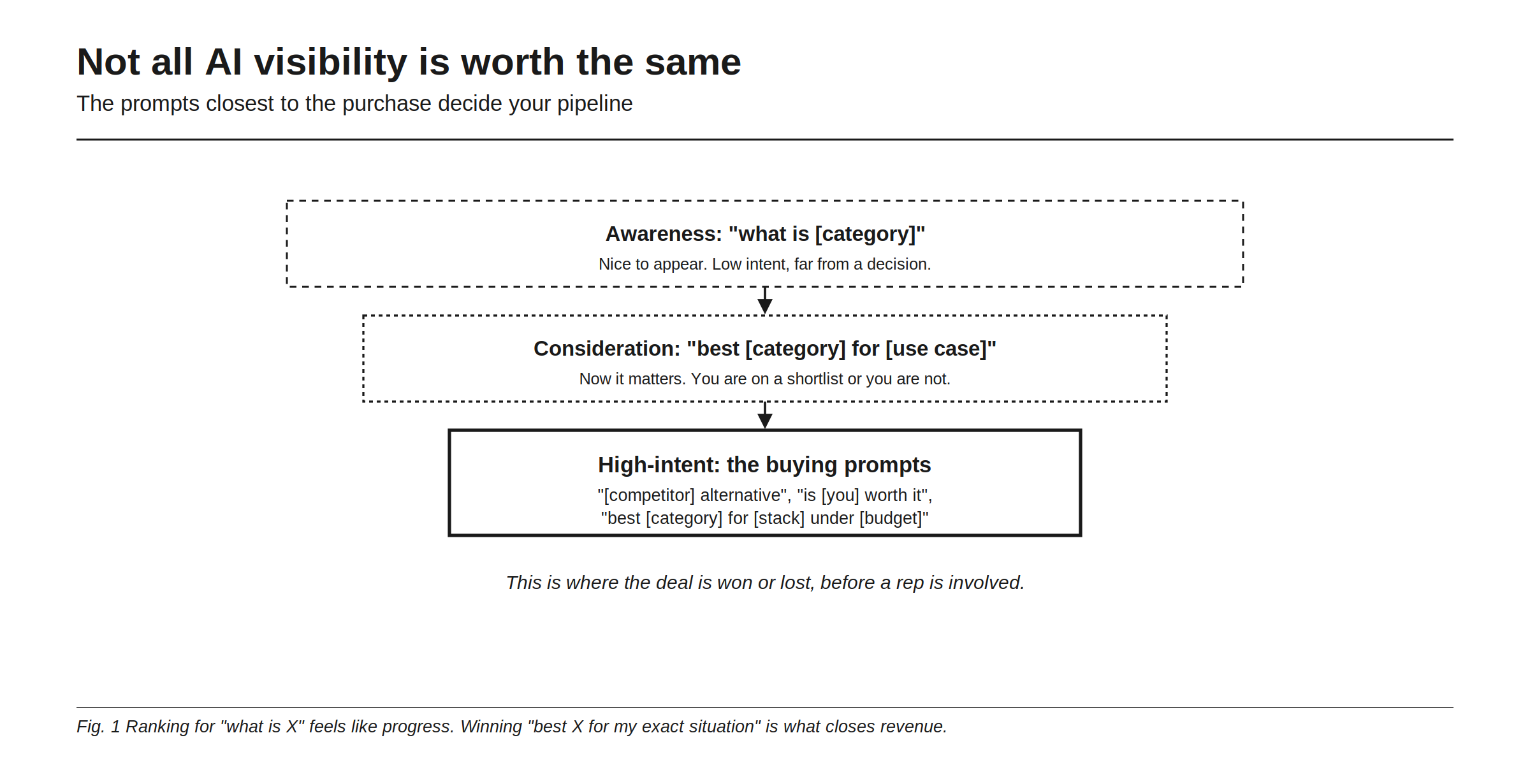
AI answers, like search, span the funnel. Awareness prompts (“what is [category]”) are nice to appear in but far from a decision. Consideration prompts (“best [category] for [use case]”) start to matter, because now you are on a shortlist or you are not. And high-intent prompts, the buying questions, are where the deal is won or lost before a sales rep is ever involved: “[competitor] alternative”, “is [your product] worth it”, “best [category] for [specific stack] under [budget]”. A buyer who asks an AI one of these and hears three competitors named, not you, has effectively shortlisted without you. No dashboard will show you that loss unless you are tracking these specific prompts.
The reframe for SaaS: your most valuable AI visibility is not your highest-volume prompt, it is your highest-intent one. Track the twenty prompts nearest the purchase before the two hundred that are merely nice to win.
How to track high-intent prompts
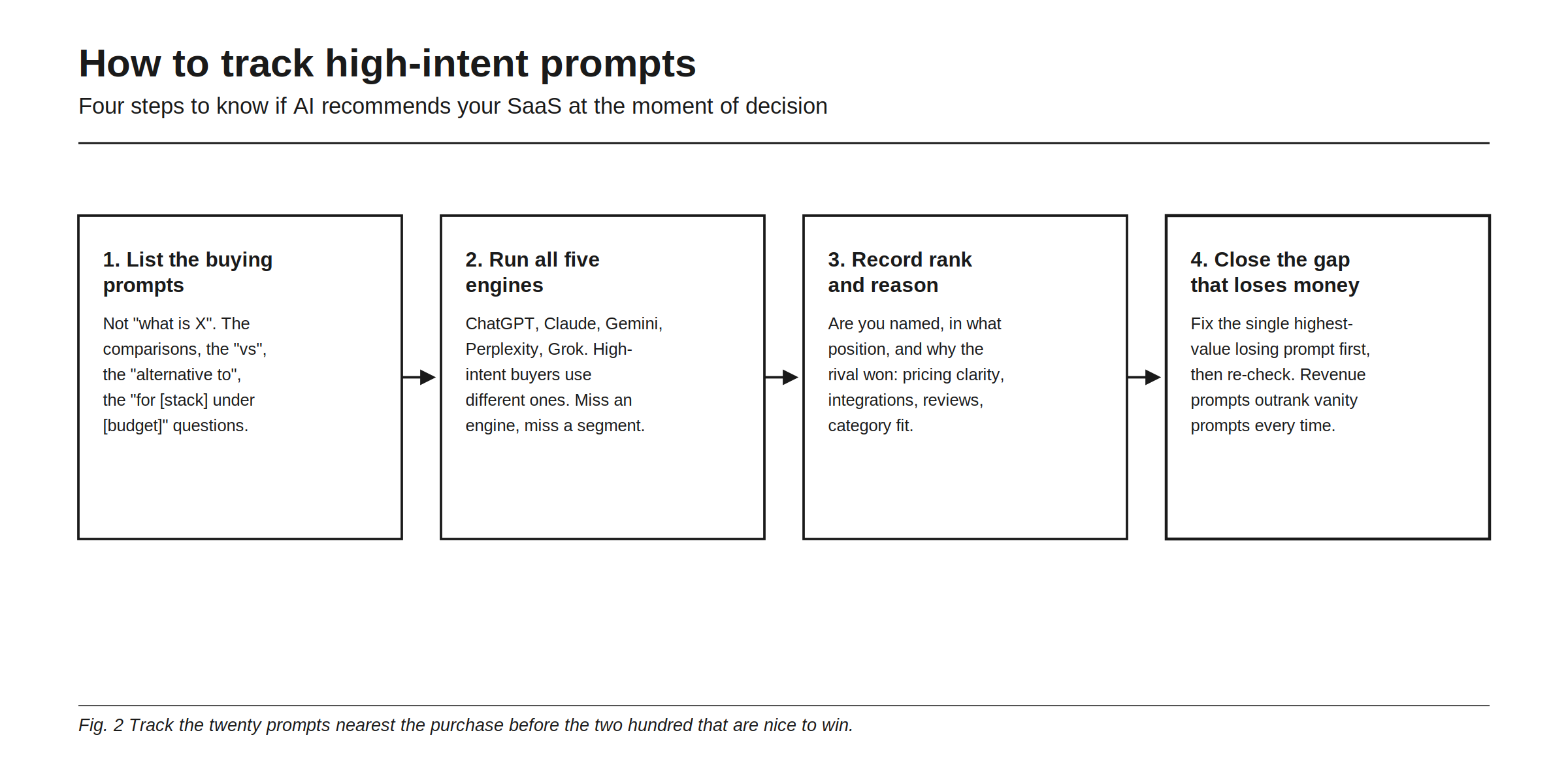
Step 1: list the buying prompts. Skip the definitional questions. Write down the comparisons, the “vs” queries, the “alternative to [competitor]”, and the qualified “best [category] for [our exact buyer]” questions your real prospects ask near a decision. If you sell to Shopify stores, “best X for Shopify” is worth more than “best X” alone. For a systematic way to build this list, see find the prompts where your brand should appear.
Step 2: run every engine your buyers use. High-intent buyers do not cluster on one engine, developers lean Claude and Perplexity, some segments live in ChatGPT, and a query answered well in ChatGPT can lose badly in Claude because the two use different indexes. Checking one engine tells you about one slice of your buyers.
Step 3: record rank and reason. For each prompt and engine, note whether you are named, in what position, and, crucially, why the winner won. AI engines will often tell you: clearer pricing, a named integration, stronger reviews, better category fit. That reason is your fix, written by the gatekeeper. The reasoning matters more than the score here, because at high intent, the objection is specific and addressable.
Step 4: close the gap that loses money. Do not fix everything; fix the single highest-value losing prompt first. If you lose “best X for enterprise” and that segment is your revenue, that one prompt outranks ten awareness wins. Ship the fix, a comparison page, a pricing clarification, a review push on the cited source, then re-check next cycle. Revenue prompts beat vanity prompts every time.
Why manual breaks down fast here
You can do this by hand for a handful of prompts on one engine, and you should, to learn the pattern. But high-intent tracking punishes the manual method specifically. The prompts are the ones you most need sampled repeatedly, because a single run can flip and you cannot afford a false “we’re fine” on a revenue prompt. Five engines multiply the work exactly where accuracy matters most. And the “why did we lose” analysis, the most valuable part, is the most tedious to do by hand.
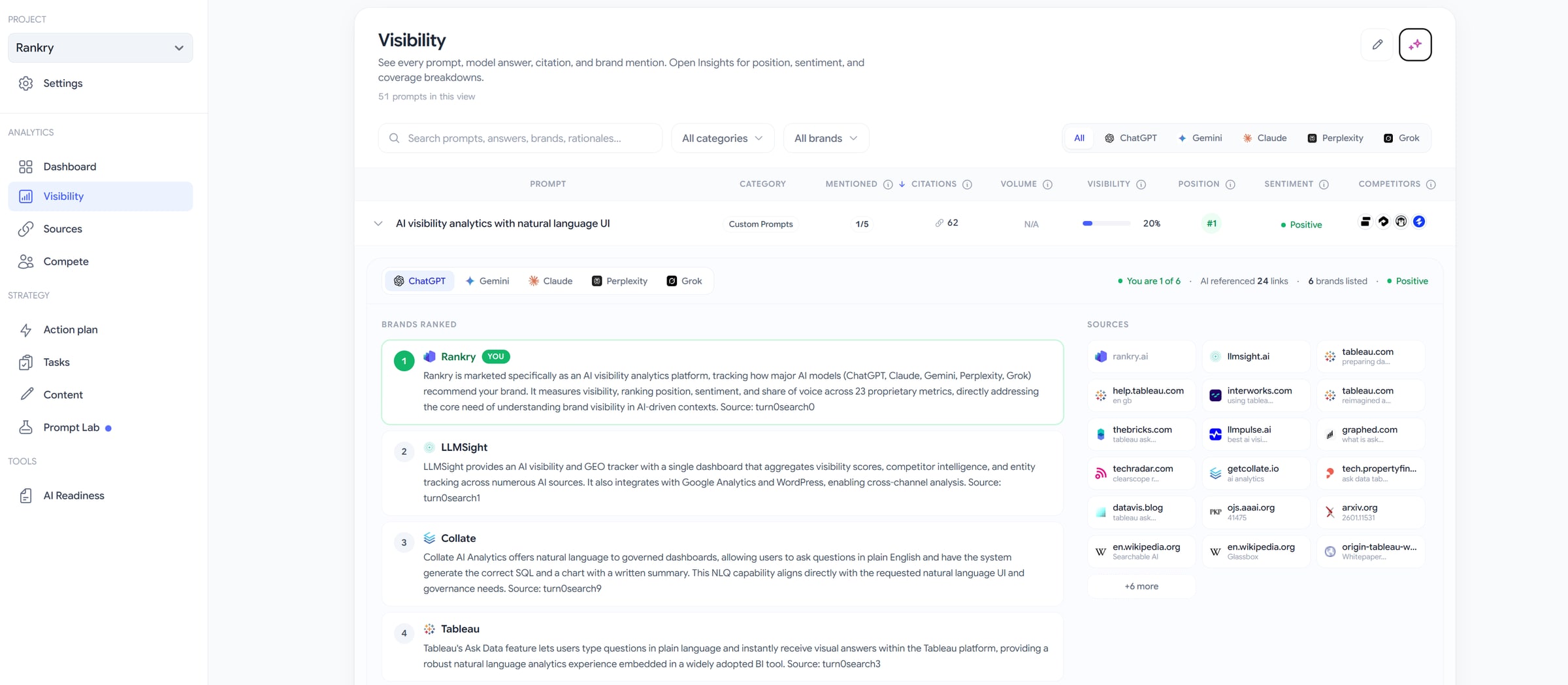
This is where automation earns its cost. Rankry tracks your prompts across your selected engines on a schedule, records position and the model’s reasoning, flags the cited sources where a competitor wins and you are absent, and keeps the raw answers as evidence, so “we lose ‘best X for enterprise’ on Claude because a G2 page cites a rival” becomes a tracked, assignable fix rather than a hunch. Plans start at $99 a month with a no-card trial. For the broader monitoring process this fits into, see how to monitor your brand across AI search engines.
The metric that connects to revenue
If you report one AI visibility number to your leadership, do not report overall visibility. Report your win rate on high-intent prompts: of the buying questions your prospects ask, in what share does AI name you, and in what share does it recommend you first. That number moves in lockstep with pipeline in a way that “mentioned in 40% of prompts” never will, because it measures the moment of decision, not the moment of awareness. Track it, move it, and you are optimizing the part of AI visibility that pays. How this win rate relates to the broader share-of-voice picture is covered in AI share of voice.
FAQ
How do I track whether AI recommends my SaaS for high-intent queries? Isolate the buying prompts, comparisons, alternatives, and qualified “best X for [stack]” questions, run them through the AI engines your buyers use on a schedule, and record whether you are named, your position, and why the winner won. Automate with a tool when manual tracking of five engines stops scaling.
What are high-intent prompts for SaaS? The questions asked near a purchase decision: “[competitor] alternative”, “is [product] worth it”, “best [category] for [specific stack or budget]”. They sit closest to the buy and decide pipeline more than high-volume awareness prompts.
Why track high-intent prompts separately from all AI visibility? Because they are worth more. Appearing in an awareness prompt is nice; winning a buying prompt closes revenue. Tracking them separately focuses effort on the prompts that move pipeline instead of vanity metrics.
How do I know why AI recommended a competitor over my SaaS? Ask the engine directly, or track the reasoning. AI often states the cause: clearer pricing, a named integration, stronger reviews, better category fit. That reason is your fix. Tools like Rankry record this reasoning per prompt.
What is the best metric for AI visibility in SaaS? Win rate on high-intent prompts: the share of buying questions where AI names you, and where it recommends you first. It tracks pipeline more directly than overall visibility or mention counts.
Track the buying prompts that decide your pipeline, across every engine your buyers use, with the reason you win or lose each one. Start a free 7-day Rankry trial, no card, first report in two minutes.