Google is now showing AI Overviews on searches for many large brand names, but no published study has yet measured how far that reaches across all branded searches. The clearest number so far comes from SEO Chris Long, who reported on September 30, 2026 that 93% of the roughly 100 brands he tested had an AI Overview, and Search Engine Roundtable’s Barry Schwartz saw the same pattern in his own spot checks. For contrast, an Amsive study published in April 2025 found AI Overviews on only 4.79% of branded keywords. The practical consequence is simple: when someone searches your name, Google may now give them a summary assembled from Wikipedia, YouTube, forums, reviews and other pages you do not control. You cannot cleanly switch that summary off, but you can audit it, see which sources feed it, and fix them.
Branded search used to be the one results page a company could treat as its own. Now there is a paragraph on it, written in Google’s voice, that your team did not write and may never have read.
What the data actually says, as of September 30
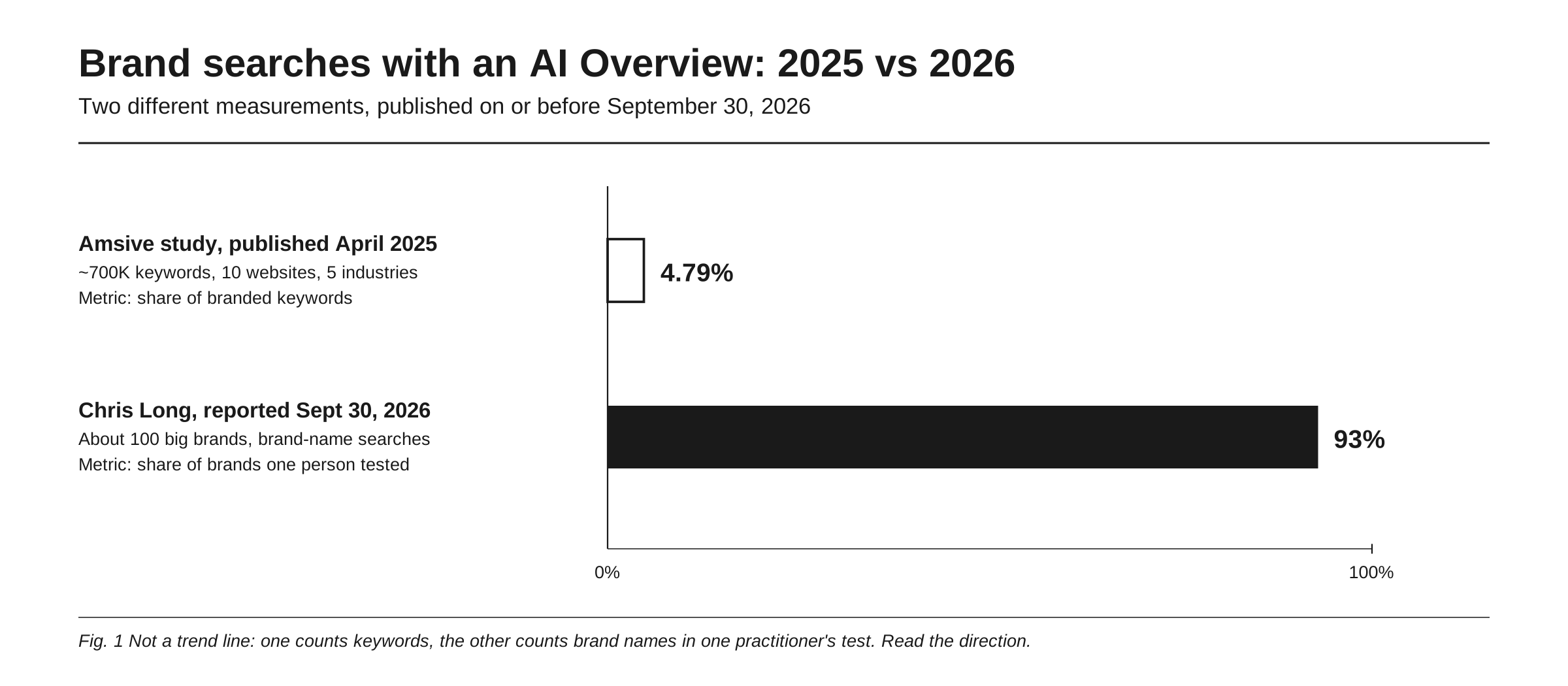
The September 30 signal is a practitioner test, not a study. Chris Long posted on X that Google is “starting to show AI Overviews for a ton of branded queries,” naming Reddit, Salesforce, Amazon and Adobe, and wrote: “93% of the brands I tested have AI Overviews appearing.” Barry Schwartz of Search Engine Roundtable noted the sample was only about 100 brands, tried several himself, and saw the same pattern. He noted two exceptions: searches for Google’s own name and for news publications did not show one, “for now.” Long had posted a similar observation in July 2026, and Schwartz added that AI Overviews in general now show for far more queries than they did then.
Read the limits before you quote it. It is one person’s sample of well-known brands, with the examples shown being searches for the brand name itself, at a single point in time, and the report does not name the market. It tells you nothing direct about smaller brands, about modified queries like “brand pricing” or “brand vs competitor,” or about other countries.
The 2025 baseline comes from a different kind of measurement. Amsive analyzed about 700,000 keywords across 10 websites in five industries (finance, education, SaaS, healthcare and pets) and found that only 4.79% of branded keywords triggered an AI Overview. One number counts keywords on 10 sites, the other counts brand names in one practitioner’s test, so the two do not form a trend line. The direction is still clear enough to act on: in Amsive’s 2025 data branded keywords rarely triggered an AI Overview, and in Long’s September test most big brand names did. Smaller brands should check rather than assume.
Where the summary sits, and who writes it
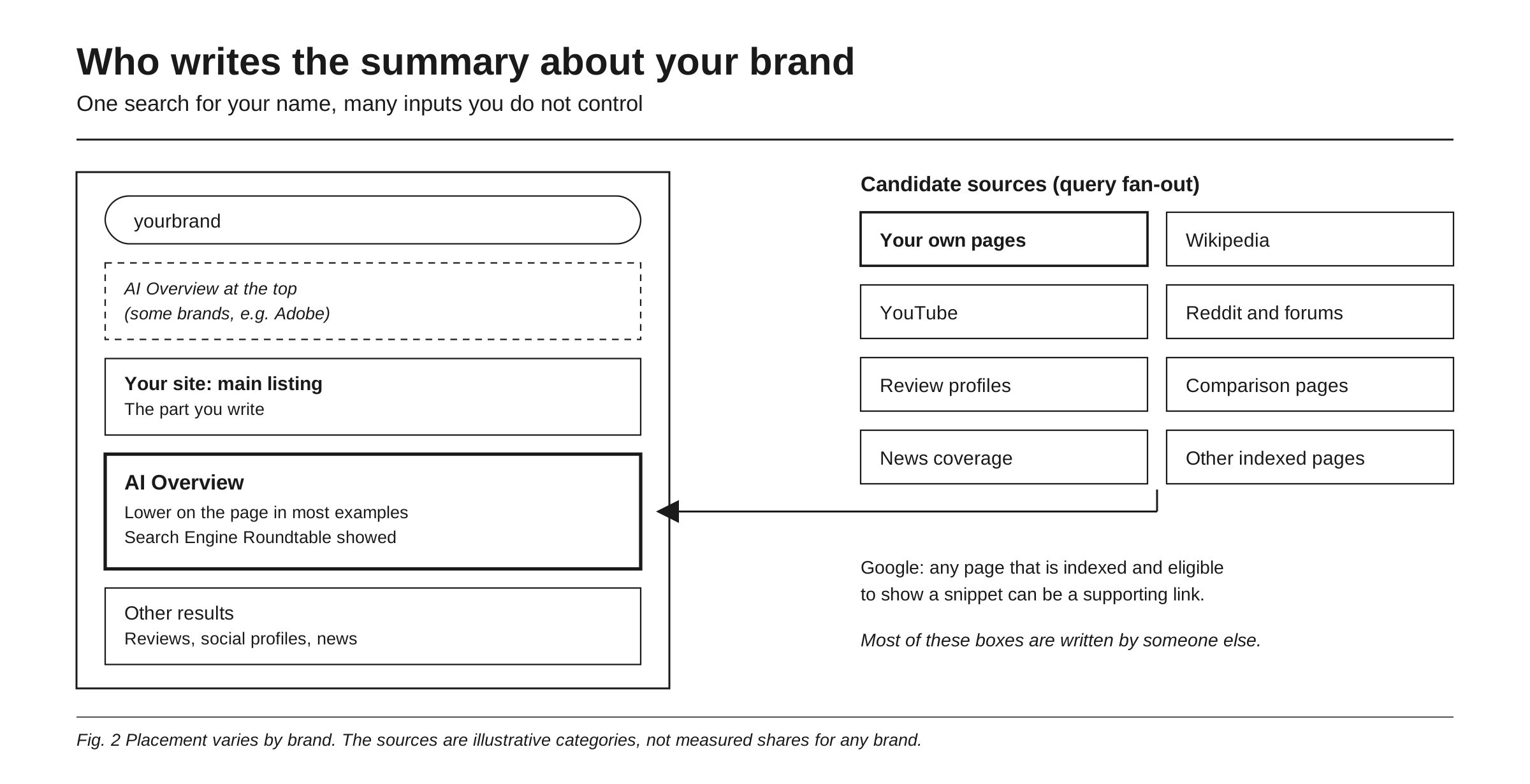
A common claim is that the AI summary about your brand now sits above your own website. The September evidence is more mixed. In most of the examples Search Engine Roundtable showed, the AI Overview appeared lower on the page, below the company’s main listing or further down. Adobe was the exception shown, with the AI Overview at the top for its own name. So placement varies by brand, and the only way to know yours is to look.
Wherever it sits, the AI Overview is the one block on a branded results page that describes you in Google’s voice rather than yours. Google’s documentation explains what feeds it. AI Overviews may use a “query fan-out” technique, issuing multiple related searches across subtopics and data sources to develop a response, and identifying supporting pages while it is generated. To be shown as a supporting link, “a page must be indexed and eligible to be shown in Google Search with a snippet,” and Google says there are no additional requirements or special optimizations. In other words, any indexed, snippet-eligible page that talks about you is a candidate source: your own pages, but also Wikipedia, YouTube, Reddit threads, review profiles, competitor comparison pages and news coverage.
We found no study published by September 30 that measures which sources Google cites on branded queries specifically. Two broader data points show the direction:
- Pew Research Center, July 2025: in browsing data from 900 US adults’ Google searches in March 2025, Wikipedia, YouTube and Reddit were the most cited sources in AI summaries, together 15% of all sources listed. These were all kinds of queries, not brand searches.
- A Rankfor.AI paper on arXiv, June 2026: across 167,551 URL citations about 128 brands in 12 European markets, it reports that 85.7% of URL citations pointed to sites the brand does not own and 14.3% to owned sites (that split is measured on its largest dataset, 131,514 citations). It covered Perplexity, Gemini and GPT-5.4, not Google AI Overviews, and Rankfor.AI is an AI visibility vendor, so treat it as directional.
The practical risk follows from that mix. A two-year-old review with your old pricing, a Reddit complaint about a bug you fixed, or a competitor’s “alternatives to you” page can each become a line in the summary. When that happens, you are dealing with the problem described in how to find and fix a wrong AI description.
One tempting fix does not work. Google lets you limit what it shows from your pages with nosnippet, data-nosnippet and max-snippet. Applying them to your own pages limits or removes your words in the summary and in your own listing’s snippet, while the third-party sources stay. That is the opposite of what you want.
What happens to clicks on brand searches
We found no published study, as of September 30, that measures click behavior on branded queries since the September expansion. Three earlier sources give the clearest picture we found:
- Amsive, April 2025: on the small set of branded keywords that triggered AI Overviews, click-through rate rose 18.68% on average, while non-branded keywords fell 19.98%. That was when only 4.79% of branded keywords had an AI Overview, so it may not hold at today’s coverage.
- Pew Research Center, July 2025: users who saw an AI summary clicked a traditional search result in 8% of visits, against 15% for those who did not. Only 1% of visits to pages with a summary included a click on a link inside it, and sessions ended on 26% of pages with a summary versus 16% of pages with only traditional results. Google called the methodology “flawed.” These were all query types.
- Seer Interactive, November 2025: across 3,119 informational and educational queries for 42 of the agency’s client organizations, being cited in the AI Overview was associated with a 35% higher organic click-through rate (0.70% vs 0.52%) and a 91% higher paid click-through rate than not being cited, based on Q3 2025 averages. Seer itself says it cannot definitively prove that citation causes the higher click-through rate.
Put together, the data does not show that branded AI Overviews cost you clicks on your own name; in 2025, the opposite held in Amsive’s sample. People searching for a brand usually want to reach it. The larger risk is what the searcher believes before the click, and the modified queries where the decision is still open: reviews, pricing, “vs” and “alternatives.” Those are the summaries to audit first.
Measuring this in Search Console has a limit worth knowing. Google says sites appearing in AI Overviews and AI Mode are reported within the “Web” search type in the Performance report, mixed with other search traffic. Since June 2026 there is also a separate generative AI performance report, which Google says reached all websites by August 31, 2026, and Google’s announcement lists impressions by page, country, device and date, not clicks (how to read Search Console’s generative AI report). For clicks, compare branded query click-through rate month over month and look for breaks, as covered in Google Search Console for AI visibility.
How to audit your branded AI Overviews
-
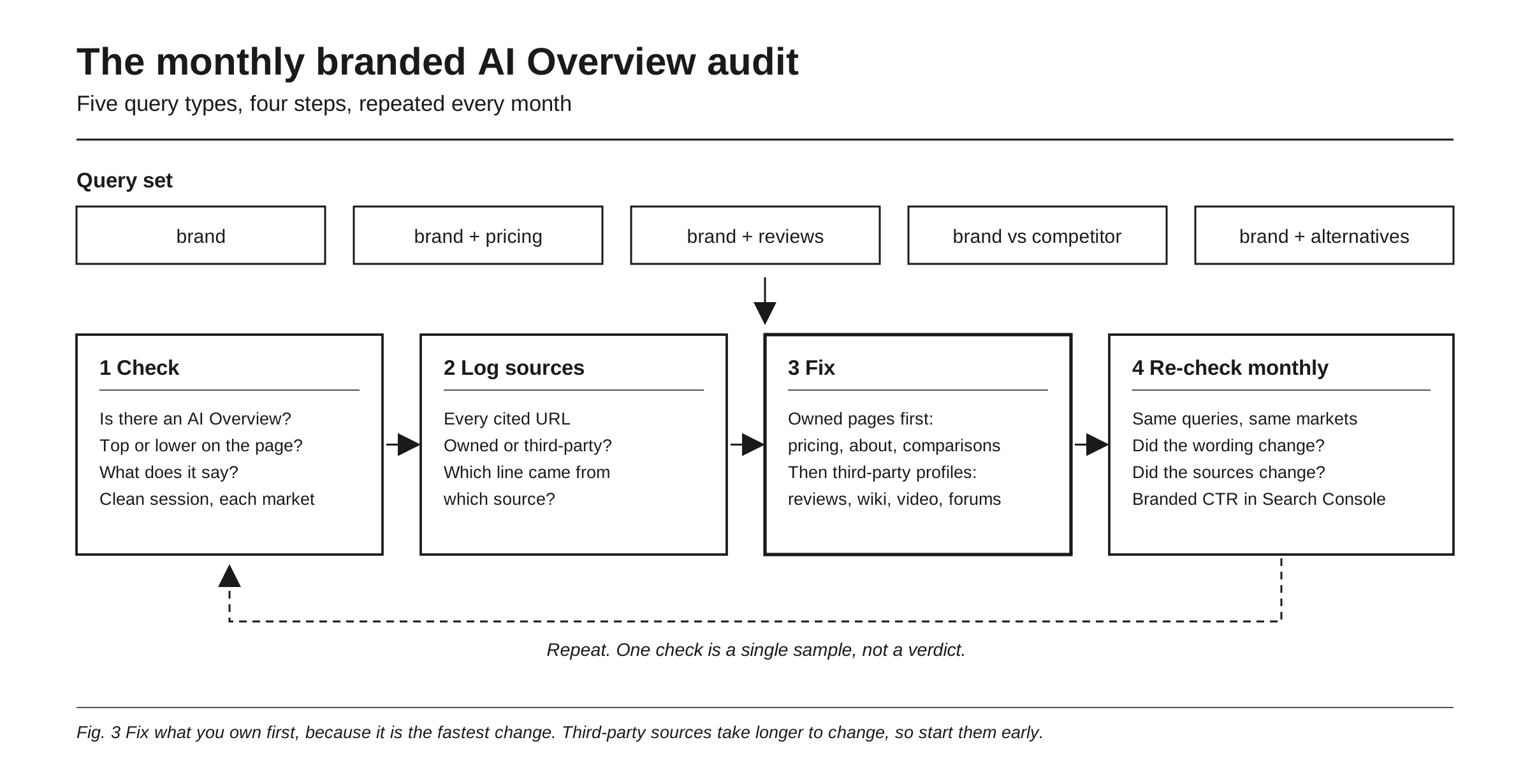
Build the query set. Start with five patterns: your brand name, brand + pricing, brand + reviews, brand vs each main competitor, and brand + alternatives. Then filter the Search Console Queries report by your brand name and add the real variants people type, such as “brand login,” “is brand legit,” or “brand for [use case].”
-
Check each query in a clean session. Use a logged-out, private browser window, in each market you sell in. Record whether an AI Overview appears, whether it sits at the top or lower on the page, and copy the text. Note the date: one check is one sample.
-
Log every cited source. Open the source links and classify each one: your own site, Wikipedia or a knowledge base, video, Reddit or forums, review platforms, competitor pages, news. Where you can, note which sentence in the summary came from which source.
-
Mark what is wrong or stale. Old prices, retired plans, missing features, a competitor’s framing of you, a resolved complaint presented as current. Rank them by how much they would affect a buying decision.
-
Fix your owned pages first. They are the fastest change. Make your pricing, about, product and comparison pages state the facts plainly in indexable text, keep them current, and keep them eligible for snippets. Use the same company name, category and description everywhere, which is the entity work in brand entity recognition for AI.
-
Then fix third-party profiles. Claim and update your review platform profiles, LinkedIn page and YouTube channel descriptions. Request corrections to factual errors on Wikipedia through its conflict-of-interest process rather than editing your own article. Answer open Reddit threads transparently and from a named account. For “vs” and “alternatives” queries, publish your own honest comparison page so there is an owned source worth citing.
-
Do not hide from the summary. Skip nosnippet as a defensive move on your key pages. It removes your voice and leaves everyone else’s.
-
Re-check monthly. Re-run the same queries in the same markets, and track four things: presence, placement, wording and sources. Pair that with branded click-through rate in Search Console. If the wording changes after a fix, you know which source moved it.
How Rankry fits
Branded AI Overviews are one surface of a larger question: what AI systems say when buyers ask about you. Rankry tracks how ChatGPT, Claude, Gemini, Perplexity, Grok and Google AI Mode and AI Overviews mention, rank, cite and recommend your brand on a stable set of buyer-intent prompts, every day, so a change in the sources or the framing shows up as a change in your data rather than a surprise in a sales call. Competitor comparison shows how your brand stacks up against rivals on the same prompts, the Google Search Console integration brings your search data in alongside your AI visibility data, and a new prompt is answered as soon as you add it.
FAQ
Do AI Overviews now show for most branded searches? For big brand names, early evidence says yes, but no published study had measured branded searches broadly as of September 30, 2026. The clearest figure is a practitioner test: Chris Long reported that 93% of the roughly 100 brands he tested, well-known names such as Reddit, Salesforce, Amazon and Adobe, had an AI Overview. That sample is small and skewed toward big brands, so check your own brand queries directly.
Does a branded AI Overview appear above my own website? Sometimes. In most examples Search Engine Roundtable showed in September 2026, the AI Overview appeared lower on the page, below the company’s main listing or further down. Adobe was an exception, with the AI Overview at the top. Placement varies by brand and query, so record it for each branded query you track.
Do branded AI Overviews reduce clicks to my site? We found no published data on that since the September 2026 expansion. In Amsive’s 2025 study, branded keywords with an AI Overview saw click-through rate rise 18.68% on average, while non-branded keywords fell. The bigger risk is what the summary tells people on reviews, pricing and comparison queries before they ever click.
Can I stop Google from showing an AI Overview for my brand name? Not cleanly. Google offers nosnippet, data-nosnippet and max-snippet to limit what it shows from your pages, but those controls only affect your own content. Third-party pages can still be cited, so blocking snippets mostly removes your own voice. Improving the sources the summary draws from is the practical lever.
How often should I check my branded AI Overviews? Monthly is a reasonable baseline, plus a check after any pricing change, product launch, rebrand or wave of reviews. Use the same queries, markets and logged-out conditions each time, and log presence, placement, wording and cited sources so you can tell what changed and which fix moved it.
Sources
- Google AI Overviews Showing For Many Large Brand Names, Search Engine Roundtable, September 30, 2026
- Google AI Overviews: New CTR Study Reveals How to Navigate Negative SERP Impact, Amsive, April 16, 2025
- Google users are less likely to click on links when an AI summary appears in the results, Pew Research Center, July 22, 2025
- Pew: Searchers Much Less Likely To Click On Links In Google Search Results With AI Overviews (includes Google’s statement), Search Engine Roundtable, July 23, 2025
- AIO Impact on Google CTR: September 2025 Update, Seer Interactive, November 4, 2025
- AI features and your website, Google Search Central, updated December 10, 2025
- Introducing Search Generative AI performance reports in Search Console, Google Search Central Blog, June 3, 2026
- How Large Language Models Source Brand Reputation Across Languages and Markets, arXiv (D. Żatuchin, Rankfor.AI), June 24, 2026
See what Google AI Overviews and the major assistants say about your brand, and which sources they cite, every day. Start a free 7-day Rankry trial, no card required.