Yes, a brand-new site can earn its first AI citation within weeks, but only under narrow conditions, and a first citation is not the same as becoming a source AI keeps using. The fastest public examples had some mix of open crawler access, aggressive indexing, pages full of specific claims and, in the cleanest case, borrowed authority from established domains. In a vendor study by MaxAEO of 1,240 sources across 132 brands, own pages reached a first citation in a median of 13 days, but sources on the weakest third of domains took 21 days against 7 for the strongest. Citations also fade, and in the same study 41% of sources cited once were not cited again the next day. Treat fast cases as anecdotes, plan for 90 days, and measure crawler hits, first citations and first third-party mentions.
You have probably seen a screenshot of a new site cited by ChatGPT two weeks after launch. The screenshot may well be real. What it leaves out is everything that made it possible, and everyone who tried the same thing and got nothing.
Four documented cases, four different starting points
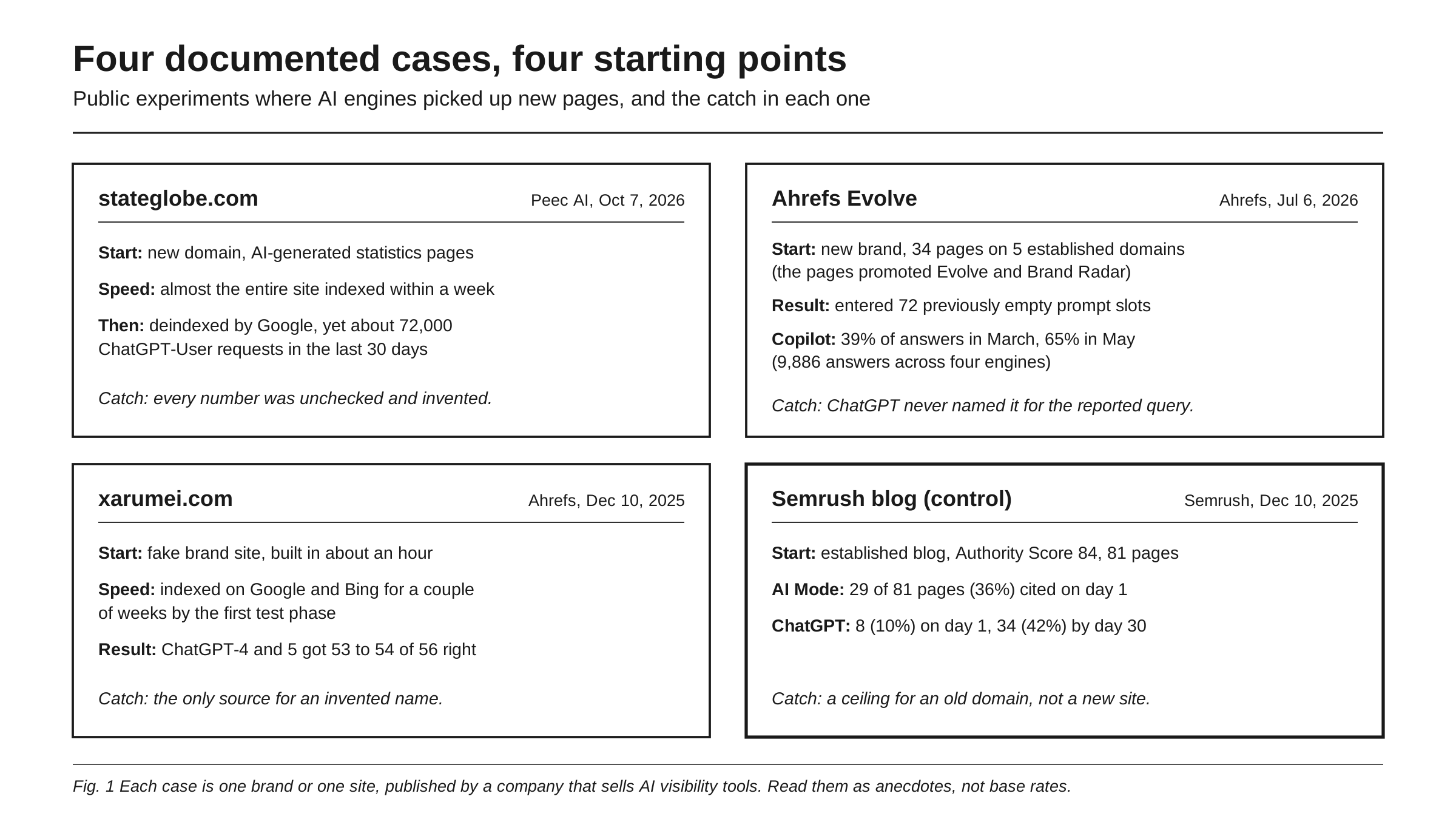
stateglobe.com (Peec AI, October 7, 2026). Metehan Yesilyurt started a new domain in March 2026 and filled it with 50,000 AI-generated statistics pages he never checked. “Using indexer tools, I got almost the entire site indexed within a week,” he wrote. Two Google updates then collapsed its Google visibility and Google later deindexed the pages, but ChatGPT kept fetching them: around 72,000 ChatGPT-User requests in the last 30 days, and more than 10,000 ChatGPT sessions in GA4 since March. Speed is possible; speed is not trust, and the author’s own line is that you “should never publish fake content.” Full breakdown: the fake-statistics experiment.
Ahrefs Evolve (Ahrefs, July 6, 2026). Mateusz Makosiewicz tracked Ahrefs Evolve, the company’s new SEO and AEO conference. The brand was new, the domains were not: 34 self-promotional pages, promoting Evolve and Ahrefs’ Brand Radar tool, went live from February 13 on five sites, including ahrefs.com and medium.com. Across 9,886 answers from ChatGPT, Gemini, Perplexity and Copilot, Evolve broke into 72 prompt-engine slots that were empty in the baseline and 82% of those came in answers citing one of the pages. On Copilot it went from essentially zero to 39% of answers in March, 57% in April and 65% in May. ChatGPT, in the author’s words, “never named Evolve for this query at all.” The author’s own caveat: “This isn’t proof.”
xarumei.com (Ahrefs, December 10, 2025). For a misinformation test, the same author built a fake paperweight brand’s site with Wix’s AI builder “in about an hour,” and it had been indexed on Google and Bing for a couple of weeks by the first test phase. Asked 56 questions, ChatGPT-4 and ChatGPT-5 got 53 to 54 right, “using the site well,” while Claude “ignored the site completely.” The catch: it was the only source for an invented name, with zero competition.
The control: Semrush’s blog (Semrush, December 10, 2025). Semrush published 81 FAQ pages on its own blog (Authority Score 84) and checked citations daily for 30 days. Google AI Mode cited 29 pages (36%) on day 1. ChatGPT search cited 8 (10%) on day 1 and 34 (42%) by day 30. That is a ceiling for an established domain, not a new-site result.
How fast is “weeks,” really?
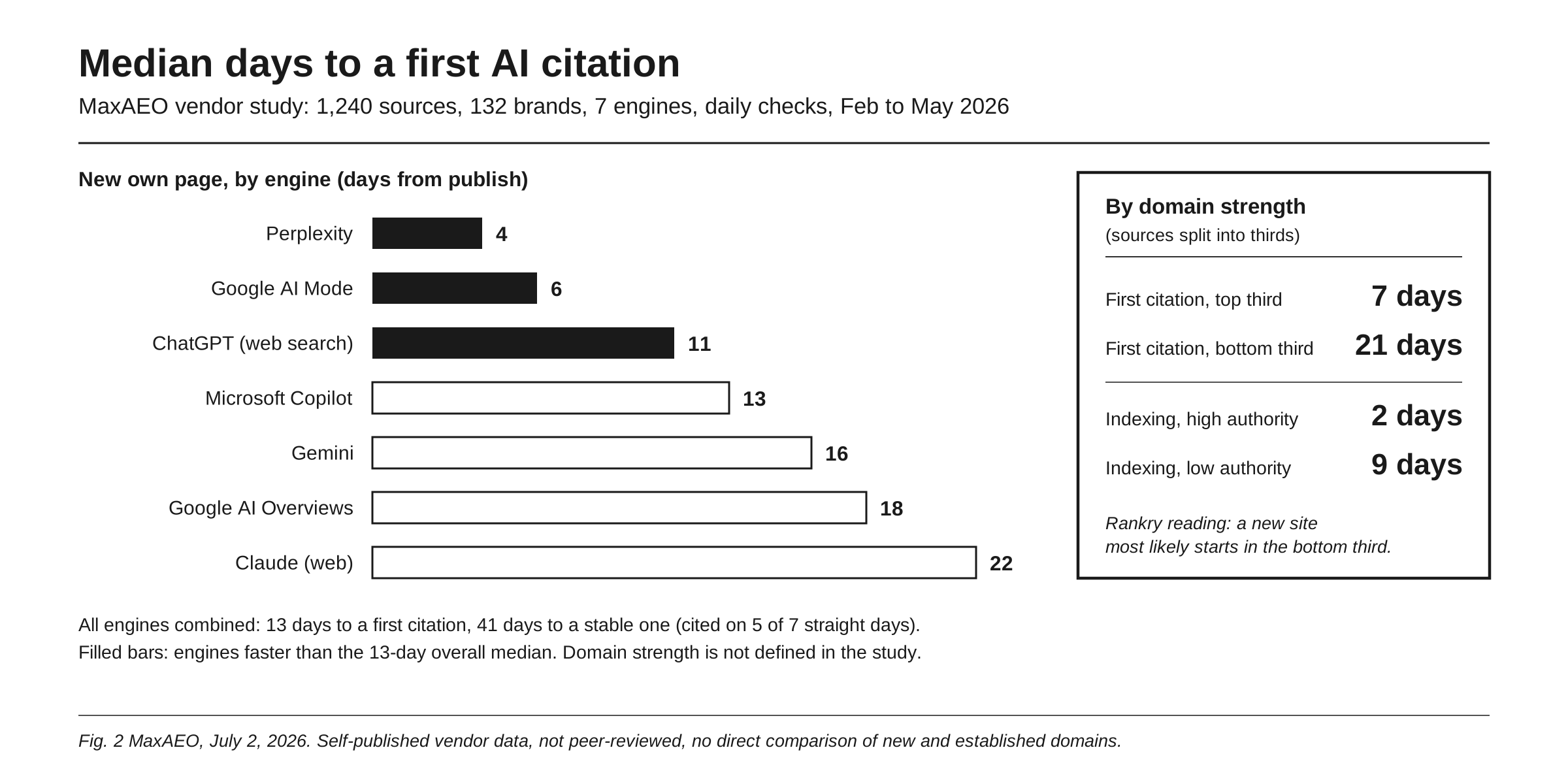
The only large baseline we found is vendor data. MaxAEO, which sells AI visibility tracking, published a study on July 2, 2026 of 1,240 new sources (740 own pages, 500 earned mentions) across 132 brands, about 50 prompts per brand and seven engines, checked daily from February to May 2026.
Its medians for a new own page, counted from the publish date: Perplexity 4 days, Google AI Mode 6, ChatGPT with web search 11, Copilot 13, Gemini 16, Google AI Overviews 18 and Claude 22. Overall: 13 days to a first citation, 41 to a stable one (cited 5 of 7 straight days). Sources on the strongest third of domains got a first citation in 7 days, the weakest in 21, and high-authority domains cleared indexing in 2 days versus 9 for low-authority ones.
Limits: it is self-published, not peer-reviewed, does not define domain strength, and does not compare new domains with established ones directly. Our reading: a brand-new site almost certainly starts in the bottom third, so 21 days is a more honest planning number than 13, and by definition roughly half of all sources took longer than the median.
What made citation fast, and what did not
Five things recur in the fast cases above.
- Crawl access. OpenAI says OAI-SearchBot is “used to surface websites in search results” in ChatGPT, that sites opted out “will not be shown in ChatGPT search answers,” and that a robots.txt change can take “~24 hours” to register. How ChatGPT sources pages beyond Bing is covered in ChatGPT’s own search index.
- Indexing. stateglobe forced it with tools. Google says crawling “can take anywhere from a few days to a few weeks,” and a page can only be a supporting link in AI Overviews or AI Mode if it is “indexed and eligible to be shown in Google Search with a snippet.” Bing’s IndexNow speeds up discovery but “does not guarantee that web pages will be crawled or indexed.”
- Specific, extractable claims. stateglobe was nothing but numbers. Xarumei was the only answer to its own name.
- Borrowed authority. Evolve’s pages lived on established domains. When the same test promoted Ahrefs’ established Brand Radar tool, 94% of new Ahrefs mentions came from third-party content, not the test pages. A separate Ahrefs study of 75,000 brands (May 2025, brands above DR 40) found branded web mentions correlated with AI Overview brand visibility at 0.664 versus 0.218 for backlinks; correlation, not causation.
- Narrow queries. Evolve appeared in 66.4% of answers to “best SEO conferences 2026” and only 15.8% for “best marketing conferences 2026.”
And four things did not hold up:
- Volume did not buy durability. stateglobe’s 50,000 pages did not survive Google.
- Being found is not being named. When a conference-promoting page was found but not cited, 74% of answers skipped Evolve, and 43% of answers that did cite one never mentioned it.
- Citations churn. In about a quarter of cases, a test page was cited once for a query on one assistant and never again. MaxAEO found only 17% of cited sources still appearing at 90 days.
- One engine is not all engines. ChatGPT never named Evolve for the query Ahrefs reported, and Claude ignored Xarumei.
Survivorship bias: read every fast case as an anecdote
Every case above was published because it was interesting. Nobody writes up “we launched and nothing happened for three months,” yet that silent majority is the real base rate. Several testers also had advantages most founders lack: established domains, research teams and their own tracking tools.
The samples are tiny: one conference, one fake brand, one stats site, one blog, and engines change faster than studies get published. Every study here comes from a company that sells AI visibility software. So does Rankry, which is why we label each study. The honest summary: a first citation in weeks is documented. A new site becoming a reliable source for competitive category prompts in weeks is not, anywhere we could find.
Rankry’s 30/60/90-day plan for a new site
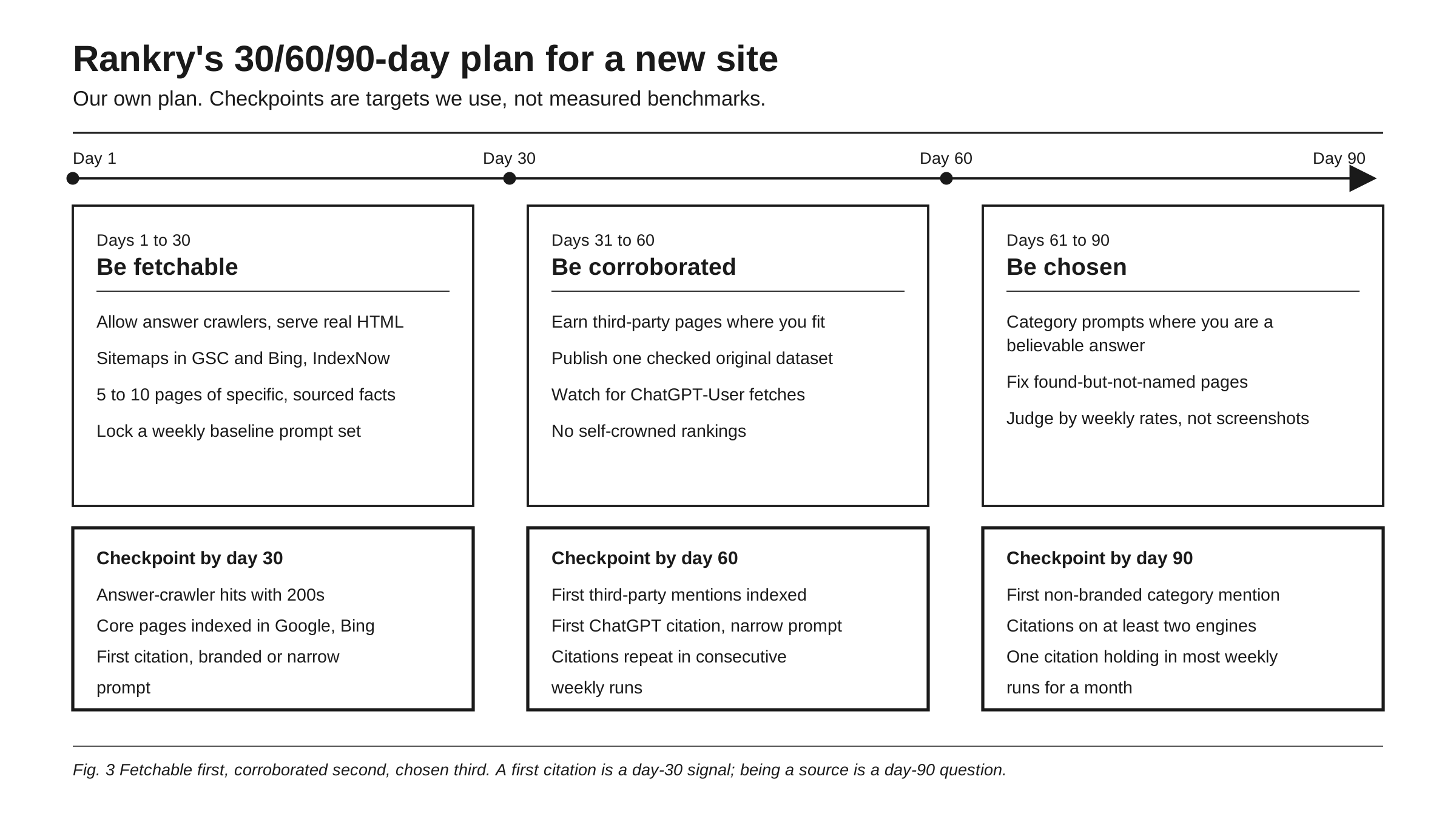
This is our own plan, built from the evidence above. The checkpoints are our targets, not measured benchmarks. If you are unsure whether you are a source at all yet, start with is my website a source for ChatGPT.
Days 1 to 30: be fetchable.
- Allow the answer crawlers (OAI-SearchBot, PerplexityBot, Claude-SearchBot) in robots.txt, serve real HTML without relying on JavaScript, and confirm 200 responses. Give OpenAI about a day per change.
- Submit sitemaps in Google Search Console and Bing Webmaster Tools, and send IndexNow pings on every publish.
- Publish five to ten pages built on specific, sourced facts: pricing, specs, comparisons, original numbers. Put the source and year next to each figure.
- Lock a baseline set of branded, narrow and category prompts and run it weekly from day one.
Checkpoint by day 30: answer-crawler hits in your logs, core pages indexed in Google and Bing, and a first citation on a branded or narrow prompt, likely on Perplexity or AI Mode first if MaxAEO’s medians hold.
Days 31 to 60: be corroborated.
- Earn third-party pages where you fit honestly: directories, partner pages, relevant lists, community answers. No self-crowned rankings.
- Publish one piece of original data that others can cite, with every number checked.
- Watch for ChatGPT-User fetches, which OpenAI describes as user-initiated, not automated crawling: a sign your pages enter live conversations.
Checkpoint by day 60: first third-party mentions indexed, a first ChatGPT citation on a narrow prompt, and citations that repeat in consecutive weekly runs.
Days 61 to 90: be chosen.
- Expand into category prompts where you are a believable answer, not every prompt in your market.
- Fix “found but not named”: rewrite cited pages so the brand claim sits in the sentence AI extracts.
- Judge by rates across weeks, not by screenshots.
Checkpoint by day 90: a first non-branded category mention, citations on at least two engines, and one citation holding in most weekly runs for a month. More on earning a first citation: how to get cited by AI.
Rankry measures most of these checkpoints; crawler hits stay in your server logs. Its AI traffic tracking shows the visits AI platforms send to your pages, the AI Readiness Checker runs 36 checks in 6 categories, and the Google Search Console integration brings your Google Search data in alongside AI results. A stable set of buyer-intent prompts, tracked every day across ChatGPT, Claude, Gemini, Perplexity, Grok and Google AI Mode and AI Overviews, shows first mentions and citations and whether they hold. New prompts are answered as soon as you add them, and competitor comparison shows who owns the answers you want.
FAQ
How long does it take a new website to get cited by ChatGPT? There is no reliable figure for brand-new domains. In MaxAEO’s vendor study of 1,240 sources across 132 brands, own pages reached a first ChatGPT citation in a median of 11 days, but the study did not isolate new domains, and its weakest third of domains took 21 days across engines. Plan for weeks to a first citation and months to a stable one.
Does IndexNow get you cited by ChatGPT faster? IndexNow tells participating search engines that a URL changed, and Bing states it does not guarantee crawling or indexing. It can shorten the indexing step, which matters because citation follows retrieval. It does not make a page more citable. Crawler access, specific content and third-party corroboration still decide whether an engine uses the page.
Is it worth publishing lots of AI-generated pages to get cited quickly? No. Peec AI’s stateglobe experiment got indexed within a week and was fetched heavily by ChatGPT, but its Google visibility collapsed after two updates, Google deindexed the pages, and the invented numbers spread into other publications. The author himself says never to publish fake content. Speed without accuracy creates risk, not a durable source.
Why does my new site get cited by Perplexity but not ChatGPT? Engines move at different speeds and pick sources differently. In MaxAEO’s vendor data, Perplexity cited new own pages in a median of 4 days versus 11 for ChatGPT. In Ahrefs’ Evolve test, ChatGPT never named the new brand for the query the author reported while Copilot did. Track each engine separately instead of assuming one result generalizes.
What should I measure in the first 90 days? Measure in order: answer-crawler hits with 200 responses, pages indexed in Google and Bing, first citations on branded and narrow prompts, first third-party mentions, and finally mentions in non-branded category prompts. Read each as a rate across weekly runs. A single screenshot of one answer tells you almost nothing about whether you are a source.
Sources
- Publish stats, get cited: The tactic that put my data all over the web, Peec AI (Metehan Yesilyurt), October 7, 2026
- Self-Promotional Content Works, Until It Backfires (AI SEO Experiment), Ahrefs (Mateusz Makosiewicz), July 6, 2026
- I Ran an AI Misinformation Experiment. Every Marketer Should See the Results, Ahrefs (Mateusz Makosiewicz), December 10, 2025
- How Fast Do AI Search Platforms Cite New Content?, Semrush (Tushar Pol), December 10, 2025
- Time to Citation in AI Search: How Long Until You Show Up?, MaxAEO (Chris Han), July 2, 2026
- Overview of OpenAI crawlers, OpenAI, n.d.
- AI features and your website, Google Search Central, updated December 10, 2025
- Ask Google to recrawl your URLs, Google Search Central, updated December 10, 2025
- IndexNow: Get started, Bing, n.d.
- An Analysis of AI Overview Brand Visibility Factors (75K Brands Studied), Ahrefs (Louise Linehan), May 26, 2025
Find out whether AI engines are citing and naming your new site, day by day. Start a free 7-day Rankry trial, no card required.