As of October 9, 2026, GPT-6 has been rolling out as the model in ChatGPT’s main Chat tab for two days: GPT-6 Sol for Plus, Pro, Business and Enterprise users since October 7 and GPT-6 Luna for Free and Go users since October 8. We found no published study that compares how many brands ChatGPT names per answer before and after that switch, so anyone quoting a number today is guessing. The only before-and-after data we found covers GPT-6 Astra in ChatGPT Work, where a 50-prompt Writesonic test found fewer searches, fewer pages read and slightly shorter answers than GPT-5.6 Sol. Earlier 2026 data shows the pattern to watch: when ChatGPT roughly doubled the pages it showed as consulted in August, Searchable’s tracked brands were mentioned slightly less often, not more. Answer length, research depth and brand slots move independently, so do not assume a bigger or deeper answer has more room for you. The practical move this week is to mark October 7 and 8 in your tracking, rerun the same prompts several times, and compare like with like.
Every model switch produces a wave of hot takes about what changed for brands. This one arrived faster than the data. Here is what is confirmed, what is not, and how to measure it properly yourself.
What actually shipped, and when
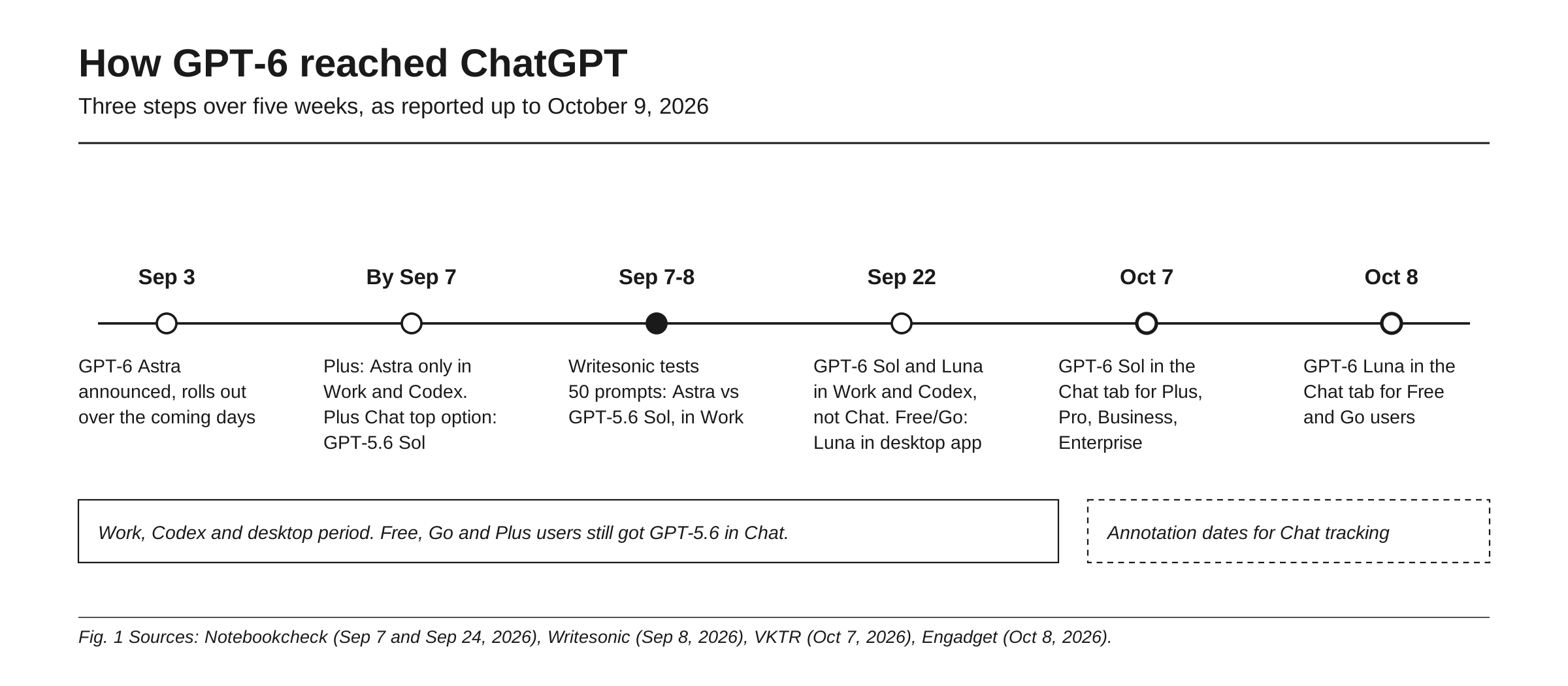
GPT-6 reached ChatGPT in three steps, and they matter differently for brand tracking.
The first was GPT-6 Astra, which OpenAI introduced on September 3. According to Notebookcheck’s September 7 report, Plus users got Astra only in ChatGPT Work and Codex. In the Chat tab, GPT-6 was listed as GPT-6 Pro for Pro, Business and Enterprise plans only, and for Plus users GPT-5.6 Sol stayed the top option in the ordinary chat window.
The second came on September 22, when GPT-6 Sol and GPT-6 Luna arrived. Notebookcheck reported on September 24 that, per OpenAI’s release notes, “the models are available in Work and Codex, but not Chat,” and that Free and Go users could use GPT-6 Luna only in the desktop app. Free and Go stayed on GPT-5.6 Luna in Chat. So for Free, Go and Plus users asking questions in the regular chat window, the model answering in September was still GPT-5.6.
The third step is the one that changes your numbers. On October 7, GPT-6 began rolling out in the Chat tab for Plus, Pro, Business and Enterprise users, powered by GPT-6 Sol, as VKTR reported that day. Engadget reported on October 8 that Free and Go users would get GPT-6 Luna, “which isn’t as capable as Sol,” starting that day.
OpenAI’s own claims about search are worth reading carefully. Per VKTR, OpenAI says GPT-6 Instant starts answering web search questions 44% sooner on average than GPT-5.6 Instant, and that GPT-6 makes better decisions about when to search the web. Those are OpenAI’s internal evaluations, not independent measurements, and neither says anything about which brands appear in the answer.
One naming trap: Sol and Luna were already model names in the GPT-5.6 generation. If your notes say “Luna,” they no longer tell you which model answered. Record the version, not the nickname.
What the first before-and-after data shows
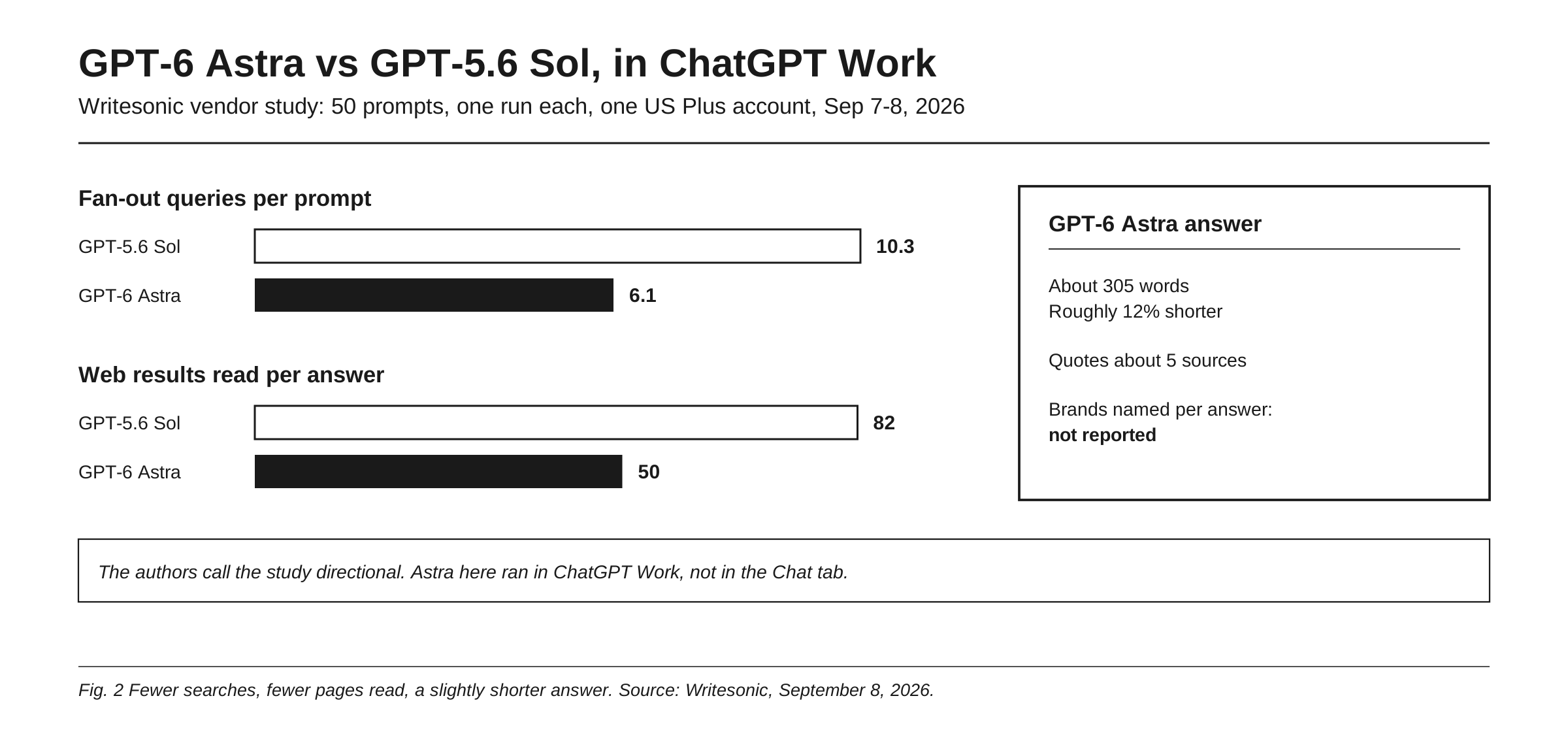
The only published comparison we found of GPT-6 against its predecessor inside ChatGPT, as of this writing, is a Writesonic vendor study from September 8. Writesonic ran 50 prompts across 16 categories on a single US Plus account on September 7 and 8, comparing GPT-6 Astra with GPT-5.6 Sol, both in ChatGPT Work, with one run per prompt per condition.
In Writesonic’s sample, Astra ran 6.1 fan-out queries per prompt versus 10.3 for Sol, a 41% drop. It read about 50 web results per answer versus 82. The answer came out at about 305 words, which Writesonic describes as roughly 12% shorter, and quoted about 5 sources. Search behavior also tilted toward brands’ own sites: 75.1% of Astra’s searches were site: searches versus 70.7% for Sol, and, adding direct opens of brand URLs, Writesonic puts 83% of Astra’s search budget on brand-owned pages. Astra’s first-party citation rate was 71.1% versus 73.1% for Sol.
Keep the limits in view. The authors call the study directional by design. One run per prompt means run-to-run variation is untested. It used one account and the Work surface, not the Chat tab where GPT-6 Sol and Luna now answer, and Writesonic notes that switching between Chat and Work by itself changes citation formatting and answer length. Repeated runs and non-English prompts are listed as open questions. And it did not report how many brands each answer named.
So the honest summary is narrow: in one small test of one GPT-6 variant, ChatGPT searched less, read less, aimed more of its searches at brand-owned sites, and wrote slightly shorter answers. Whether GPT-6 Sol and Luna in the Chat tab behave the same way is not yet measured.
Longer or deeper answers do not mean more shortlist slots
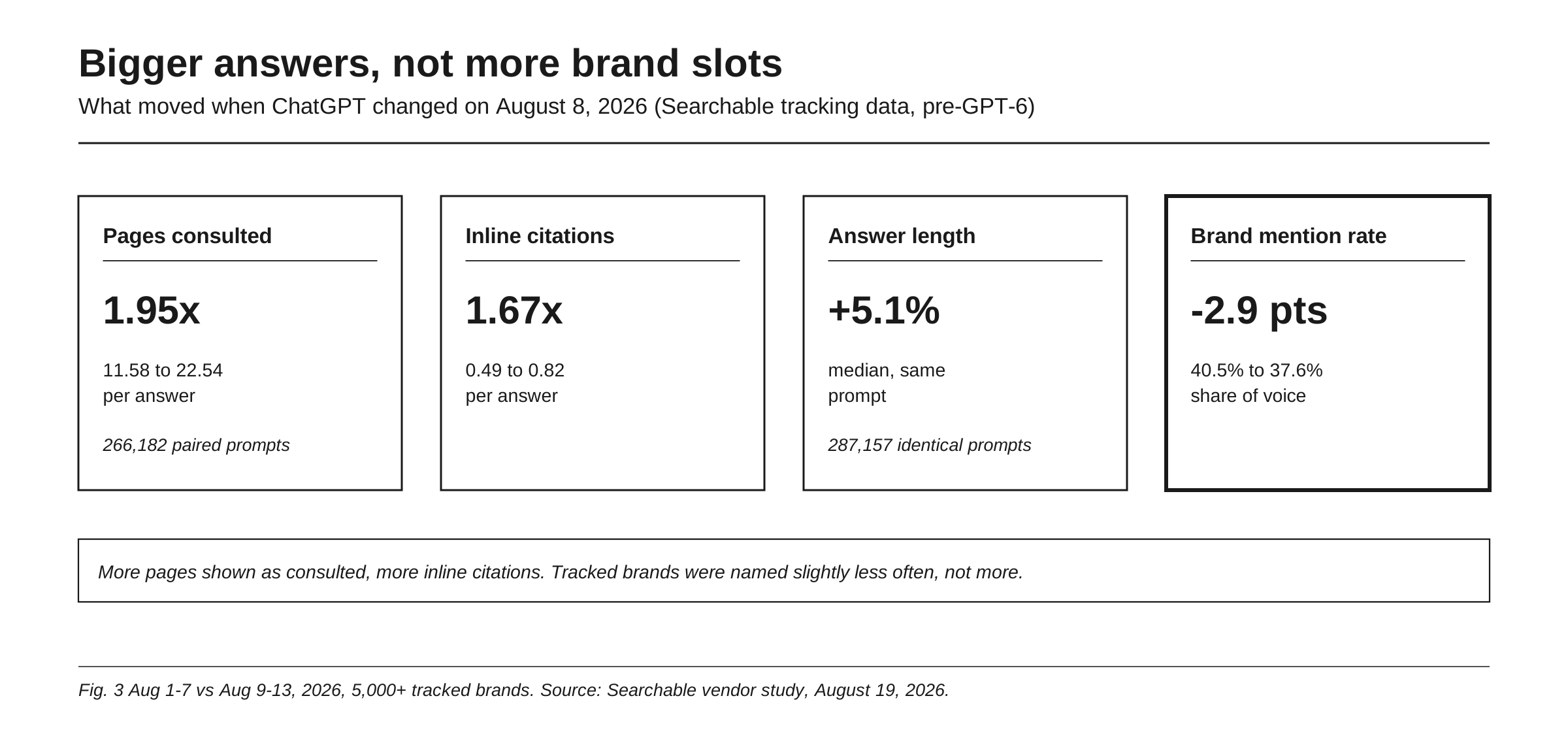
The instinct after any model switch is to assume a bigger answer means more brands get named. Large-sample data from earlier in 2026 points the other way.
On August 8, before GPT-6 arrived, the research ChatGPT showed per answer changed overnight. Searchable, a vendor tracking more than 5,000 brands, compared August 1 to 7 with August 9 to 13 and published the results on August 19. Across 266,182 prompts that ran in both windows, pages shown as consulted per answer went from 11.58 to 22.54. Inline citations per answer rose from 0.49 to 0.82. On 287,157 identical prompts, the median answer grew only 5.1%. And the tracked brands’ mention rate fell from 40.5% to 37.6%.
Searchable adds an important caveat: it cannot yet tell whether ChatGPT researched more or only disclosed more of a process it already ran. Searchable says everything measured in the answer body, including inline citations, is unaffected by that question.
Changes also do not all push in the same direction. Seer Interactive compared GPT-5.5 with GPT-5.6 Luna on 346 matched prompts, published September 24. Consulted sources fell 43%, from 6,134 to 3,481, and inline citations fell 12.9%, while the share of fan-out queries using site: jumped from 21.6% to 76%. One change showed more pages consulted, the other fewer, yet both leaned toward specific domains: Searchable also saw the share of ChatGPT sub-queries using site: rise from 0.2% to 18% after August 8.
Three takeaways for brand teams:
- Length, research depth and brand count are separate dials. In Searchable’s August data, ChatGPT wrote slightly more, read more and cited more while tracked brands were mentioned less often.
- Position matters more in a longer answer. Being the first name in a short list is not the same outcome as a passing mention in a later paragraph, even though both count as “mentioned.” Track where you appear, not only whether.
- Your own site is doing more of the work. Both Writesonic’s Astra data and Seer’s Luna data show heavy domain-scoped searching, so pages ChatGPT can fetch and quote on your domain are part of how it decides what to say about you.
For the broader mechanics of why recommendations shift without anything changing on your side, see why AI recommendations change overnight.
How to re-baseline your tracking after a model switch
A model switch breaks the comparison between last month and this month. You have not lost visibility or gained it until you have measured the same thing twice under the new model. Here is the process we recommend.
- Annotate the switch dates. Mark October 7 (GPT-6 Sol for Plus, Pro, Business and Enterprise) and October 8 (GPT-6 Luna for Free and Go) on every ChatGPT trend line. Any change that starts there needs a different explanation than a change that starts mid-month.
- Exclude the transition days. Searchable skipped August 8 when comparing windows. Do the same: compare a clean week before October 7 with a clean window after October 8, not a range that straddles the rollout.
- Freeze the prompt set. Compare only prompts with identical wording in both windows. Adding or rewording prompts during a switch makes it impossible to tell whether the model or your inputs moved.
- Run each prompt several times. A single run is one sample. Read mention rate, position and citation as rates across repeated runs, which is the logic behind how many times to ask before you trust the answer.
- Split by plan tier if you can. Plus, Pro, Business and Enterprise users now get GPT-6 Sol in Chat, while Free and Go users get GPT-6 Luna. If your buyers skew toward one tier, weight that view.
- Track three numbers separately: whether you are mentioned, where in the answer you appear, and whether your pages are cited. A switch can move one without the others.
- Wait for at least two clean weeks before acting. Early reads are noisy, rollouts are uneven, and OpenAI can adjust a model after launch. Hold strategy changes until the new baseline settles.
- Check that your key pages are reachable. With ChatGPT leaning on domain-scoped searches, confirm your product, pricing and comparison pages load for crawlers and say plainly what you do.
What to measure from here
The useful question is not “did GPT-6 add brand slots?” It is “did my share of the slots that exist change, and where in the answer do I sit?” That requires a stable set of buyer-intent prompts, run repeatedly, with your competitors measured on the same prompts in the same windows.
Expect more data soon. Vendors with large prompt panels are likely to publish post-GPT-6 comparisons once they have clean windows on both sides of October 7 and 8. When they do, check the same things you would check in your own data: identical prompts, excluded transition days, sample size, plan tier, and whether the brand counts come from the answer body or from a source panel.
This is the kind of change Rankry is built to make visible. Rankry runs a fixed set of buyer-intent prompts every day across ChatGPT and the other major engines, so a model switch shows up as a dated break in your mention, position and citation trends rather than an unexplained wobble. Competitor comparison shows whether a shift is yours alone or category-wide, and a new question is answered as soon as you add it. For a full view of what to watch inside ChatGPT, see our ChatGPT visibility tracker guide.
FAQ
Does GPT-6 name more brands per answer than GPT-5.6? As of October 9, 2026, we found no published study that answers this for the Chat tab. GPT-6 Sol and Luna reached Chat on October 7 and 8, too recently for clean before-and-after windows. The one GPT-6 comparison we found, Writesonic’s 50-prompt Astra test in ChatGPT Work, did not report brands per answer.
Are GPT-6 answers longer than before? Not in the only data we found. In Writesonic’s test of GPT-6 Astra in ChatGPT Work, answers came in at about 305 words, which Writesonic describes as roughly 12% shorter than GPT-5.6 Sol’s. That covers one variant on one surface, one run per prompt, so it may not reflect GPT-6 Sol or Luna in the Chat tab.
Why did my ChatGPT visibility change in early October? GPT-6 began replacing GPT-5.6 in the Chat tab on October 7 for Plus, Pro, Business and Enterprise and on October 8 for Free and Go. Any shift starting then may come from the model switch. Compare identical prompts in clean windows on either side of those dates, with several runs per prompt, before concluding anything.
Does a longer AI answer give my brand a better chance to appear? Not necessarily. In Searchable’s August data, ChatGPT nearly doubled the pages it showed as consulted and cited more sources inline, yet tracked brands’ mention rate dipped from 40.5% to 37.6%. Length, research depth and brand count move independently, so measure your mention rate and position directly.
How long should I wait before judging a model switch? At least two clean weeks after the rollout, excluding the transition days. Early reads mix old and new model behavior, rollouts reach tiers on different days, and models get adjusted after launch. Compare the same prompts, run several times, against a clean pre-switch window.
Sources
- GPT-6 Astra is on ChatGPT Plus, but only in Work and Codex, Notebookcheck, September 7, 2026
- ChatGPT Free gets GPT-6 Luna, but only in the desktop app, Notebookcheck, September 24, 2026
- GPT-6 Astra Searches 40% Less Than the Model Before It, and Reads Brands Directly Instead, Writesonic, September 8, 2026
- OpenAI Brings GPT-6 to All ChatGPT Users With Interactive Intelligent UI, VKTR, October 7, 2026
- GPT-6 is coming to all tiers of ChatGPT, Engadget, October 8, 2026
- ChatGPT’s research depth doubled: What it means for brands, Searchable, August 19, 2026
- AI Citations Aren’t Your Top KPI: ChatGPT-5.6 Luna Runs More Targeted Searches, Seer Interactive, September 24, 2026
See whether a model switch moved your brand, or only the answer around it, with the same prompts tracked every day. Start a free 7-day Rankry trial, no card.