To get your brand recommended by Perplexity, clear two gates in order: make your pages retrievable, PerplexityBot allowed, content server-rendered, pages fresh and matched to buyer questions, and make them absorbable, front-loaded answers with specific claims the model can quote. Then do the step most brands skip: earn your place in the third-party comparisons Perplexity already cites for your category, because for “best X” prompts those pages, not yours, usually decide the shortlist. Measure weekly, and expect movement in weeks rather than quarters.
That speed is the reason to do this work at all. As we covered in how Perplexity picks the sources it cites, every Perplexity answer runs through live retrieval with a strong freshness bias, so it is the one major engine where this quarter’s content work shows up in this quarter’s answers.
Which engines this applies to. Retrievable and absorbable are universal requirements: ChatGPT, Claude, Gemini, Grok, Microsoft Copilot, and Google AI Overviews all need to reach your page and extract a clean claim from it. What is specific to Perplexity is the speed of the payoff, because its freshness bias means new work can show up within weeks, while the same change can take a quarter to move an engine that leans harder on established consensus. Use Perplexity as the fast feedback loop, then check whether the gain carried to the other six rather than assuming it did. The weekly cross-engine loop is in how to monitor your brand across AI search engines.
The two gates
Every failed Perplexity strategy we have diagnosed failed at one of two points, and they need different fixes.
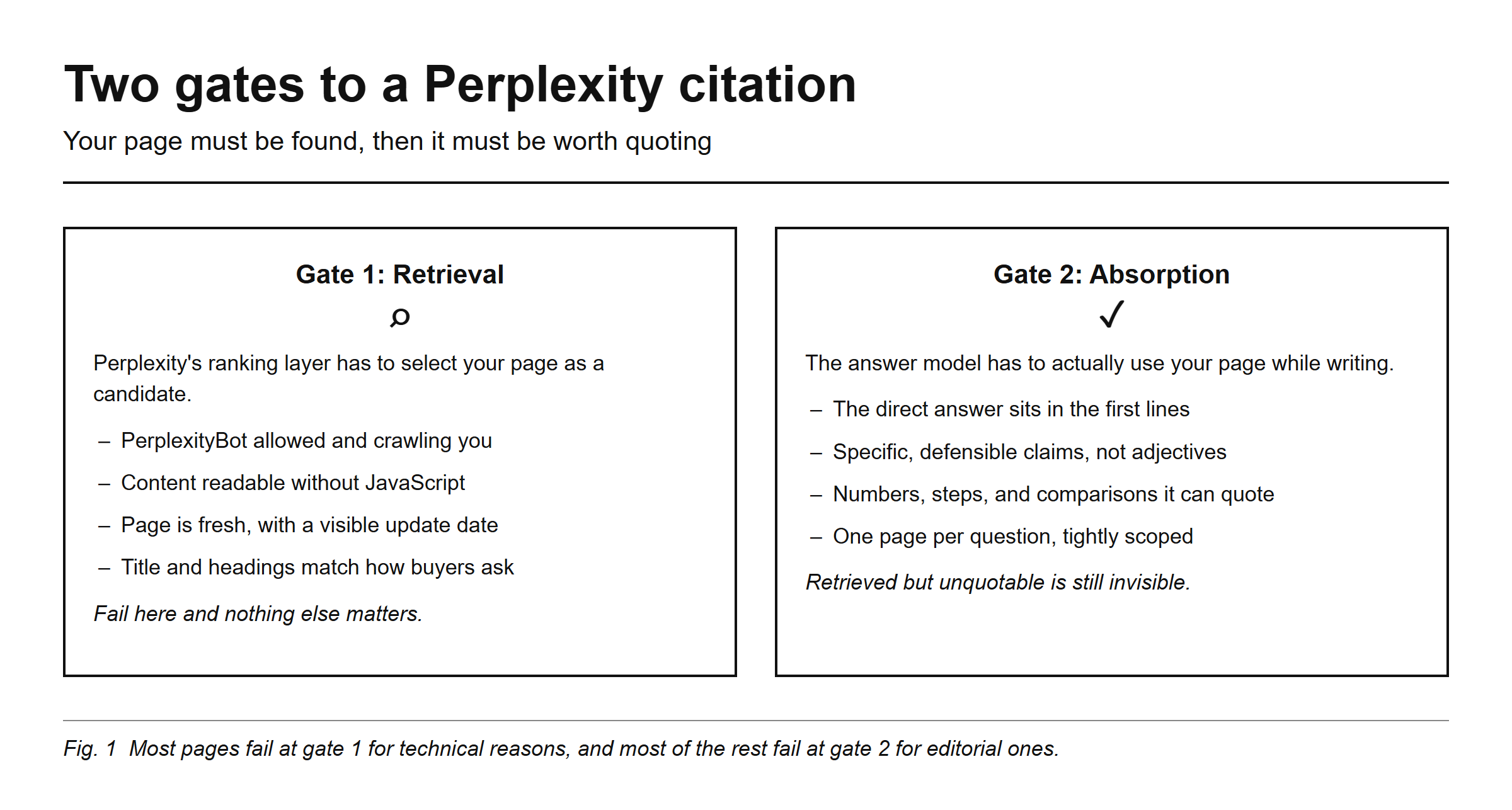
Gate one is retrieval: Perplexity’s ranking layer has to pick your page as a candidate for the answer at all. That is a technical and topical bar, the crawler can reach you, the content renders without JavaScript, the page is fresh, and the title and headings match the question as buyers actually phrase it. Gate two is absorption: with your page in front of it, the model has to find something worth using. That is an editorial bar, a direct answer in the first lines, claims specific enough to defend, numbers and comparisons it can lift. A page can pass retrieval and still contribute nothing to the answer, which from the outside looks identical to not existing.
The playbook, in order
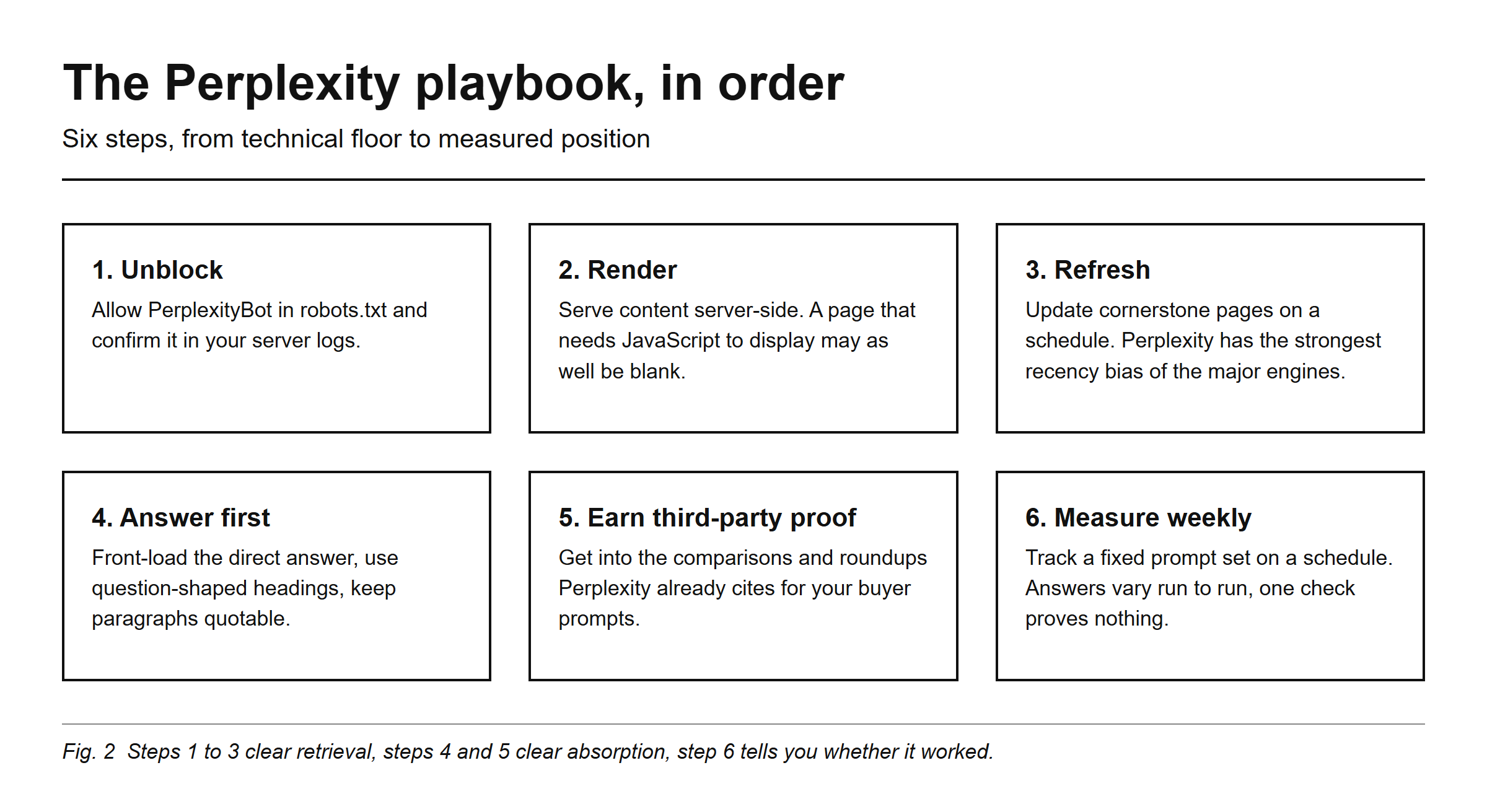
Step 1: unblock. Check robots.txt for anything that disallows PerplexityBot, including blanket “block all AI bots” rules written years ago, then confirm in your server logs that the bot actually visits. No crawl, no index, no citations, and everything after this step is wasted until it is fixed.
Step 2: render. Serve your content server-side. Perplexity’s fetchers, like most AI crawlers, do not reliably execute JavaScript, so a client-rendered page can be a blank document from their side of the glass. The mechanics and the fixes are in do AI crawlers read JavaScript.
Step 3: refresh. Put your cornerstone pages, the ones targeting your money prompts, on an update schedule, monthly or quarterly, with the update date visible on the page. This is the tactic Perplexity rewards hardest. The refresh has to be real, updated numbers, current screenshots, revised claims, because a cosmetically bumped date with stale content fails gate two anyway.
Step 4: answer first. Restructure target pages so the direct answer to the page’s question sits in the opening lines, headings are phrased the way buyers ask, and each paragraph makes one specific, quotable claim. This is the same discipline that wins across engines, detailed in optimizing content for AI search, and on Perplexity it is decisive because the reranker explicitly scores structure.
Step 5: earn third-party proof. Run your buyer prompts in Perplexity and note which domains it cites, the comparison sites, industry roundups, and review pages that keep appearing. For recommendation prompts, those pages usually decide the shortlist, and being absent from them caps your ceiling no matter how good your own site is. Getting included, updated, or fairly represented on the sources Perplexity already trusts is slower work than on-site fixes, but it is where recommendation visibility actually lives. Why a mention on those pages is not yet a recommendation, and what closes that gap, is covered in mentioned is not recommended.
Step 6: measure weekly. Pick a fixed set of buyer-intent prompts and run them on a schedule, watching presence, rank, and which sources each answer cites. Perplexity’s answers vary between runs and shift as its index refreshes, so a single check proves nothing in either direction. Finding the prompts worth tracking is its own exercise, see find the prompts where your brand should appear.
What to expect, and when
Perplexity is the fast engine, and it is honest about your inputs. Technical fixes from steps 1 and 2 show up as crawl activity within days. Freshness and structure work from steps 3 and 4 typically starts moving citations within a few weeks, because retrieval re-evaluates your pages every time they are fetched. Third-party proof from step 5 is the slow lever, weeks to months, and also the durable one, because those citations keep working for you across every prompt in the category.
The trap to avoid is declaring victory or defeat off one good or bad answer. Position on Perplexity is a distribution, not a number, which is why step 6 is part of the playbook and not an afterthought.
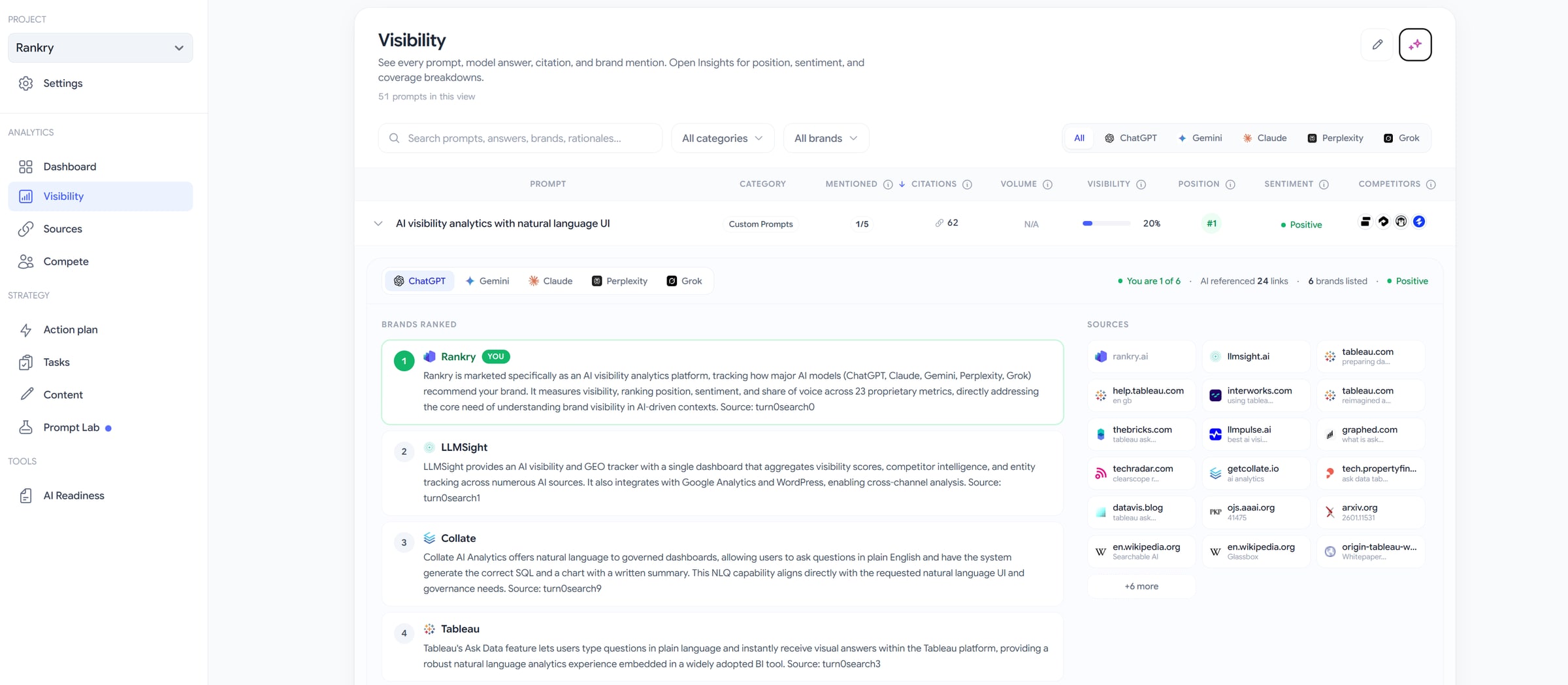
Rankry tracks your Perplexity position weekly alongside ChatGPT, Claude, Gemini, Grok, Microsoft Copilot, and Google AI Overviews, with every answer’s cited sources listed and the raw responses kept as evidence, then turns the gaps into a prioritized fix list. You can see the Perplexity view in detail on the Perplexity visibility tracker page.
FAQ
How do I get my brand mentioned in Perplexity answers? Clear two gates. First retrieval: PerplexityBot allowed, content server-rendered, pages fresh and matched to how buyers ask. Then absorption: front-loaded answers with specific, quotable claims. Then earn spots in the third-party comparisons Perplexity already cites for your category.
Does updating content really improve Perplexity visibility? Yes, more than on any other engine. Perplexity has the strongest recency bias in AI search, so a scheduled refresh of your cornerstone pages, with visible update dates, is one of the highest-leverage tactics available.
Why is my brand in Perplexity’s index but never recommended? For recommendation prompts like best tools for X, Perplexity leans heavily on third-party comparisons and roundups. If you are absent from the pages it already cites, your own site alone rarely carries you into the shortlist.
How long does it take to see results in Perplexity? Weeks, not quarters. Because every answer runs through live retrieval and the index refreshes constantly, Perplexity reflects content improvements faster than ChatGPT, whose training layer moves on much slower cycles.
How do I measure whether it is working? Track a fixed set of buyer-intent prompts on a weekly schedule and watch presence, rank, and cited sources over time. Answers vary between runs, so a single manual check tells you almost nothing.
Will the same work get me recommended on the other engines? Partly, and more slowly. Retrievable pages and quotable claims help on ChatGPT, Claude, Gemini, Grok, Microsoft Copilot, and Google AI Overviews too. What does not transfer is the timing: Perplexity’s freshness bias can reflect new work within weeks, while engines that lean on established consensus can take a quarter. Use Perplexity as your fast feedback loop, then verify the gain carried across the other six.
See exactly how Perplexity ranks, describes, and cites your brand against competitors, tracked weekly with raw responses as evidence. Start a free 7-day Rankry trial, no card, first report in two minutes.