When an AI engine recommends your brand with a caveat, such as “limited integrations,” “pricey for small teams” or “support can be slow,” it is usually repeating a weakness it read somewhere: a review, a Reddit thread, a competitor’s comparison page, or your own outdated pricing or limits page. No published study we could find ranks individual words, so the claim that “limited” is the single word AI uses most against brands is not confirmed. What the research does show: in SEO vendor BrightEdge’s analysis of Google AI Overviews and ChatGPT, product limitations and compatibility drove 21% of categorized negative mentions, and in AI visibility vendor Ranqo’s 36,495 tracked answers, price or cost was the largest criticism theme its keyword pass could identify, while comparison prompts produced negative mentions 9.5 times as often as problem-solution prompts. Caveats cluster in comparison and evaluation questions, close to the purchase. The fix is to treat every qualifier as a claim with a source: surface it with audit prompts, trace it to the page the engine read, then correct your own pages or answer on the third-party page where it lives.
You can sit on every AI shortlist in your category and still lose the deal in the clause after your name. “A solid option, though its free plan is limited” is a mention, a recommendation and a reason to pick someone else, all in one sentence.
What the research confirms, and what it does not
We looked for the source behind the idea that “limited” is AI’s most common negative qualifier, checking research and trade coverage published through September 23, 2026. None of it counts individual words. Three analyses do describe what AI criticizes brands for, and outside of scandals they overlap.
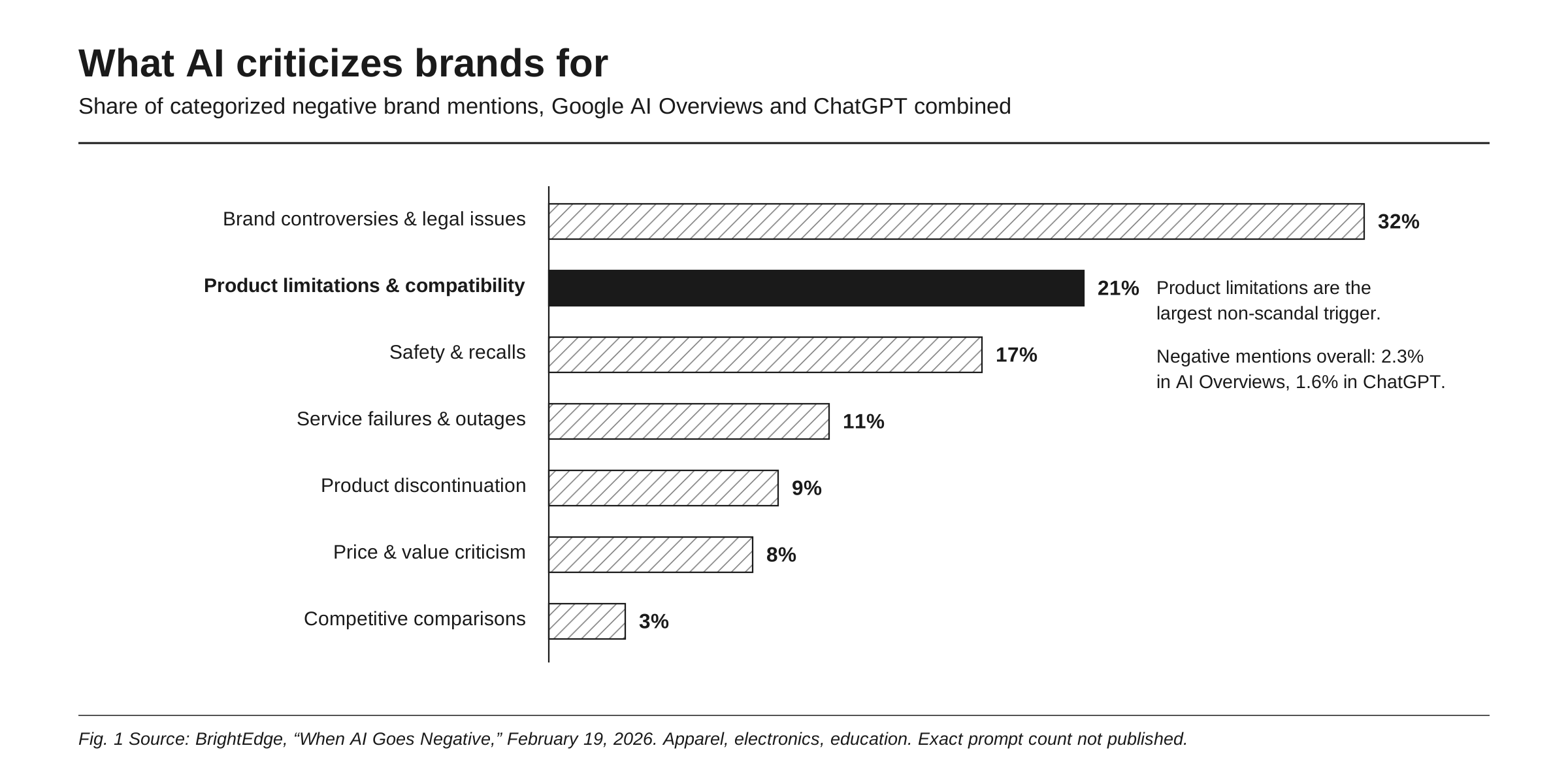
BrightEdge, February 19, 2026. The SEO platform used its own AI Catalyst tool to classify every brand mention in its sample of Google AI Overviews and ChatGPT answers for apparel, electronics and education. Negative mentions were rare: 2.3% in AI Overviews and 1.6% in ChatGPT. Among the negatives it could categorize, drawn from prompts where only one engine went negative, brand controversies and legal issues led at 32%, followed by product limitations and compatibility at 21%. Price and value accounted for 8%. The report gives no exact prompt count or collection dates, and Google told Fortune the report “misunderstands how AI Overviews work.”
Ranqo, August 28, 2026. The AI visibility vendor classified 36,495 answers tracked on its platform across 4,703 prompts, recorded between January 25 and August 28, 2026. The brand was named in 12,938 of them, and 299 were negative. In the 505 sentences that carried a negative judgment, price or cost was the top theme at 20.2%, about 2.9 times the next one. Ranqo warns that its keyword pass matched only 36.8% of sentences, so the result “describes a shape rather than a taxonomy.”
Coalition Technologies, July 1, 2026. In a Forbes Council Post, the agency’s president described prompting logged-out ChatGPT, Gemini, Perplexity, Claude, Grok and Microsoft Copilot with “Tell me about [brand],” starting with a manual review of 17 client brands. The engines “surfaced concerns about turnaround time, availability, returns, shipping, high prices, limited stock and similar service issues.” The post does not say which engines were harshest.
So “limited” is a plausible candidate: limitations are BrightEdge’s second-largest negative category, and “limited stock” appears in Coalition’s list. Nobody has shown it is number one. Outside of scandals, AI criticizes brands mainly for what the product lacks, what it costs and how it operates, and those are the qualifiers buyers act on.
Why AI attaches the qualifier: it repeats what it read
An AI engine usually does not invent a weakness. It relays one. In Ranqo’s data, 19.2% of negative sentences named their source out loud: reviews, forums, users on a community site. Coalition saw the same pattern: “Common sources included Reddit, Yelp, Quora, the Better Business Bureau, Google Business Profile reviews,” plus Clutch and category-specific review sites, while “Positive commentary frequently came from owned digital assets.”
Four kinds of pages are worth checking first.
Reviews. In Coalition’s words, “Recurring complaints across public sources can become the way an AI answer frames the company.”
Reddit and forum threads. A thread asking why your product lacks an integration can outlive the integration you shipped last spring.
Comparison pages. Competitor-written “X vs Y” pages and listicles list your drawbacks. Semrush’s June 2026 guide lists “Comparisons that position competitors more favorably” among the third-party sources to review.
Your own outdated pages. A pricing page that still shows last year’s free-plan caps, an integrations page missing half your connectors, a limits page with no date. The same guide tells marketers to check owned pages for “Outdated claims,” “Vague positioning,” “Weak product explanations,” “Missing context,” and “Ambiguous wording.” More on pricing pages in why your pricing page is invisible to ChatGPT.
BrightEdge CEO Jim Yu told Fortune that Google sometimes pulls negative information that can be years old. A caveat can be accurate about a version of your product you retired.
Not every caveat is a real weakness, though. Semrush’s guide cites a Coalition Technologies client whose military surplus sleeping bags ChatGPT kept calling “outdated technology,” because it linked “surplus” with obsolete gear. The fix was refreshed messaging on the about page, homepage and social profiles.
How a caveat costs you the shortlist
Caveats concentrate in evaluation questions, the ones closest to the purchase.
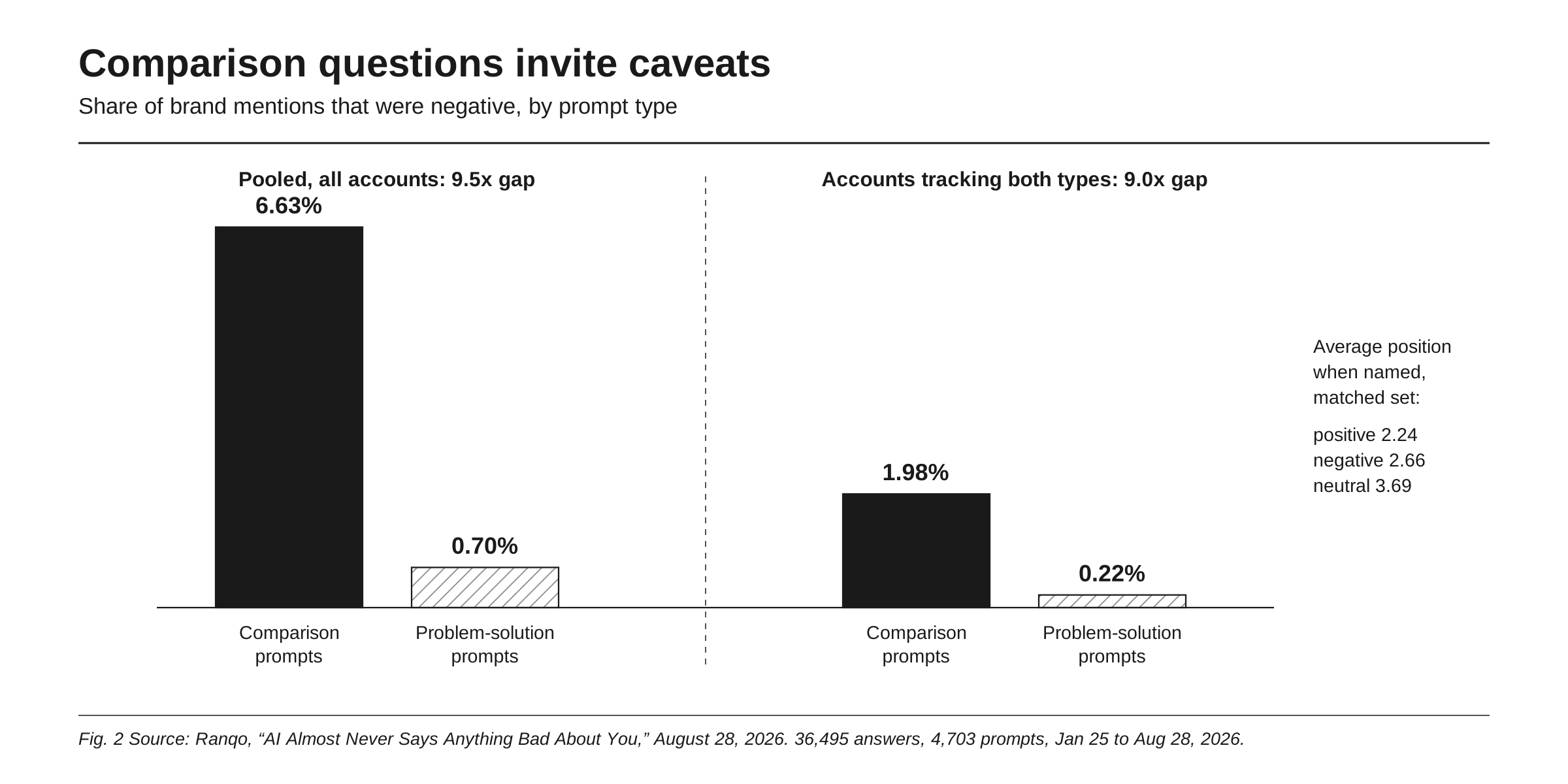
In Ranqo’s data, comparison prompts returned negative sentiment on 6.63% of brand mentions, against 0.70% for problem-solution prompts, a 9.5x gap. On accounts that tracked both types, the rates were 1.98% and 0.22%, still about 9x. Ranqo’s explanation: “A comparison question is a request for drawbacks, so the answer goes and finds some.” BrightEdge found a similar pattern for ChatGPT: it was three times as likely as Google to go negative on product evaluation queries, and 19.4% of ChatGPT’s negative-sentiment responses came on consideration prompts, against 1.5% for Google AI Overviews.
Placement suffers too. In Ranqo’s matched set, positive mentions averaged position 2.24 and landed first 53.6% of the time. Negative mentions averaged 2.66 and landed first 37.4% of the time. Ranqo measures position only when a brand is named, so it cannot say whether a caveat drops you from the list. It does show criticized brands sitting lower than praised ones, and in a three-item answer that can separate the pick from the alternative.
Two caveats about the data. First, Ranqo found neutral mentions placed lower still, at 3.69, so a flat description can hurt more than a critical one. That is the framing problem covered in how AI frames your brand beyond positive and negative. Second, engines differ: in Ranqo’s matched comparison, Perplexity’s negative rate was 6.7% against ChatGPT’s 2.6%. Check each engine on its own.
How a caveat differs from a wrong fact
If the AI says you discontinued a product you still sell, that is a false fact, and the process in how to find and fix a wrong AI description applies. If it describes you accurately but aims you at the wrong buyer, that is framing. A caveat sits between them: a real or once-real weakness attached to a recommendation. “Limited integrations” may have been true in 2024. “Expensive for small teams” may be true today and still fixable, because the AI may not know about your starter plan.
You cannot correct a caveat by declaring it false. You change the evidence: ship the missing piece, document it where engines read, scope the limit honestly, or give the review or thread a current answer.
How to find and fix every negative qualifier
-
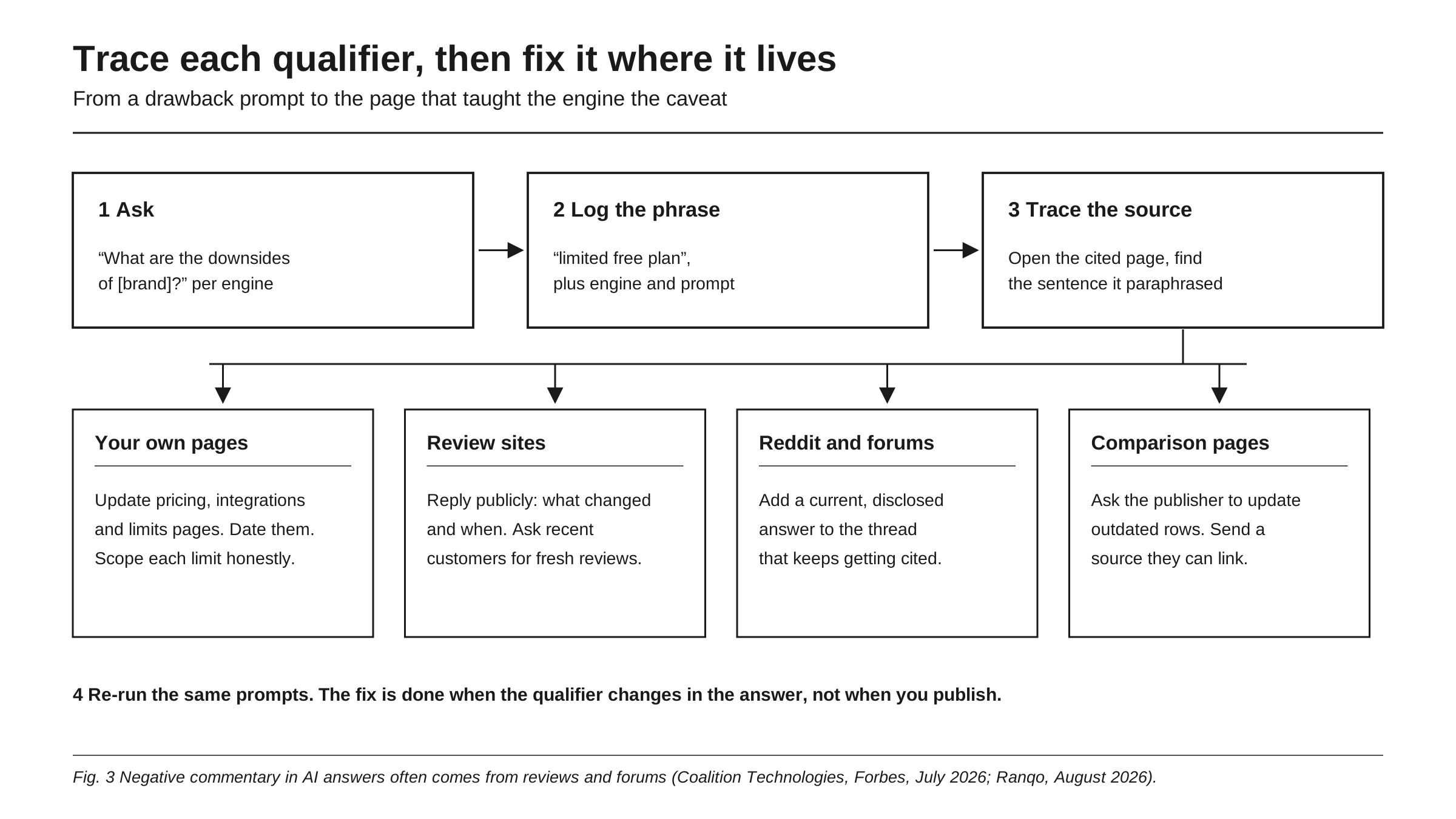
Run drawback prompts on purpose. Ask each engine “What are the downsides of [brand]?”, “[brand] vs [competitor] for a 20-person team”, “Is [brand] worth it?” and “What do users complain about with [brand]?” Run each several times, because single answers vary.
-
Log the exact qualifier, not a sentiment score. Write down the phrase (“limited free plan,” “few native integrations,” “slow support response”) and the engine that said it.
-
Trace each qualifier to the cited page. Open the sources the engine cites for that answer and find the sentence it paraphrased. Ranqo found nearly one in five negative sentences names its source type outright. Full method in how to track citations and sources in AI search.
-
Sort the qualifier: still true, partly true, or outdated. If it is outdated, the job is evidence. If it is still true, decide whether to fix the product or scope the claim (“the free plan covers one workspace; teams use Pro”).
-
Fix your own pages first where they are the source. Update the pricing page with current plan limits stated plainly, keep a complete integrations page with one line per connector, and publish a limits page with a visible “last updated” date.
-
Answer on review sites. Reply publicly to reviews that name the weakness, say what changed and when, and ask recent customers to review the current version. Ranqo notes that when a model passes on an old complaint from a review site, editing your own domain does not address it: the page the engine reads has to change.
-
Close the loop on Reddit and comparison pages. Add a current, disclosed answer to the thread that keeps getting cited. Ask comparison publishers to update outdated rows, and send them a source they can link.
-
Re-run the same prompts and track the phrase. A fix is done when the qualifier disappears or softens in the answer, not when you publish. Semrush reports one case, WorkLounge, a coworking space that AI had misdescribed, where rewriting about 90 pages lifted favorable AI sentiment from 67% to 82% over the following months. One vendor-reported case, not a controlled study, but the change came over months, not days.
Make caveats a tracked metric
The hard part is knowing which caveat appears for which prompt in which engine, and whether it is still there a month later. Rankry runs a stable set of buyer-intent prompts every day across ChatGPT, Claude, Gemini, Perplexity, Grok and Google AI Mode and AI Overviews, and shows how each engine mentions, ranks, cites and recommends your brand. Add the drawback prompts from step 1 and they are answered right away, and competitor comparison shows how rivals are mentioned and ranked in the same prompts. After a fix, the daily data shows whether your position in those prompts moved.
FAQ
Is “limited” really the word AI uses most against brands? It has not been shown. No study published through September 2026 that we could find ranks individual words. The confirmed pattern is broader: BrightEdge found product limitations and compatibility drove 21% of categorized negative mentions, and Ranqo’s keyword pass found price or cost the largest criticism theme. “Limited” fits both, but its exact rank is unmeasured.
Why does ChatGPT mention my product’s weaknesses? Usually because a buyer asked a comparison or evaluation question, and the answer looks for drawbacks. In Ranqo’s data, comparison prompts produced negative mentions 9.5 times as often as problem-solution prompts. The weakness itself usually comes from a source the engine read: reviews, forums, competitor comparison pages or your own outdated pages.
Does a negative qualifier remove my brand from AI recommendations? Ranqo’s data cannot say, since it measures position only when a brand is named. It does show negatively described brands sitting lower: in its matched set they averaged position 2.66 and ranked first 37.4% of the time, against 2.24 and 53.6% for positively described brands. In short answers with two or three picks, that gap can decide who gets chosen.
How do I find the source of a negative qualifier? Run the drawback prompt in each engine, open the sources cited in that answer, and find the sentence the engine paraphrased. Start with review sites and Reddit, which were common sources of negative commentary in Coalition Technologies’ review, then check comparison pages. If nothing is cited, search those platforms for the exact complaint.
How long does it take for AI to drop a caveat after I fix the source? We found no published benchmark, so plan in months rather than days. Semrush reports one case where rewriting about 90 pages lifted favorable AI sentiment from 67% to 82% over the following months. Re-run the same prompts on a schedule and treat the fix as done only when the qualifier changes in the answer.
Sources
- When AI Goes Negative: How Google AI Overviews and ChatGPT Handle Brand Criticism Differently, BrightEdge, February 19, 2026
- BrightEdge Data Reveals New AI Brand Risk for CMOs: Google AI Overviews Are 44% More Likely to Criticize Brands Than ChatGPT, BrightEdge, March 5, 2026
- Google’s AI overviews are 44% more likely to trash your brand than ChatGPT, Fortune, March 12, 2026
- AI Almost Never Says Anything Bad About You, Ranqo, August 28, 2026
- AI Models Surface Negative Brand Commentary: Lessons For Brands, Forbes (Jordan Brannon, Coalition Technologies), July 1, 2026
- What is AI sentiment analysis? A marketer’s guide, Semrush, June 15, 2026
Track how each AI engine mentions and ranks your brand in the prompts where buyers decide, and see whether it moves after you fix the source. Start a free 7-day Rankry trial, no card required.