LLM positioning lag is the gap between the day you change what your product is, who it serves or what it costs, and the day AI engines start describing the change. It happens because answers come from two places that update on different schedules. Model memory is frozen at a training cutoff, and for the recent OpenAI, Anthropic and Google models we checked that were available on September 29, 2026, the published cutoffs fall between March and June 2026. Retrieval is live, but engines do not search on every prompt, and when they do, they often cite third-party pages that may still carry your old story. You shorten the lag by rewriting the web the engines read (your pages with explicit dated statements, then the reviews, listicles and profiles they cite), by diagnosing whether each stale answer came from memory or from a cited page, and by re-measuring the same prompts every week.
You announced the pivot, rewrote the homepage and briefed sales. Then a prospect pastes a ChatGPT answer into the call that describes the company you were last year. That is not a hallucination. It is a scheduling problem, and it has mechanics you can work with.
Positioning lag is not the same as a wrong fact
A wrong fact is an error: an invented founding year, a feature credited to a rival. That problem, and how to trace it, is covered in how to find and fix a wrong AI description. Positioning lag is different because the old description was once true. The model learned it correctly. You changed, and the engines have not caught up.
Semrush wrote about the problem under that name in a September 29, 2026 article, “The LLM positioning lag.” Its examples are prompts the author ran in ChatGPT, with no run counts or model versions reported, so treat them as illustrations, not measurements. In Semrush’s examples, Contentsquare acquired Hotjar in 2021 and completed the merger by July 2025, yet ChatGPT listed Hotjar second for heatmapping software with no mention of Contentsquare. Blue Apron added a pay-as-you-go option in August 2025, and ChatGPT did not mention it. Duolingo added math in 2022, music in 2023 and chess in 2025, and ChatGPT still recommended it only for languages. Semrush notes that each company had announced its change through press, its own pages or product launches.
The agency RankScience reported the same pattern on itself in January 2026. It discontinued A/B testing software and PPC services in 2024, yet ChatGPT, Gemini and Perplexity kept recommending it for those services. For a buyer, that is not a typo. It is a reason to skip you, or to call you for something you no longer sell.
Clock one: model memory stops months before launch day
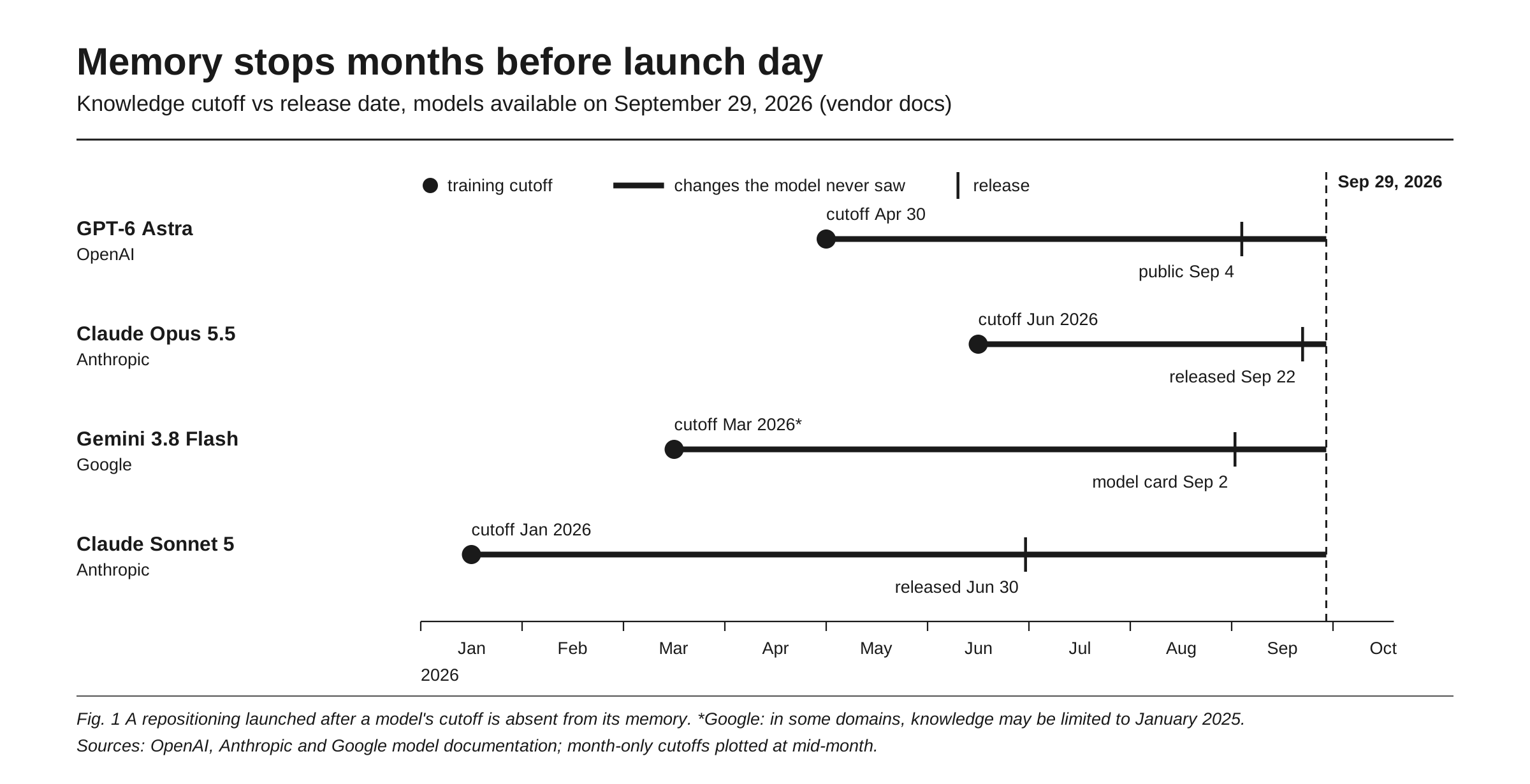
LLM Metrix describes AI engines as running on two clocks: a training clock and a retrieval clock. The training clock is the model’s knowledge cutoff, and the vendors publish it.
OpenAI’s model docs give GPT-6 Astra, released to the public on September 4, 2026, an April 30, 2026 knowledge cutoff. GPT-6 Luna, released September 22, has a May 18, 2026 cutoff, and the older GPT-5.6 Luna has February 16, 2026. Anthropic lists Claude Opus 5.5, released September 22, and Claude Sonnet 5.5, released September 28, with a June 2026 training data cutoff. Claude Sonnet 5, released June 30 and still available, stops at January 2026. Google’s model card for Gemini 3.8 Flash, published September 2, gives a March 2026 cutoff, then adds that “users can expect updated information for some domains while in others they may experience the model’s knowledge is limited to January 2025.”
So a pricing change you shipped in July 2026 is not in the memory of any model on that list. A rebrand from May 2026 is in Claude Opus 5.5’s training window but not in GPT-6 Astra’s. And a cutoff is not a guarantee: a change that happened a few weeks before the cutoff appears in a thin slice of the training data, against years of pages describing the old you. Semrush makes the same point: “Years of old positioning can outweigh a recent change.”
Clock two: retrieval, which is not always on
If every answer came from a live search, the training clock would matter less. It does not work that way. The vendors let the model decide. Anthropic’s documentation states that “Claude determines when to search based on the prompt.” Google bills Gemini grounding per “search query that the model decides to execute.” OpenAI has not published how often ChatGPT searches, as OtterlyAI noted in August 2026.
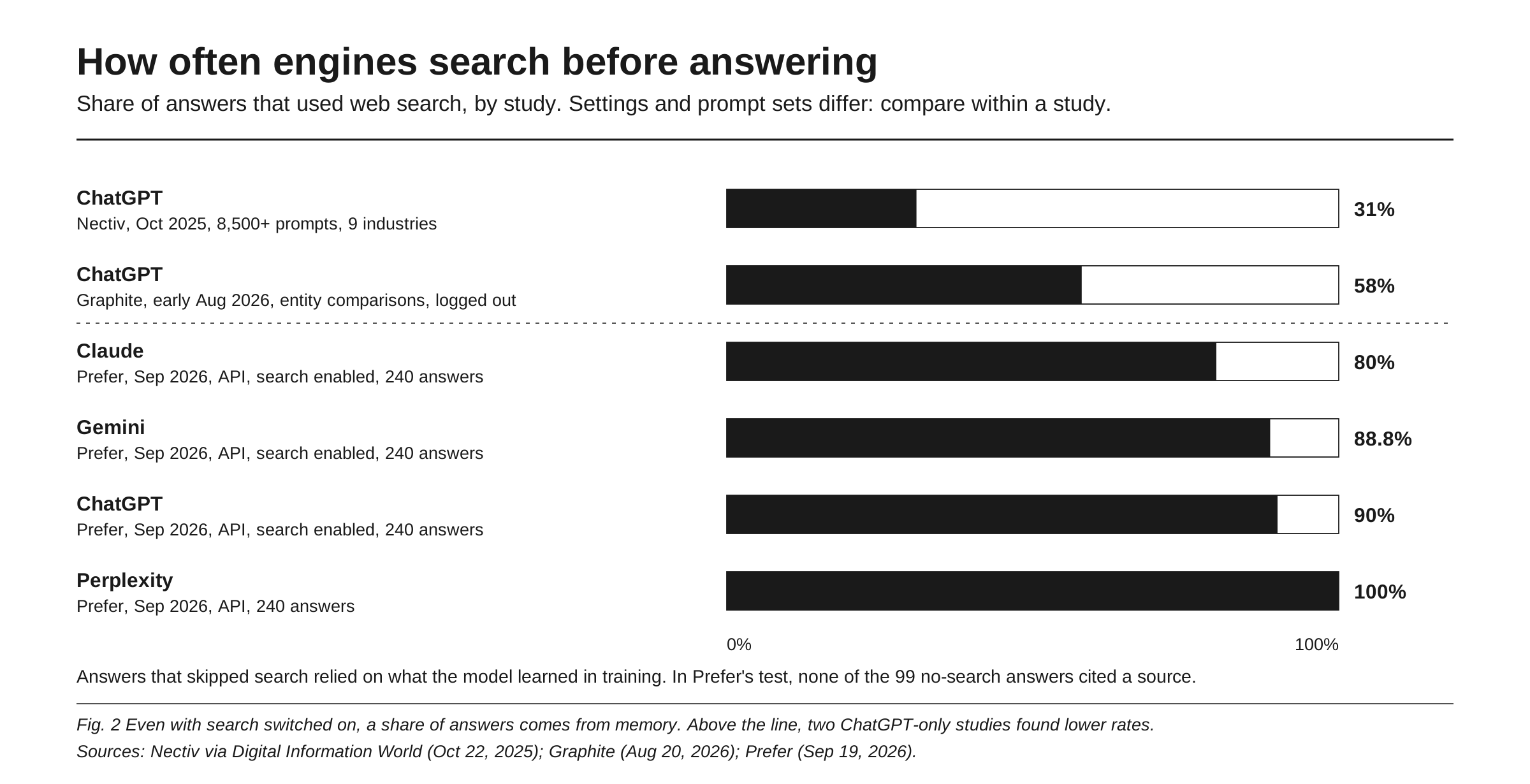
Third-party measurements fill part of the gap. None comes from the AI companies themselves, and they disagree because they test different things. Nectiv found that 31% of more than 8,500 prompts across nine industries triggered at least one ChatGPT web search, as Digital Information World reported in October 2025. The agency Graphite found 58% of logged-out ChatGPT responses showed evidence of search for entity-comparison prompts in early August 2026, based on 100 prompts with 100 responses each. Graphite also cites Similarweb data showing that across all prompt types, only 7% of US ChatGPT responses have citations.
Prefer, which sells AI visibility tracking, sent 80 questions about AI search to four engines through the DataForSEO API on September 13, 2026, with web search requested on every call: three runs each, 960 answers. Perplexity searched every time, ChatGPT 90%, Gemini 88.8% and Claude 80%. None of the 99 answers that skipped search cited a source. Prefer notes that API answers can differ from the consumer apps.
The pattern holds across the studies: a meaningful share of answers comes straight from memory, even when search is available. For those answers, your new homepage does not exist.
When retrieval does run, it often reads other people’s pages. The GEO agency DerivateX ran 40 B2B SaaS buyer prompts ten times each in ChatGPT with search on and logged 233 recommendations. When ChatGPT recommended a tool, it cited that tool’s own website 11.6% of the time and a third party 88.4% of the time. Every cited page it analyzed used a list format. In that sample, G2 and Capterra received zero citations, which is a reminder to check what each engine cites in your category instead of assuming. The listicle written in 2024 that calls you “a simple tool for small teams” is the page doing your positioning. Pages that go stale lose citations over time, the pattern in the 3-month citation cliff, but until they drop out, they keep repeating the old story.
How to tell a memory answer from a retrieval answer
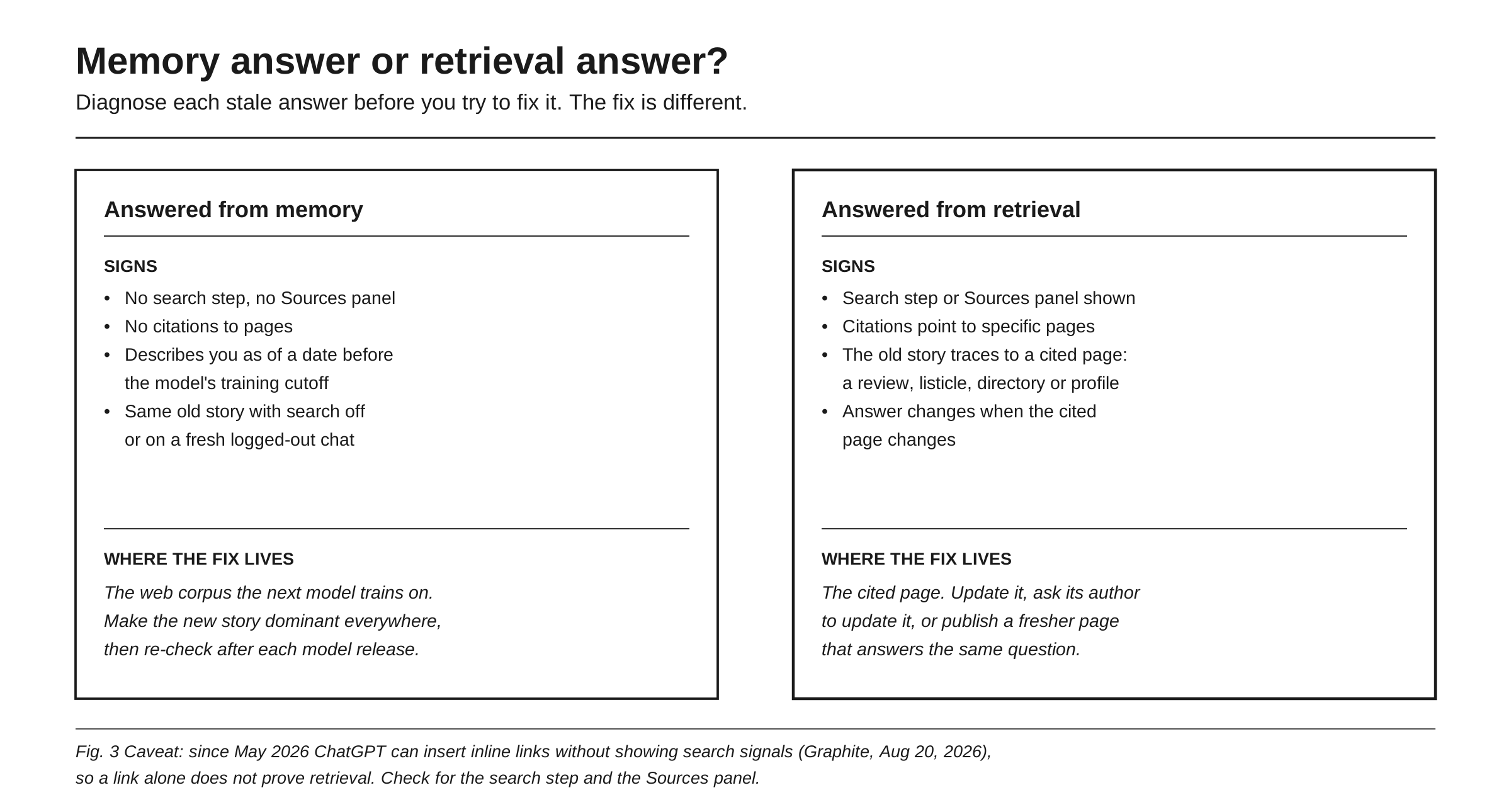
The diagnosis decides the fix, so do it per prompt and per engine. A retrieval answer shows its work: in ChatGPT, a search step or a Sources panel; in the APIs, a web_search_call item from OpenAI, search result blocks from Anthropic, or search call and citation data from Gemini. The stale claim usually traces to one cited page. A memory answer shows none of that, and it describes you as you were before the model’s cutoff.
One caveat. Graphite reports that since May 2026, ChatGPT can insert inline links without showing either search signal. A link alone does not prove the answer was retrieved. Look for the search step.
Graphite also found that forcing search changes the result. For prompts that never trigger search on their own, visibility measured with forced search differed by about 20 points on average from the default answer. If your monitoring forces search, it can show your new positioning while real buyers, on default settings, still get the memory version.
A relaunch checklist to shorten the lag
We found no published study that measures how many weeks positioning lag lasts. It depends on the engine, the prompt and how much of the web still tells the old story. What you can control is how much new evidence exists, how consistent it is and how fast you see the change land.
-
Rewrite owned pages with explicit, dated statements. On the homepage, about page, pricing page and product pages, say what changed and when: “As of June 2026, [Brand] serves mid-market finance teams; we no longer offer the starter plan.” Semrush’s advice points the same way: name the category, the audience and the date of the shift. Place the statement high on the page and write it so the sentence still makes sense when quoted alone.
-
Publish a changelog entry and a press release on your own domain. A dated post on a site you control gives search-enabled engines a current page to cite, and it leaves future training data one clear record linking the old offer to the new one. Then pitch the trade press your buyers read, so the change also shows up on sites you do not own.
-
Update every profile you control. LinkedIn, Crunchbase, G2 and Capterra profiles, app store listings, Wikidata, and your Organization schema. Use the same two or three sentence description everywhere, the consistency discussed in brand entity recognition for AI. If you have a Wikipedia article, request corrections through its talk page instead of editing it yourself.
-
Find the third-party pages engines cite, and ask for updates. Run your buyer prompts, collect every cited URL that describes the old positioning, and email the authors with the new facts and a dated source. Prioritize pages that appear across several engines. Where an author will not update, publish a fresher page that answers the same question.
-
Diagnose each stale answer before acting. If it was retrieved, fix the cited page. If it came from memory, there is no shortcut: keep building the new evidence and re-check when the next model ships with a later cutoff.
-
Re-measure the same prompts weekly, without forcing search. Track a fixed set of buyer prompts per engine, record whether each answer describes the old or new positioning, and note which sources each engine cited. The lag ends when the answers change, not when you publish.
Where Rankry fits
Rankry runs a stable set of buyer-intent prompts across ChatGPT, Claude, Gemini, Perplexity, Grok and Google AI Mode and AI Overviews, every day, and records whether you are mentioned, how you rank against competitors and which sources each engine cited. For a relaunch, that gives you a before-and-after baseline on the same prompts, a list of the stale third-party pages still being cited, and a daily read on which engines have moved to the new story. Add a prompt such as “what does [Brand] do?” the day after launch and every engine answers it right away, and AI traffic tracking shows whether visits from AI platforms change after the update. Tracking citations at that level is covered in how to track citations and sources in AI search.
FAQ
What is LLM positioning lag? It is the delay between changing your product’s positioning, pricing, name or audience and AI engines describing the change. It happens because models answer partly from training data with a fixed cutoff and partly from live retrieval, and retrieval often cites third-party pages that may still describe your old positioning. A September 2026 Semrush article uses the term.
How long does it take ChatGPT to learn about a rebrand? We found no published study that measures a typical duration. For answers from memory, nothing changes until a model with a later training cutoff ships, and as of September 2026 those cutoffs ran months behind release dates. For answers from retrieval, the change appears once the pages ChatGPT cites are updated or replaced.
Why does AI cite outdated pages about my company? When ChatGPT searches, it often cites third parties. In a study of 233 ChatGPT software recommendations by the agency DerivateX, 88.4% of citations pointed to a third-party page, not the vendor’s site, and every cited page it analyzed was a list. Listicles, reviews and directory profiles written before your change keep circulating until someone updates them.
How can I tell if an AI answer came from search or from memory? Look for a search step or a Sources panel in the app, or search output in the API response. If neither appears and the answer matches your pre-cutoff positioning, it most likely came from memory. Note that since May 2026 ChatGPT can add inline links without searching, so a link alone does not prove retrieval.
Does updating my website fix outdated AI answers? It is necessary but not enough. Your site fixes retrieval answers only when engines cite it, and in one study ChatGPT cited the vendor’s own site 11.6% of the time. Memory answers ignore it until the next model trains. Update your site, then your profiles and the third-party pages engines actually cite, and re-measure weekly.
Sources
- The LLM positioning lag: What it is and how to avoid it, Semrush, September 29, 2026
- Why AI Platforms Still Recommend Your Old Brand or Discontinued Services, RankScience, January 12, 2026
- The Rebrand Problem: Why AI Still Calls You by Your Old Name, LLM Metrix, June 23, 2026
- GPT-6 Astra model page, OpenAI API docs
- GPT-6 Luna model page, OpenAI API docs
- GPT-5.6 Luna model page, OpenAI API docs
- GPT-6 (Astra public release September 4, 2026; Sol and Luna September 22, 2026), Wikipedia
- OpenAI launches GPT-6 Sol and Luna, DataNorth, September 23, 2026
- Claude Opus 5.5 model overview, Anthropic docs (released September 22, 2026)
- Claude Sonnet 5.5 model overview, Anthropic docs (released September 28, 2026)
- Claude Sonnet 5 model overview, Anthropic docs (released June 30, 2026)
- Gemini 3.8 Flash model card, Google DeepMind, September 2, 2026
- Gemini 3.8 Flash, Gemini API docs (latest update September 2026)
- Web search tool, Anthropic docs
- Grounding with Google Search, Gemini API docs
- Web search tool guide, OpenAI API docs
- How often does ChatGPT trigger a Web Search? (2026 Data), OtterlyAI, August 4, 2026
- How Often Does ChatGPT Search the Internet? New Data Gives a Clear Answer (Nectiv study), Digital Information World, October 22, 2025
- Do Not Force Search in Prompt Tracking, Graphite, August 20, 2026
- How AI engines search and cite: 960 answers measured, Prefer, September 19, 2026
- B2B SaaS AI Citation Study: How ChatGPT Recommends Software, DerivateX, May 31, 2026 (updated September 22, 2026)
See how each AI engine describes your product after a relaunch, which stale pages it still cites, and the day the answers change. Start a free 7-day Rankry trial, no card required.