AI Overviews now show up on most of the decision-stage searches Semrush tracks, though the 88% figure needs its label. In a Semrush study published October 21, 2026, AI Overviews appeared on 88% of a fixed panel of 400 US desktop commercial keywords in August 2026, up from 45.75% in September 2025. The panel mixes five buying modifiers. “Best X for Y” keywords reached 96.12%, and “review” keywords reached 89.04% in Semrush’s table as reported by PPC Land, up from 30.14% in September 2025. Weighted by search volume, coverage hit 97.08%. So on a “best” or “review” query in these categories, a buyer usually sees a Google summary built from listicles, forums, videos, review platforms and brand pages. The job shifts from ranking a page to being a source that summary reads and a brand it names.
Affiliate publishers and brands built pages to catch these queries. Both now sit below an answer, and the evidence on who gets cited, and who still gets the click, is thinner than the headline suggests.
What Semrush actually measured
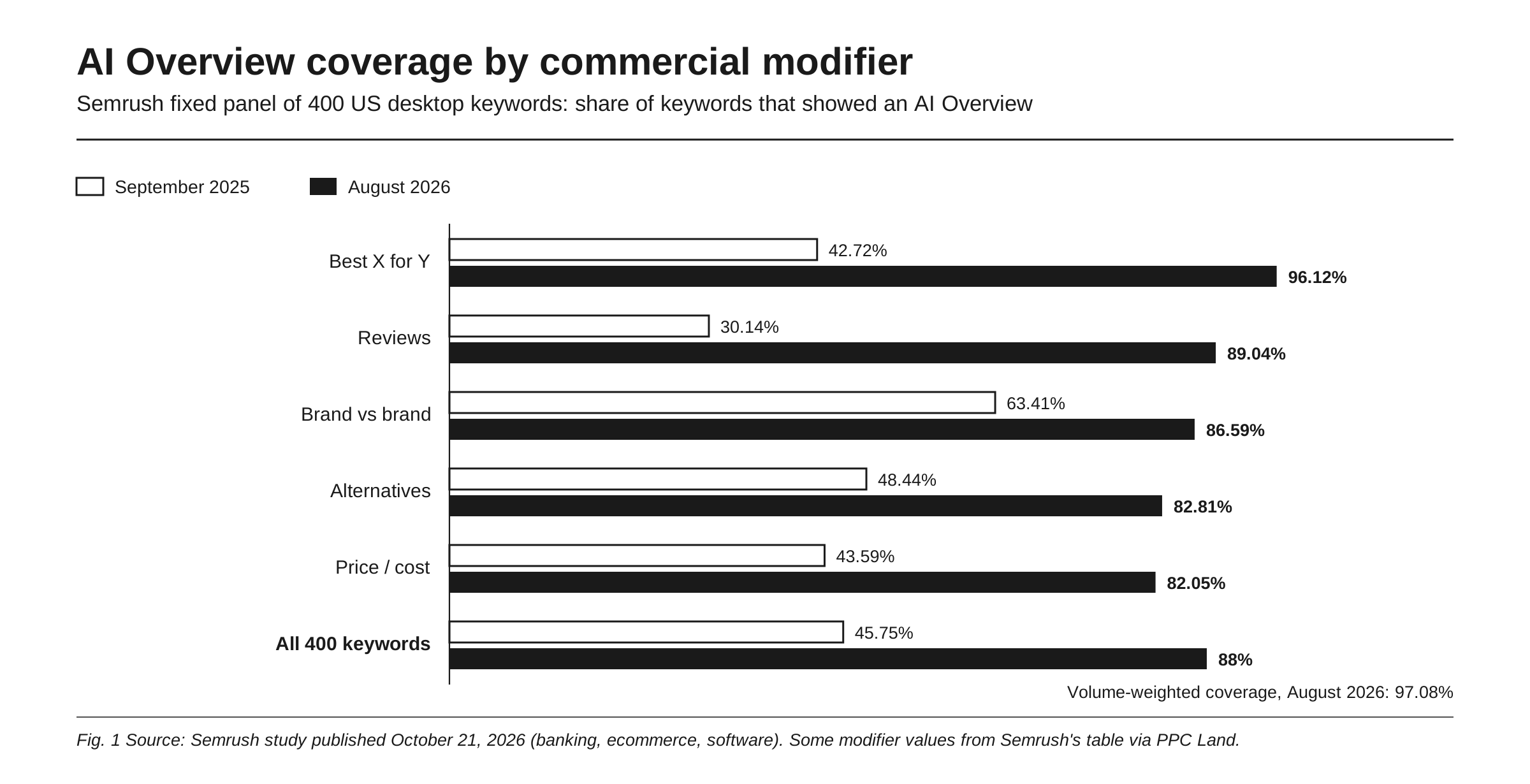
Semrush sells AI Overview tracking, so read this as a vendor study. It built a fixed panel of 400 keywords across banking, ecommerce and software, each carrying one of five modifiers: alternatives, brand vs brand, best X for Y, price or cost, and reviews. Using US desktop data, it checked monthly from September 2025 to August 2026 whether each keyword showed an AI Overview.
- Every modifier group finished above 80%, from 82.05% (price or cost) to 96.12% (best X for Y).
- Reviews moved the most, from 30.14% to 89.04% (the table value PPC Land reports), which Semrush’s text rounds to “nearly 90%.”
- All three industries landed between 85% and 91%. Ecommerce rose the most, from 32.62% to 85.11%.
- Best X for Y reached 100% in both banking and software. Software reviews sat at 75%, while banking reviews jumped from 13.79% to 89.66%.
- The 12% of keywords without an AI Overview made up less than 3% of search volume.
The limits: 400 keywords, three industries, US desktop only, with no published selection criteria. Cell sizes are unpublished; PPC Land estimates roughly 20 to 30 keywords per industry and modifier cell, so one keyword can move a cell three to five points. As PPC Land put it, the panel “says little about the share of all Google searches.” There is no click data.
The safe reading: for “best” and “review” queries in these categories, an AI Overview is now the default. Branded queries are a separate story, covered in AI Overviews on branded searches.
Which sources AI Overviews cite on “best” and “review” queries
Semrush gives no panel-wide source breakdown, only an example: for “mailchimp vs klaviyo,” the AI Overview cited Klaviyo’s own guide for “Choose Klaviyo if…” and a Zapier page for the Mailchimp side, plus a YouTube video and another third-party site. Three other studies fill in more, each with its own sample.
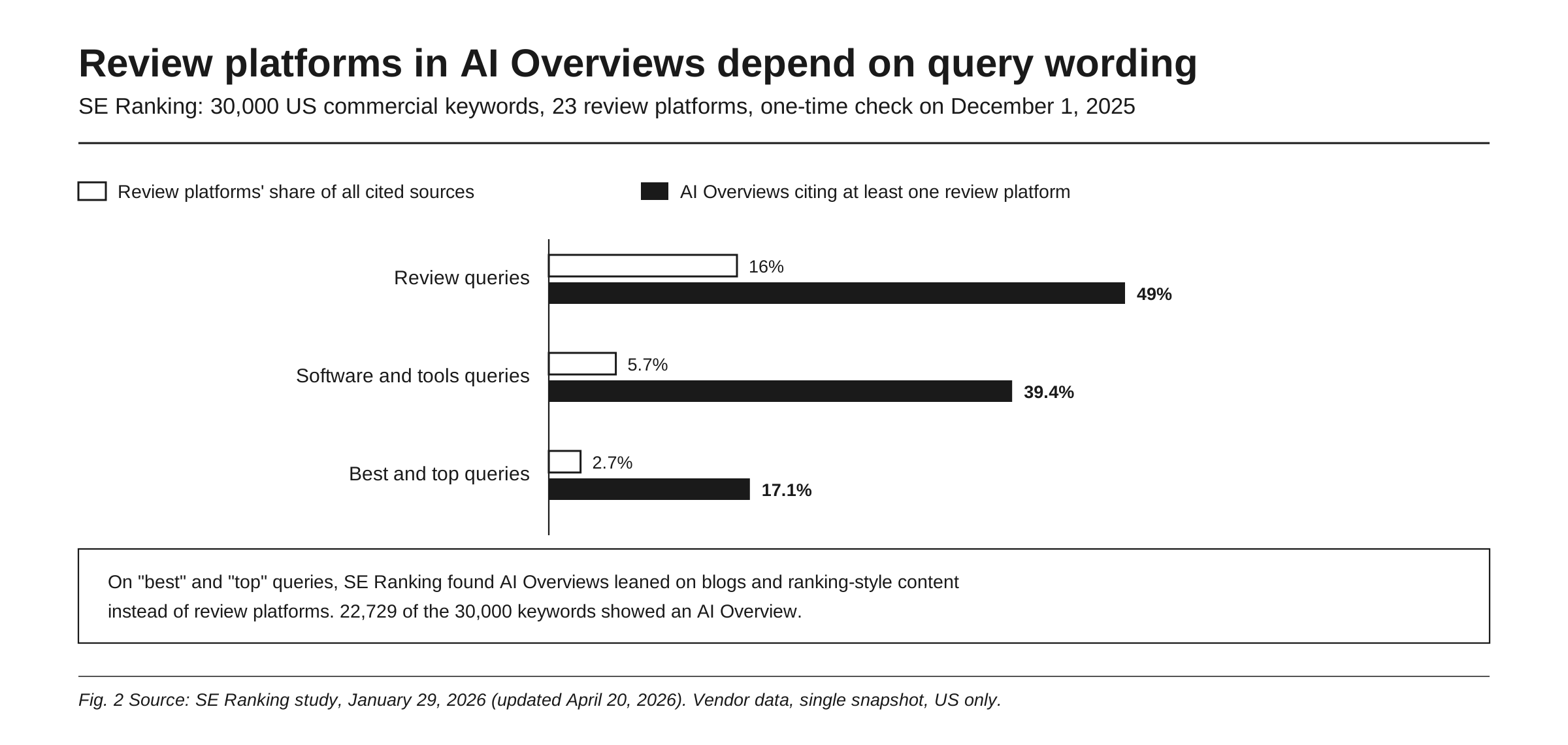
Query wording changes the source mix. SE Ranking, another SEO tool vendor, checked 30,000 US commercial keywords on December 1, 2025, a single snapshot; 22,729 showed an AI Overview. It tracked 23 review platforms, most of them software review sites. On explicit “review” queries, 49% of AI Overviews cited at least one review platform, and those platforms made up 16% of all cited sources. On “best” and “top” queries, only 17.1% did, at 2.7% of sources. SE Ranking’s reading: on those queries, “AI prefers blogs and ranking-style content.” Five platforms, Gartner Peer Insights, G2, Capterra, Software Advice and TrustRadius, took nearly nine in ten review-platform links.
Lists lead, and Google adds forums and video. OtterlyAI, a vendor of AI visibility tracking, analyzed 617,985 citations from seven engines on US buyer questions in September 2026. In its per-engine split, of every 100 pages Google AI Overviews cited, 45 were listicles and 23 were forums or videos. Reddit and YouTube supplied 92% of those forum and video citations in AI Overviews. Engines outside Google kept forums and video below 3%.
Being cited is not being recommended. SEO consultant Lily Ray checked 100 B2B “best [category] software” queries with Ahrefs Brand Radar at three dates between April and June 2026. Eighty triggered an AI Overview. Those Overviews cited 323 self-promotional listicles, and in 224 cases (69%) the brand that published the list was left out of the recommendation.
Put together: “review” queries pull review platforms, “best” queries pull ranked lists, and Google layers Reddit and YouTube on top. The wider listicle data, including who publishes the lists, is in why listicles get most AI citations.
What happens to clicks
We found no study measuring clicks on these commercial queries since coverage passed 80%. Semrush says ranking first “likely won’t lead to as much traffic,” without a number. Here is what exists.
A randomized field experiment by Saharsh Agarwal and Ananya Sen, an SSRN working paper revised June 17, 2026, tracked 1,065 US desktop Chrome users across 68,089 searches in early 2026, as reported by PPC Land. When an AI Overview was shown, outbound organic clicks fell by 39.8%. The statistically significant effect came from informational queries, 71% of the sample. For transactional queries, 12% of the sample, the effect was not statistically distinguishable from zero, but that estimate is noisy. It is an absence of proof, not proof of safety.
Amsive’s 2025 study of about 700,000 keywords on 10 sites found click-through rate fell 19.98% for non-branded keywords with an AI Overview. That predates the commercial expansion.
The sharpest signal for review publishers comes from SE Ranking. By its own traffic estimates, the five most cited review platforms lost 76.5% (Gartner Peer Insights) to 92.2% (TrustRadius) of US organic traffic between early 2024 and the end of 2025, and SE Ranking found no clear correlation between AI Overview citations and traffic retention. Being among the most cited sources did not protect them. The causes are not isolated, but the point stands: citations and clicks are separate outcomes. The full click evidence is in what AI Overviews cost in clicks, and what you gain.
What changes for review publishers and brands
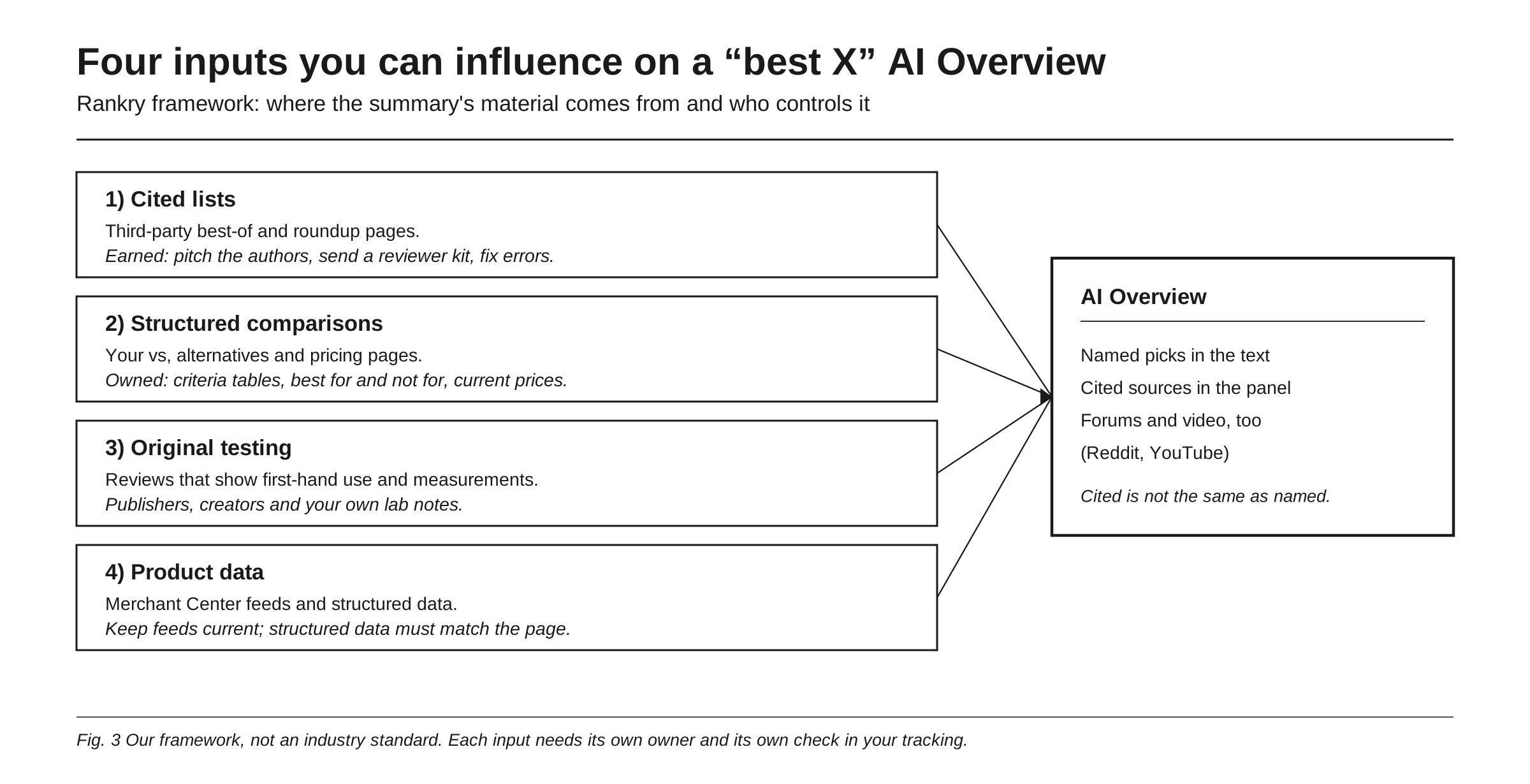
The figure is our framework, not an industry standard. It sorts the inputs a “best X” AI Overview draws on by who controls them.
For affiliate and review publishers, the product used to be a ranked page that earned the click. Now part of the value is being a source the summary reads, and a page worth clicking when the summary is not enough. Google’s review guidance describes the kind of page that holds up. It asks reviewers to “provide evidence such as visuals, audio, or other links of your own experience with what you are reviewing,” to “share quantitative measurements,” and, when calling something the best, to “include why you consider it the best.” A rewritten spec sheet gives the summary nothing it cannot get elsewhere. Original testing does.
For brands, ranking your own “best X” page is no longer enough: the summary can cite your page while naming a rival, as Ray’s count shows. Your levers are the lists and review platforms the summary already reads, comparison pages clear enough to quote, and consistent product facts.
Google says there is no special schema or AI file needed to appear in AI features. Its guidance does list checking that “your Merchant Center and Business Profile information is up-to-date” and making sure structured data matches the visible text on the page. For product brands, that is the product data input in the figure.
A playbook for commercial-intent pages
This checklist is our framework, built on the studies above.
-
Check coverage yourself. Group your commercial keywords by modifier (best, review, vs, alternatives, pricing) and record which show an AI Overview in your market.
-
Log the cited sources per query. Classify each as a listicle, review platform, forum, video, publisher review or brand page. Methods are in how to track citations and sources in AI search.
-
Get onto the cited lists. Pitch the authors of recurring lists with a reviewer kit: positioning, honest “best for” and “not for,” pricing and limits.
-
Publish structured comparisons. Build vs, alternatives and pricing pages with criteria tables and current prices, structured, in Semrush’s words, so Google can “pull clean passages.”
-
Invest in original testing. Publishers: show the test, the photos and the numbers. Brands: give reviewers access, data and room to criticize.
-
Fix product data. Keep Merchant Center current, and make structured data match what the page shows.
-
Earn reviews where the summary looks. Review platforms matter most on “review” queries. Ask customers only where each platform’s rules allow it.
-
Show up on YouTube and in forums honestly. Work with creators your audience trusts, and join Reddit threads as a disclosed brand.
-
Measure three outcomes per query. Whether an Overview appears, whether you are cited, and whether you are named.
How to monitor commercial AI Overviews
Start with Search Console. Google’s generative AI performance reports, rolled out to all websites as of August 31, 2026, show impressions in AI features by page, country, device and date. Clicks are not among the listed metrics, so they tell you where you appear, not what the appearance earned.
Search Console cannot show the answer itself: which brands the summary named and which sources it cited. Rankry runs a stable set of buyer-intent prompts every day across ChatGPT, Claude, Gemini, Perplexity, Grok and Google AI Mode and AI Overviews, and records which sources each engine cites. You can compare your mentions and citations against named competitors, connect Google Search Console to see your search data next to those answers, and a new “best X for Y” query is answered as soon as you add it.
FAQ
Do AI Overviews really appear on 88% of “best” and “review” searches? Not exactly. The 88% covers Semrush’s whole panel of 400 US desktop commercial keywords in August 2026, across five modifiers. The “best X for Y” group alone reached 96.12%, and the “reviews” group 89.04% in Semrush’s table as reported by PPC Land. The panel covers three industries, banking, ecommerce and software, so check your own category before planning around the number.
Which sources do AI Overviews cite for “best X” queries? Mostly ranked lists, with forums and video added. In OtterlyAI’s September 2026 data, 45 of every 100 pages cited in AI Overviews were listicles and 23 were forums or videos, mainly Reddit and YouTube. SE Ranking found review platforms in only 17.1% of AI Overviews on “best” and “top” queries, versus 49% on explicit “review” queries.
Do AI Overviews reduce clicks on commercial queries? The data is thin. Semrush’s study has no click data. A 2026 field experiment, as reported by PPC Land, found outbound organic clicks fell 39.8% when an AI Overview was shown, driven by informational queries; the effect on transactional queries could not be told apart from zero in a small, noisy sample. In SE Ranking’s estimates, the most cited review platforms lost most of their organic traffic from early 2024 to late 2025.
Should affiliate and review sites keep publishing “best” lists? Yes, if the lists carry evidence the summary cannot produce on its own. Lists are a leading source in AI Overviews, but citation does not guarantee clicks. Google’s review guidance asks for first-hand evidence, measurements and a reason for every “best” pick. Track whether your pages are cited, and treat clicks as a separate metric.
How do I check whether AI Overviews cite my brand on commercial queries? Group your commercial keywords by modifier and record, for each, whether an AI Overview appears, which sources it cites and which brands it names. Search Console’s generative AI reports show your pages’ impressions in AI features but not clicks. Repeat the same checks weekly or monthly so changes stand out from noise.
Sources
- AI Overviews have nearly doubled across five commercial search modifiers [Study], Semrush, October 21, 2026
- Google AI Overviews now hit 88% of tracked commercial keywords, Semrush finds, PPC Land, October 22, 2026
- Review platforms lost 90% of traffic over the past 2 years, yet they top AI Overview citations for commercial queries, SE Ranking, January 29, 2026 (updated April 20, 2026)
- What Content Do AI Engines Cite? A Study of 617,985 Citations Across 7 Engines and 5 Industries, OtterlyAI, October 14, 2026
- Why Calling Yourself the ‘Best’ Could Be Helping Your Competitors Win in AI Search, Lily Ray (Substack), June 17, 2026
- Researchers find Google AI Overviews cut publisher clicks 39.8%, PPC Land, July 1, 2026
- Google AI Overviews: New CTR Study Reveals How to Navigate Negative SERP Impact, Amsive, April 16, 2025
- Write high quality reviews, Google Search Central, last updated December 10, 2025
- AI features and your website, Google Search Central, last updated December 10, 2025
- Introducing Search Generative AI performance reports in Search Console, Google Search Central Blog, June 3, 2026
See which sources AI Overviews and the major assistants cite on your “best” and “review” queries, and whether they name you or a rival. Start a free 7-day Rankry trial, no card required.