The strongest evidence so far says AI Overviews take a large share of organic clicks on the searches where they appear. In what its authors call the first randomized field experiment on the feature, they reported a 38% drop in outbound organic clicks in April 2026, then revised it to 39.8% in June. The loss sits in informational searches; on navigational and transactional searches the study found no measurable change, although those samples were smaller. What you can gain is narrower but real: Seer Interactive found brands cited inside an AI Overview earn clearly higher click-through rates than uncited brands, Amsive’s 2025 data showed branded keywords gaining CTR, and visits referred by AI assistants convert well in Adobe’s retail data. The practical response is to re-plan content by query type, measure citations as well as clicks, and report the AI impressions Google now shows in Search Console.
Many teams have felt this as a slow leak in informational traffic. In 2026 a controlled experiment finally put a number on it, and it is worth reading closely before you quote it.
What the 38% study actually measured
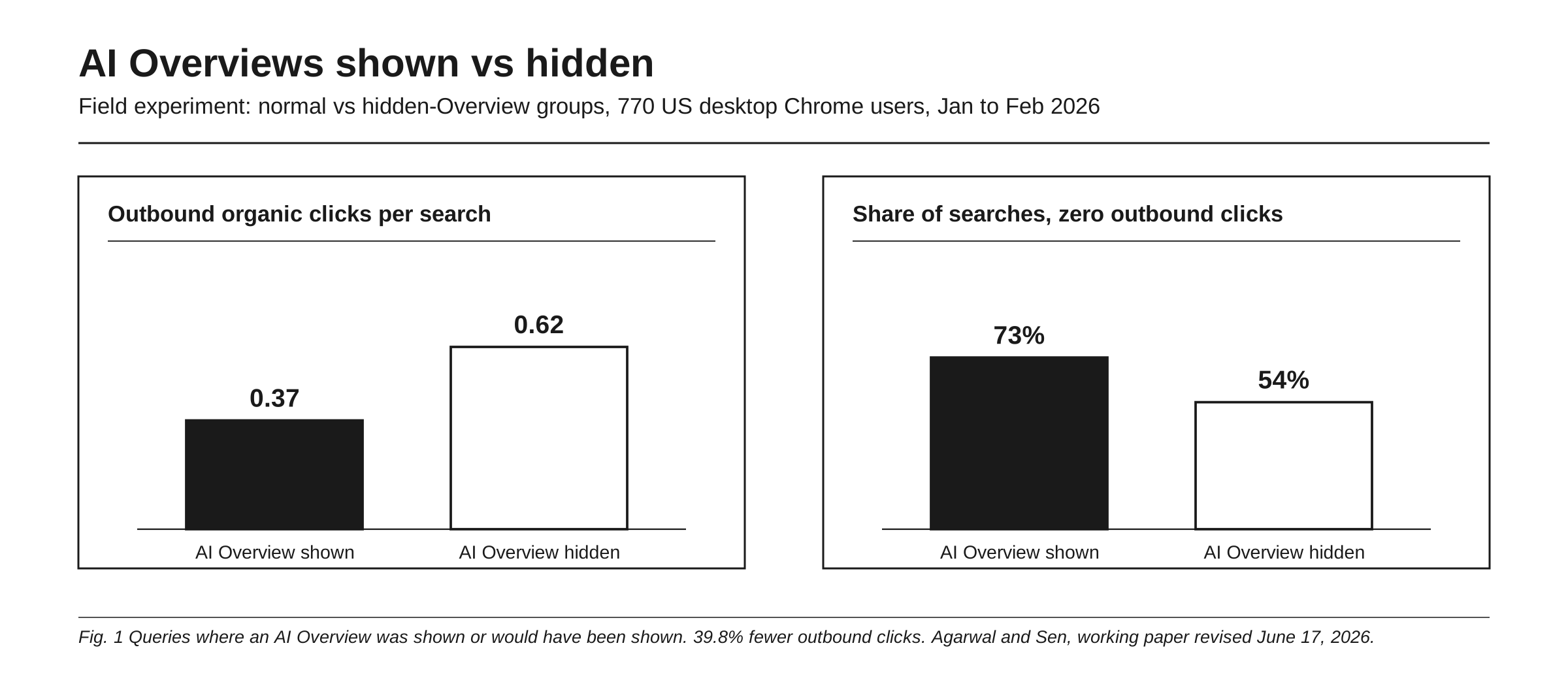
The number comes from Saharsh Agarwal of the Indian School of Business and Ananya Sen of Carnegie Mellon University. They built a Chrome extension, recruited participants through Prolific, and randomly assigned them to three groups: normal Google Search, Google Search with AI Overviews removed in real time, and searches redirected to AI Mode. In total, 1,065 US participants passed the browser history checks. The main comparison uses the 770 people in the normal and hidden-Overview groups, who ran 68,089 unique searches over two weeks each; data collection ran from January 7 to February 10, 2026.
In the revised version of the paper, on queries where an AI Overview was shown or would have been shown, participants made 0.37 outbound organic clicks per search with the Overview and 0.62 without it. The chance that a search ended with no outbound organic click was 0.73 with the Overview and 0.54 without it. AI Overviews appeared on about 41% of observed queries, and sponsored clicks stayed flat. More than 87% of Overviews sat at the top of the page, and that is where the effect lived: removing a top-position Overview raised outbound clicks by 88%, while lower placements had no measurable effect.
Read the limits before you repeat the number. It is a working paper, not yet peer reviewed. The sample is active desktop Chrome users in the US with enough browsing history to qualify, not all Google users. It measures clicks, not revenue, and it does not estimate how the total loss grows as Google shows Overviews on more queries, though the authors expect it to grow.
Earlier observational studies point the same way with different numbers:
- Pew Research Center, July 2025: in browsing data from 900 US adults in March 2025, covering 68,879 searches, users clicked a traditional result in 8% of visits to pages with an AI summary, against 15% without one. Only 1% of visits to pages with a summary included a click on a link inside it.
- Amsive, April 2025: across about 700,000 keywords on 10 websites, keywords that triggered AI Overviews saw CTR fall 15.49% on average, and non-branded keywords fell 19.98%.
Only the experiment used random assignment, so it is the best evidence that the Overview itself causes the loss.
What you lose: top-of-funnel informational clicks
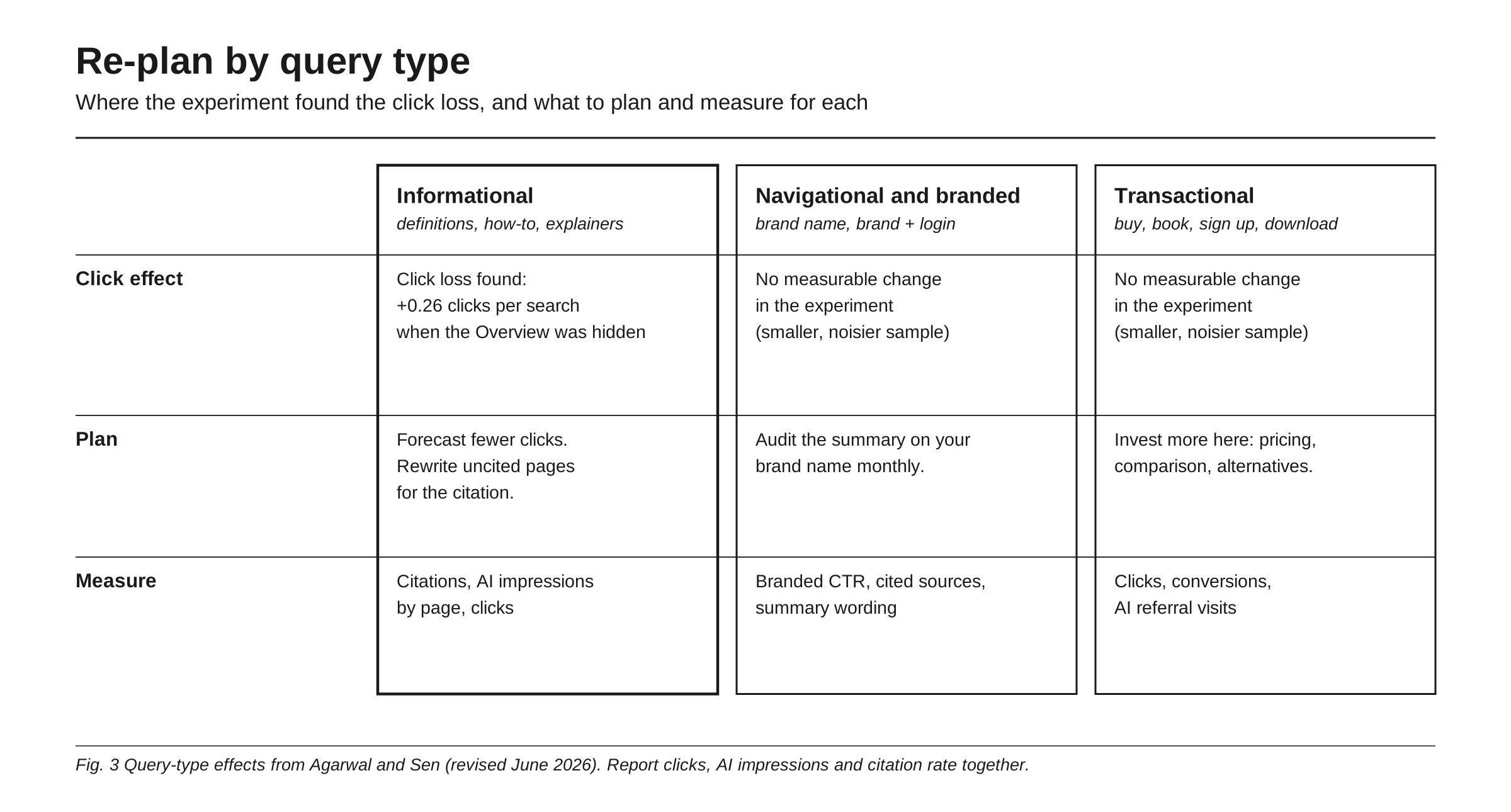
The loss is not spread evenly. In the revised experiment, informational queries made up 71% of the sample, and hiding the Overview added 0.26 clicks per search on them. Navigational queries (18%) and transactional queries (12%), as classified by the authors with an LLM, showed effects that could not be distinguished from zero, though the authors note those estimates are noisier. Search Engine Journal’s summary of the revision also reports that Overviews were triggered or intended on 53% of informational queries, 15% of navigational and 6% of transactional ones.
So the pages that lose are the ones built to answer a question: definitions, “what is” guides, how-to explainers, comparison primers. If your content program judged success by sessions on those posts, the measure broke before the content did.
The study also tested Google’s main defense. Google’s Liz Reid wrote in August 2025 that total organic click volume was “relatively stable year-over-year” and that Google was sending “slightly more quality clicks,” meaning visits where users do not quickly click back. The post included no figures, and Search Engine Journal reported in April 2026 that Google still had not shared data to back the claim. In Agarwal and Sen’s data, the extra clicks sites got when Overviews were removed looked the same as other clicks: back-button returns, visits under 10 seconds with no interaction, and time on page did not differ meaningfully between groups. The authors call this “at odds with the view that AIOs primarily eliminate low-engagement website visits.”
Users did not report missing the feature either. Endline survey scores for satisfaction, information quality and ease of finding information were nearly identical with and without Overviews, and in the revised paper over 95% of participants in both groups said they noticed no change or were unsure.
What you gain: citations, brand clicks, and better visits
The gains are real, but they are relative, not absolute.
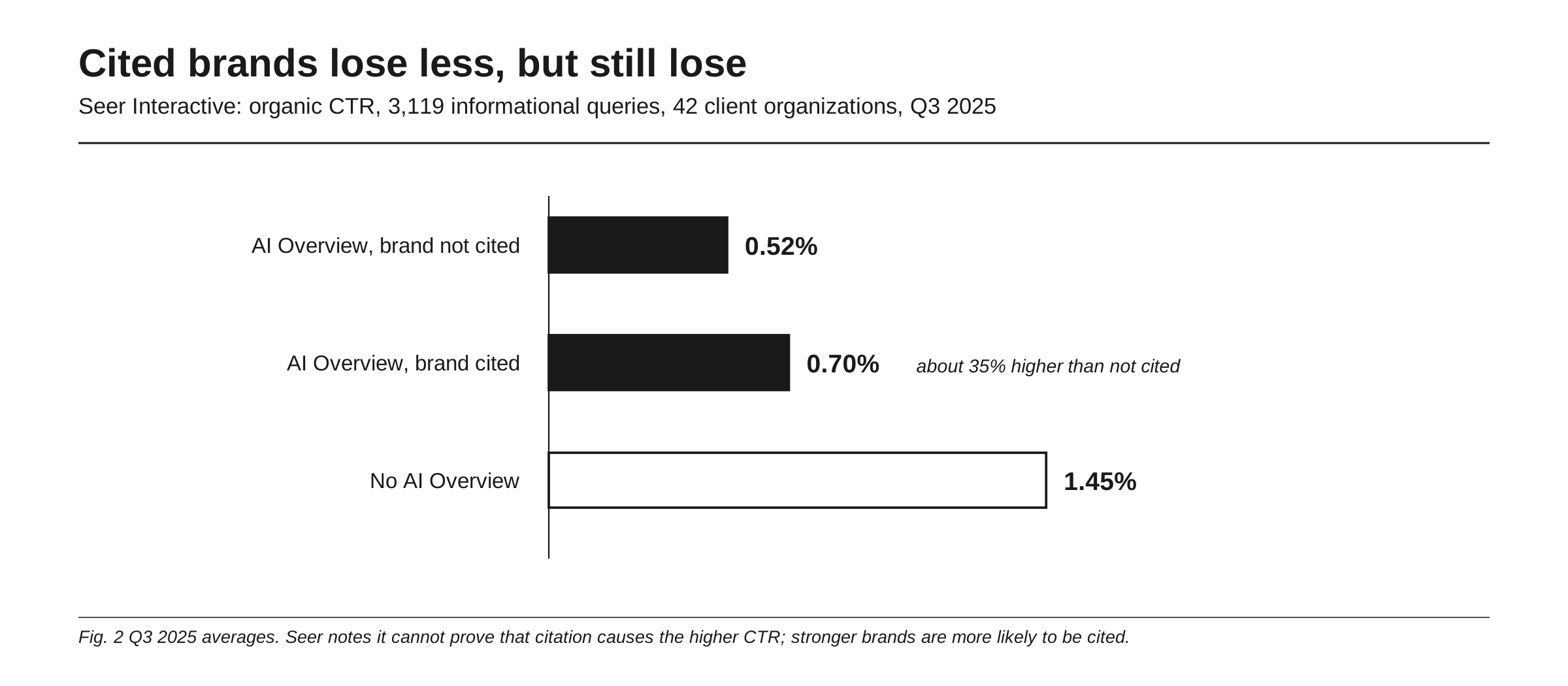
Being cited softens the loss. Seer Interactive’s November 2025 study covered 3,119 informational queries for 42 client organizations, with 25.1 million organic impressions from June 2024 to September 2025. In Q3 2025, organic CTR was 0.70% when the brand was cited in the AI Overview, 0.52% when it was not, and 1.45% on queries with no Overview. That is about 35% higher CTR for cited brands, and paid CTR was 91% higher (7.89% vs 4.14%). Seer’s April 2026 update, across 5.47 million queries for 53 brands from January 2025 to February 2026, reports that being cited “delivers +120% more organic clicks per impression versus when you are not cited,” but “still underperforms No AIO by -38%.” That second 38% is a different measurement from the experiment, so do not mix them up. Seer also states it cannot prove causation, since stronger brands are more likely to be cited.
Brand searches can hold up. In Amsive’s sample, branded keywords that triggered an AI Overview saw CTR rise 18.68% on average. Only 4.79% of branded keywords triggered one at the time, so the result may not hold today; see AI Overviews on branded searches.
AI-referred visits convert well, in one vendor’s retail data. Adobe Digital Insights, a vendor whose data comes from Adobe Analytics, reported in June 2026, based on more than one trillion visits to US retail sites, that AI-referred visitors in May 2026 converted at a rate 54% higher than non-AI traffic, generated 53% more revenue per visit, and were 36% less likely to bounce. Digital Commerce 360 noted this reversed 2025, when AI-referred conversion rates were nearly half those of other traffic. Two cautions: Adobe measures visits referred by AI assistants and tools, not clicks from AI Overviews, and the data is retail only. The broader argument is in why AI traffic converts better.
What Google now lets you measure
On June 3, 2026, Google announced Search Generative AI performance reports in Search Console. They cover generative AI features in Search, including AI Overviews and AI Mode, plus generative AI features in Discover, with breakdowns by page, country, date and, for Search only, device. Impressions are the core metric; the reports do not show clicks. Google first rolled them out to a subset of sites, and on August 31, 2026 it noted: “we’ve rolled out these insights to all websites worldwide.” Sites with too few AI impressions may still not see a report.
That gives you the missing half of the picture. Clicks tell you what you lost; AI impressions by page tell you where Google’s AI is still using your content. A page with rising AI impressions and falling clicks is being shown in the answer more often while being visited less. Reading the report is covered in how to read Search Console’s generative AI report, and combining it with your other search data in Google Search Console for AI visibility.
How to re-plan content and reporting
-
Split your keyword set by query type. Tag every tracked query as informational, navigational (including branded) or transactional. The experiment found the loss in the first group, so forecast and report the three separately.
-
Re-forecast informational traffic down, not to zero. For pages that answer questions, set targets on citations and AI impressions alongside sessions. A 40% click drop on a page that is still cited is a different problem from a page that disappeared.
-
Check which informational pages get cited. In the Pages tab of the generative AI report, list URLs with AI impressions. Compare them with pages that lost clicks. Brands cited in the Overview earn more clicks per impression in Seer’s data, so uncited pages with large losses are your rewrite list.
-
Rewrite for the citation, not the click. Put the direct answer near the top in plain indexable text, and add the data and specifics a summary cannot fully carry, so the click still has a reason to happen.
-
Shift investment toward decision-stage pages. Pricing, comparison, “best for” and alternatives pages sit closer to navigational and transactional intent, where the experiment found no measurable click loss, though on smaller samples and without testing those page types directly.
-
Protect branded results. Branded CTR held up in Amsive’s 2025 data, but the summary on your brand name is written from sources you may not control. Audit it monthly.
-
Measure AI referrals separately. Track visits from ChatGPT, Perplexity, Gemini and other assistants as their own channel, with conversion rate, so a smaller but better channel is not buried in “direct.”
-
Report three numbers, not one. Each month show clicks, AI impressions and citation rate on your priority queries. Clicks alone will tell leadership the content program is failing when part of it is being read inside the answer.
How Rankry fits
The question behind the click loss is broader than Google: when buyers ask an AI system about your category, are you the source it uses? Rankry tracks how ChatGPT, Claude, Gemini, Perplexity, Grok and Google AI Mode and AI Overviews mention, rank, cite and recommend your brand across a stable set of buyer-intent prompts, every day, so citation rate becomes a trend you can report next to clicks. The Google Search Console integration brings your search data in alongside it, AI traffic tracking shows the visits AI platforms send to your site, and competitor comparison shows who is being cited where you are not.
FAQ
Do AI Overviews really cut clicks by 38%? In one randomized field experiment, yes on the queries where they appear. Agarwal and Sen first reported a 38% drop in outbound organic clicks in April 2026 and revised it to 39.8% in June, in a study of 1,065 US desktop Chrome users. It is a working paper, not peer reviewed, and the loss was concentrated in informational searches, not all queries.
Which queries lose the most clicks to AI Overviews? Informational ones. In the experiment, hiding the Overview added 0.26 clicks per search on informational queries, while effects on navigational and transactional queries could not be distinguished from zero, though those samples were smaller and noisier. Definitions, how-to guides and explainers carry the most risk.
Does being cited in an AI Overview bring clicks back? Partly. In Seer Interactive’s Q3 2025 data, cited brands had 0.70% organic CTR versus 0.52% for uncited brands, about 35% higher, but both trailed the 1.45% CTR on queries with no Overview. Seer says it cannot prove citation causes the difference, since stronger brands are more likely to be cited.
Are the clicks AI Overviews remove low-quality clicks? The experiment suggests not. Back-button returns, visits under 10 seconds with no interaction, and time on page did not differ meaningfully between groups. Google has said it sends slightly more “quality clicks” than a year earlier, but it has not published data to support that, according to Search Engine Journal’s April 2026 reporting.
Can I see AI Overview performance in Search Console? Yes, for impressions. Google’s Search Generative AI performance reports, announced June 3, 2026 and rolled out to all websites worldwide by August 31, 2026, show impressions from AI Overviews, AI Mode and Discover by page, country, date and, for Search, device. They do not show clicks, so pair them with the regular Performance report.
Sources
- Study Confirms Google AI Overviews Cut Organic Clicks 38%, Search Engine Journal, April 27, 2026
- Researchers find Google AI Overviews cut publisher clicks 39.8%, PPC Land, July 1, 2026
- Google AI Overviews Study Finds Lost Clicks Weren’t Lower Quality, Search Engine Journal, July 1, 2026
- The Impact of Google AI Overviews on Publisher Traffic and User Experience: Evidence from a Field Experiment, Agarwal and Sen, SSRN working paper (not peer reviewed), posted April 2026, revised June 17, 2026
- Google users are less likely to click on links when an AI summary appears in the results, Pew Research Center, July 22, 2025
- Google AI Overviews: New CTR Study Reveals How to Navigate Negative SERP Impact, Amsive, April 16, 2025
- AIO Impact on Google CTR: September 2025 Update, Seer Interactive, November 4, 2025
- AIO Impact on Google CTR: 2026 Update, Seer Interactive, April 24, 2026
- AI in Search is driving more queries and higher quality clicks, Google (Liz Reid), August 6, 2025
- Google Pushes “Bounce Clicks” Explanation For AI Overview Traffic Loss, Search Engine Journal, April 25, 2026
- Q3 AI Traffic Trends Report, Adobe Digital Insights, June 2026
- Adobe: AI-referred traffic to retail sites doubles in a year, Digital Commerce 360, June 17, 2026
- Introducing Search Generative AI performance reports in Search Console, Google Search Central Blog, June 3, 2026
- Google finally gives Search Console its own generative AI visibility reports, PPC Land, June 3, 2026
- Google Search Console AI Reports Rolled Out Worldwide, Search Engine Journal, August 31, 2026
See where AI Overviews and the major assistants cite you, and where they cite a competitor instead, every day. Start a free 7-day Rankry trial, no card required.