If you know SEO, you are not starting over with AI visibility, but you do have to unlearn four reflexes and keep everything else. What transfers: being crawlable and retrievable, clean structure and headings, structured data and clear entities, real authority, and third-party links and mentions, the foundation still matters because AI cannot cite what it cannot read. What does not transfer: chasing a stable rank position, assuming one engine’s rules fit all, optimizing your own site above all else, trusting a single check as truth, and measuring success by the click, because these reflexes actively mislead you in AI search. The shift in one line: stop thinking “keyword and rank,” start thinking “buyer question and recommendation,” across five engines that disagree. This guide is the field map for making that transition without throwing away the skills that still apply.
The biggest risk for an experienced SEO is not ignorance, it is confident pattern-matching, applying a rank-and-click mental model to a system that does not rank and often does not produce a click.
SEO you know vs AI visibility
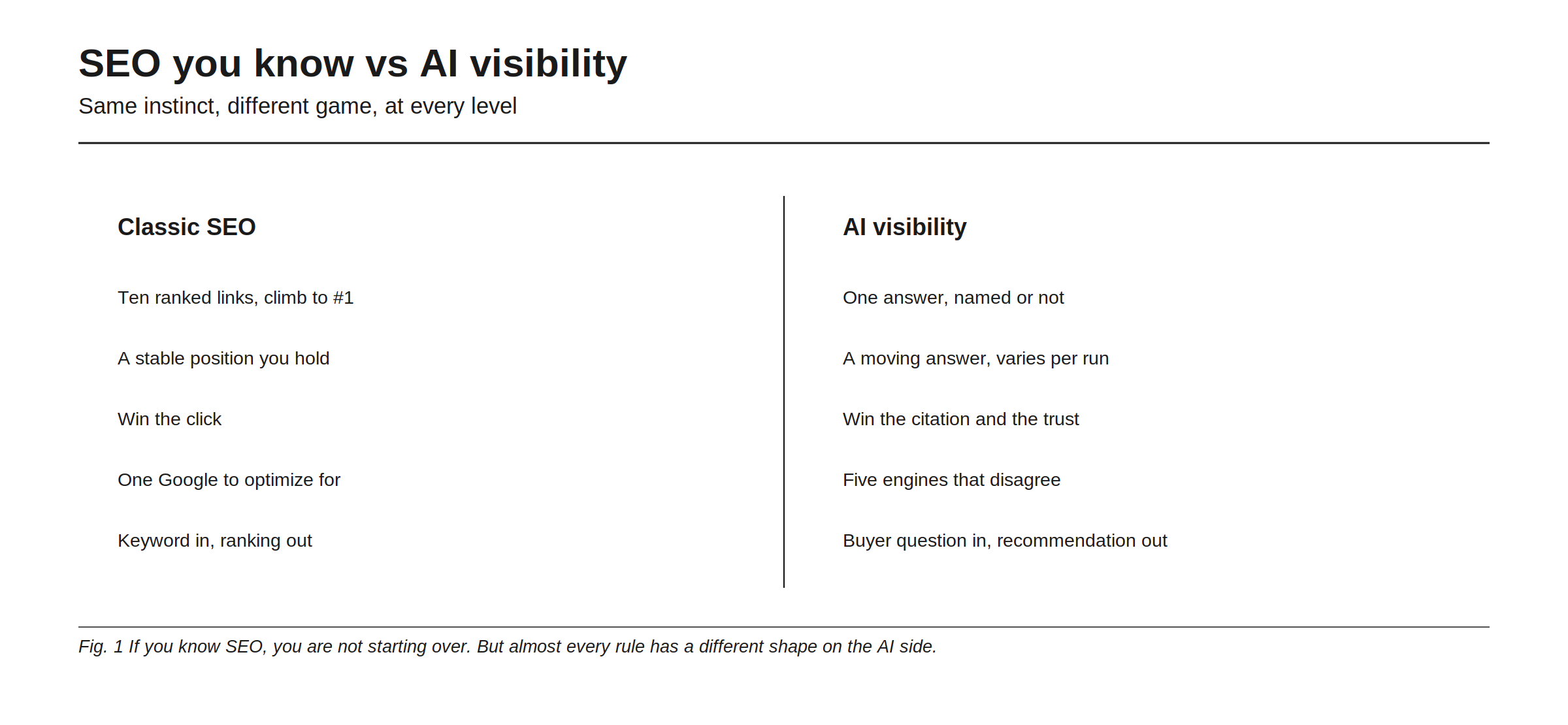
At every level, the same instinct meets a different game. Classic SEO gives you ten ranked links and you climb to number one; AI gives you one answer, and you are named or not. SEO offers a stable position you hold; AI gives a moving answer that varies per run. SEO is about winning the click; AI is about winning the citation and the trust. SEO has one Google to optimize for; AI has five engines that disagree. SEO takes a keyword in and gives a ranking out; AI takes a buyer question in and gives a recommendation out.
If you know SEO you are not starting over, but almost every rule has a different shape on the AI side. The variance point specifically, that AI answers move between runs, is why single checks mislead, covered in how many runs a number needs before you can trust it.
What transfers, what does not
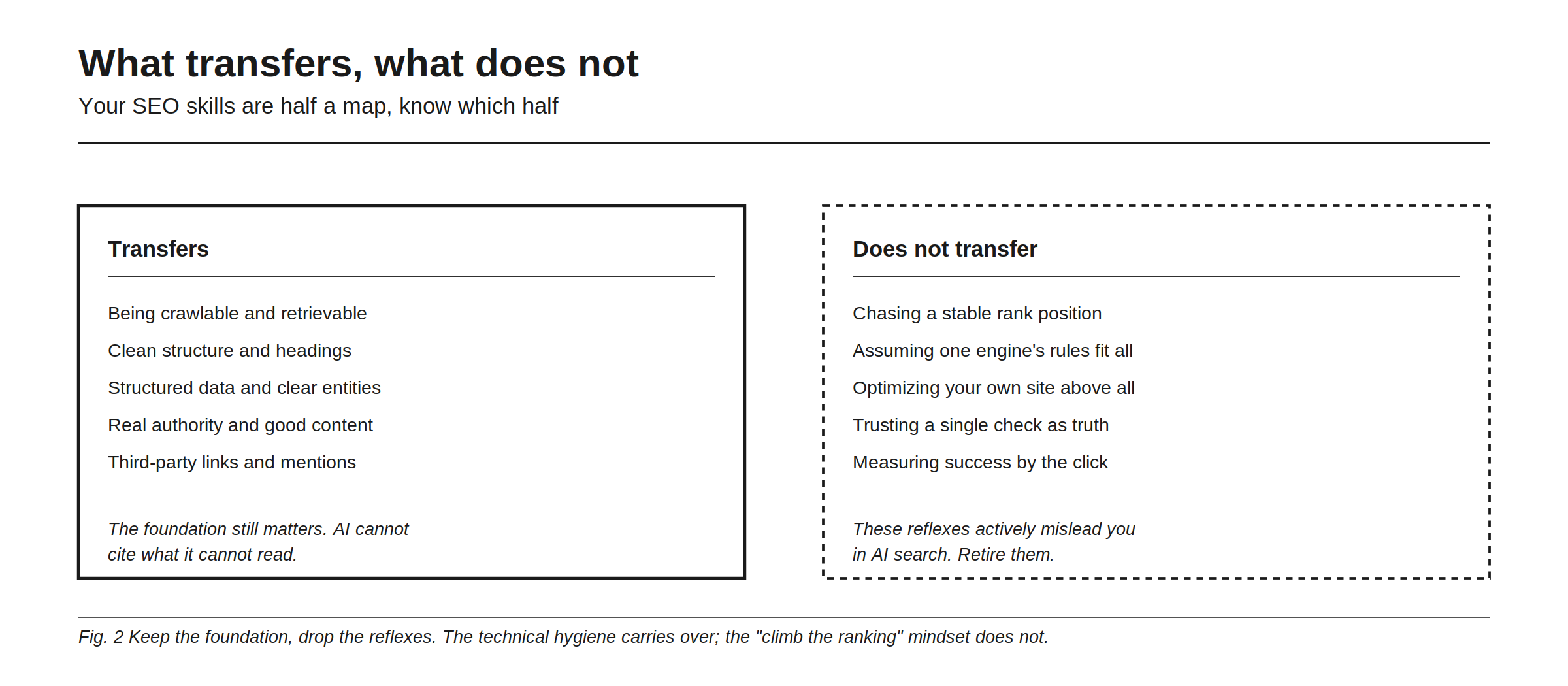
Your SEO skills are half a map; the trick is knowing which half. What transfers: being crawlable and retrievable, clean structure and headings, structured data and clear entities, real authority and good content, and third-party links and mentions, because the foundation still matters and AI cannot cite what it cannot read. What does not transfer: chasing a stable rank position, assuming one engine’s rules fit all, optimizing your own site above all, trusting a single check as truth, and measuring success by the click, because these reflexes actively mislead you in AI search and should be retired.
Keep the foundation, drop the reflexes. The technical hygiene carries over; the “climb the ranking” mindset does not. The reflex that hurts SEOs most is over-optimizing their own site, when AI weights third-party sources higher, which is the whole point of where AI actually gets its sources.
The transition, in order
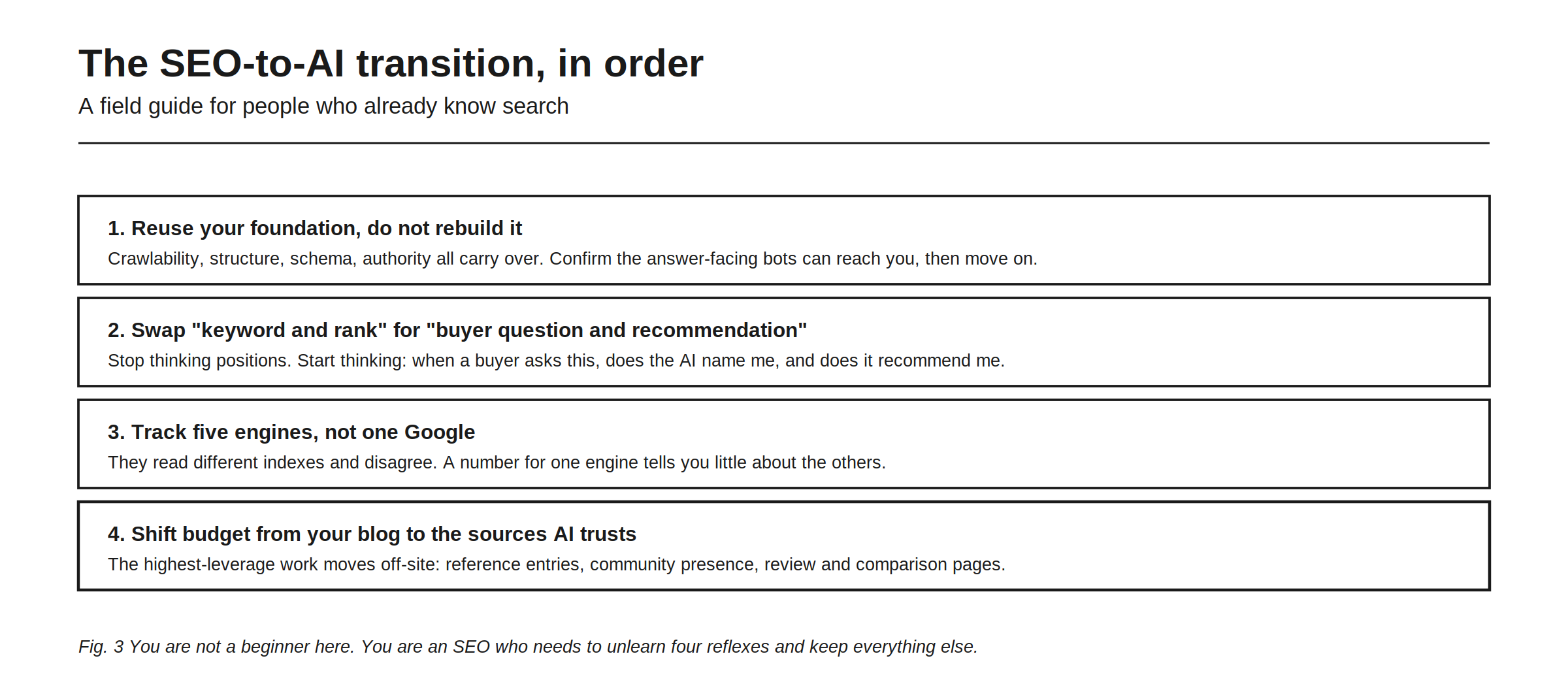
Four steps, in sequence. First, reuse your foundation rather than rebuilding it: crawlability, structure, schema, and authority all carry over, so confirm the answer-facing bots can reach you, then move on, and which bots those are is in the five types of AI bots. Second, swap “keyword and rank” for “buyer question and recommendation”: stop thinking positions and start thinking, when a buyer asks this, does the AI name me and does it recommend me, the distinction in the mention-versus-recommendation gap. Third, track five engines, not one Google: they read different indexes and disagree, so a number for one engine tells you little about the others. Fourth, shift budget from your blog to the sources AI trusts: the highest-leverage work moves off-site to reference entries, community presence, and review and comparison pages.
You are not a beginner here. You are an SEO who needs to unlearn four reflexes and keep everything else. That is a much shorter path than starting from zero, which is the encouraging part of this whole shift.
The mindset flip that ties it together
Everything above reduces to one change of question. SEO asked “how do I rank for this keyword,” a question about position on a page you compete to appear on. AI visibility asks “when my buyer describes their problem, does the machine name and recommend me,” a question about presence and trust inside a single answer. The first is about beating other pages; the second is about being the answer, or the source the answer is built from. Once that flip lands, the rest follows naturally: you stop obsessing over your own rankings, start caring what third parties say, track multiple disagreeing engines instead of one, and measure recommendations instead of clicks. The skills you spent years building, technical hygiene, authority, content quality, are the price of entry, not the game itself. The game is being the trusted answer, and the way you know if you are winning is by tracking it, the loop in how to monitor your brand across AI search engines. Rankry is built for exactly this transition, tracking name, rank, recommendation, and cited sources across every engine you run, from $99 a month on a no-card trial.
FAQ
Is AI visibility just SEO with a new name? No. They share a technical foundation, crawlability, structure, authority, but differ fundamentally: SEO is about ranking a page and winning a click, while AI visibility is about being named and recommended inside a single answer across multiple engines that disagree.
What SEO skills transfer to AI visibility? The foundation: making your site crawlable and retrievable, clean structure and headings, structured data and clear entities, genuine authority, and third-party links and mentions. AI cannot cite what it cannot read, so technical hygiene still matters.
What SEO habits hurt me in AI search? Chasing a stable rank position, assuming one engine’s rules apply to all, over-optimizing your own site, trusting a single check as truth, and measuring success by the click. These reflexes mislead you because AI does not rank, varies per run, and weights third-party sources.
Do I need to track more than one engine for AI visibility? Yes. Unlike SEO’s single dominant Google, AI visibility spans five major engines that read different indexes and produce different answers. A result for one engine tells you little about the others, so track them separately.
How do I transition from an SEO to an AI visibility mindset? Reuse your technical foundation, then swap “keyword and rank” for “buyer question and recommendation,” track five engines instead of one, and shift effort from your own blog to the third-party sources AI trusts. You are unlearning four reflexes, not starting over.
Track name, rank, recommendation, and cited sources across every engine you run, built for SEOs making the shift. Start a free 7-day Rankry trial, no card, first report in two minutes.