Often yes, but the trigger is the language of the question more than the country of the user. In a Temso AI analysis of 7 million citations, non-English prompts drew 85.4% local-language sources in Google AI Overviews, 76.7% in Copilot, 70.2% in ChatGPT and 51.7% in Grok. A smaller Weglot test found lower local-language shares, 23% to 35%, but the same direction: ask the same questions in English and local sources nearly vanish, as in Japan, where .jp domains fell from 26% of citations to about 1%. How local the answer gets also depends on the engine, the category and how you define “local,” so published country-level ccTLD shares range from 2% in Argentina to 41% in Brazil. In Temso’s data, Grok and ChatGPT mixed the most English sources into non-English answers.
If you sell in several countries, this decides which of your pages can get cited where. This article is about which country’s sources get cited. Which brands get recommended in different cities is a separate question, covered in geo-variation in brand recommendations, and physical businesses competing for “near me” answers are covered in our local AI visibility guide.
Language decides first
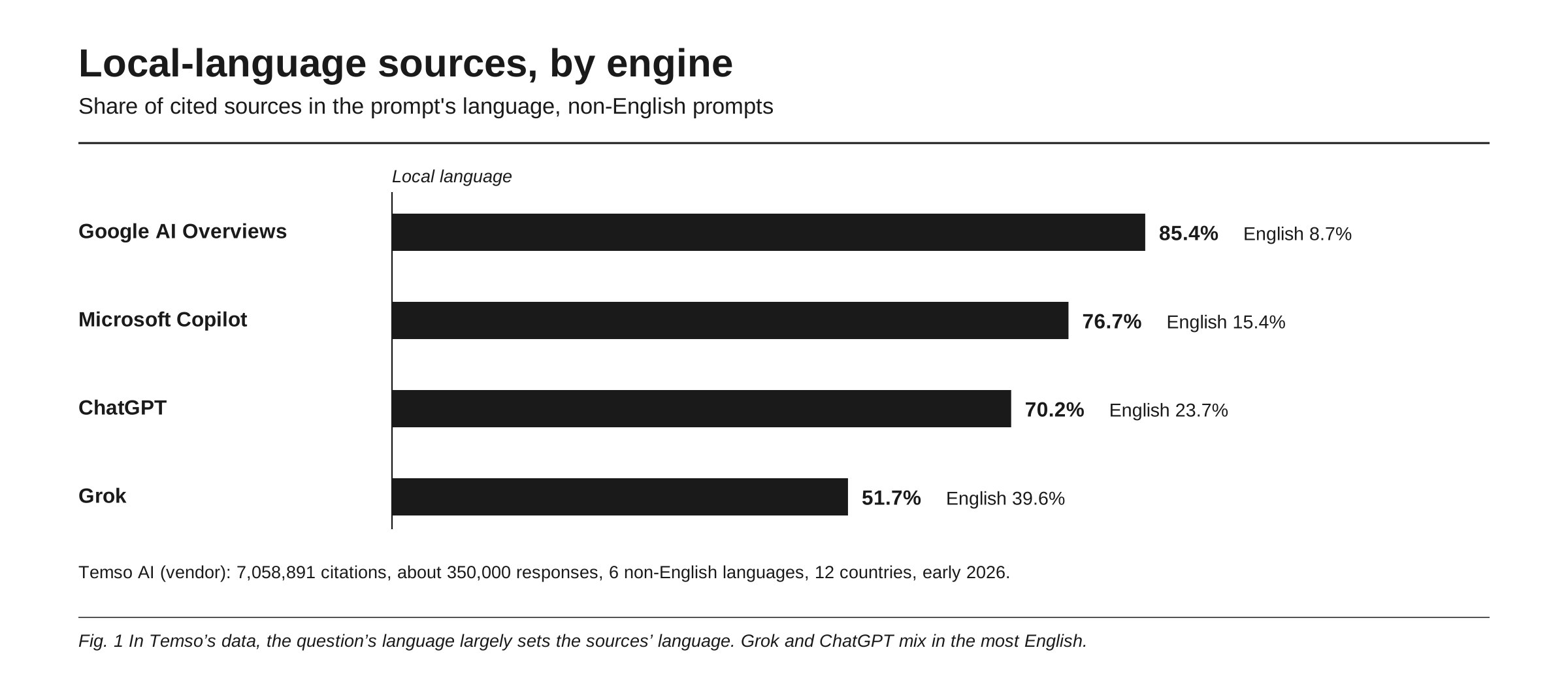
The largest dataset comes from Temso AI, an AI visibility vendor: 7,058,891 citations from about 350,000 responses across four engines, six non-English languages, 12 countries and 47 industries, collected in early 2026. Temso matched each cited page’s language against the prompt’s.
For non-English prompts, the local-language share was 85.4% in Google AI Overviews (English 8.7%), 76.7% in Copilot (15.4%), 70.2% in ChatGPT (23.7%) and 51.7% in Grok (39.6%). For Dutch prompts, 54% of Grok’s sources were English against 38% Dutch.
A small independent test agrees. Jonas Villwock ran 24 German mental health and relationship questions through ChatGPT, Perplexity and Google AI Overviews (600 citations, tracked with Peec AI). ChatGPT cited English sources in half the cases; Perplexity and Google together stayed about 96% German. It is the only Perplexity reading we found, and 24 queries is a signal, not a rate.
ChatGPT’s English habit has a visible cause. Peec AI, another vendor, analyzed more than 10 million ChatGPT prompts and 20 million background searches (fan-outs), keeping only sessions where the user’s IP country matched the prompt language. For non-English prompts, 43% of fan-out searches ran in English, and 78% of runs included at least one English search. By language, that share ranged from 66% (Spanish) to 94% (Turkish). In Peec’s manual tests, a Polish question about auction sites left out Allegro.pl or ranked it below eBay, and a German question about German software companies listed none. Fan-outs are searches, not citations, but they shape what can be cited.
Country by country: what has been measured
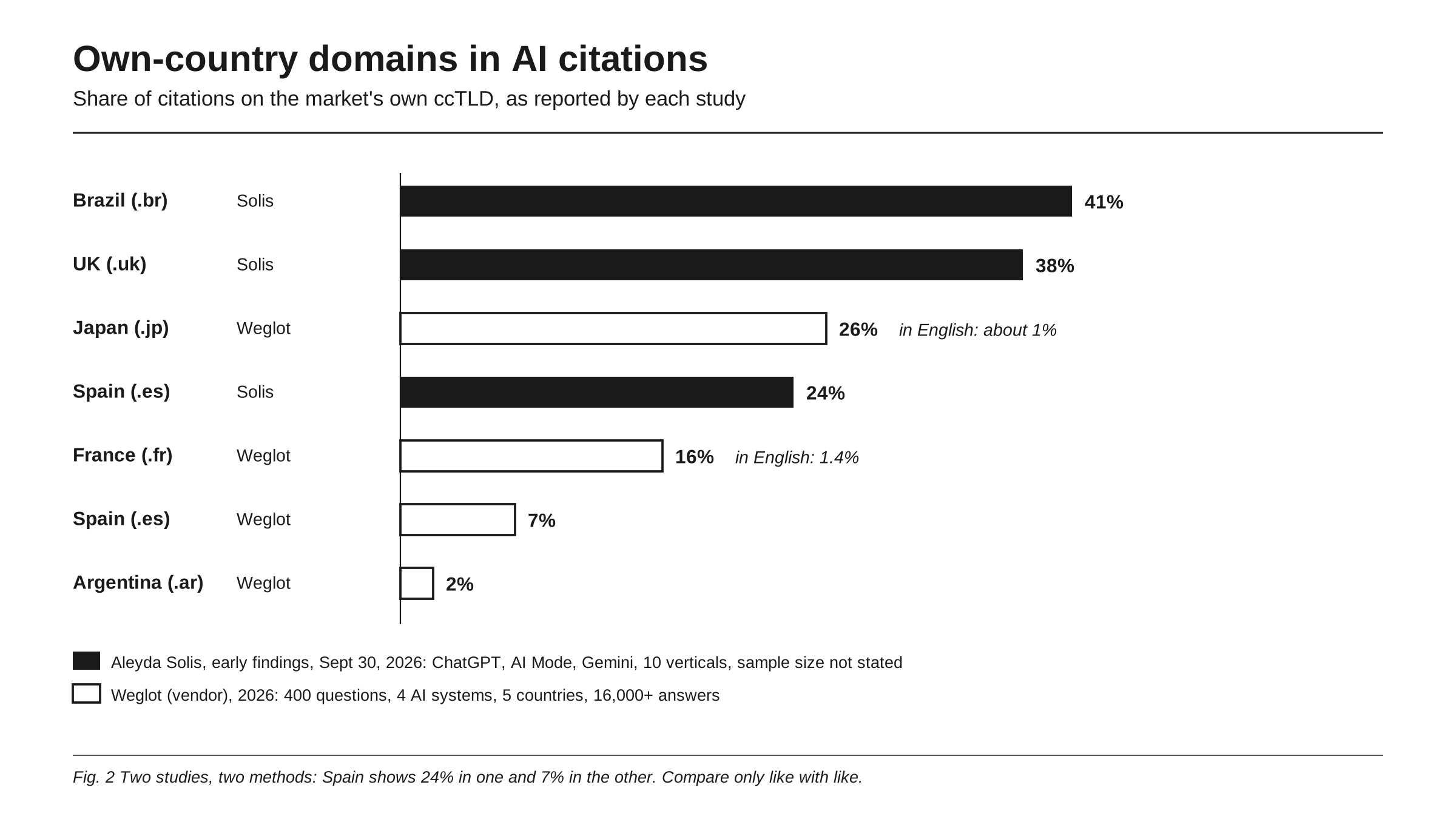
Country-level numbers are scarcer and use different definitions. Here is what is published.
Japan. Weglot, a website translation vendor, asked 400 questions in English and in each market’s language across four AI systems (OpenAI, Anthropic and Google models plus Google AI Overviews) in five countries, logging sources from more than 16,000 answers. Asked in Japanese, 26% of citations went to .jp domains, against about 1% in English. Counting Japanese pages on global sites such as ja.wikipedia.org, the local-language share was 35% versus 1.3%.
France. French queries sent 16% of citations to .fr domains, against 1.4% for English queries, and 30% to French-language sources overall.
Spain. Two sources, two answers. Weglot found 7% of citations on .es domains and 26% in Spanish. Aleyda Solis, an independent international SEO consultant, shared early findings on September 30, 2026 from tracking ChatGPT, Google AI Mode and Gemini across 10 verticals, with the US as a control: .es domains took 24% of citations. Topics, engines and method differ, and her post gives no sample size, so the two numbers cannot be compared directly.
Argentina. Only 2% of citations went to .ar domains, but 23% were Spanish-language, against 1.1% in English. Weglot’s summary: “the models followed the language rather than geography.”
Brazil and the UK. In Solis’s early data, own-country ccTLDs took 41% of citations in Brazil and 38% in the UK. These count only ccTLDs, so local sites on .com or .org sit outside them. For ChatGPT, 61% of UK citation weight went to domains also cited in the US, compared with 51% in Spain and 46% in Brazil.
Clicks, not citations. A separate Solis analysis of Similarweb data on 87 million AI search visits in 10 markets, reported by Search Engine Journal in April 2026, found local domains leading many markets: Amazon.it took 46.2% of clicks in Italian ecommerce, Bol.com led Dutch ecommerce, Bahn.de led German travel and MercadoLivre led in Brazil. In SEJ’s summary of her view, the pattern “reflects who has the usable answer locally, not brand size.”
Why engines go local or global
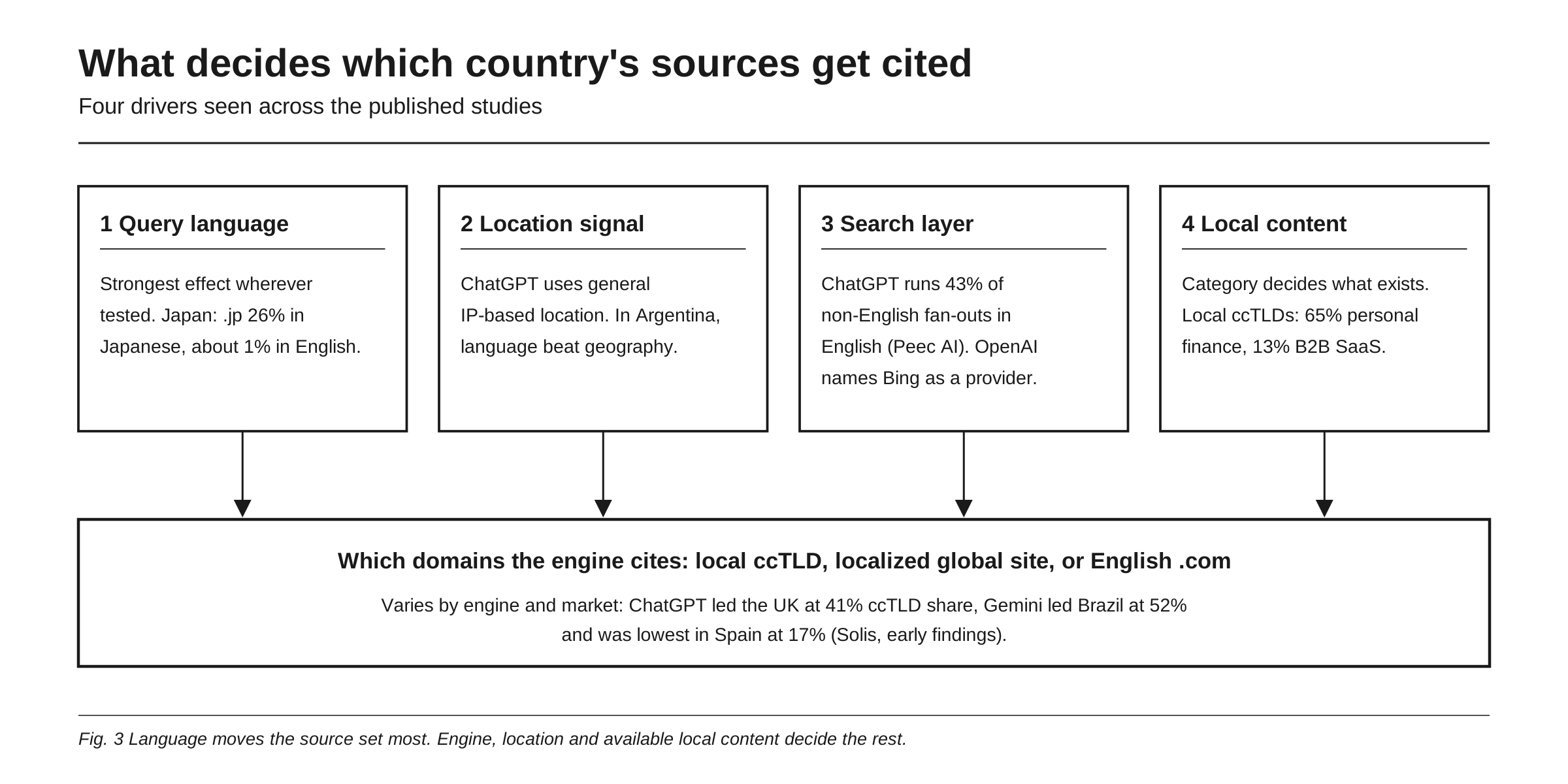
Query language. It is the strongest signal in every dataset that tested it. The same user in Japan gets a local source set in Japanese and a global one in English.
Location signals. OpenAI’s help documentation says ChatGPT “collects general location information based on your IP address.” Weglot’s Argentina result suggests language can outweigh it.
The engine’s search layer. OpenAI says ChatGPT may share queries “with third-party search providers such as Bing,” and Peec shows it often searches in English. Google says AI Overviews and AI Mode may use a “query fan-out” technique, and a page must be indexed in Google Search to appear as a supporting link. No single engine is the most local everywhere, though. In Solis’s data, ChatGPT had the highest UK ccTLD share at 41% against 26% for both Google platforms, while Gemini led Brazil at 52% and was lowest in Spain at 17%. Temso measured page language and Solis measured ccTLDs, so their engine rankings are not directly comparable.
Local content availability. Engines can only cite local pages that exist, and category drives that. Temso found 76.9% local-language citations for K-12 education, 68.0% for accounting and audit and 67.9% for payment processing, but 47.3% for data analytics software and 35.5% for hotels, where English sources took 52.4%. Solis saw the same split by ccTLD: 65% of personal finance citations, 59% in home and DIY, 54% in automotive, 20% in consumer electronics and 13% in B2B SaaS. Inside Spanish personal finance, ChatGPT’s local share was 62%, against 30% for AI Mode and 22% for Gemini.
The pattern for a multi-country brand: in finance, education, home and automotive categories, local sources took most citations in these samples, so English-only pages have little room. In software and hotels, English sources keep a large share even for local-language prompts.
A playbook for brands selling in several countries
-
Publish real local-language pages for each market you sell in. In Weglot’s data, local-language sources barely appeared for English prompts and rose to 23% to 35% of citations for local-language prompts. Translate the pages buyers compare on, such as product, pricing, comparisons and FAQs, not only the navigation.
-
Keep one language per page. Google says it “uses the visible content of your page to determine its language” and recommends avoiding side-by-side translations.
-
Implement hreflang the way Google documents it. “Each language version must list itself as well as all other language versions,” return links are required (“If page X links to page Y, page Y must link back to page X”), and x-default sets the fallback. Google does not use hreflang to detect language, and it documents no separate hreflang effect on AI Overviews; it says AI features have “no additional requirements” beyond being indexed and eligible for a snippet.
-
Do not rely on IP redirects. Google says, “Don’t use IP analysis to adapt your content,” and notes that “Most, but not all, Google crawls originate from the US.” If local versions only show up for local IPs, Google warns it “may not be able to crawl variations of your site properly.”
-
Build local third-party presence. In finance, home and automotive, local ccTLDs took 54% to 65% of citations in Solis’s data. Local press, local review sites, local marketplaces and industry associations are the kinds of domains that can earn those citations, and your own blog cannot stand in for them.
-
Keep your English pages strong. ChatGPT added English searches to 78% of non-English runs in Peec’s data, and English took 48.8% of Temso’s citations in data analytics software. For software, English comparison pages still count abroad.
-
Track each market in its own language. Write buyer prompts the way locals ask them, run them on each engine, and record the cited domains. An English prompt set says little about your visibility in Madrid or São Paulo. How to log and compare sources is covered in how to track citations and sources in AI search.
The limits of this evidence
Every dataset here has a catch. Temso, Peec and Weglot are vendors, and Weglot sells translation, so local-language findings suit it. Temso reports by language, not country. Weglot tested named models (GPT 5.5, Claude Haiku 4.5, Gemini Flash 3.5) and does not say whether through APIs or consumer apps, so results may differ from what users see. Solis’s numbers are early findings without a sample size. No study we found covers Perplexity or Copilot country by country. And “local” means three different things across these studies: ccTLD, page language, or a locally focused site on any domain. Compare numbers only when definitions match. For how engines source answers in general, see where AI actually gets its answers.
What holds across all of them: the question’s language moves the source set most, the effect varies by engine and category, and a global average hides the market you care about. Rankry runs a stable set of buyer-intent prompts every day across ChatGPT, Claude, Gemini, Perplexity, Grok and Google AI Mode and AI Overviews, and records which sources each engine cites. Track your prompts in each market’s language and you can see whether engines cite your local pages, your .com or a local competitor. Competitor comparison shows who holds the citations you lack, and a new market’s questions are answered as soon as you add them.
FAQ
Do AI engines prefer local websites? Often, when the question is asked in the local language. In Temso AI’s analysis of 7 million citations, 85.4% of Google AI Overviews sources and 70.2% of ChatGPT sources matched the prompt’s language. Weglot’s smaller test found 23% to 35% local-language sources. Asked in English, local sources nearly disappear: in Weglot’s Japan test, .jp domains fell from 26% to about 1%.
Does my location or my language matter more? In the published data, language matters more. ChatGPT uses general IP-based location, but Weglot’s Argentina test showed Spanish prompts drew 23% Spanish-language sources and only 2% from .ar domains. The engines pulled Spanish content from Spain, Mexico and localized global sites instead of Argentine domains.
Which AI engine cites the most local sources? It depends on the market and the metric. By page language, Temso found Google AI Overviews most local at 85.4% and Grok least at 51.7%. By ccTLD, Aleyda Solis’s early data put ChatGPT highest in the UK at 41%, Gemini highest in Brazil at 52%, and Gemini lowest in Spain at 17%. No engine leads everywhere.
Does hreflang help with AI Overviews? Google documents hreflang for Search: it marks localized versions of a page, each version must list itself and all others, and return links are required. Google does not claim a separate effect on AI Overviews. It says AI features have no additional requirements beyond a page being indexed and eligible for a snippet.
Do I need a ccTLD for each country? Not necessarily. In Weglot’s Japan data, .jp domains took 26% of citations, but counting Japanese pages on global sites such as ja.wikipedia.org the local-language share was 35%, and Solis notes ccTLD counts miss local sites on .com. The data points to local-language content and local mentions, whatever the domain. Google’s international guide covers ccTLDs, subdomains and subdirectories as options, each with pros and cons.
Sources
- Lost in Translation: How AI Models Handle Local-Language Sources, Temso AI, updated April 20, 2026
- How AI Search Engines Cite Sources by Language and Country, Weglot, July 27, 2026 (updated September 8, 2026)
- How local are AI answers? Early findings, Aleyda Solis on X, September 30, 2026
- AI Search Click Patterns Reveal Local Domain Advantage, Search Engine Journal, April 30, 2026
- ChatGPT searches in English, even when you don’t, Peec AI, February 12, 2026
- ChatGPT Search Often Switches To English In Fan-Out Queries: Report, Search Engine Journal, February 18, 2026
- 600 AI Citations Analyzed: Wrong Language, 5% Congruence, Jonas Villwock, November 11, 2025
- ChatGPT search, OpenAI Help Center
- Tell Google about localized versions of your page, Google Search Central, updated September 21, 2026
- Managing multi-regional and multilingual sites, Google Search Central, updated December 10, 2025
- AI features and your website, Google Search Central, updated December 10, 2025
See which sources each AI engine cites for your buyers’ questions, in every language you sell in. Start a free 7-day Rankry trial, no card.