A Gemini visibility tracker monitors whether Google’s Gemini names your brand when buyers ask for recommendations, across both the Gemini app and Google’s AI Overviews, and records your mention rate, position, sentiment, and cited sources over time. Gemini needs its own tracking because it lives inside Google’s ecosystem: it draws on Google’s index and structured data, it powers AI Overviews and AI Mode in Search, and it rewards the Google-shaped work, strong SEO, clean schema, entity clarity, more than the chat-first engines do. The best trackers cover Gemini alongside ChatGPT, Claude, Perplexity, and Grok; Rankry does this from $99 a month with a no-card trial. This guide covers what makes Gemini different and how to track it.
If you already invest in SEO, Gemini is the engine where that investment pays the most direct dividend, and also the one where a tracker most quickly shows you whether it is working.
Where this sits in the wider picture. Gemini earns its own article because it is the engine where your classic Google work carries over most directly, and the only one that appears on two separate surfaces. Everything else is shared: the same buyer prompts, the same four signals, and the same weekly cadence you run on ChatGPT, Claude, Perplexity, Grok, and Microsoft Copilot. The useful pairing to keep in mind is Gemini and Copilot, because both inherit a search index, Google’s and Bing’s, rather than crawling the web for themselves, which makes your position in those two indexes the gate for both.
Why Gemini is its own visibility problem
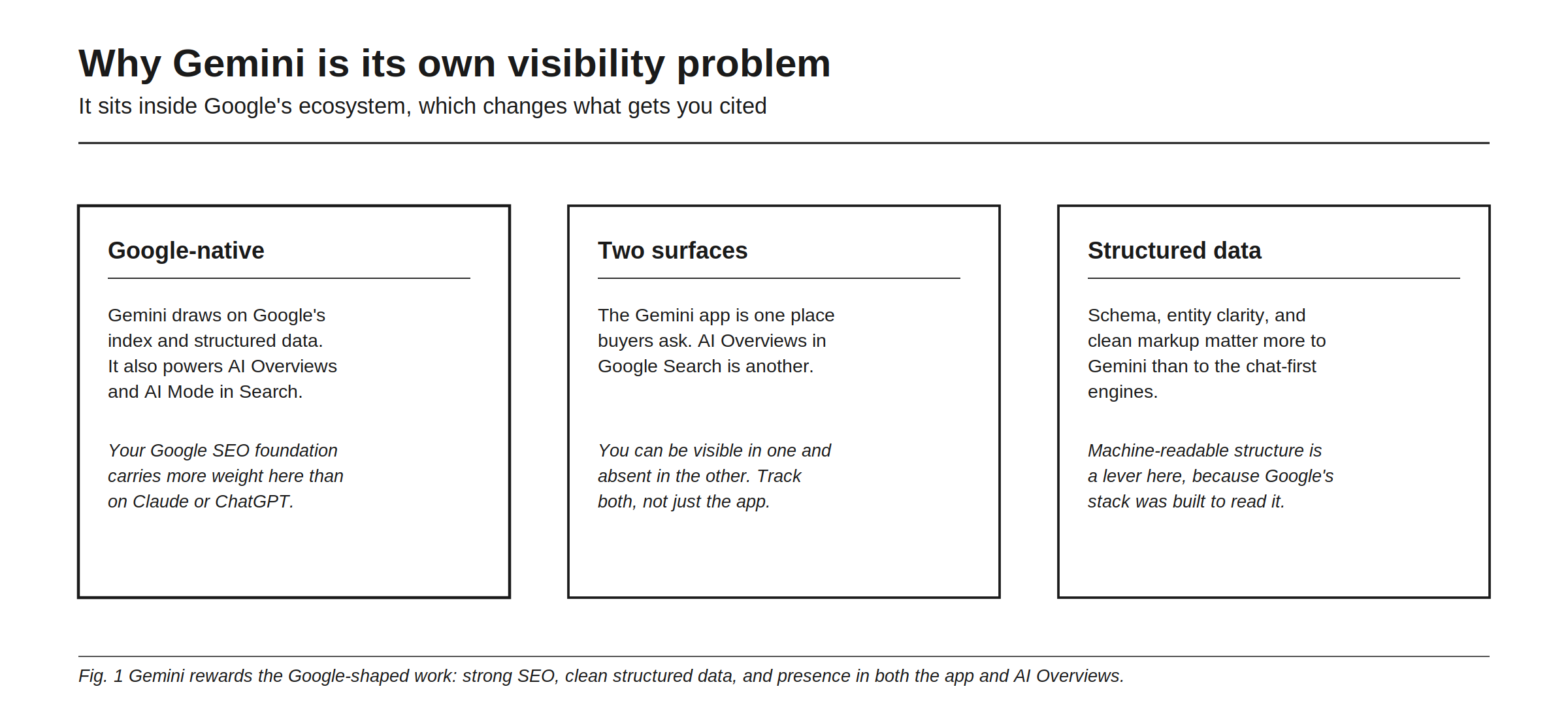
Three things make Gemini distinct. It is Google-native: it draws on Google’s index and structured data, and it powers AI Overviews and AI Mode inside Search, so your Google SEO foundation carries more weight here than on Claude or ChatGPT. It has two surfaces: the Gemini app is one place buyers ask, and AI Overviews in Google Search is another, and you can be visible in one and absent in the other, which means tracking the app alone misses half the picture. And it leans on structured data: schema, entity clarity, and clean markup matter more to Gemini than to the chat-first engines, because Google’s stack was built to read exactly that.
The takeaway for tracking: Gemini rewards the Google-shaped work, and a Gemini tracker has to watch both the app and AI Overviews as separate places you can win or lose.
How to track Gemini visibility
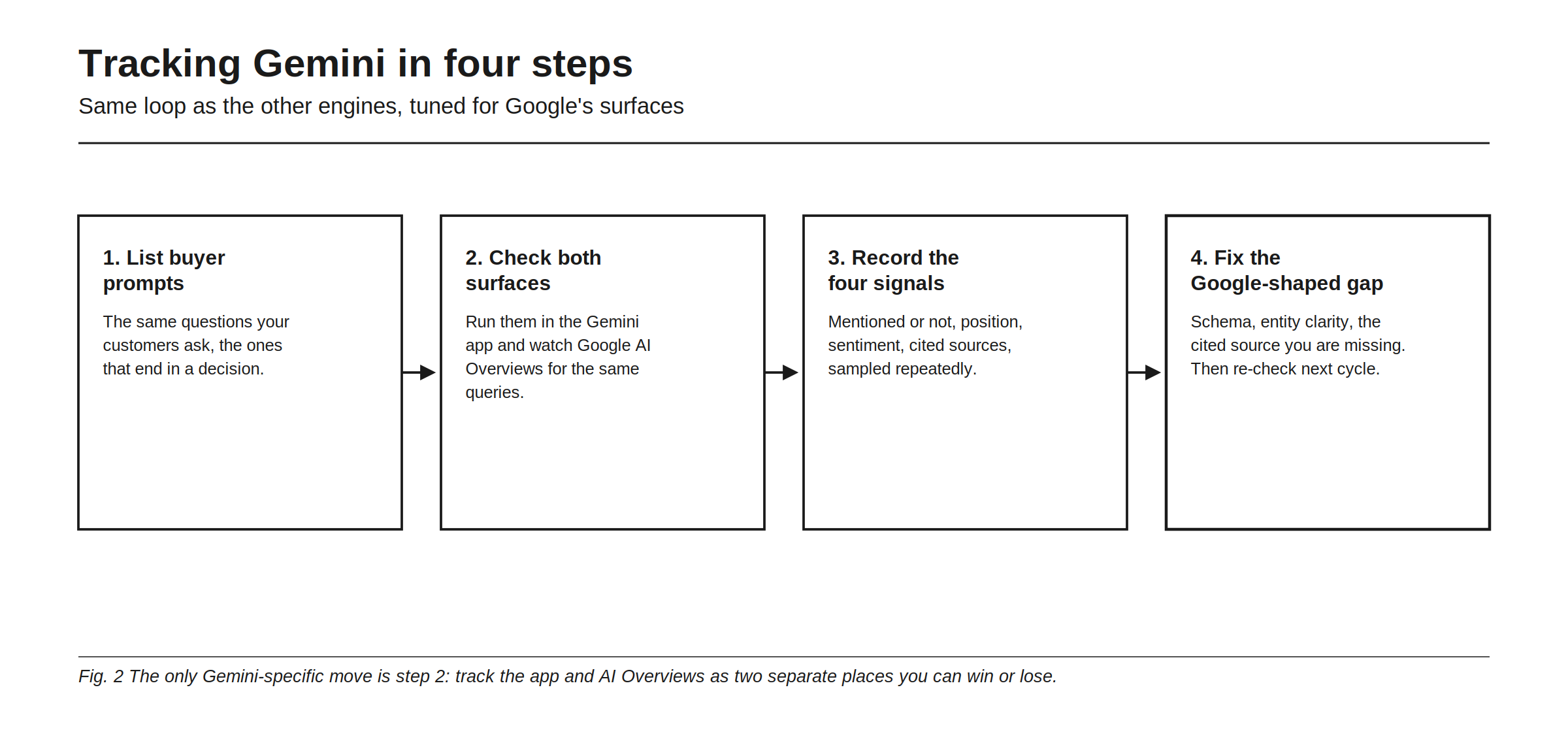
The loop is the same as the other engines, with one Gemini-specific tuning. First, list your buyer prompts, the questions that end in a decision. Second, check both surfaces: run the prompts in the Gemini app and watch Google AI Overviews for the same queries, because they can disagree. Third, record the four signals, mentioned or not, position, sentiment, cited sources, sampled repeatedly to beat run-to-run variance. Fourth, fix the Google-shaped gap: missing schema, a fuzzy entity, or a cited source you are absent from, then re-check next cycle.
The only genuinely Gemini-specific step is the second one. Everywhere else, the discipline matches the broader loop in how to monitor your brand across AI search engines.
The structured-data lever
Because Gemini sits on Google’s infrastructure, machine-readable structure is a real lever here in a way it is not everywhere, though what schema does and does not do is worth being precise about. Organization and Product schema, a clean and consistent entity across your site and profiles, and valid markup all help Gemini place you correctly in a comparison. This is also the training-versus-search distinction worth knowing: Google-Extended lets you opt out of having your content train Gemini’s models without affecting your inclusion in Search and AI Overviews, so you can protect training data while staying visible. The full crawler picture is in should you allow or block AI crawlers.
If you want to influence one thing for Gemini specifically, make your entity unambiguous and your key pages structured. Gemini is the engine most able to reward that work.
Free vs automated Gemini tracking
Manually, you can open the Gemini app in a clean session, run your prompts several times, and separately check whether you appear in AI Overviews for the same queries in Google Search. Log mention, position, and sources weekly. It works, and it teaches you how Gemini describes you.
The limits are coverage and consistency: two Gemini surfaces plus four other engines is a lot to sample by hand, and single runs mislead. Rankry tracks Gemini alongside ChatGPT, Claude, Perplexity, and Grok, samples to smooth variance, and keeps the cited sources and history, from $99 a month on a no-card trial. For the per-engine strategy that feeds this, see AI search ranking strategies, and for the two engines that need a method of their own, which ChatGPT you are actually tracking and how to track brand mentions in Perplexity.
FAQ
What is a Gemini visibility tracker? A tool that monitors whether Google’s Gemini names your brand when buyers ask for recommendations, across the Gemini app and AI Overviews, recording your mention rate, position, sentiment, and cited sources over time.
How is tracking Gemini different from tracking ChatGPT? Gemini sits inside Google’s ecosystem, so it leans on Google’s index and structured data, rewards SEO and schema more, and appears on two surfaces (the app and AI Overviews). ChatGPT is chat-first with its own retrieval blend.
Does my Google SEO affect my Gemini visibility? More than with any other engine. Gemini draws on Google’s index and powers AI Overviews, so strong SEO, clean schema, and entity clarity carry directly into Gemini visibility.
Can I stop Gemini training on my content but stay visible? Yes. Google-Extended lets you opt out of AI training without affecting your inclusion in Google Search and AI Overviews, so you can protect training data while remaining eligible for citations.
How do I track my brand in Google AI Overviews? Run your buyer queries in Google Search and record whether an AI Overview names you, in what position, and which sources it cites, sampled repeatedly. A tracker like Rankry automates this alongside the Gemini app and the other engines.
Track Gemini across both surfaces, plus every other engine you run, with schema-level gaps flagged. Start a free 7-day Rankry trial, no card, first report in two minutes.