To track your brand in Perplexity, monitor citations, not just mentions, because Perplexity attaches numbered sources to every answer and a mention without a citation is close to worthless. Run a fixed set of 20 to 30 buyer-intent prompts weekly in a clean session and one chosen mode, and for each record four things: whether your domain was cited, at what source position, the exact URL used, and which competitors were cited instead. Then cross-check against real perplexity.ai referral traffic in your analytics. This works by hand for about 30 prompts in one mode; across Perplexity’s three modes and the other engines, a tool like Rankry automates it from $99 a month. Here is the full method and why Perplexity plays by different rules than ChatGPT.
Perplexity is the most measurable AI engine in 2026, because it shows its receipts. Every answer comes with sources, which turns “did AI mention us” from a guess into something you can actually count. That advantage only helps if you track the right level.
The four levels of Perplexity visibility
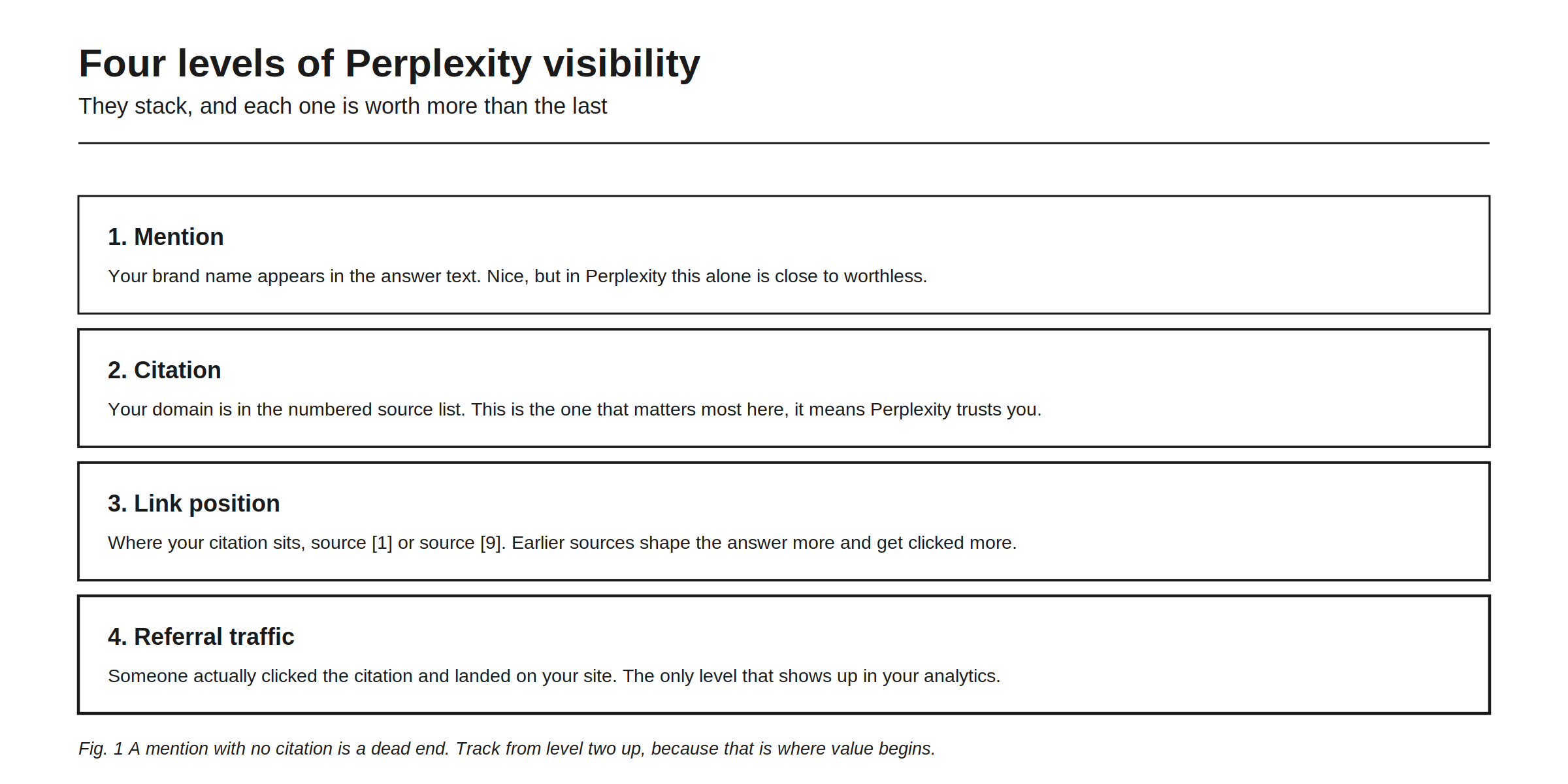
Visibility in Perplexity is not one thing, it is four, and they stack. A mention is your brand name appearing in the answer text, which is nice but in Perplexity is close to worthless on its own. A citation is your domain appearing in the numbered source list, and this is the level that matters most here, because it means Perplexity actually trusted your page enough to build the answer on it. Link position is where that citation sits, source [1] versus source [9], and earlier sources both shape the answer more and get clicked more. Referral traffic is the top level, someone clicked your citation and landed on your site, and it is the only level that shows up in your analytics.
The practical rule: track from level two up. In ChatGPT you often celebrate a mention, because ChatGPT frequently answers in confident prose with no sources at all. In Perplexity, where every answer is sourced, a mention with no citation behind it is a dead end. The citation is the unit of value, so the citation is the unit you track. This is the opposite emphasis from our ChatGPT guide, and it is why Perplexity needs its own playbook rather than a copy of one.
Why Perplexity is different: it always shows its sources
Perplexity runs on retrieval-augmented generation with live web search, which means it fetches current pages and answers from them, then lists what it used. Unlike ChatGPT’s default prose or Google’s tucked-away AI Overview sources, Perplexity puts numbered citations inline on every response. That has two consequences for tracking. First, it is the easiest major engine to audit by hand, because you can see exactly which URLs fed the answer. Second, because it leans on live retrieval, positions are less stable than a static ranking, new content can appear within days, and citations can swap week to week. So Perplexity rewards freshness and punishes a set-and-forget approach more than most engines, which makes regular tracking not optional but the whole point. The mechanics of what gets cited across engines are in LLM citation tracking.
One question, three modes, three answers
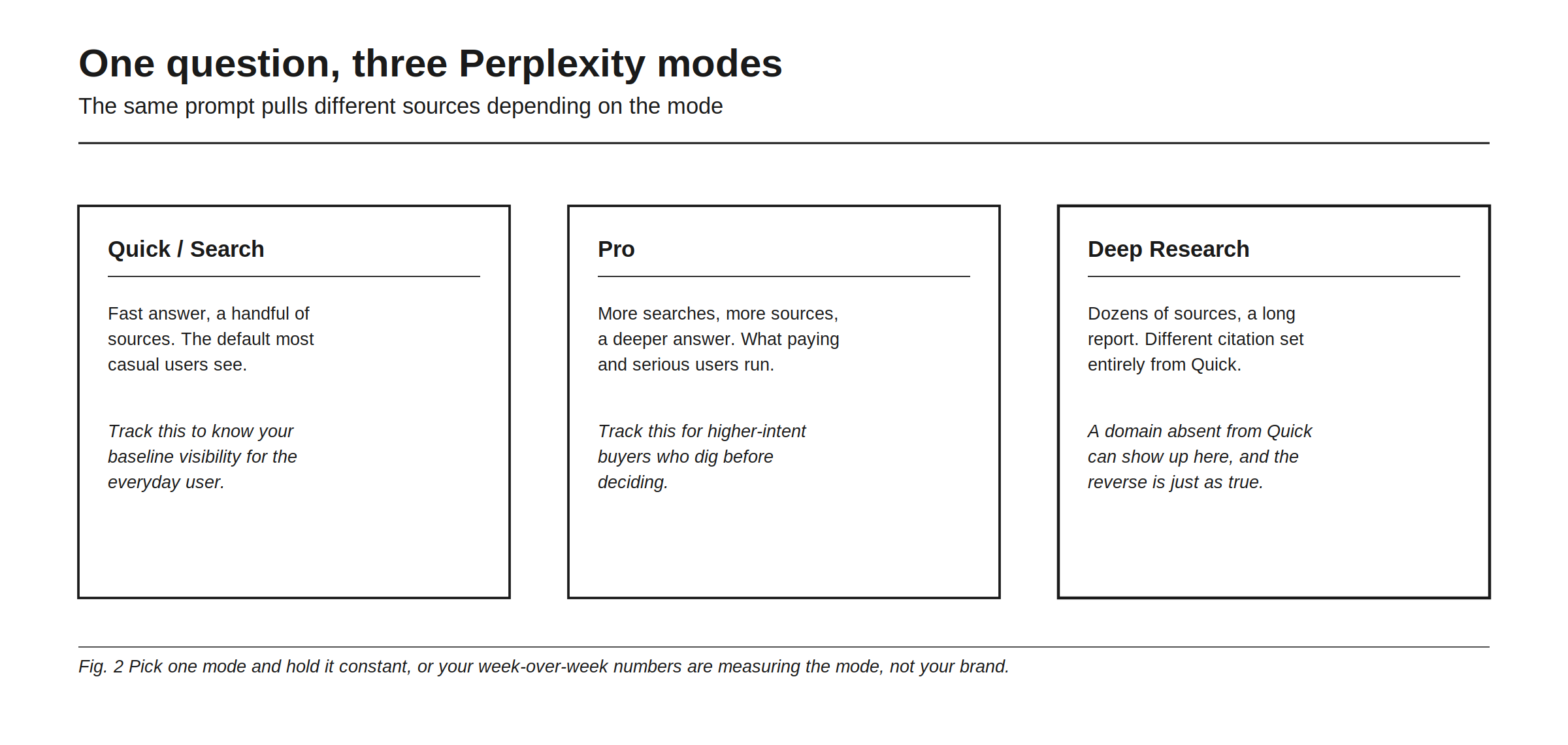
Here is the trap that ruins most Perplexity tracking: there is no single Perplexity answer. The same prompt pulls a different source set depending on the mode. Quick or Search mode gives a fast answer from a handful of sources, the default most casual users see, and tracking it tells you your baseline visibility for the everyday user. Pro mode runs more searches and cites more sources for a deeper answer, what paying and serious users run, so tracking it captures higher-intent buyers who dig before deciding. Deep Research pulls dozens of sources into a long report, a completely different citation set from Quick, where a domain absent from the quick answer can suddenly appear, and the reverse is just as true.
The discipline is simple and non-negotiable: pick one mode and hold it constant, or your week-over-week numbers are measuring the mode, not your brand. If you have the capacity, track two, Quick for reach and Pro for high-intent, but never mix their results in the same trend line. This is the Perplexity version of the surface problem that also shapes ChatGPT visibility.
The manual tracking loop
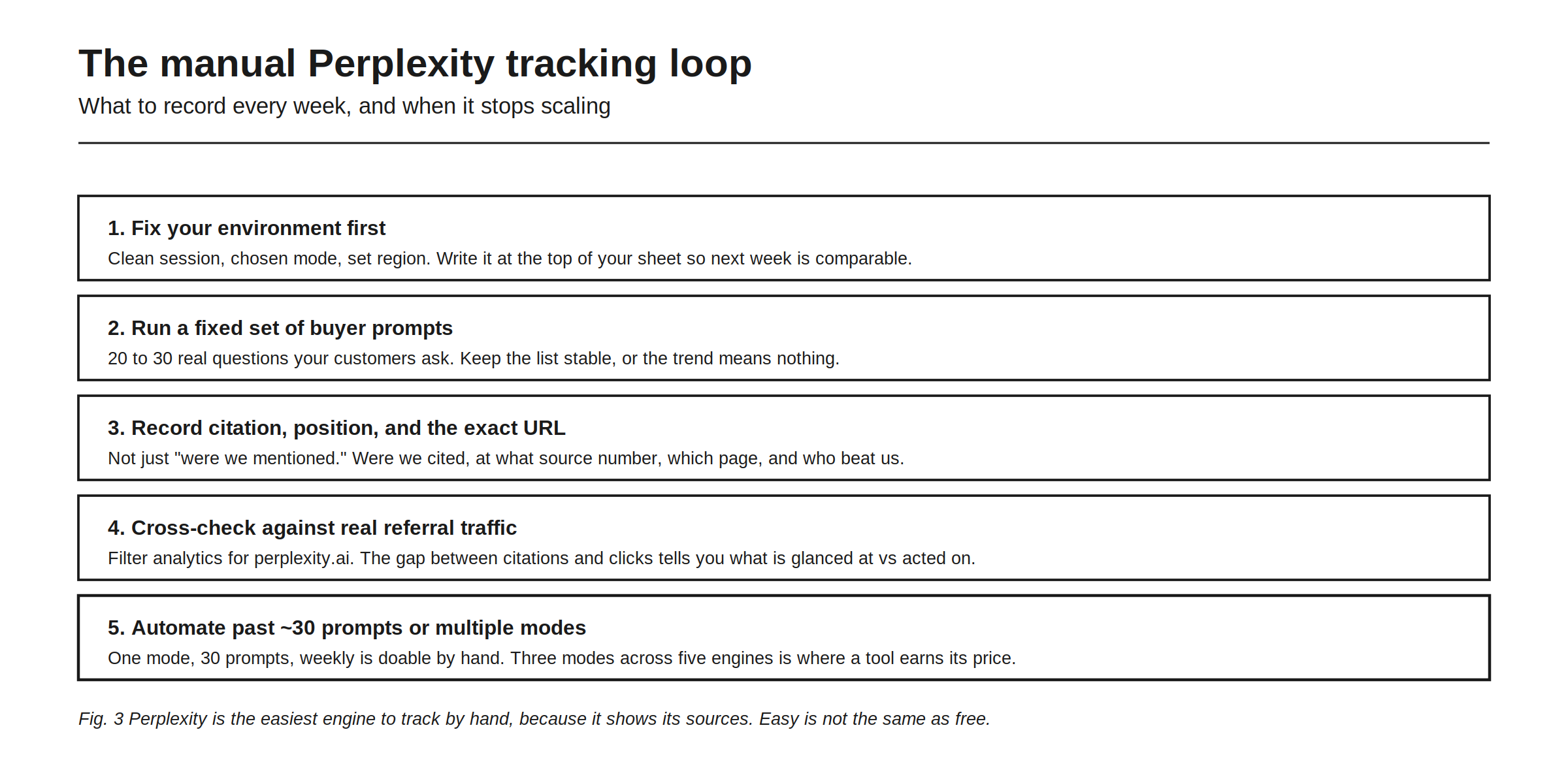
Five steps, no tool required to start. First, fix your environment: clean session, chosen mode, set region, written at the top of your sheet so next week is comparable. Second, run a fixed set of 20 to 30 real buyer prompts, mixing branded and unbranded questions, and keep the list stable so the trend means something. Third, record citation, position, and the exact URL, not just “were we mentioned,” but were we cited, at what source number, which specific page, and who beat us. Fourth, cross-check against real referral traffic by filtering your analytics for perplexity.ai, because the gap between citations and clicks tells you what users glance at versus what they act on. Fifth, automate once you pass roughly 30 prompts or want multiple modes, because one mode at 30 prompts weekly is doable by hand, but three modes across five engines is where a tool earns its price.
Perplexity is genuinely the easiest engine to track manually, since the sources are right there. Easy is not the same as free: parsing citation positions and URLs across dozens of prompts every week, in more than one mode, is exactly the repetitive work that gets skipped by week three.
Turning citation data into action
Tracking is only useful if it feeds a fix. When you see a competitor cited for a prompt where you are absent, you have a target: that specific page or domain is what Perplexity trusts on that question. Earn a presence there, or publish the answer-first page that deserves the citation, then re-check next week to see if Perplexity picked it up. Because Perplexity favors fresh, well-structured, clearly-sourced content, the pages that win citations tend to lead with a direct answer, use clean headings, and cite their own claims. Rankry tracks Perplexity citations, positions, and cited URLs alongside ChatGPT, Claude, Gemini, and Grok, and flags exactly where a competitor is cited and you are not, from $99 a month on a no-card trial. The broader loop this fits into is in how to monitor your brand across AI search engines, and the sister guide for Google’s engine is the Gemini visibility tracker.
FAQ
How do I track brand mentions in Perplexity? Run a fixed set of 20 to 30 buyer prompts weekly in a clean session and one chosen mode, and record for each whether your domain was cited, at what source position, the exact URL, and which competitors were cited. Cross-check against perplexity.ai referral traffic.
What is the difference between a mention and a citation in Perplexity? A mention is your brand named in the answer text. A citation is your domain appearing in Perplexity’s numbered source list. In Perplexity the citation matters far more, because every answer is sourced, so a mention with no citation behind it carries little weight.
Does Perplexity show its sources? Yes. Perplexity attaches numbered inline citations to every answer, which makes it the most measurable AI engine for brand tracking. You can see exactly which URLs fed each response, unlike ChatGPT’s default prose or Google’s collapsed AI Overview sources.
Why do my Perplexity results keep changing? Perplexity uses live web retrieval, so it fetches current pages each time. Citations can swap week to week, new content can appear within days, and positions are less stable than a fixed ranking. This is why weekly tracking is the practical minimum.
Do Perplexity modes affect what gets cited? Yes, significantly. Quick, Pro, and Deep Research each pull different source sets for the same prompt, so a domain cited in one mode may be absent in another. Pick one mode and hold it constant for tracking, or you are measuring the mode instead of your brand.
Does a Perplexity citation drive traffic? Only if the user clicks it. A citation is a linked source, but a mention or citation is not automatically a visit. Cross-referencing citation data with perplexity.ai referral traffic shows which citations actually send people to your site.
Track your Perplexity citations, positions, and cited URLs, next to every other engine, with competitor gaps flagged. Start a free 7-day Rankry trial, no card, first report in two minutes.