Not entirely, but on traffic the skeptics have the stronger numbers. In Marie Haynes’s analysis of 100 sites and more than 145 million GA4 sessions, ChatGPT sent 0.62% of the sessions Google organic sent, and Google drove 96.5% of conversions across the channels she compared, even though ChatGPT visitors converted at 13.8% against 3.02%. An agency benchmark from The SEO Works, covering 95 sites, found organic search sent 39 times more traffic than AI assistants, and Kevin Indig could not establish a reliable link between AI visibility and later branded or direct traffic. What the data does not settle is influence that never produces a tagged click, which analytics measure poorly, as ChatGPT’s October tagging bug showed. The defensible conclusion is proportional: SEO still earns most of the revenue, and GEO deserves a measured budget with a test that can prove or disprove it.
Between October 14 and 21, 2026, one benchmark was updated and two new analyses appeared, and coverage summed them up as “3 New Studies Suggest AI Visibility & Search Not Worth Investing In.” The studies say something narrower and more useful than that, and the details decide what you should do with your budget.
What the three studies measured
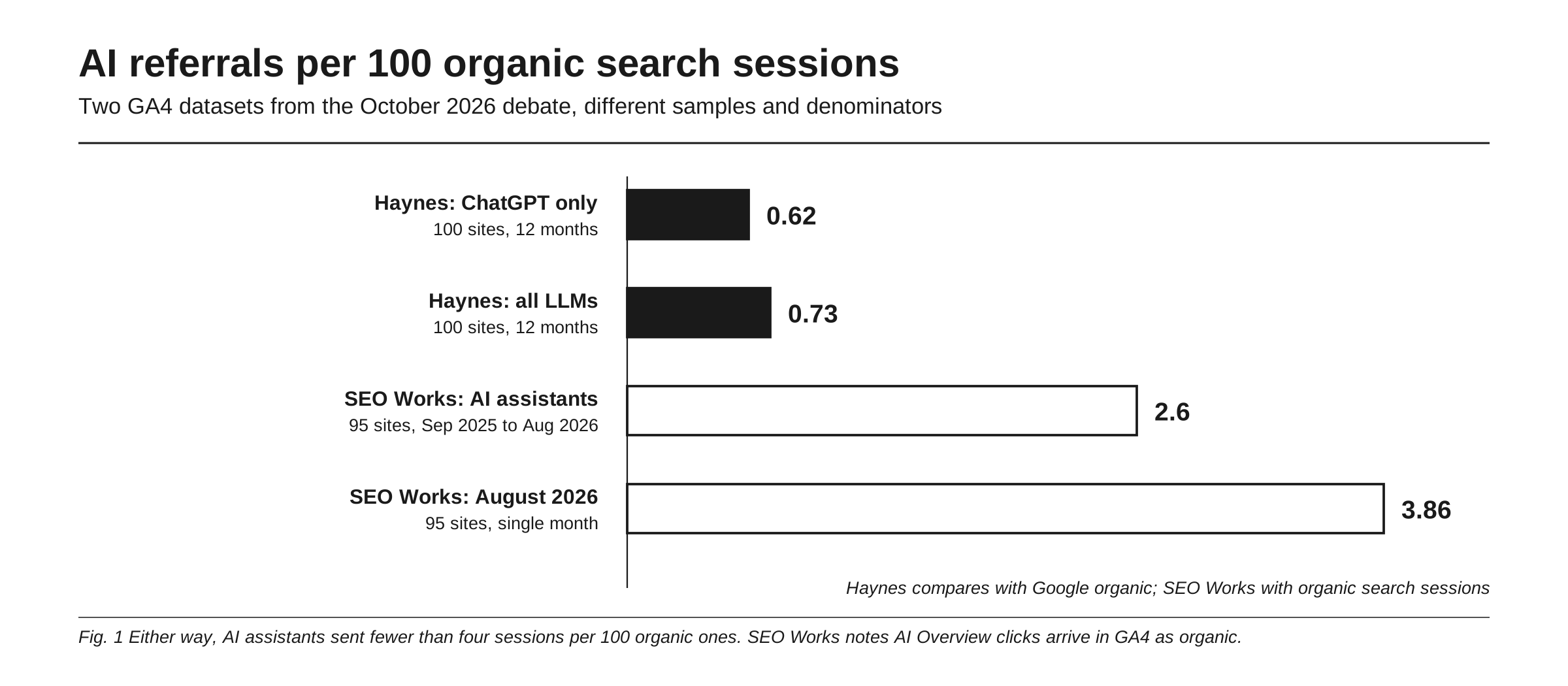
Marie Haynes, “GEO is a distraction” (October 21). Haynes, an SEO consultant, looked at 12 months of GA4 data from 100 sites of varying sizes, more than 145 million sessions. ChatGPT sessions equaled 0.62% of Google organic sessions; with all other LLMs included, 0.73%. Only 55 of the 100 sites tracked conversions. Among those, ChatGPT visitors converted at 13.8% and Google organic visitors at 3.02%, yet Google drove 96.5% of conversions across the channels analyzed, and 27 times more conversions than all LLMs combined. The dataset comes with no published industry mix or conversion definitions. It is a practitioner analysis, not a peer-reviewed study.
The SEO Works benchmark (published September 7, updated October 14). This UK agency, which itself sells SEO and GEO services, analyzed 95 GA4 properties from September 2025 to August 2026: 2,825,594 organic sessions against 72,095 AI referral sessions. Organic search sent 39 times more traffic; AI assistants sent 2.6% of what organic sent. Conversion comparisons use 63 sites that cleared minimum volume thresholds.
Kevin Indig, “Does AI drive more direct traffic?” (October 19). Indig ran two checks. Across 12 GA4 properties, skewed toward B2B, direct sessions with identifiable AI traces were 0.003% of direct traffic, and engaged direct traffic was flat. Then, for four brands, he ran 632 tests comparing weekly AI visibility with branded search and direct traffic at delays of up to six weeks. One site showed a 0.72 correlation between AI share of voice and direct traffic, but it did not survive a test with shifted timing, and he could not establish a reliable link.
The case that GEO is a distraction
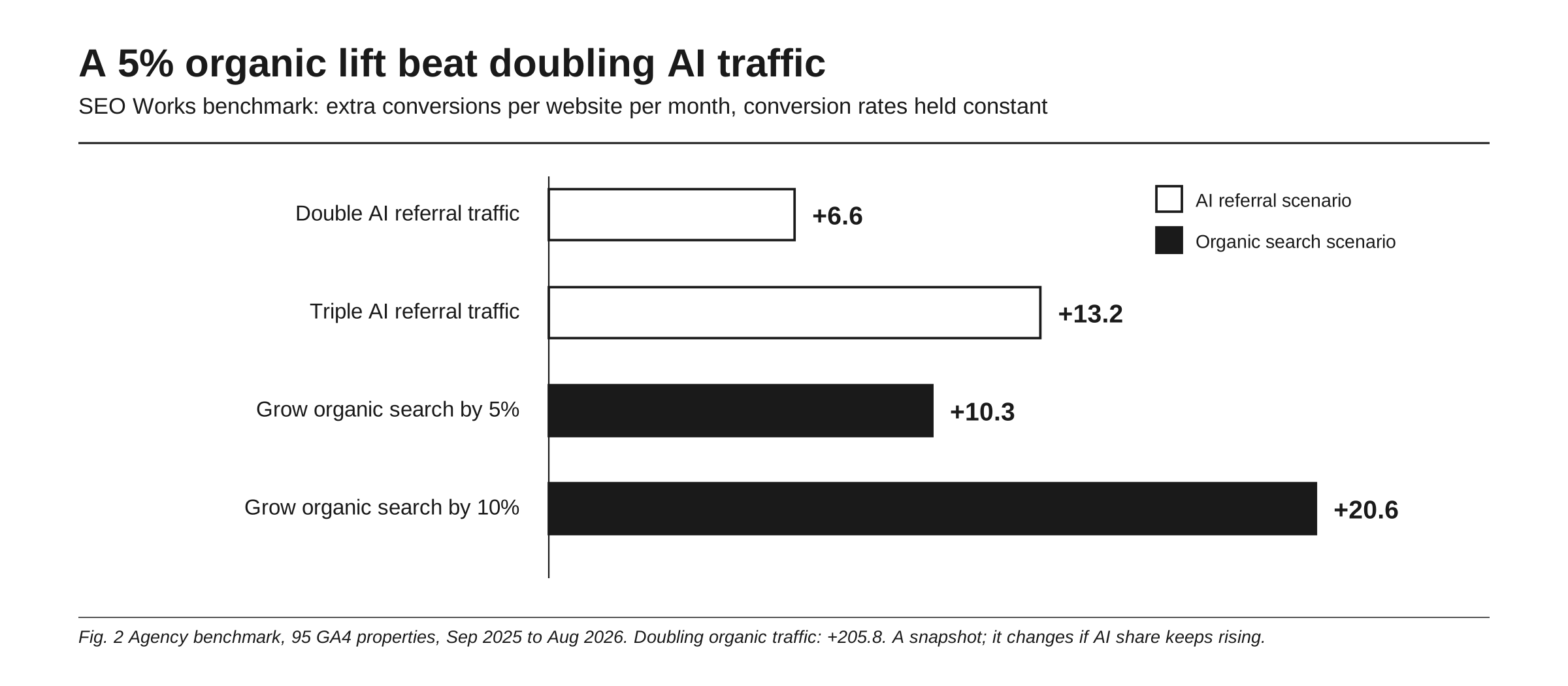
The volume argument is hard to dispute. In The SEO Works data, AI referrals delivered 3.2 conversions for every 100 from organic search. Holding conversion rates constant, doubling AI referral traffic would add 6.6 conversions per website per month, while a 5% lift in organic search would add 10.3. A team choosing between those two projects on these numbers picks organic.
The conversion-rate argument is weaker than it first looks. Haynes found ChatGPT visitors converting at more than 4.5 times the Google organic rate. The SEO Works found AI traffic converting at 7.18% against 6.08% for organic, a ratio of 1.18x, and worse than organic on 23 of 63 sites. For the 10 B2B product sites, AI traffic converted at 0.62 times the organic rate. The same dataset gives 0.67x against paid search and 2.48x against direct, so any multiple quoted without its comparison channel means little. The broader case for AI traffic quality, and its limits, is in why AI traffic converts better.
Rand Fishkin of SparkToro summarized the three studies on October 22 and concluded that traffic from AI assistants is “nearly non-existent,” and that even after accounting for dark and indirectly influenced traffic, “it’s vanishingly small.”
What the data cannot see
The studies count tagged clicks. Three gaps sit outside that count.
Tags break. On October 14, Search Engine Roundtable reported that, according to Adobe’s Cedric Huesler, GPT-6 opened links with no referrer and without the utm_source=chatgpt.com tag, so analytics filed those visits as direct. On about 500 pages where ChatGPT drove at least 5% of visits, he compared October 9 to 13 with the week before: ChatGPT fell about 31,000 visits a day while direct rose about 26,000 a day on the same pages. LLM Pulse, an AI visibility vendor, saw ChatGPT referral sessions fall around 46% from October 9 to 11 across the sites it monitors. Huesler later said OpenAI confirmed to him on October 14 that it was a bug, with a fix rolling out on October 15 and tagged clicks back to roughly 95% to 100% of the level a week earlier. That confirmation is secondhand; OpenAI had not commented publicly, and Huesler wrote that the referrer was still missing on most ChatGPT clicks. The SEO Works window ended before this happened, but it shows how fragile the measured number is. See how to track AI referral traffic in GA4.
Google’s own AI answers count as organic. The SEO Works excluded AI Overviews because those clicks arrive as ordinary organic sessions, and it calls its measured AI contribution “a floor.” Haynes makes a related point from the other side: “The AI search that is actually sending people to businesses today isn’t ChatGPT. It’s Google.” “SEO versus GEO” is partly a false split when Google’s own AI answers send their clicks as organic traffic, as covered in what AI Overviews cost in clicks, and what you gain.
Influence without clicks is unproven, in both directions. Indig could not isolate it, though he states an effect could still exist. The SEO Works tested the “billboard” idea directly: after controlling for growth in the rest of each site’s traffic, the correlation between AI growth and direct growth was -0.230 (p = 0.075), not statistically meaningful. On the other side, Indig cites Ramp, which estimated that 30% to 40% of its direct traffic was coming from answer engines, confirmed with self-reported attribution, and Similarweb research showing users who received AI brand recommendations were more likely to visit those brands over the following seven days. Small samples that find nothing do not prove there is nothing.
Where the two sides agree
Read closely, the skeptics and the GEO advocates overlap more than the headlines suggest.
The SEO Works found that sites gaining AI referral traffic were the sites whose organic performance was improving: a correlation of +0.534 after controlling for growth in the rest of each site’s traffic (p < 0.0001). It calls the most plausible reading that the same underlying work drives both, and says the data establishes only that the two are not independent. Haynes’s argument is about where to aim, not whether AI matters: she points to Google as the AI search sending people to businesses today. Fishkin, following Mike King, argues AI should be treated as a brand channel, “invested-in and measured as such,” and not as a traffic channel.
The trend is unsettled. Haynes reports that in her dataset ChatGPT referral growth stalled around August 2025 and has declined since. The SEO Works saw AI referrals rise from 2.29% of organic sessions before May 2026 to 3.04% after, while calling a four-month window provisional. Neither dataset tells you what your own category will do next year.
How to size your GEO budget: Rankry’s proportional test plan
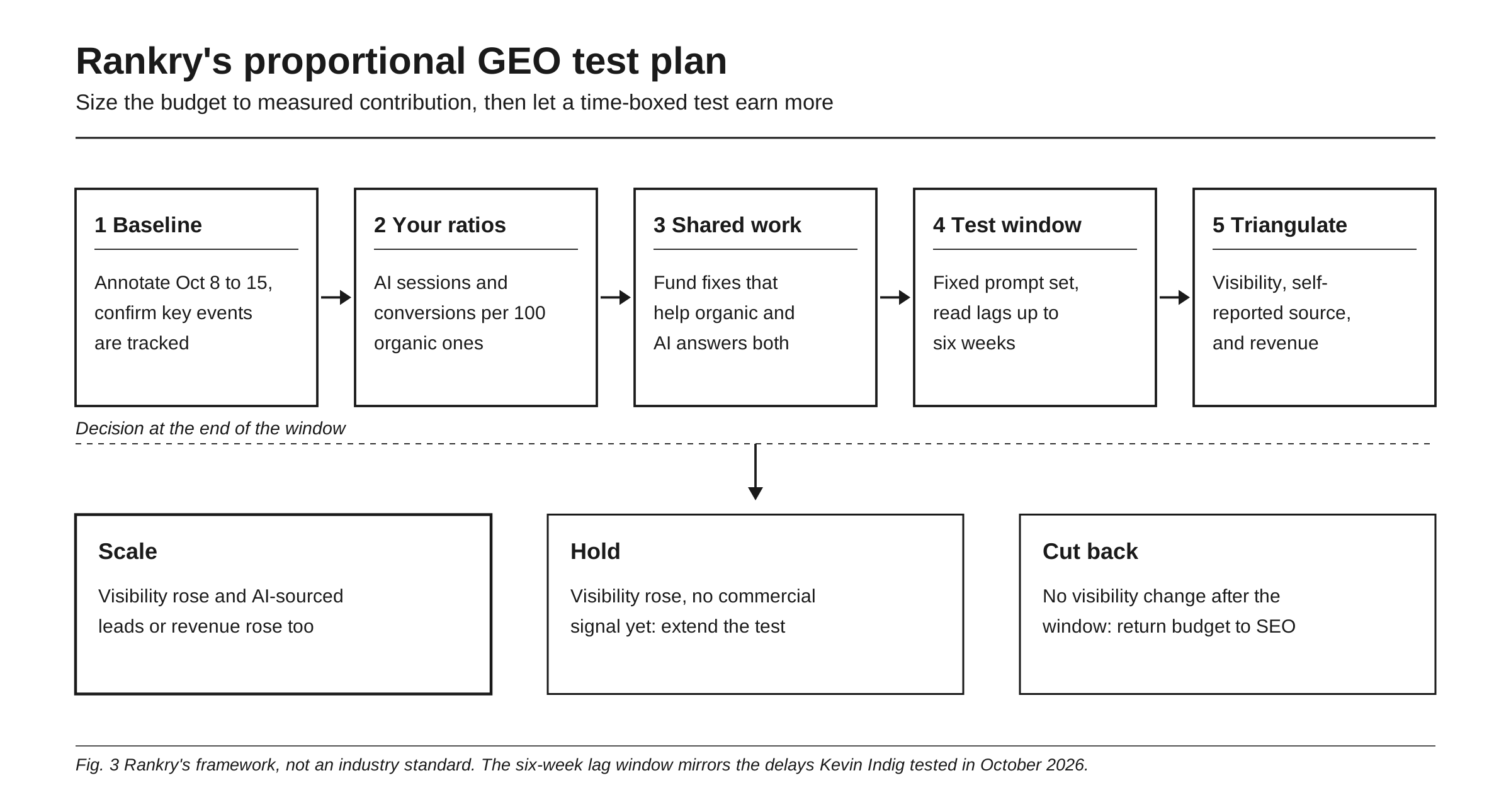
This is our framework for turning the debate into a budget decision. It is not an industry standard, and it uses your data, not anyone’s averages.
-
Clean the baseline first. Annotate October 8 to 15, 2026 in GA4 so the tagging bug does not distort trend lines. Confirm you track key events at all: Haynes found 45 of her 100 sites tracked none.
-
Compute your own three ratios. AI referral sessions per 100 organic sessions, AI conversions per 100 organic conversions, and AI conversion rate against organic, not against direct or paid. A separate AI referral view helps here; see Introducing AI Traffic.
-
Set the starting share in proportion to measured contribution. Put the bulk of search spend where conversions come from today. Add a fixed, time-boxed test allocation on top, and write down its size and end date before the test starts.
-
Fund shared work before GEO-only work. Given the organic and AI correlation in The SEO Works data, prioritize fixes that can help both: crawlable pages, direct answers near the top, clear comparison and pricing pages, and credible third-party coverage.
-
Run the test on a fixed prompt set. Record baseline AI visibility on the buyer prompts that matter, change one cluster of pages, then read visibility weekly. Allow for delays of up to six weeks, the range Indig tested, and distrust a single strong correlation: his 0.72 did not hold up.
-
Triangulate the outcome. Indig recommends combining where your brand appears, how customers say they found you, and what happens commercially. Add AI tools as options in a “How did you hear about us?” field and follow those leads to revenue.
-
Decide by rule at the end of the window. If visibility rose and AI-sourced leads or revenue rose, scale. If visibility rose with no commercial signal yet, hold and extend. If visibility did not move, return the test budget to SEO. Repeat each quarter.
How Rankry fits
The test above needs a visibility number that holds still long enough to compare. Rankry tracks how ChatGPT, Claude, Gemini, Perplexity, Grok and Google AI Mode and AI Overviews mention, rank, cite and recommend your brand across a stable set of buyer-intent prompts, every day, so a before-and-after read is possible. AI traffic tracking shows the visits AI platforms send to your site, the Google Search Console integration keeps organic data in the same view, and competitor comparison shows who is named where you are not. None of that proves revenue on its own; it gives the revenue question a reliable baseline.
FAQ
Is GEO a waste of money? Not by default, but it is easy to overspend on. In the October 2026 studies, AI assistants sent a small fraction of organic traffic and conversions. The data supports a proportional budget: most spend on work that drives organic revenue, plus a time-boxed GEO test with clear decision rules, judged on your own conversion and visibility data.
How much traffic does ChatGPT send compared with Google? In Marie Haynes’s analysis of 100 sites and more than 145 million sessions, ChatGPT sent 0.62% of the sessions Google organic sent, or 0.73% with all LLMs included. In The SEO Works benchmark of 95 sites, AI assistants sent 2.6% of organic search sessions over 12 months. Samples, periods and denominators differ.
Does AI traffic convert better than organic search? It depends on the sample and the comparison. Haynes found 13.8% for ChatGPT against 3.02% for Google organic on 55 sites. The SEO Works found 7.18% against 6.08%, about 1.18x, with AI converting worse on 23 of 63 sites and at 0.62x for B2B product sites. Always state the comparison channel.
Did ChatGPT stop passing referral data in October 2026? Temporarily, for the tag. Adobe’s Cedric Huesler reported that GPT-6 dropped utm_source=chatgpt.com from links starting October 8, sending visits to direct. He said OpenAI confirmed a bug to him and a fix rolled out October 15. He also wrote that the referrer was still missing on most ChatGPT clicks.
How much of my search budget should go to GEO? No study gives a universal percentage. Start from your own ratios: AI sessions and conversions per 100 organic ones. Fund the share those numbers justify, put shared SEO and GEO fixes first, and add a fixed test allocation with an end date. Scale only if visibility and AI-sourced revenue both rise.
Sources
- GEO is a distraction, Marie Haynes, October 21, 2026
- 3 New Studies Suggest AI Visibility & Search Not Worth Investing In, Search Engine Roundtable, October 22, 2026
- ChatGPT Referrals Convert Well, but Google Organic Still Drives Far More Results, Scalevise, October 22, 2026
- How Much Traffic Do AI Assistants Actually Send, And Does It Convert Better?, The SEO Works, September 7, 2026 (updated October 14, 2026)
- Does AI drive more direct traffic?, Kevin Indig, Growth Memo, October 19, 2026
- Is AI Visibility a Marketing BoonDoggle?, SparkToro, October 22, 2026
- OpenAI Drops UTM Parameters From ChatGPT Results (GPT-6), Search Engine Roundtable, October 14, 2026
- ChatGPT Referral Traffic Fell by Almost Half on October 9, 2026. Here’s What We Know, LLM Pulse, October 13, 2026 (updated October 21, 2026)
- ChatGPT UTM tag loss was a bug, Adobe’s Huesler says; fix rolling out, Relevant Audience, October 16, 2026
- AI Search Traffic Studies (October 2026): ChatGPT Sends 0.62% of Google Organic, Organic Search Sends 39x More, and the Page Features AI Cites Most, Mean CEO, October 24, 2026
Put a stable AI visibility baseline under your GEO test before you decide its budget. Start a free 7-day Rankry trial, no card required.