AI visibility for B2B SaaS is the practice of getting your product mentioned, ranked, and recommended when buyers ask ChatGPT, Claude, Gemini, Perplexity, Grok, Microsoft Copilot, and Google AI Overviews for software recommendations, and it matters more for SaaS than for almost any other category, because SaaS is bought by research and AI answers are where that research now happens. The playbook has five stages: audit your position across the engines your buyers use, fix retrievability before content, build answer-shaped pages and third-party corroboration, prioritize high-intent buying prompts, and monitor weekly. This guide walks through all five and links to the deep dive for each.
If your buyers ask an AI “best [your category] for [their situation]” and it names three competitors and not you, the deal is often lost before it ever appears in your pipeline. That is the problem this playbook solves.
Why AI visibility hits B2B SaaS hardest
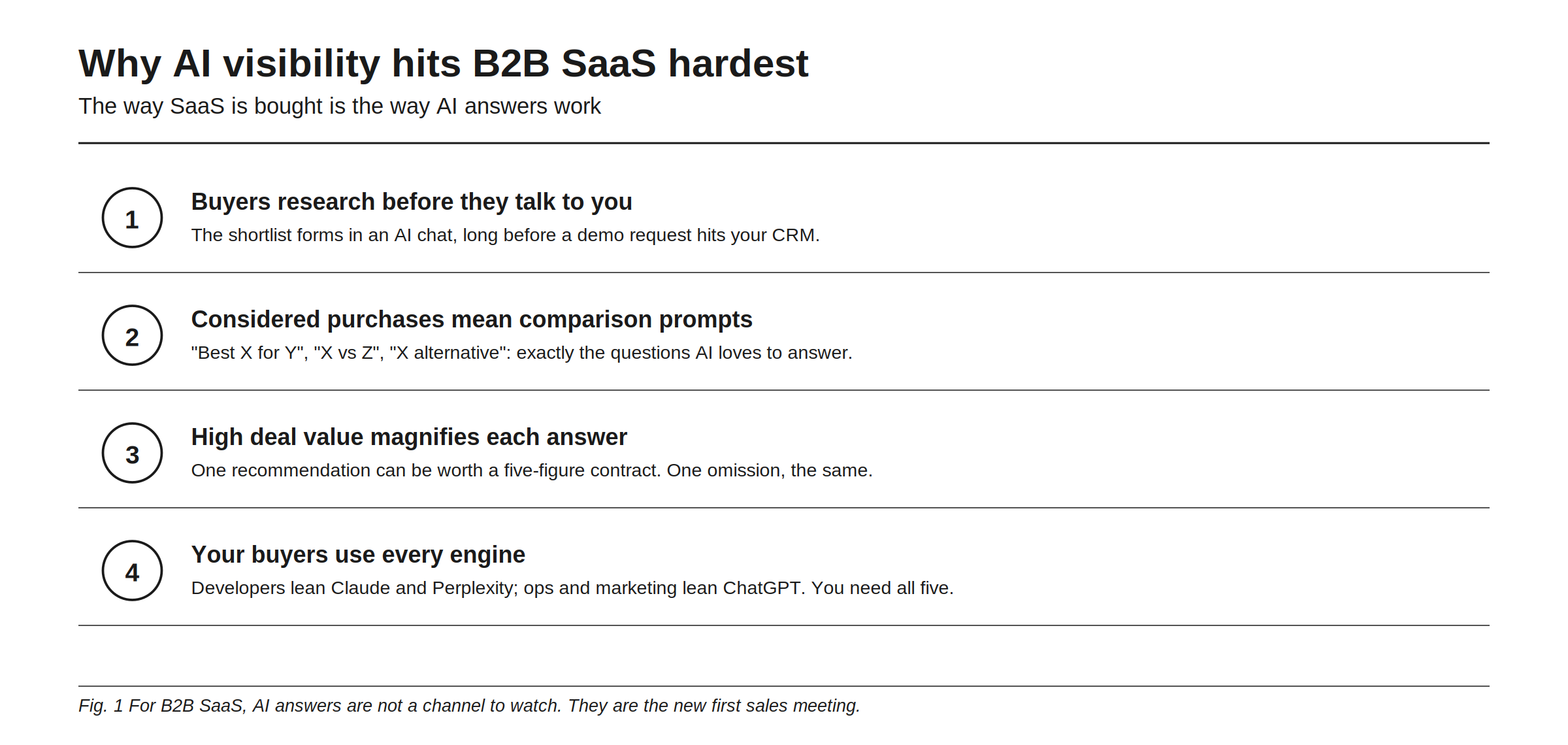
Four features of how SaaS is bought line up exactly with how AI answers work. First, buyers research before they talk to you: the shortlist forms in an AI chat long before a demo request reaches your CRM, so you are being evaluated in a room you cannot see. Second, considered purchases produce comparison prompts, “best X for Y”, “X vs Z”, “X alternative”, which are precisely the questions AI is best at answering with a confident shortlist. Third, high deal value magnifies every answer: one recommendation can be worth a five-figure contract, and one omission costs the same. Fourth, your buyers use every engine, developers lean Claude and Perplexity, ops and marketing lean ChatGPT, so single-engine visibility leaves whole segments unseen. Put together, AI answers are not a channel for B2B SaaS to watch; they are the new first sales meeting, and you are either in the room or you are not.
The five-stage playbook
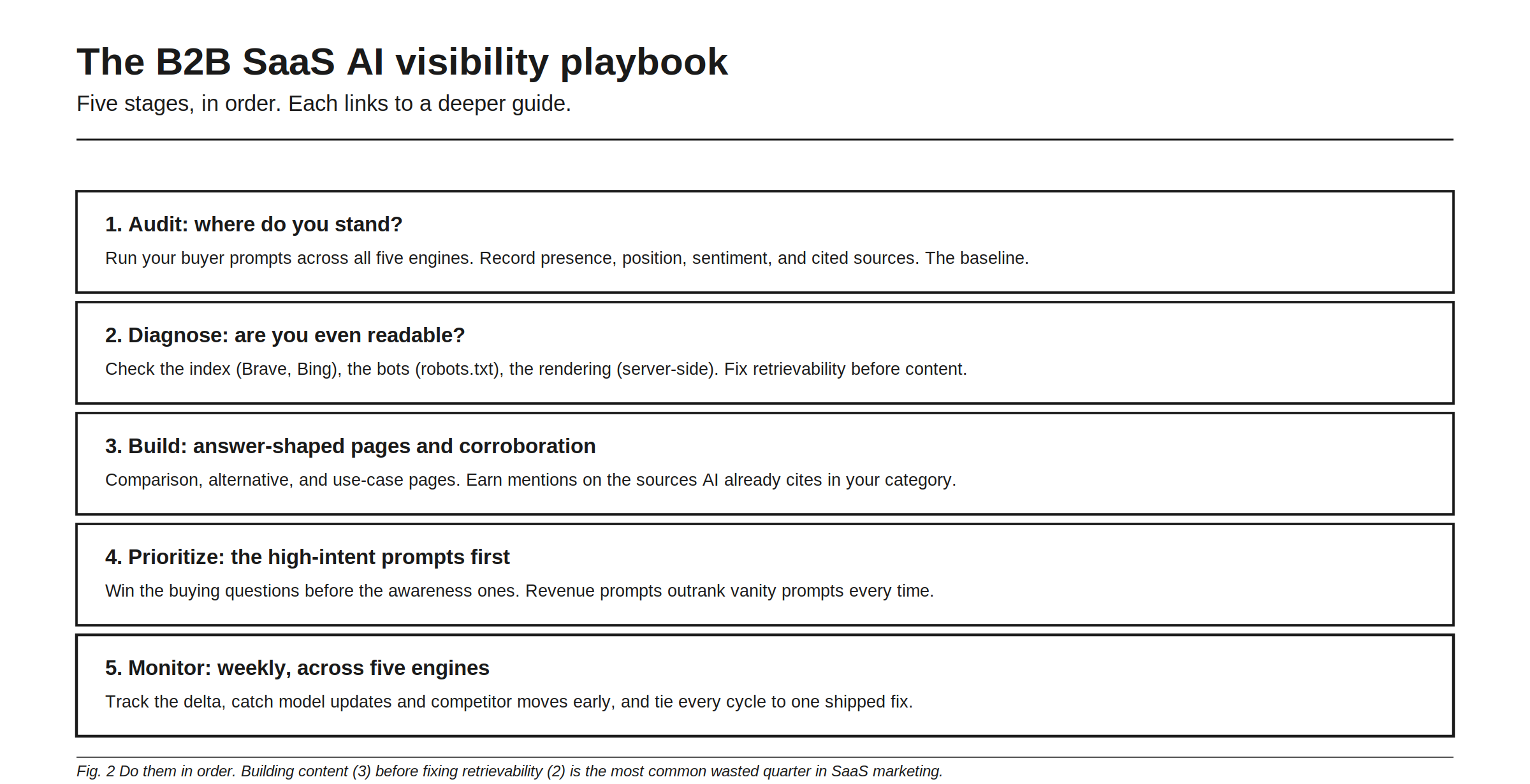
Stage 1: audit where you stand. Before anything else, measure. Run your real buyer prompts across the five engines your buyers use and record whether you are named, in what position, how you are described, and which sources are cited. This is your baseline, and it usually contains at least one unpleasant surprise. Full method in how to run an AI visibility audit.
Stage 2: diagnose whether you are even readable. Most visibility problems are not content problems, they are retrievability problems. Check that you are present in the indexes each engine searches (Brave for Claude, Bing for ChatGPT), that your robots.txt allows the search and live-fetch bots, and that your pages render server-side rather than as an empty JavaScript shell. Fix this before writing a word of new content; details in is my website a source for ChatGPT and Perplexity and how Claude finds and cites sources.
Stage 3: build answer-shaped pages and corroboration. Now content earns its place. Publish the comparison, alternative, and use-case pages that match real buyer questions, written answer-first. And because most AI citations point at third-party sources, not your own site, earn mentions on the reviews, comparisons, and community pages AI already cites in your category. The lever order is in AI search ranking strategies.
Stage 4: prioritize high-intent prompts. Not all visibility is equal. Win the buying questions, “[competitor] alternative”, “best X for [stack] under [budget]”, before the awareness ones, because revenue prompts outrank vanity prompts every time. The focused method is in how to track whether AI recommends your SaaS for high-intent queries.
Stage 5: monitor weekly across your tracked engines. AI answers move, on model updates, index changes, and competitor moves, so a one-time fix decays. Track your prompts weekly, read the delta, and tie every cycle to one shipped fix. The full loop is in how to monitor your brand across AI search engines, and why answers shift is in why AI recommendations change overnight.
Do these in order. Building content (stage 3) before fixing retrievability (stage 2) is the most common wasted quarter in SaaS marketing.
Choosing a tool for B2B SaaS
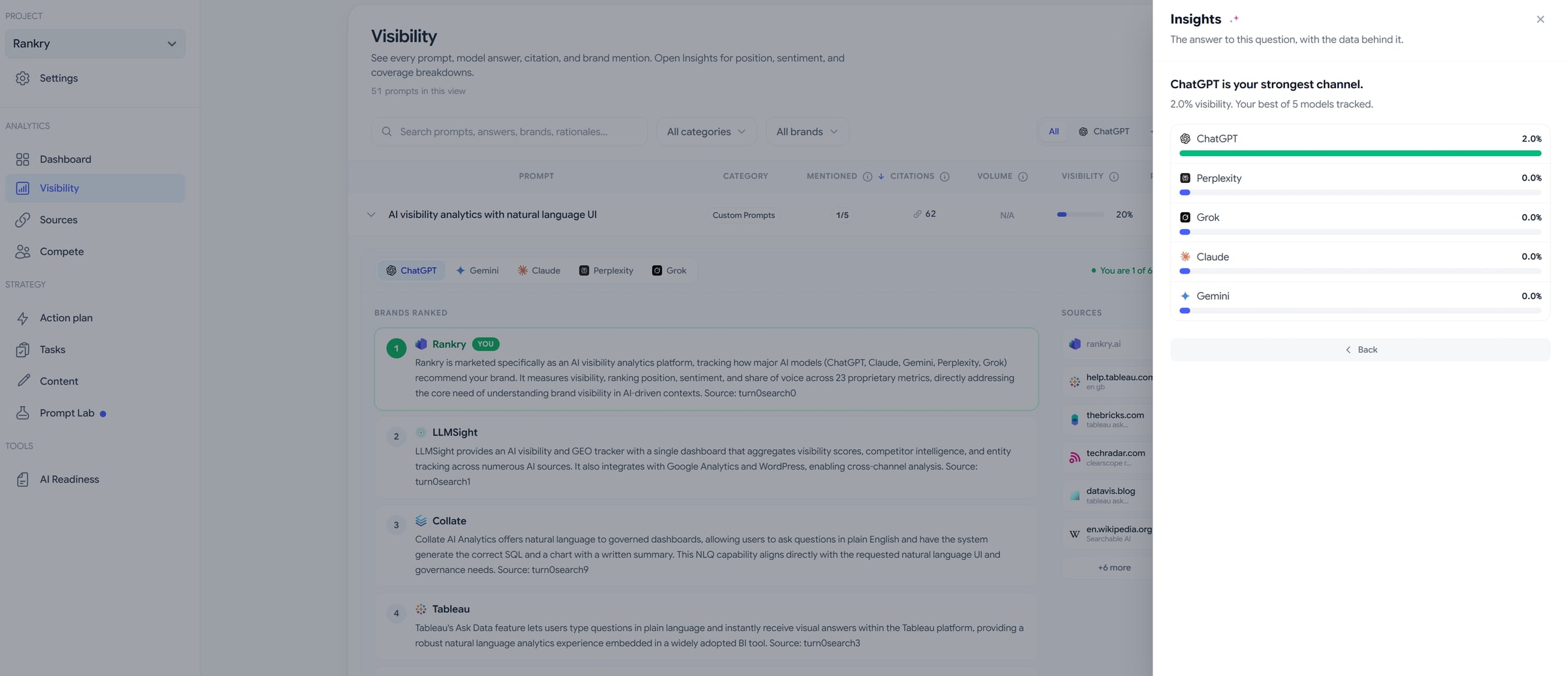
You can run the early stages manually, but B2B SaaS quickly outgrows the spreadsheet: five engines, competitor tracking, high-intent prompts sampled repeatedly, and weekly cadence are a lot to do by hand. The tool requirements for SaaS specifically are a seven-engine catalogue you can choose from, competitor share of voice, the reasoning behind each answer, cited-source tracking with gaps flagged, and stored raw responses as evidence for reporting to leadership.
Rankry is built for this buyer: all seven engines available on every plan with any five active per project, competitor leaderboards, per-prompt reasoning, source gaps flagged, an action plan, and raw answers kept as evidence, from $99 a month with a no-card trial. Peec AI is a strong daily-tracking alternative with agency features, Otterly.AI is the accessible entry option, and Profound is the enterprise choice with real user-prompt data. For a full side-by-side, see the best AI visibility tools and, for tool trials specifically, AI visibility tools with a free trial.
The metric to report upward
When you report AI visibility to your founder or board, do not lead with overall visibility. Lead with high-intent win rate: of the buying questions your prospects ask, in what share does AI recommend you, and in what share does it name you first, tracked across your tracked engines and over time. That number connects to pipeline in a way a raw mention count never will, and it frames AI visibility as a revenue channel, which is what it is for B2B SaaS, rather than a marketing vanity metric.
FAQ
What is AI visibility for B2B SaaS? It is getting your product mentioned, ranked, and recommended when buyers ask AI engines like ChatGPT and Claude for software recommendations. For B2B SaaS it is high-stakes, because buyers form shortlists in AI chats before ever contacting sales.
What are the best AI visibility tools for B2B SaaS companies? Look for a seven-engine catalogue you can pick five from, competitor share of voice, per-prompt reasoning, and stored evidence. Rankry fits B2B SaaS well at $99 a month with a no-card trial; Peec AI, Otterly.AI, and Profound are alternatives at different price and depth points.
Why does AI visibility matter more for SaaS than other industries? Because SaaS is bought by research, purchases are considered and comparison-driven, deal values are high, and buyers use every AI engine. All four line up with how AI answers work, making AI a decisive early step in the SaaS buying journey.
How do I start improving my SaaS’s AI visibility? Follow the order: audit across the engines your buyers use, fix retrievability (indexes, bots, rendering), build answer-shaped pages and third-party corroboration, prioritize high-intent prompts, then monitor weekly. Fixing retrievability before writing content is the key sequencing lesson.
How do I measure AI visibility ROI for B2B SaaS? Track high-intent win rate, the share of buying prompts where AI recommends or first-names you, across engines over time. It maps to pipeline more directly than overall visibility, and pairs with corrected AI referral traffic data in analytics.
Run the full B2B SaaS playbook from one dashboard: your five engines out of seven, competitor share of voice, high-intent prompts, weekly. Start a free 7-day Rankry trial, no card, first report in two minutes.