A mention tracker, rank tracker, visibility tracker, and citation tracker are four different things people often assume are one product. A mention tracker asks whether the AI named you at all. A rank tracker asks where you landed when the answer is a list. A visibility tracker asks what share of many runs include you. A citation tracker asks whether the AI linked to your domain as a source. These metrics move independently: you can be mentioned without being cited, cited without being mentioned, or rising in mentions while falling in recommendations. So the right question is not “what is my AI visibility,” but “which of these four am I measuring, and why.” This guide separates them, shows how they interact, and tells you which to ask a vendor about on a demo.
Most arguments about AI visibility are not really about performance. They are denominator arguments in disguise: two tools “disagree” because they are counting different things and calling all of it “visibility.” Get the definitions straight and the confusion clears up fast.
Four trackers, four different questions
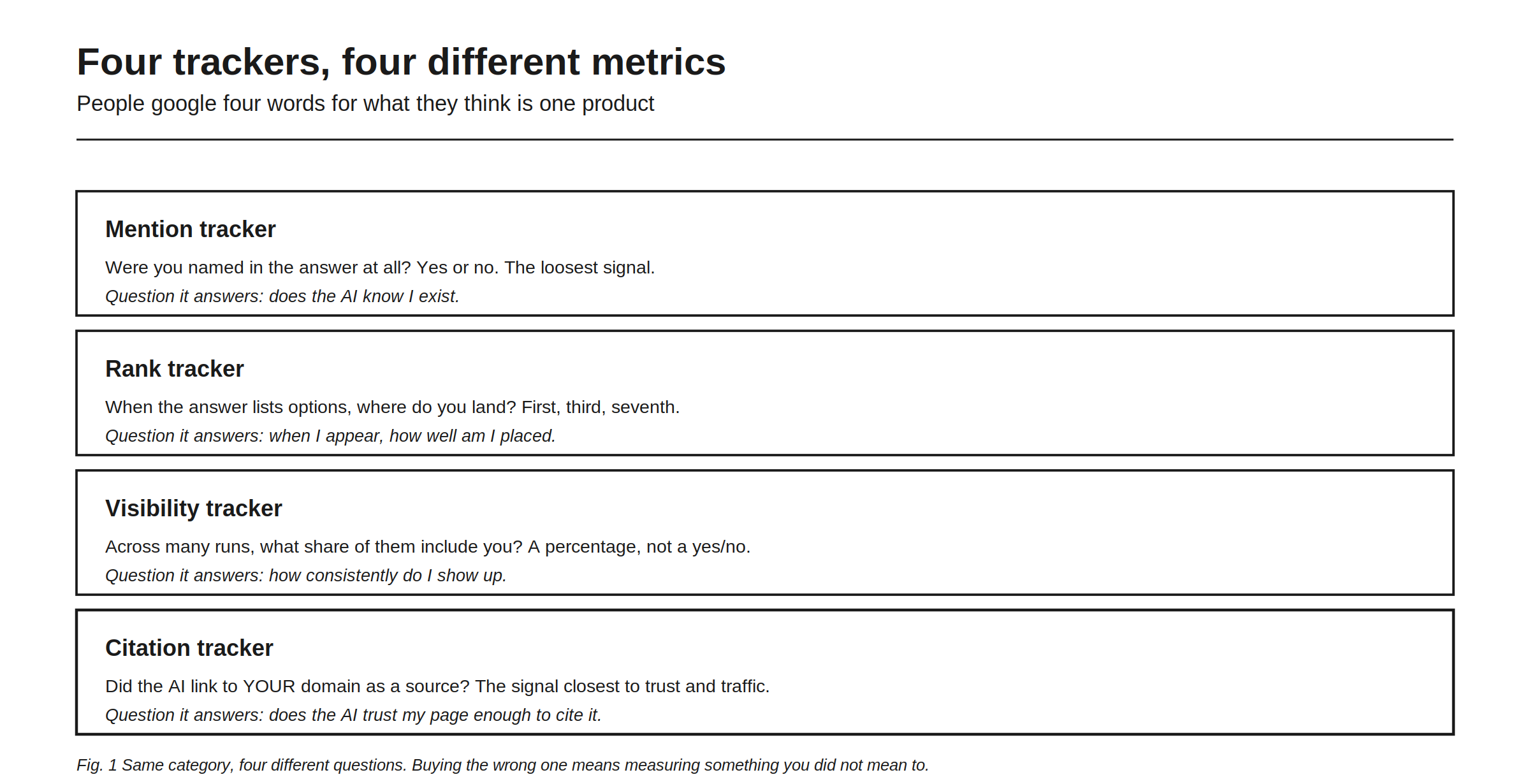
Here is the clean split. A mention tracker asks: were you named in the answer at all, yes or no? It is the loosest signal, and it answers “does the AI know I exist.” A rank tracker asks: when the answer lists options, where do you land, first, third, seventh? It answers “when I appear, how well am I placed.” A visibility tracker asks: across many runs, what share of them include you, as a percentage rather than a yes/no? It answers “how consistently do I show up.” And a citation tracker asks: did the AI link to your domain as a source? It is the signal closest to trust and traffic, and it answers “does the AI trust my page enough to cite it.”
Same category, four different questions. Buying or building the wrong one means measuring something you did not mean to measure, then making decisions on it. The rest of this guide is about not doing that.
Why they are not interchangeable
The reason this matters is that the metrics are driven by different factors and move on their own. Mention rate depends heavily on how well-known your brand entity is, while citation rate depends on whether specific pages of yours are retrievable and trusted, two different jobs with two different fixes. Research in 2026 found that a large share of AI brand presence takes the form of “ghost citations,” where an engine pulls facts from your page without ever naming your brand, so you get influence with no credit. Meanwhile citation behavior varies wildly by engine, with some engines citing sources a quarter of the time and others almost never. Treating all of this as one “visibility” number averages away the exact distinctions you need to act.
There is also a concentration problem worth knowing: analyses show a small set of top brands capture a hugely disproportionate share of AI mentions, and roughly a quarter of brands have zero AI mentions at all. Which end of that you are on determines whether mention rate is a nice-to-have or an existential metric for you.
They move independently
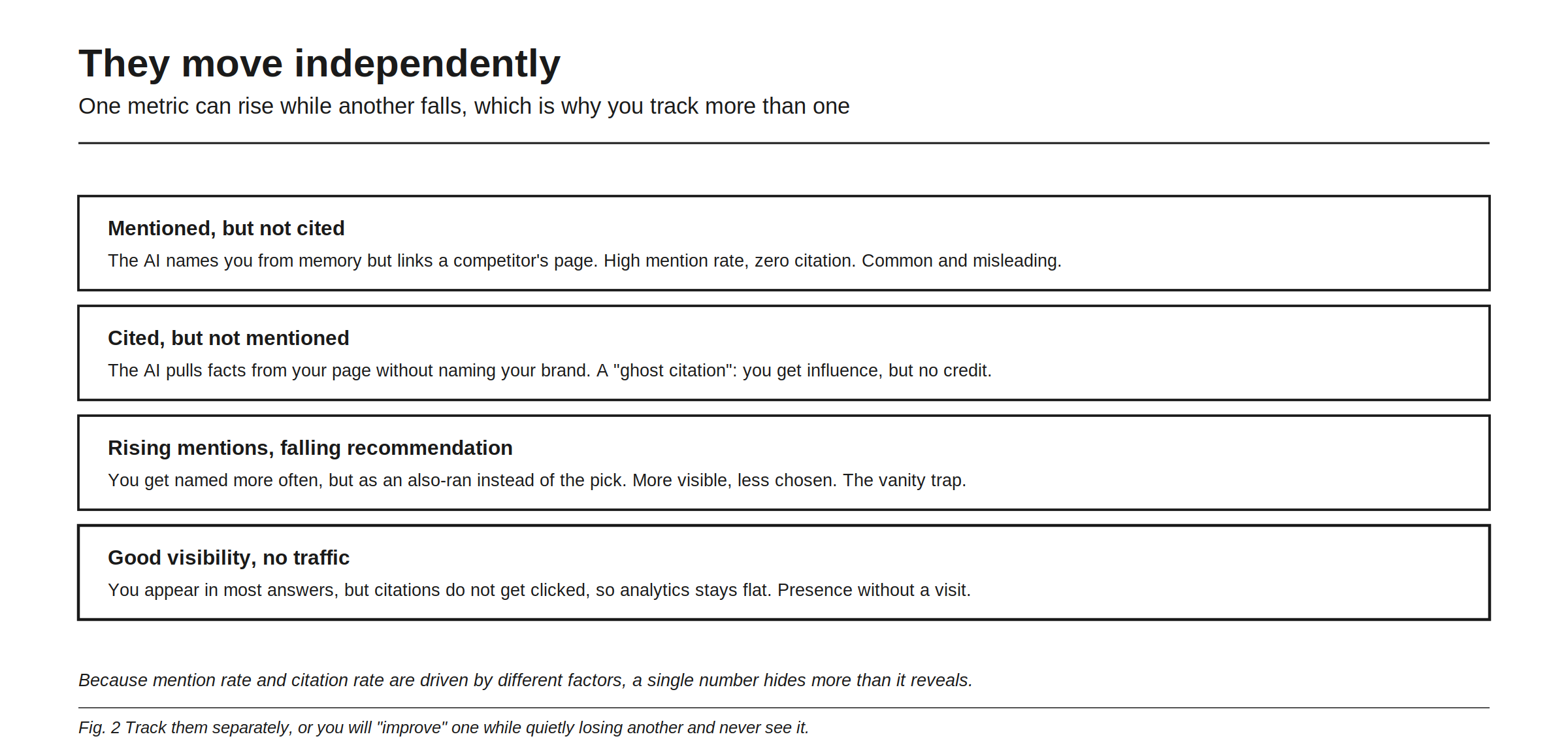
Four real situations show why one number hides too much. Mentioned but not cited: the AI names you from memory but links a competitor’s page, giving you a high mention rate and zero citation, which is common and misleading. Cited but not mentioned: the AI pulls facts from your page without naming your brand, the ghost citation, where you get influence but no credit. Rising mentions, falling recommendation: you get named more often but as an also-ran instead of the pick, so you are more visible and less chosen, the classic vanity trap. And good visibility, no traffic: you appear in most answers but citations do not get clicked, so analytics stays flat, presence without a visit.
Because mention rate and citation rate are driven by different factors, a single blended score can improve while the thing you actually care about gets worse. Track them separately, or you will “improve” one while quietly losing another and never see it. The mention-versus-recommendation trap specifically is covered in how to track brand mentions in ChatGPT, and the citation side in LLM citation tracking.
The one question to ask a vendor
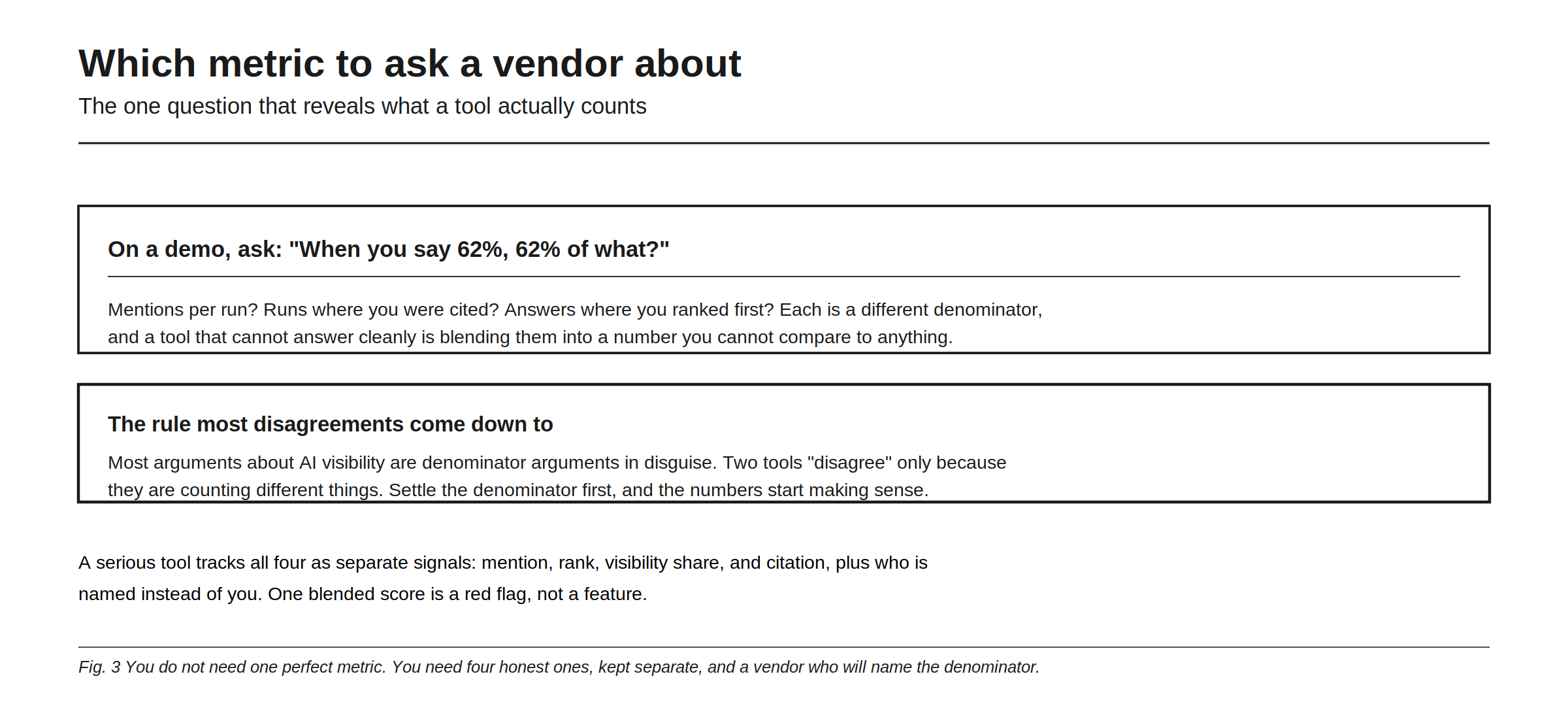
On a demo, ask one question: “When you say 62%, 62% of what?” Mentions per run? Runs where you were cited? Answers where you ranked first? Each is a different denominator, and a tool that cannot answer cleanly is blending them into a number you cannot compare to anything. This is the rule most disagreements come down to: two tools “disagree” only because they are counting different things, so settle the denominator first and the numbers start making sense. Why two honest tools still show different figures even after that is explained in why two trackers never show the same number.
A serious tool tracks all four as separate signals, mention, rank, visibility share, and citation, plus who is named instead of you. One blended score is a red flag, not a feature. You do not need one perfect metric. You need four honest ones, kept separate, and a vendor who will name the denominator.
Which metric should you actually prioritize?
It depends on where you are. If you are in the roughly one-in-four bracket of brands with zero AI mentions, mention rate comes first, because you cannot rank or be cited in an answer you never appear in. Once you are reliably mentioned, shift to citation rate and rank, because being named as an also-ran does not close deals, and citations are what drive the higher-intent clicks. Visibility share (your percentage across runs) is the metric to watch over time, because it smooths the run-to-run randomness that makes any single check unreliable, more on that math in how many runs a number needs before you can trust it. And all of it should be tracked per engine, because ChatGPT, Claude, Gemini, and Perplexity behave differently: the ChatGPT specifics are in which ChatGPT you are actually tracking and the ChatGPT rank tracker guide, Perplexity in tracking brand mentions in Perplexity, and Gemini in the Gemini visibility tracker guide.
Rankry tracks all four signals as separate numbers across every engine you run, seven available on every plan with any five active per project, with the reasoning and cited sources behind each, so you never have to guess which denominator a score is using, from $99 a month on a no-card trial. The full monitoring loop is in how to monitor your brand across AI search engines.
FAQ
What is the difference between a mention tracker and a rank tracker? A mention tracker records whether you were named in the answer at all, yes or no. A rank tracker records where you land when the answer is a list, first versus seventh. One measures presence, the other measures placement when present.
What is the difference between visibility and citation in AI tracking? Visibility is the share of runs that include your brand, a consistency percentage. A citation is whether the AI linked to your domain as a source. You can have high visibility (named often) with low citations (rarely linked), or the reverse.
Can I be cited by AI without being mentioned? Yes. This is called a ghost citation: the AI pulls facts from your page to build the answer without naming your brand. You get influence over the answer but no visible credit, which is why citation and mention are tracked as separate metrics.
Why do two AI visibility tools give me different numbers? Usually because they use different denominators, different prompt sets, run counts, model versions, and regions, and weight mentions and citations differently. Most “disagreements” between tools are denominator differences, not one tool being wrong.
Which AI visibility metric matters most? It depends on your stage. If you have zero mentions, mention rate comes first. Once you appear reliably, citation rate and rank matter more, because being named as an also-ran does not convert and citations drive the higher-intent clicks. Track all four, prioritized by where you are.
What should I ask an AI visibility vendor on a demo? Ask “when you report a percentage, a percentage of what.” If they cannot cleanly say whether it is mentions per run, cited runs, or first-place answers, they are blending metrics into a number you cannot compare or act on.
Track mentions, rank, visibility share, and citations as four separate signals across every engine you run, with no blended mystery score. Start a free 7-day Rankry trial, no card, first report in two minutes.